grew up in the church and so, from a very early age I was told about God. I heard about what God was like and what he wanted from me. I absorbed stories about God’s priorities and actions and I even learned how to speak to God in prayer. But I do not think that I can say that I actually met God in my early life in the church or in my family.
No, I would have to say that the church taught me about God, but it was Canada that introduced me to God. At least that is how I think of it. For me, and I’m sure that this is true for many Canadians, I feel that the most authentic experiences of God that I have had have happened when I left behind the cities and found myself in Canada’s vast untamed wilderness – mostly, in my case, up in the Muskokas. Consider this:
Have you been there, standing in a grove of trees, massive trunks around you on every side making you feel as if your strongest bones are like bendable twigs? Have you stood underneath the great green canopy, a vault more magnificent over your head than what any architect has achieved in any earthly cathedral or temple?
Have you ever crawled out of your tent just as the sun peeks over the horizon in order to push your canoe out over the stillest and calmest waters in all creation? Have you heard the call of the loon echo across the water as the other birds begin their calls from the surrounding woods? And have you slowly and silently dipped your paddle into the water to make your bow cut through the thin wisps of fog and known them to be far holier than the all the clouds of incense that have ever poured from a golden jewel encrusted censer?
But, most of all, have you ever gone out on cloudless and moonless night when you are far from any artificial source of light? Have you raised your eyes to the heavens and suddenly found yourself in the midst of a universe so vast that you knew you were nothing. And, at the same time, were the stars and the great river of the Milky Way so bright and so close that it seemed as if you would be able to touch them if only you managed to stretch your fingers a little higher? Have you heard the song of the stars just before dawn singing together – singing, it is to be admitted, at a frequency that cannot be detected by any human ear, and yet, all the same it is the most perfect and holy oratorio that ever could be.
Have you done these things? I have. And I have seen the night sky light up with dozens of meteors in a few minutes, I have felt the power of an approaching thunderstorm and relished in the calm that has fallen after it has passed over. And I have seen God in seeing and experiencing all of these things.
I suspect that many of you have had these kinds of experiences, though not in exactly the same ways that I have because such experience is intensely personal. And we are not alone. I believe that the very first place that human beings encountered God and knew themselves to be in the very presence of the divine was when they were confronted with the incredible beauty and majesty of nature.
The Bible makes this point often. In the Book of Job, the main character is on a continual search for God. He desperately wants God to appear before him so that he can confront God with all of the bad things that God has allowed to happen to him. Job wants to judge God and he gets rather frustrated that God doesn’t show up. Nevertheless, Job admits that, if you look in the right places, God is not so hidden as he has been pretending: “ask the animals, and they will teach you;” he declares, “the birds of the air, and they will tell you;ask the plants of the earth, and they will teach you; and the fish of the sea will declare to you.” Clearly the natural world has access to certain truths that escape the rest of us.“Who among all these does not know that the hand of the Lord has done this?In his hand is the life of every living thing and the breath of every human being.”
This is the same truth that Jesus was trying to point out when he famously invited his disciples to “look at the birds of the air” and to “Consider the lilies of the field, how they grow.” Now the point in what both Job and Jesus is saying is not that the natural world will teach you theology – it will not explain to you all of the human ideas about who God is supposed to be and how God is supposed to act. What it will teach you is something much more important: that you can trust in God.
I think it is important to note that, according to these passages, reflecting on nature may not give you the answers to all the questions about God that you might have. It will not, for example, answer the question that Job is most desperately asking throughout the book that bears his name: why does God allow bad things to happen to good people. It will not answer the question, “where is God when there is suffering?” (That question was most definitively answered in the life, suffering, death and resurrection of Jesus of Nazareth.)
But the promise is that, if you reflect on the natural world that God has created and when you see the ways that all parts of it work together to meet the needs of the birds of the air, the flowers of the field, the animals and the fish of the sea, you do indeed see that there is a compassion and care built into the creation itself that teaches you profound and true things about the character of God. It teaches you that God is a heavenly Father that you can trust even if you do not completely understand him.
In our Psalm reading this morning, the magnificent display of the stars in the dome of the heavens speaks a somewhat different truth: “When I look at your heavens, the work of your fingers, the moon and the stars that you have established;what are human beings that you are mindful of them, mortals that you care for them?” Here the lesson is about the smallness of humanity – a way of putting our own small concerns into a bit of a cosmic perspective. And yet, even here there is a message of God’s concern for God’s human creation for those who will hear it: “Yet you have made them a little lower than God, and crowned them with glory and honour.”
I have done my studies in Bible, in theology and church history. I have learned all of the ways that human beings have developed to talk about God, about the trinity and the nature of salvation. I have engaged in endless discussions of theodicy – the same question the Job asks in his book, the question of how we can justify the things that God allows to happen – and have found answers that at least make some logical sense. These have been good discussions that have helped me to grow. But still I would argue, the greatest and most enduring lesson I ever had about God came from the woods, the lakes, the rivers and the vast open skies of Canada.
I know that God is present everywhere and that there is truly no place where God is not fully present, but I will still insist that God is closer when I am in such places because this is not about what makes logical sense. This is about encountering God in your heart, not in your understanding.
If you have ever been out in the woods or on the lakes and rivers or up in the mountains of Canada, I suspect you know exactly what I have been talking about. If you haven’t, then maybe you don’t. But I promise you that there is a truth in what I have been saying.
The question is, if there is truth in it, what do we do with that truth? How can we apply it to our lives today? The first thing I would say is this: if God is uniquely experienced in the wildlands of Canada, then, for God’s sake, let us not cut ourselves off from such places.
I know that can be hard for some of us to do. Modern life seems to conspire to cut us off from the natural environment. It is quite possible for huge numbers of people to go through their days without encountering a truly natural setting – to encounter no growing things that have not been made to grow according to some human plan. But I would suggest to you that if you do not have the time or the means to spend some quality time surrounded by nature, you need to find the time and create the means. Your spiritual life – not to mention your general health – will only improve.
Of course, one of the reasons why many of us have trouble encountering nature is that it is disappearing in too many ways. Yes, there are enormous swaths of it here in Canada – places where you can travel all day without seeing a human-made structure. But our ability to affect and damage even those huge swaths of land has grown until it is out of control. Our energy and mining projects are destroying habitats. Our consumption patterns are affecting the climate and we need to think carefully about what we do in response to that.
I know that both Job and Jesus said that you could look at nature and see in it the proof that God knows how to take care of all his creatures including us. But we have taken the wrong lesson from that. We have thought that it meant that we could just go and take and take and take from nature as if it were an inexhaustible resource that we could never deplete or destroy. That was never the message and thinking that way has taken us to a dangerous place.
What Jesus and Job were talking about was living in relationship with the natural world – entering into a conversation with the birds of the air and the flowers of the field. These things can only teach us that our heavenly Father is looking out for us when we don’t see them as something merely to exploit to enrich ourselves. If the natural world doesn’t teach us some humility, doesn’t teach us to say, “what are human beings that you are mindful of them, mortals that you care for them?” then we have clearly missed the lesson.
So I do believe that another application of these passages is to rethink our relationship with the natural world – to learn not to see it as something merely to be exploited or as something that will just absorb our waste. This, too, is a way of finding God in the woods, lakes, rivers and mountains.
The second verse of O Canada is rarely sung, but I’m told that it goes like this, “O Canada! Where pines and maples grow. Great prairies spread and lordly rivers flow. How dear to us thy broad domain, From East to Western sea. Thou land of hope for all who toil! Thou True North, strong and free!” And it is certainly true that this natural beauty is something we find very dear indeed. But it is more than that too. It is a place where God has made Godself known to us – where God draws near for those who have eyes to see him. For this we give thanks, but for this we also pray, “God keep our land glorious, free and alive with such beauty.”
#140CharacterSermon The church taught me many things about God. Canada's wilderness introduced me to God. #Canada150 #GodKeepOurLand
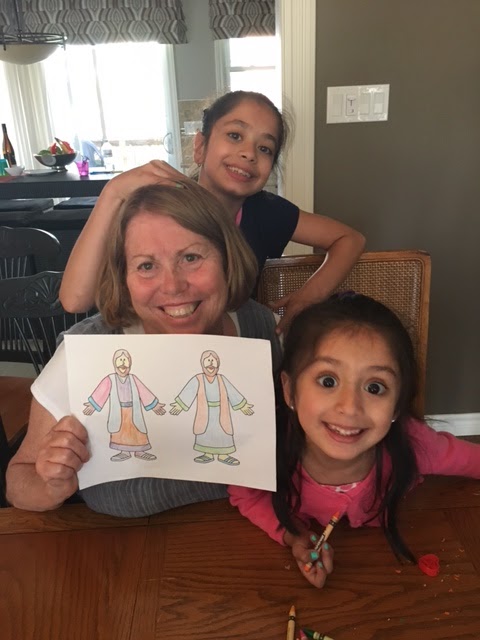
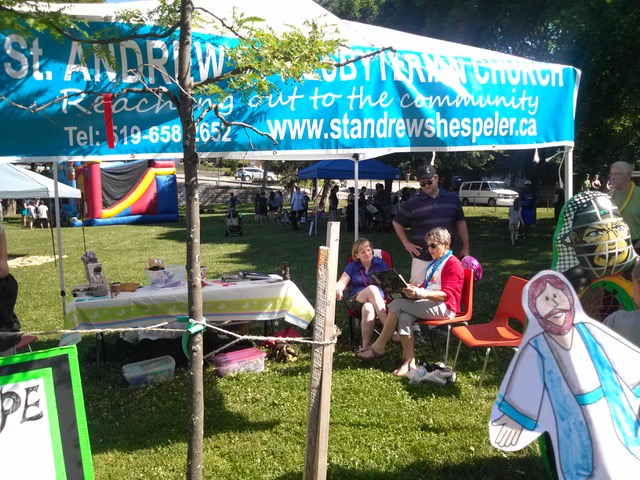
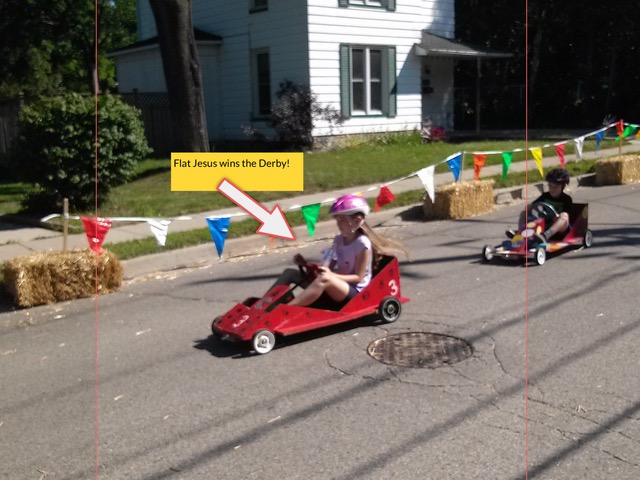
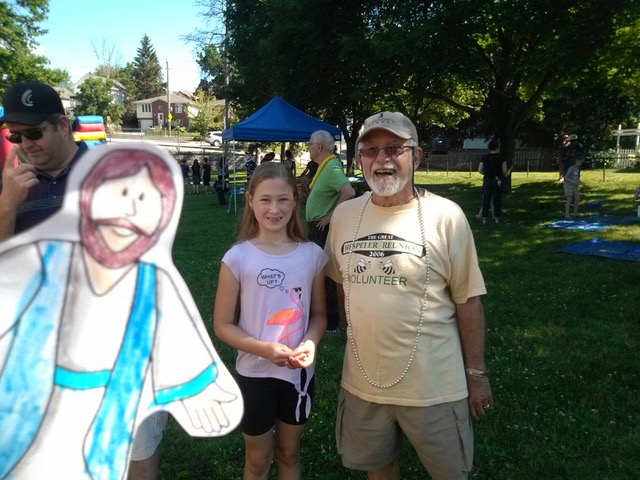
This summer our Sunday School project is to take Flat Jesus with us and see how far he gets. If you don't have your Flat Jesus drop in to church and pick one up! This isn't just for Sunday School students, it's for everyone! When you snap that picture, please send it to me so I can post it.
n the passage we read this morning from the Book of Deuteronomy, we are given an account of an ancient Israelite harvest festival. When the people harvested their crops, they were to take the first portion of that produce and present it as a gift to the Lord. This was a common practice in the ancient world and local temples of many different gods in many different places depended on it for major support.
Something that is unique about this harvest festival as described in Deuteronomy, though, is the speech that every Israelite male was to repeat as he gave his gift, a speech that began, “A wandering Aramean was my ancestor…” From there the worshipper went on to tell the whole story of the people of Israel through their slavery in Egypt and how, through Moses, God saved them from slavery and brought them out through the wilderness and into the land that he had promised to that wandering Aramean ancestor. It is quite a story to have every single male citizen tell once a year; you have to wonder what all of that is about.
I have a bit of an idea. You know that story of the origins of the people of Israel? It is a great story, but here’s the thing: it probably didn’t happen exactly like that. I mean, it never does – there is always a difference between the story that a people tells about where they came from and how it actually went down.
Even the Bible occasionally admits as much. This morning we read an account of the moment when the children of Israel left the land of Egypt. You all know what that moment is supposed to look like. It is a big dramatic scene in the movie, The Ten Commandments. All of the Jews are gathered around – one people united together around their common ethnic and cultural identity, ready to set out to search for freedom together.
Except, the Book of Exodus lets it slip that it wasn’t exactly like that. lets it slip that it wasn' onelike. It is a big dramatic like. It is a big dramatic It says that, when the Israelites were ready to leave Egypt, “a mixed crowd also went up with them.” What? I don’t remember seeing that in the Ten Commandments! But when you think about it, it makes a lot of sense. Ancient Egypt, the most powerful empire in the world at that time, was a slave economy and it drew its slave population from all the regions around it. Of course all these slaves resented their captivity. Of course they longed to be free! Any opening, any loosening of Egypt’s brutal regime would have been seen as a reason to hope for escape. Of course as many slaves as could have managed to would have joined any such exodus.
But what does that do to the story? It certainly muddies the story of the origin of the people of Israel that we have been told. It suggests that maybe they weren’t all descended from one common ancestor. I mean, sure there could have been a core group that traced their origins back to a certain tribe, but the Bible suggests here that others may have attached themselves to this group and come to join them in the worship of their God and in other customs. That is, after all, realistically what happens in the origins of most national identities.
There is a word that appears in the ancient documents and inscriptions of that part of the world at about that period of time – in the writings of people such as the Egyptians, the Hittites, the Sumerians and others. They speak of a group of people that they call the “Apiru.” They do not speak highly of them. The context seems to indicate that this word meant slave, nomad or bandit somewhat interchangeably. Apparently this word, Apiru, was loosely applied, to roving bands of troublemakers. It doesn’t seem to indicate any specific ethnic group so much as a social designation of generally undesirable people.
Well, the theory is that this ancient word, apiru, is actually the origin of the word Hebrew. You see, that is how outsiders would have seen the people who came to be known as the Hebrews (or the Israelites) when they first appeared on the historical stage – as a loose collection of slaves, nomads and general troublemakers. In some ways, that was who they were, but over time they did manage to forge a common identity, particularly as they went through some powerful experiences of God together.
And one of the keys to their development of that common identity was the telling of the stories of those experiences of God. Without the stories, the experiences didn’t make sense. So that explains why it was considered so important that every Israelite tell the story regularly. That was why every individual, whether directly descended from Abraham or not, needed to stand before the priest and say, “A wandering Aramean was my ancestor…”
That is how a national identity always works. The actual history of how a people come to be living together in a land is always messy. People usually enter into the land as individuals. Some might be raiders, exiles, slaves or refugees. Others arrive as rulers, investors or entrepreneurs. But once they are there, the only way that they can find an identity beyond their particular tribe or group is by telling common stories that they all share. That is the process that we see at work in the passage in Deuteronomy and, frankly, in many of the national stories told throughout the Old Testament. It’s not that the stories aren’t true, it is that they are more than just true – that people found meaning in them beyond the literal meaning of the story.
This question of identity is also important to Canadians as we continue to celebrate 150 years and more of history. People sometimes complain that there is just no clear Canadian sense of national identity. Sometimes we simply define ourselves by what we are not: specifically that we are not Americans. We play up minor little quirks like the way we pronounce the last letter of the alphabet (and, yes, of course it has to be “zed”), or a rather unique way of saying “out and about” that we have that everybody but us can hear. And of course we will go on about peculiar passions like Tim Horton’s coffee, hockey and beer that actually tastes like something. But we don’t seem to feel as if all of that, put together, really amounts to what you would call a solid national identity.
Our Old Testament story teaches us that national identities don’t just happen. They are formed, sometimes intentionally, through shared stories.o what you woudsomething. onounce the last letterere is just no clear Canadas of that nation and adopting them a If Canada is lacking when it comes to a strong sense of national identity, is that because it is lacking when it comes to things to be proud of? Of course not! There are so many achievements that we can celebrate in the areas of science, art, sport, policies and so much more.
What we may lack, however, is that sense of a shared narrative. Canadians have come from many backgrounds and individual stories. The First Nations were here like just about forever and everyone else entered as an immigrant, refugee, exile or transient. We talk about all of that forming a great cultural mosaic and there is certainly a great richness and beauty in that diversity. But if we can’t find a way to tell a story of this nation that everyone can feel a part of, it will not be enough.
That is, I think the real genius of the story that is prescribed in Deuteronomy. It is the kind of story that anyone should be able to find themselves in. I mean, not everyone may have a literal wandering Aramean – the actual Abraham – as their ancestor, but they probably have a wandering Scotsman expelled from his farmland to make way for sheep, or a starving Irishman desperately looking for something to fill his stomach with after the potato crop has failed.
Not everyone might have had the Egyptians treat them harshly and afflict them, by imposing hard labour on them, but there are many who suffered under various forms of modern day slavery, who fled repressive regimes and unlivable conditions to find freedom.
Not everyone might have experienced God delivering them “with terrifying display of power, and with signs and wonders,” though I know that some have. But every single one of us has experienced the joy of coming to live in “this land, a land flowing with milk and honey” and a land overflowing with the beauty and bounty that God has placed in it for our wise use.
I guess that what I am saying is that there is a story of what it means to be Canadian and to love this country and to know it to be your home, but it is not necessarily the story that they keep telling us. This year, in honour of Canada’s 150th birthday, the CBC created an extended documentary called, “The Story of Us,” that attempted to do what I have been talking about and offer Canadians a common story that we could all share.
As you have probably heard, the series was sharply criticised from many quarters. People complained that it contained many historical inaccuracies, that various groups were given stereotypical representations, that entire communities were written out of the story altogether. Some of these flaws, I think, were unavoidable. You can’t tell a good national story without being inaccurate sometimes, and you cannot include every group in the story. These things alone shouldn’t have derailed the project.
I suspect that the bigger problem was the assumptions that they made about what a national story was supposed to be – a notion that they may have picked up from our neighbours to the south. Maybe they thought that the story was supposed only to be about the winners, the triumphs and the accomplishments. These things are a great part of it, to be sure, but I don’t necessarily think that they are the heart. So many who have come to love this country, have not come to do so through their triumphs but through their struggles. They found refuge here. They found safety and hope when the world elsewhere had offered them little of either.
Many First Nations people, for example, have hardly had an experience with the Canadian government that has been joyful and affirming but have developed and displayed a deep love and commitment to this country and have worked at calling us to be our best. That is an essential part of Canada’s story and it stirs my heart more than many a tale of victory on the Plains of Abraham or on the banks of the Red River.
A colleague of mine, Rev. Tony Boonstra recently posted a rewrite of the passage we read from Deuteronomy this morning. I was amazed to see someone else thinking along the same lines that I was, so I can’t think of a better way to close this morning than by sharing Tony’s take on a what a story of Canada is:
My great, great, great grandfather was a feudal serf, eking out a living for his family, literally by the sweat of his brow. There were numerous children and the family clan grew in number.
We suffered severe deprivation under the feudal system and were grievously persecuted during the time of the Reformation. Our family was torn apart; some who remained true to the Roman Catholic faith; some who joined the Protestants under the leadership of Prince William of Orange.
During the Industrial Revolution, we experienced the bitter pain caused by the tremendous social upheaval. Then in the beginning part of the 20th century, we suffered scarcity of basic essentials during the Great Depression of the 1930’s. This was hardly past when we suffered humiliation and the loss of freedom under the German occupation during World War II.
Many times in desperation we cried out to God. In time, He chose to lead a few of us in number, to a land flowing with milk and honey, a country we affectionately call Canada. For a generation we remained quiet and to ourselves getting used to what for us were foreign traditions and uncommon values.
But now we have come to bring our first fruits. We have chosen to share in the responsibility of making this country a welcome haven and home for all its citizens. And so today we bring our gifts, our ideas, our values, our dreams, our story, and we offer them freely in gratitude to Creator God, who so lavishly has entrusted to our care, the whole word.
We covenant with you to make Canada a country where all people are given the respect they deserve, where people are given the freedom to embrace the values and traditions that are dear to them. We want Canada to be a country where the beauty of all God created is appreciated and where all people are valued for the unique beings they are.
ho here has a Canadian passport? If you travel, you know that it is one of the most valuable things that you can carry with you – more important than money or your phone or your insurance. And do you know why? Because of what you find printed in gold on the cover of that passport. There you will find the coat of arms of the Dominion of Canada. The presence of that coat of arms is an indication that, wherever you may travel, you are under the aid and protection of the Canadian crown.
A coat of arms is, therefore, a very powerful symbol, or, if you prefer, a set of symbols because every element in the arms carries a great deal of meaning. But there are two particular elements I want to focus on today – specifically the words. First of all, there is a ribbon that runs about the main shield upon which are words that you can just barely make out. The words, in Latin, are “desiderantes meliorem patriam,” which means “desiring a better country.” These words are actually the motto of the Order of Canada – that select group of people who have been honoured by the government for their extraordinary contribution to our country.
The words should sound familiar to you today, though, because they are taken from one of our scripture readings this morning: “But as it is, they desire a better country, that is, a heavenly one.” Those words were taken from the Letter to the Hebrews as a motto for the Order of Canada. You can see why such a motto is fitting. The people who most often make the biggest contribution to a country like Canada are those who are not merely satisfied with how things are but who dream of making something better. We are all the beneficiaries of their spirit.
But what exactly is that “better country” we strive for. That is not always easy to see. Change, after all, is always hard and disruptive. You don’t really want to risk it unless you are sure that the result will indeed be a “better country.” How do we get a picture of what that “better country” could be?
Well, that brings us to the other words that appear on Canada’s motto: “A Mari usque ad Mare” which is translated as “From Sea to Sea.” Those English words probably sound more familiar as they are still used by politicians often enough, though, these days, they usually will say, “from sea to sea to sea” or “from coast to coast to coast” to recognize that Canada actually has three coasts and that the arctic coast and our sovereignty over its waters is of growing importance.
But what is the meaning behind such a motto? Is it simply a statement of the geographical extent of the country of Canada? I mean, a motto is supposed to be something inspirational – something that stirs the heart and, at first glance, this seems only to be an attempt to describe a map of Canada in as few words as possible. Please tell me it is about more than that! Well, indeed it is! In fact, there is a whole lot of meaning packed into those five Latin words.
To understand them, you need to go back to a gentleman named George Monro Grant. Grant, as far as we can tell, was the first man to apply those words, “from sea to sea,” to the country of Canada. He used those words very soon after confederation, in fact, at a time when Canada didn’t really extend beyond the end of the Great Lakes. So, at the time, to dream of a country and government that reached as far as the Pacific Ocean was a challenge and a vision to strive for.
But it was also about more than that. George Grant, you see, was a Presbyterian minister and the first time he used those words, “from sea to sea” was in a sermon. In fact, he used that phrase often and in many sermons because those words were taken directly from scripture – specifically the Psalm that we read this morning: “May he have dominion from sea to sea, and from the River to the ends of the earth.”
So let us explore, a little bit, those words that became so significant for our country. Grant, as a minister, wasn’t just interested in those few words from the Psalm but in the full context.
The Psalm itself is rather unique in the Book of Psalms. The whole thing is a prayer for the king. At some point, a Biblical editor added some words ascribing the Psalm to King Solomon, but the prayer is not focused on any one particular king and was likely used on many occasions down through the generations when prayers for the king were needed. So it is not a psalm about a particular personality but about the institution of kingship in general.
To put it in modern terms, it is not a psalm about a leader (such as Prime Minister Trudeau, for example) but about leadership in general or even better about governance in general. So we can look at this psalm to discover what the Bible thinks – dare I say, what God thinks – is important about governance. Another way to think of it: what makes a country great?
And clearly, there are a number of priorities that are named in this psalm. A key one is dominion, as we see in the verse we have been talking about: “May he have dominion from sea to sea, and from the River to the ends of the earth.” Dominion is about responsible and effective government – power and influence and what we call sovereignty extending from one body of water to another. In the case of the Psalm, the dominion was supposed to extend from the Euphrates River in the distant east to the Mediterranean in the west. Munro, of course, thought of Canada extending from the Atlantic to the Pacific and more recently politicians have stretched our imaginations further north to the Arctic Sea.
And that kind of dominion (which is basically effective government) is a good thing – it creates stability and makes the country a safe and predictable place to live in. But, again, we have to ask, what is supposed to be accomplished through this dominion? It is not an end in itself, though we sometimes think of it that way.
Well, the psalm is perfectly clear about what it thinks that the king ought to do with his dominion. He ought to do justice: “Give the king your justice, O God, and your righteousness to a king’s son. May he judge your people with righteousness, and your poor with justice.” That’s where the psalm begins and the theme of righteousness and justice runs right through it with those two words begin repeated over and over again. So to understand this psalm and what it is saying about dominion, we need to understand what it means by justice and righteousness.
The first thing we need to observe is that justice and righteousness are essentially two parts of the same thing as far as the Bible is concerned. The key word, in Hebrew, is tsedeq which can be translated either as justice or as righteousness. Tsedeq is so important in the Bible because it is an essential part of God’s character. God is nothing if God is not just.
Tsedeq, or justice, is basically the idea of a world in perfect harmony – the world as God intended it to be. It is closely connected to the concept of shalom which is usually translated as peace, but shalom always meant more to the ancient Hebrews than the idea of peace means to us. Shalom was about all parts of creation being in harmony with one another.
One thing that justice means, therefore, is that when something has gone wrong in the world – when a crime has been committed, for example – justice demands that it be set right. That includes what is called restorative justice, such as when stolen property is restored or victims compensated. It can also include retributive justice such as when the person committing the crime is punished in a fitting and measured way.
And that is often where we end the discussion about justice – with retributive and restorative justice – but, as far as the Bible is concerned, that is just the tip of the iceberg. For the God of the Bible, the essence of justice was found in something called distributive justice. You see, as far as this psalm and many other parts of the Bible are concerned the greatest offence against the justice of God, the greatest indication that all is not working out according to the will of God, is when the goods of this world are so unevenly shared that there were some who go without their basic needs of life being met while others live in an overabundance.
The psalm makes it clear, in fact, the king’s most important duty is the application of this kind of distributive justice. Yes, he might be involved, from time to time, in the application of retributive justice. He has to ensure that those who commit crimes are fairly and swiftly judged. He has to make sure that judges are fair and impartial and that their judgments do their best to right the wrongs that have been committed. But his main job is actually to make sure that the resources of his society are distributed in such a way that nobody lacks what they need to survive and to thrive. a wwa
So it was not enough, for the psalm, to simply pray that there should be prosperity in the land: “May the mountains yield prosperity for the people, and the hills.” Prosperity meant nothing if it did not come “in righteousness,” that is to say, if it did not come equally to all.
And so the job of the king was to “defend the cause of the poor of the people, give deliverance to the needy.” That is to say that he was to stand on the side of the people who were most disadvantaged and were least likely to gain anything from the prosperity in the land. At the same time, the king was to “crush the oppressor,” by standing in the way of those who would keep the prosperity of the land confined to those who were already wealthy.
If Canada today has the motto “from sea to sea,” we likely have one man to thank for that, Presbyterian minister, George Monro Grant. But if Grant pushed for that to be our motto, and he did, he had a vision for this country that extended beyond the Pacific Ocean and even the far-off Arctic. He saw a land where there would be true dominion and sovereignty (and yes, by the way, it was upon Grant’s insistence that this country was given the name, “the Dominion of Canada” at Confederation). But that dominion was not an end in itself, it existed for the sake of making sure that the wealth of the land would be for all the people of the land.
One hundred and fifty years later, it would not be out of place for us to pause and ask if this country has lived up to Grant’s vision. Dominion has been established from sea to sea to sea. We may have to work to maintain that, especially in the north, but it seems well in hand. But what about the justice component of that vision? How good are we at building prosperity in this country and building it in such a way that it is shared equally among all as much as possible? Given that the disparity between the rich and the poor has only been on the rise in Canada, I would say we have a great deal of work to do there.
“From sea to sea,” does indeed contain within it quite a vision. If we could live up to the vision not only in terms of dominion but also in terms of justice, just think of what this country could be, I am convinced that it could be the next thing that God is calling us to. For God, fortunately never ceases to send among us those who dream of a better country, and who put themselves on the line to see it happen. Could you be one of the next people that God is calling to seek a better country by standing up for what is right and just?
#140CharacterSermon From Sea to Sea is Canada's motto. It is about more than just geography. It is about seeking God's justice #Canada150
Sunday, July 2 is, of course, the day after Canada celebrates a big birthday this year. It will be a very special morning for a number of reasons:
Let's just start with the bulletin. Can we just say that it will be a little bit special? There are flags for everyone and lots of the pins (but probably not enough for all so that it first-come, first serve.
There will be some amazing music that has been specially prepared for the day
Jean McMurtrie will sing a beautiful piece called, "Where the Spirit of the Lord is."
Singer-Songwriter, Gabrielle McAndless will debut her new offering, "Rest and Repose."
Violinist Zoé McAndless will be playing, "Liebesleid" by Fritz Kreisler.
Gabrielle McAndless
The Minister, Scott McAndless will continue his special "Canada 150" sermon series by looking at Canada's motto, "A Mari Usque ad Mare." Here is a short introductory video for the message:
So please plan to join us on July 2 as we celebrate and pray for our beloved country. It is also a great time to invite your friends and family to join you.
Now when all the kings who were beyond the Jordan in the hill country and in the lowland all along the coast of the Great Sea toward Lebanon – the Hittites, the Amorites, the Canaanites, the Perizzites, the Hivites, and the Jebusites – heard of this, 2 they gathered together with one accord to fight Joshua and Israel.
A
nd it came to pass that a settler people came even unto this land and found that it was a rich and good – a land that was flowing with beaver pelts and lumber and many fish. And they knew that God had given this land to be a possession for them and for their children and for their children’s children until they became a people as numerous as the stars in the sky.
And lo there were nations that were in this land that God had given to the settlers. And these nations, the Iroquois, the Algonquin, the Cree, the Anishinaabe and many others heard of these settlers. But somehow they did not get the memo which said that God had given the land even unto them. And so these nations, each in their own way, sought t
o continue in their way of life despite the coming of these settler people. But this proved not so easy to do for there were many diseases and other problems that had been brought over with the people, and these played havoc with the nations of the land and many died.
And yes, there were some of the nations who found that it was impossible to live with these settlers among them and they chose to fight and protect the land of their ancestors. They were quickly and easily defeated.
And so it came to pass that the settler people began to believe that it would be an easy thing for them to possess this land that had been given to them. Surely the nations of the land would be quickly defeated or die from diseases before very long. Surely their “inferior” culture and “primitive” rituals and beliefs would be swiftly assimilated into the much “superior” culture and religion of the settler people. They took this to be an inescapable truth. Of course, their total dominance and possession of everything was assured.
But there was a problem for the short term. Sure, the people of these nations were certain to disappear and melt away eventually, but that would take time – maybe a few generations. But for right now, there were still too many of them and they were living on land that the people wanted for various reasons. They were looking for a solution.
Joshua 9:3-15
3 But when the inhabitants of Gibeon heard what Joshua had done to Jericho and to Ai, 4 they on their part acted with cunning: they went and prepared provisions, and took worn-out sacks for their donkeys, and wineskins, worn-out and torn and mended, 5 with worn-out, patched sandals on their feet, and worn-out clothes; and all their provisions were dry and moldy. 6 They went to Joshua in the camp at Gilgal, and said to him and to the Israelites, “We have come from a far country; so now make a treaty with us.” 7 But the Israelites said to the Hivites, “Perhaps you live among us; then how can we make a treaty with you?” 8 They said to Joshua, “We are your servants.” And Joshua said to them, “Who are you? And where do you come from?” 9 They said to him, “Your servants have come from a very far country, because of the name of the Lord your God; for we have heard a report of him, of all that he did in Egypt, 10 and of all that he did to the two kings of the Amorites who were beyond the Jordan, King Sihon of Heshbon, and King Og of Bashan who lived in Ashtaroth. 11 So our elders and all the inhabitants of our country said to us, ‘Take provisions in your hand for the journey; go to meet them, and say to them, “We are your servants; come now, make a treaty with us.”‘ 12 Here is our bread; it was still warm when we took it from our houses as our food for the journey, on the day we set out to come to you, but now, see, it is dry and moldy; 13 these wineskins were new when we filled them, and see, they are burst; and these garments and sandals of ours are worn out from the very long journey.” 14 So the leaders partook of their provisions, and did not ask direction from the Lord. 15 And Joshua made peace with them, guaranteeing their lives by a treaty; and the leaders of the congregation swore an oath to them.
W
hen the inhabitants of some of the nations saw that some of their neighbouring nations had been brought to a low estate they on their part acted with cunning – or at least it seemed that way from the settlers’ point of view. They went and prepared provisions and placed them in the bags and bowls that they had made according to their traditional methods in their villages. And they put on their traditional garments. These were beautiful things and well-made, but they looked poor in the sight of the settler people because they did not have the form of top hats and waistcoats, silks and satins.
And so the nations came unto the settler people and the settler people came up with the idea of making treaties with them. This was of great interest to the settlers because it would allow them to expand and possess much of the land that they believed that God had given them without having to deal with violence or resistance. But, of course, to make treaties, they would have to give the people of the nations certain lands and rights and resources. Perhaps in the future, some of those things that they gave them would get in the way of what they would want to do and it would get costly to fulfill everything that they promised.
But then the settler people looked at the items and the clothing that the people of the nations had cunningly brought with them and they were reassured. In their eyes, these things were an indication of a dying culture and a way of life that would soon disappear. And behold, the settlers said unto themselves, “Surely these nations will soon pass away. What does it matter if we give them land and promises, they will not be around long enough as distinct nations to stop us from taking back these things when we need them.”
And so the settler people made peace with them, guaranteeing their lives by treaties; and the leaders swore oaths unto them. They told them that their queen, who lived in a far-off land, would be a mother to them. “You will always be cared for,” they said, “all the time, as long as the sun walks.”
Joshua 9:16-18
16 But when three days had passed after they had made a treaty with them, they heard that they were their neighbors and were living among them. 17 So the Israelites set out and reached their cities on the third day. Now their cities were Gibeon, Chephirah, Beeroth, and Kiriath-jearim. 18 But the Israelites did not attack them, because the leaders of the congregation had sworn to them by the Lord, the God of Israel. Then all the congregation murmured against the leaders.
W
hen many days and months and years had passed after they
swore an reasured. that they promised.get ld be a mother to themn to tell us about m without fear of violence or resistence. had made these treaties with them, the settler people heard something that disturbed them. It seemed that the people of the many nations had not disappeared or simply been assimilated as expected. At first, they thought that it was only a small setback. Surely the assimilation process only needed a little bit of encouragement. And so some plans were put in place. For example, they put in place a plan to take the children of the people of the nations away from their parents and put them in schools where they would be separated from their communities for many months or even years at a time. In this way, they thought, the culture and way of life would naturally disappear as parents failed to pass it on to their children. And anyways, the settler people reasoned, this would only be a blessing on the children of the nations who would be exposed to the “superior” culture and spiritual traditions of the settlers. Surely they were only doing it for their own good.
So the settler people put these plans and others like them in place, but things did not go as they imagined. The schools that they set up became places of great cruelty, which, when you think of it, is not all that surprising as the plan itself had a deep cruelty to it from the outset. Also, it turned out, breaking families apart and ripping children from their communities created and exacerbated many other social problems that would persist for generations including substance abuse, suicide and domestic violence.
And yet, despite all this, the people of the nations still stubbornly refused to disappear as expected. Though they still had little power, for some reason, it became harder and harder to ignore their grievances – and it turned out that there were many grievances.
And then all the congregation of the settler people murmured against the people of the nations. Some said that, if their communities had problems, then it was all their own fault, that they should clean up their own finances and politics before they looked to them for help. They also told stories about the people of the nations – said that they all drank or didn’t want to work or take care of their properties. When they spoke of the people of the nations in these terms, it just seemed so much easier to write them off.
But, despite all of this, it became clear that the people of the nations were not disappearing and would not disappear. All of this made the settler people complain against their leaders. “Why should we continue to abide by the terms of the treaties that we made with them?” they asked.
Joshua 9:19-20
19 But all the leaders said to all the congregation, “We have sworn to them by the Lord, the God of Israel, and now we must not touch them. 20 This is what we will do to them: We will let them live, so that wrath may not come upon us, because of the oath that we swore to them.”
O
ne of the most amazing people I have ever met is the Rev. Margaret Mullin. She is the minister of Place of Hope Presbyterian Church in Winnipeg. She is also a trained and recognized First Nations elder who has been given the name “Thundering Eagle Woman.” She is of mixed heritage – Scotch/Irish and Ojibway – and so she has a unique perspective on what it means to be part of both what I have been calling the settler people and the people of the nations.
When I met Margaret, she talked to us quite a bit about the meaning of treaties. First Nations people often see the treaties that their ancestors entered into as an essential part of their identity for good and for ill. This is not all that surprising because those treaties have a big impact on their daily lives. They tell them where they can live, what they can do on the land and what limits their livelihood. They greatly influence their choices regarding things like marriage, child rearing and custody. Many First Nations people carry status cards that define their rights and benefits based on the treaty terms negotiated by their ancestors.
The treaties all also have a great influence on how non-native people see First Nations people. Honestly, they are also the basis of many of the complaints and stereotypes that you hear.
What we miss, Margaret taught me, is the fact that there are always two sides of a treaty. What we miss is the idea that, if the First Nations are a treaty people, then so are we. For we too live day in and day out under the effects of these treaties. Most Canadians live on land that was acquired through a treaty. That is not precisely true here in Waterloo Region, of course. The land that most of us live on is part of the HaldimandTractt – land that originally belonged to three different nations. But the land was later given to the Six Nations of the Iroquois by the British Crown in appreciation for their extraordinary bravery and loyalty during the American Revolution.
So this land wasn’t part of a treaty but it was won by the Six Nations at exceptional cost. And, once they had it, their battle was not over for the government absolutely refused to allow them to set up any businesses on their land. The Iroquois wanted to become entrepreneurs like what they had observed in European society but the government absolutely refused to let them operate any business. The government didn’t even want to allow them to sell the land unless it was to another member of the Six Nations who couldn’t use it for business. They had to fight yet again just to be able to sell it to the people who eventually sold it to you and me. So we may not be living on treaty land here but we are living on land that First Nations people fought for and died for again and again and we are a part of that story of the land.
So it is not just First Nations people, we are all treaty people. It is just that we have often not been aware of it. And there is cost, but also a benefit of being a treaty people. The cost, as the Israelites learned in the time of Joshua, is that you have to keep the terms of the treaty even if the people do not behave as you thought they would. The Israelites understood that the consequences of breaking a treaty were serious. After all their relationship with God was based on a treaty – the covenant, they called it – and it was drilled into them that, as we read this morning, that many curses would follow on the breaking of that treaty. This was true of any treaty and these curses would have been recited when the Israelites made a treaty with anyone including the Gibeonites.
So God taught them to respect and keep the terms of a treaty. But it was also not just a question of avoiding punishment. There were abundant blessings that were available to all oath keepers. We see that in the first part of the responsive reading we made this morning. Treaties are hard, there will often be times when we do not want to live up to the promises made in them and it may be costly to do so, but God’s promise is that when we do so, the blessings that come to all will far outweigh any costs.
I would suggest, therefore, that we all start thinking of ourselves as a treaty people. Canada is a nation built through talks and treaties – not so much by wars and battles. And that is a very good thing, not only because of what we have been able to build in this country together, but because there is blessing that God offers to those who keep their oaths and promises at all cost. Those blessings should be Canada’s always. And indeed the blessings that First Nations people have brought to this country are abundant and amazing. They have contributed to our culture, our science, our communal life in more ways than we could possibly list. For this, we ought to be thankful to God.
Of course there is much work to do. Of course, there are still many ways in which we, as a people, fail to keep to the intentions of the treaties that we entered into. When opportunities to profit arise, we are far too ready to conveniently forget what has been promised. The message of the passage in Joshua, however, is the God is watching, God cares. God often even uses the promises we make that we maybe didn’t completely understand at the time, to bring good thing to us. God works in some amazing ways.
s I’m sure we’ve all heard by now, Canada came into being 150 years less two weeks ago and the Dominion of Canada was actually created by an act of the British Parliament. But I don’t think that that was when Canada actually began. I believe that the Canada that I love actually began a few years earlier with a hearty greeting shouted from a rowboat.
Let me explain. You may recall from your high school history classes that the idea of Canada all began with the initiative of a group of people we lovingly call the Fathers of Confederation and a meeting in the City of Charlottetown in Prince Edward Island in the year the city of Charlottownhe 1864. They are called the Fathers of Confederation for two reasons. First of all, they were called fathers because they were all men because nobody in the world at that time believed that women had the capacity to make the kinds of deals necessary to create a new country. Yes, people had rather small minds when it came to certain things back then.
But they were also called fathers because they were all engaged in the work that was deemed an essential part of being a father back then – the work of building up the power, wealth and influence of their own families. Take, for example, ealth and influence of their own fessential part of being a father bacrld at t Father of Confederation Arthur Gordon who was, at that time the Lieutenant Governor of New Brunswick. Historians agree that it was Gordon who really got the whole confederation project rolling. He proposed a meeting of the leaders of the three maritime colonies, Nova Scotia, New Brunswick and Prince Edward Island, to discuss an administrative union.
Now, there were a few reasons why such a union seemed like a good idea at the time. There were economic benefits that might come from a better trade deal with the United States in the post-Civil War era and there were certain political benefits. But honestly, no one was overly excited about the idea. It was with a distinct lack of enthusiasm that the colonies agreed to hold a meeting.
So why was Gordon so keen? Why did he twist so many arms? Well, Arthur Gordon figured that he was in an excellent position to be elected leader of this new union. He was basically pushing the whole project in order to become the most powerful man in the Maritimes. But you can’t blame Gordon. That is what a father is supposed to do – it is all about building up the brand of your own family.
But then something happened. All of a sudden two giants invited themselves to the party that was being planned in Charlottetown: Upper and Lower Canada (or what we know today as Ontario and Quebec). They were economic and political powerhouses that could have easily overwhelmed the little Maritime players. And in fact, that was exactly what they intended to do. They were going to sweep into town, psyche everyone out and basically grab control of this new political entity for their own purposes. Yes, Ontario and Quebec were in it only to gain more for themselves and their families.
The delegation from Upper and Lower Canada (or, “the Canadas” as they were called) knew exactly what to do to make a big impression. They hired the biggest and best steamship that worked on the St. Lawrence River. They would arrive in style and with a show of force. And, of course, now that they knew that the Canadas were coming, the Maritimes suddenly realized that this meeting was much more important than they had thought. They started to scramble for position in their own ways.
That was the setup for the beginning of talks about confederation. Just a whole lot of concern for money and power and what is in it for me and my family. And I realize that there are still people who think that that is what being a country and being a part of a country in this world is about. But what if there is another way?
In his Letter to the Galatians, Paul says something that speaks to me a fair bit about what it means to be a Canadian. “For you were called to freedom, brothers and sisters,” he writes. And that is one of the most valuable things that we are all given as Canadians: freedom. We have the freedom to believe, to think, to speak and pursue our own lives on our own terms. This freedom is at the foundation of just about everything that makes life in our country worthwhile and we must vigilantly stand on guard to make sure that this freedom is not eroded. (Hmm, stand on guard, someone should write a song about that.)
But, though freedom is indeed a wonderful and precious thing, Paul recognized that it came with certain risks. He goes on from there to say, “only do not use your freedom as an opportunity for self-indulgence.” And, in many ways, the story of modern political freedom is the story of exactly that – a story of people taking the freedom that they are given in their nation state and using it in a relentless pursuit of their own self-interest. I don’t think I am saying anything radical here, am I? That is the basic philosophy of neo-liberalism and capitalism. You only need to open up the business section of the newspaper or tune into a business channel to be reminded that we are all supposed to be out there doing whatever the law will allow us to do in order to get as rich as we possibly can. That relentless pursuit of self-interest is, we are promised, is what will make all of us better off.
And, I’ll tell you, I actually do accept that to a certain extent. While I do not think that capitalism is a perfect economic system, I don’t actually think that there is such a thing as a perfect economic system. There is no way to set up a system where all of the resources of a society are fully shared by everyone. And, all things considered, I do think that capitalism might just be the best possible economic system for the world here and now.
But I also think that that relentless self-interested drive that is so essential to capitalism does indeed sometimes lead to terrible abuses and injustices. As Paul puts it, we can end up biting and devouring one another, until we are consumed by one another. It is one of the ever-present possible side effects of unbridled capitalism. It is a real problem that has invaded the histories of many a nation. It is a force that is still at work in our world today.
And I do think that, if you look at the birth pangs of the Canadian Federation that were on display at the Charlottetown conference as the Fathers of Confederation gathered each one pursuing his own self-interest, you can see that they were setting up this country for a long history of biting, devouring and consuming.
But have you heard the story of what happened next? I love this story. The delegation from the Canadas sailed with near regal splendour into the Charlottetown harbour. They pulled up to the wharf and then boarded boats manned by four uniformed oarsmen and a boatswain. Kevin MacLeod, www.incomp boat was too big for the city' neer' Everything was crisp and pressed and marvelous you can be sure. Oh man, were they going to show these Maritimers that they meant business!
Except nobody was watching – nobody was even there. You see, the night before the circus had arrived in Charlottetown and set up just outside of town. Everyone had gone out to see the show.
Well, not quite everyone. The Maritime Fathers of Confederation had left a secretary,time fathers of confederation had left on William Henry Pope, behind to welcome their guests. The Canadas’ delegation heard a squeak, squeak, squeak and squinted into the sunlight to make out Pope’s little rowboat as he came to meet them. I would have loved to see the looks on their faces as he welcomed them with warm Eastern hospitality, but absolutely no awe at their appearance and no ceremony beyond a hearty, “Welcome, me boys!”
I happen to believe that it was at that instant that the Canada that I most love came into existence because the record seems to indicate that from that moment on, the “Fathers of Confederation” were able to set aside some of the expectations that a patriarchal society (that is, a society organized around and for the benefits of fathers) had heaped upon them. They entered into talks that focussed on how each part of the confederation could be a support to the rest, how the strength of one part could complement the weakness of another and how the support could be repaid in other ways.
I am not suggesting that they created a federation that had no flaws or hidden problems. Of course, there would be growing pains and constitutional wrangling. But they did build a nation where the ideals of mutual support and care were firmly entrenched and there would be an abiding belief that we are all stronger when we stand together despite our differences.
The Apostle Paul writes this to the church in Galatia: “through love become slaves to one another.” And I realize that the image of slavery is not very helpful to most of us. I know of no one who would relish the opportunity to identify as a slave. A more degrading position you could not imagine. But Paul is not speaking of slavery as it is usually conceived here. That is plain because he begins by affirming that we are free. What is more, the slavery he is talking about is created out of love and not out of fear or violence.
No, what Paul is talking about is the fact that true strength for all requires that we not just be interested in our own benefit or position. He is talking about how a truly successful father (or mother, for the gender doesn’t matter) is able to look beyond their own interest and the interest of their tribe and see that we are all stronger when we stand together and we can cherish even the weakest amongst us. “For the whole law is summed up in a single commandment, ‘You shall love your neighbour as yourself.’”
Canada, I believe, is stronger, better and even able to lead the world when it keeps to those simple ideas. I know it is hard sometimes. I realize that, at this very moment, we have our struggles. Alberta, for example, has a very urgent economic need to find a way to get its oil out to the coast. British Columbia has a simultaneous and urgent need to protect its coastal waters from contamination. Quebec has a perennial and I would say a legitimate problem with the constitution and most of the rest of Canada has an understandable fear of even talking about it. There are clashes between small businesses that will struggle to pay a higher minimum wage and the working poor who are already struggling without it.
I don’t pretend for one moment that it will be easy to work all these competing concerns out. But I really don’t fear for the future of our country despite them because the agreement that we must look beyond our own personal needs runs deep in our country. It might even run back to a rowboat in the Charlottetown harbour. Did you know that the citizens of Charlottetown recently installed a sculpture of William Henry Pope and his rowboat. I look forward to the day that they put that sculpture on a stamp, it is a great symbol of our nation.
What are the applications of all of this to our nation today, to our own individual lives and to our churches? I think there are many. The temptation to look out only for our own interest, for what we want or need, will always be there. It is human and we are only human. But the power that comes when we learn to look past that is great. It can transform the world and our personal lives. It was always intended to transform the church. Just to counter the persistent message of our world that you must only think of yourself and your family can be a great start to building a better nation and a better world for all. This too is the good news of the Christian gospel.
#140CharacterSermon #Canada began with a welcome from a rowboat. This teaches us about looking beyond our own personal needs. #Canada150
Sunday June 18, 2017 is Fathers' Day and we will be celebrating that (and praying for fathers everywhere) at St. Andrew's. But Father's day also falls in the midst of our series celebrating Canada 150 this year. Hope you can join us for:
Some very special music by our own Madison Lightfoot.
Reflections on the following passage and what it says to us about our country and its origins:
Galatians 5:13-1413 For you were called to freedom, brothers and sisters; only do not use your freedom as an opportunity for self-indulgence, but through love become slaves to one another. 14 For the whole law is summed up in a single commandment, “You shall love your neighbour as yourself.” 15 If, however, you bite and devour one another, take care that you are not consumed by one another.
The sermon was inspired by the above scripture and a rather odd occurrence at the first meeting of the Fathers of Confederation in Charlottetown. It is entitled "Canada 150: Call to a Nation from a Rowboat."
Here is a little promotional video for the sermon and the Canada 150 story:
This Sunday Service was a celebration of Christian Education at St. Andrew’s Hespeler and was led by representatives of the Christian Education Committee and participants. The following message was not merely spoken by Joni Smith (our Family Ministries Coordinator) but acted out by the children, youth and members of the congregation with the help of a very special web master.
The Web of Connectedness
June 11, 2017
Scripture Readings: Romans 12: 3-8
Humble Service in the Body of Christ
For by the grace given me I say to every one of you: Do not think of yourself more highly than you ought, but rather think of yourself with sober judgment, in accordance with the faith God has distributed to each of you. For just as each of us has one body with many members, and these members do not all have the same function, so in Christ we, though many, form one body, and each member belongs to all the others. We have different gifts, according to the grace given to each of us. If your gift is prophesying, then prophesy in accordance with your faith; if it is serving, then serve; if it is teaching, then teach; if it is to encourage, then give encouragement; if it is giving, then give generously; if it is to lead, do it diligently; if it is to show mercy, do it cheerfully.
W
e gather today to celebrate Christian Education. What does that mean? We celebrate all of the babies and toddlers and preschoolers in the nursery and the entire team of people who look after these little ones every Sunday. We celebrate all of the Sunday School children and, again, all of the people who lead and teach them every Sunday. We are thankful for all of the youth who are in our midst. We are especially thankful for their participation here; in the Youth Band, on the Tech Team, in the nursery and Sunday School and for just being here with us. And we are thankful for all of the people who are involved with our youth. We celebrate those who lead and participate in “adult” bible study and those who come to Family Night.
Today we also acknowledge and celebrate that we are a community of faith, that we are all connected, we each have an important role to carry out within our church family. As Jesus said, “For where two or three gather in my name, there am I with them.” (Matthew 18:20)
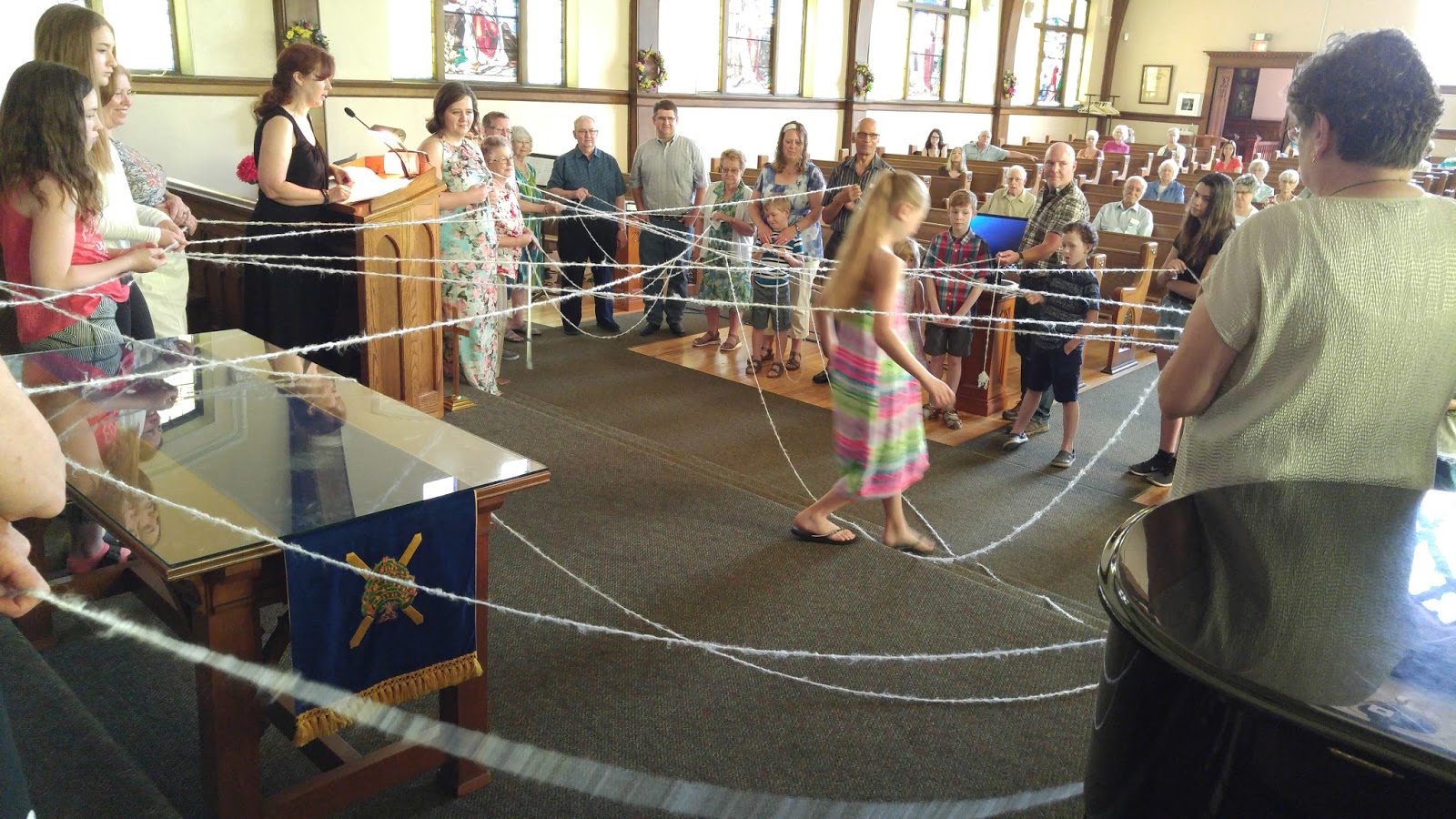
Today the Sunday School children and team and some of our youth are going to build a Web of Connectedness. This will help all of us visualize the importance each of us hold in the life of St. Andrew’s. As we build our web we will begin to see how each of us has an important role to play in the family and community of St. Andrew’s. We will pass the yarn back and forth to build our own unique web. Each person will eventually hold a piece of the web.
How are we connected? There are many, many ways in which we are all connected. Some people here are indeed related! Some sitting here today are members of families who have worshipped here for generations. One’s niece is someone else’s granddaughter. We have aunts and uncles, cousins, siblings, parents, etc. here.
When we build the web more we see that there are more connections. There may be people here today because someone else was their teacher in high school and inspired and encouraged them to be a part of this family. Or someone is here because another person reached out to them.
And we continue to build our web. People are connected through their shared gifts, talents and passions. People who love music are connected through our choirs and ensembles, with Corey, maybe unknowingly, weaving a silken web throughout. Others are connected because they like to study the Bible and upcoming messages weekly. And many are connected because they love to cook. The kitchens here, connect many, many people because let’s face it St. Andrew’s people love to eat!
We could go on to list the ways in which we are connected. It is a fun exercise to do, to make us realize that we are all in “this” together. But what is “this?”
“Living then, as everyone one of you does, in pure grace, it’s important that you not misinterpret yourselves as people who are bringing this goodness to God. No, God brings it all to you. The only accurate way to understand ourselves is by what God is and by what he does for us, not by what we are and what we do for him.
In this way we are like the various parts of a human body. Each part gets its meaning from the body as a whole, not the other way around. The body we’re talking about is Christ’s body of chosen people. Each of us finds our meaning and function as a part of his body. But as a chopped-off finger or cut-off toe we wouldn’t amount to much, would we? (The Message, excerpts from Romans 12)
And we continue to build that web, but not for ourselves. We build that web to worship and honour God. Together we can share all of the gifts and talents that we have been blessed with. Each of us has a ‘job’ and that is to share our talents. When we begin to realize that we are stronger together we will be able to do great things. We will be able to reach out to each other and to our neighbours both locally, nationally and internationally. In these ways we will build an even bigger web, one that can reach far and wide.
As we near the completion of our web we can pause to look at all of the intricate connections. Some are small, faint connections and others are complex, strong connections. But each connection is vital to keeping the web intact.
Now let’s take a look at what happens when we become detached or unconnected. When even one person causes a break in the web, we lose our strength and sometimes our focus. There will be many times when we lose our focus and get sidetracked, but Paul clearly states, “I urge you, brothers and sisters, to watch out for those who cause divisions and put obstacles in your way that are contrary to the teaching you have learned. Keep away from them.” (Romans 16:17) We must keep watch so that we do the work that God has intended us to do.
As more points in the web are dropped we will see that the web, indeed, becomes very weak. If left untended it will eventually disintegrate completely and will be gone. We must do everything we can to build each other up, to support one another and work together. “And let us consider how we may spur one another on toward love and good deeds, not giving up meeting together, as some are in the habit of doing, but encouraging one another—and all the more as you see the Day approaching.” (Hebrews 10: 24-25)