Category: Minister

Minister’s blog

“Amen! May the Lord do so!”

Posted by on Sunday, June 28th, 2026 in Minister, News

Watch sermon video here:

https://youtu.be/mPcEMSVqVMY

Hespeler, June 28, 2026 © Scott McAndless – Fifth Sunday after Pentecost
Jeremiah 28:1-9, Psalm 89:1-4, 15-18, Romans 6:12-23, Matthew 10:40-42

How many times over the last few years have you been exactly where the Prophet Jeremiah is in our reading this morning from the book that bears his name? “Amen! May the Lord do so!” Jeremiah cries out to another prophet named Hananiah.

He says this because Hananiah has just prophesied that God is about to undo all of the awful things that have happened recently. The nation has been defeated, the king and many leading citizens have been taken away into exile, and the holy temple of the Lord has been plundered of all of its sacred objects. This is disaster piled upon disaster.

Hananiah’s Promise

But it is okay, Hananiah says, because all of it is about to be undone. All of the treasures and all of the people will be returned. The terrible tyrant, Nebuchadnezzar, the cause of all this misery, will lose his power. And it will all happen within two years, which is incredibly fast for the ancient world, more like two weeks for our modern fast-paced world.

And Jeremiah hears this incredible prophecy, and he cries out, “Amen! May the Lord do so!” Because who wouldn’t want that? When it seems as if everything in our world has completely fallen apart, when everything is topsy-turvy, the one thing we long for is for everything to go back to how it used to be.

We recognize, I think, that everything wasn’t perfect before.  There were all kinds of failures, problems and injustices. But when the massive changes come upon us, they overwhelm us so completely that any promise of a return to normalcy can make us cry out, “Amen! May the Lord do so!”

I seem to have been doing that a lot lately. Especially – I don’t really know why – for the last year and a half or so. And I know that I’m not alone.

Economic Turmoil

About a year and a half ago, for some strange and inexplicable reason, our Canadian economy was thrown into turmoil. Our trade relations were suddenly in uncharted territory. And it was scary and disturbing. And what happened?

Well, it turned out that our country was heading into an election. And so, prophets showed up on the scene. They showed up in the form of politicians. And what did those prophets promise? A return to normalcy. They promised that, within a certain number of months, they would restore our trade relations to normal.

It wasn’t just one politician, mind you. They all promised to repair the relationship with our trading partner and to make everything go back to the way it was. They may have had different plans to get there, but they were all heading to the same place.

Canadian Response

And how did we Canadians respond? “Amen!” we cried, “May the Lord do so!” And I know that Canadians most certainly did not all vote the same, but they all seem to have voted with the same motivation for the candidates that each thought had the best way to get there.

And ever since, I assume, everything has been fine because I kind of stopped paying attention. No? Everything is not fine yet? Hmm, that is too bad.

Hormuz Troubles

More recently, it has happened again. All of a sudden, four months ago, shipping traffic through the Strait of Hormuz was shut down. Again, I’ve not been paying attention, but I’m sure that whoever started whatever led to that must have had good reasons which they thoroughly explained.

But it turned out that shipping traffic in that part of the world was really important. Who knew? And the shutdown caused some really big problems all over the world, so much so that everyone was very quickly longing for the Strait to just be open and for things to just go back to normal.

Two Week Prophecy

Many prophets, in our time, particularly seem to hang out on social media where they can speak to the whole people just like the ancient prophets did. And one particular prophet went on a social media platform that he owned to prophesy that everything would be fixed very quickly.

It would all be over, he promised, in a matter of two weeks, tops. Well, maybe four or certainly no more than six weeks, but that everything would very quickly go back to how it used to be. And of course, how did we all respond? “Amen!” we cried, “May the Lord do so!”

Multiple Extensions

And when those two or four or six weeks went by without everything being fixed, we were quickly reassured by updated prophecies. It would just be a couple more weeks. “Amen! May the Lord do so!” We just had to threaten total annihilation and really mean it this time. “Amen! May the Lord do so!” A little inexpensive naval blockade would quickly do the trick. “Amen! May the Lord do so!”

And, well, here we are about exactly four months later. Nothing really seems to have bounced back to the way it was before all of this began. (And it is not as if everything was great before it began but at least the Strait was open, which has become the only thing that matters). But don’t worry, the latest Memorandum of Understanding and the ongoing two months of negotiations enforced by renewed threats is going to fix everything real soon. “Amen! May the Lord do so!”

When Jeremiah cried out, “Amen! May the Lord do so!” I believe that he meant it. He was human. He was just as troubled by what had gone wrong over the last few years as anybody else. He would have been happy to see the exiles released and all the stolen items returned.

Jeremiah’s Addition

But he also added something else. “As for the prophet who prophesies peace,” he said, “when the word of that prophet comes true, then it will be known that the Lord has truly sent the prophet.”

Now, what did he mean by that? He was truly uttering great wisdom that we need to take to heart. He was saying that, when people come along and promise that everything’s going to go back to the way it used to be, we need to receive such a promise with a great deal of skepticism.

Prophetic Agendas

We need to practice skepticism first of all because anyone who says that probably has their own agenda. They want you to feel and react in a certain way, and most often, what they want you to be is complacent so that they can continue to do whatever they want.

They understand that there will always be something soothing and comforting about the promise to take everything back to the status quo. People crave a familiar situation, especially when it seems as if everything has been thrown into chaos. So always be aware that such promises are being made to manipulate you.

God’s Agenda

But there is another, more important reason why Jeremiah counsels skepticism. Jeremiah, himself a prophet who had given more than his fair share of very negative prophecies, has a sense of how God actually works. And, while we may crave what is familiar and comfortable, God has a different priority. God craves what is right and what is just.

Remember what I said before about how, when things get chaotic, we tend to forget the very real problems that existed before the chaos began? Well, we might forget, but God never does. And God knows that the crisis that we are living through today may be a step towards the world that we need to be living in tomorrow. And so, when we are so desperate to go back to how things used to be, God wants us to go through to where we need to be.

A Reckoning

And so I am going to be a bit of a Jeremiah today. “The Strait of Hormuz is about to open wide, you say?” “Amen! May the Lord do so!” say I, but…

And all of Canada’s trade relations will soon be restored, you say? “Amen! May the Lord do so!” say I, but…

But maybe a reckoning on how everything was working before all of this began is needed. And maybe until we can build an economy in which most of the benefits don’t just flow right to the very top and we learn to prioritize sustainability over profitability and environmental concerns over spending on weapons of war, this kind of chaos will continue to appear. We can’t just go back; we have to find a way through.

I am no expert on global affairs and certainly not on economics, so you can certainly write me off as a false prophet just like Hananiah wrote off Jeremiah. But I would caution you to practice the same skepticism towards those prophets who are telling you what you want to hear as Jeremiah did.

Application to the Church

But I guess we are not going to solve the world’s problems here and now, so maybe I ought to take this wisdom of Jeremiah and also apply it a little bit closer to home.

I think that Jeremiah’s word is one that the church needs to hear these days. There is no question that the church is presently living through fast-paced and disorienting change. And what do we often hear as a result? I hear a lot of church people talking about and dwelling on how things used to be.

“Oh, if only we could go back to the days when everyone felt obligated to be in church on Sunday, and there was nothing else to do anyway. Why doesn’t God make things like that again?”

And to that I say, “Amen! May the Lord do so!” But what if God has something for us to learn from where we are now? What if how things used to be was not as perfect as we remember, and God wants us to be a better and more resilient church? What if the church needs to go through, not just to go back? If we just put all our energy into trying to get back to how things used to be, we might miss that opportunity.

Personal Application

But perhaps the hardest place to apply Jeremiah’s wisdom is in your own personal life. I have no doubt that many of you are dealing with something in your life right now that has thrown your lives into chaos. If you’re not there now, you have been there before and, chances are, you will be there again sooner or later. That is just a part of living in this world.

And because of that, I’m sure that you have uttered that prayer of the heart. You have cried out in your soul for God to put things back to how they used to be. And I join my prayer to you, and in my soul I do cry out, “Amen! May the Lord do so!”

I am not the only one who understands the cry of your heart. Your God understands it too. God never wants to subject any of God’s people to such hardships and struggles, and yet they are practically inevitable when you are living in this broken world. So, yes, God totally understands your desire for things to go back.

Going Back or Going Through?

But, at the same time, I want you to consider that there may be no going back to how things used to be and that what God is ready to do is to be with you as you go through your chaos. Consider the possibility that, as you embrace the difficulties that you face, God may meet you to offer strength and wisdom and guide you through to the place where you will be able to find not only consolation but hope.

I understand, of course, all those who long for things to go back to how they used to be. The cry of my heart is “Amen! May the Lord do so!” But I also know that we have a God who calls us to hope. And hope is about much more than just putting things back how they used to be. It is about moving forward with courage and wisdom to meet the challenge of a new day.

Amen! And may the Lord give us such an enduring hope.

Continue reading »

Six Steps to Being a Successful Sire

Posted by on Sunday, June 21st, 2026 in Minister, News

Watch Sermon Video Here:

https://youtu.be/cMPmH6NOAYk

Hespeler, June 21, 2026 © Scott McAndless – Fourth Sunday after Pentecost
Genesis 21:8-21, Psalm 86:1-10, 16-17, Romans 6:1b-11, Matthew 10:24-39

I am sure that on this day, Father’s Day, in churches across the country, preachers are stepping into their pulpits clutching sermons to their breasts with titles like “Seven Biblical Secrets to Being a Great Father,” or “Six Steps to Being a Successful Sire.”

And I totally get that impulse. This is that one day in the year when we pause to celebrate the role of father. We recognize the wonderfully positive impact that Fathers can have. And so, we pack the fathers into our churches (or at least we pack them in as best we can for a late Sunday in June) and tell them we love them.

Supporting Fathers

But we also recognize that it is a difficult job to be a dad. Raising children only seems to be getting harder. And fathers sometimes struggle to be that hero that everyone seems to expect them to be. And so, of course, preachers are going to want to give some practical advice to their congregations – advice that many fathers are hungry for.

And I would certainly like to do the same thing and offer some real support for the wonderful and faithful fathers who are part of this congregation. But I think that there might be one little problem.

Biblical Father Examples

It turns out that there are not all that many great examples of fathers in the Bible. I mean, think of all the heroes of the Bible. How many were really great fathers?

King David messed up his family so badly that he literally ended up fighting a civil war against his own son. Moses abandoned his wife and sons in the middle of the Exodus, sending them back to Zipporah’s father (Exodus 18:1-9). Jacob’s favouritism towards one of his sons led to the others trying to kill Joseph.

And, as for the heroes of the New Testament, both Paul and Jesus famously never married and had no children. And then there is the time when Jesus described his mission like this: “For I have come to set a man against his father, and a daughter against her mother, and a daughter-in-law against her mother-in-law, and one’s foes will be members of one’s own household.” That doesn’t sound particularly “pro-family,” does it?

The Greatest Biblical Dad

Ah, but surely there is one exception, one biblical father who breaks the mould. Abraham has got to be the most celebrated father in history. He is known as the father of many nations, not to mention the father of three major world religions. Surely, he has something to teach us about being a great dad.

In our reading this morning, we zoom in on Abraham’s family at a key moment, as they gather to celebrate a milestone in the life of Abraham’s youngest son. The child grew and was weaned, and Abraham made a great feast on the day that Isaac was weaned.”

Now, I know that in our culture, weaning is not something that we tend to celebrate, but I guess it was a big deal for them. Children nursed for a very long time – it was by far the safest way to feed infants in a world with dodgy water supplies. So, it really was a big deal when a 4 or 5-year-old finally graduated to a diet made up of solids.

Celebrating Milestones

And we can certainly think of many milestones we celebrate in our children’s lives – significant birthdays, graduations and such. And so maybe right here we can find our first piece of advice for the fathers among us. Sermon point number one: take advantage of every milestone you can to communicate to your children just how special they are.

And there is absolutely a significant truth there. It is true that we really ought to make good use of every opportunity we have to let our children know just how unique and special they are. And look, we even have a lovely little scene of domestic bliss as we see Abraham’s new child together with his half-brother: “Sarah saw the son of Hagar the Egyptian, whom she had borne to Abraham, playing with her son Isaac.”

Let’s Look Ahead

Isn’t that sweet? The family is really coming together at this celebration. But, before we jump ahead to make a second sermon point about creating opportunities for your children to play together or something like that, I’m beginning to think that maybe I ought to have read this entire passage before I started into this sermon. Because I just looked ahead and I think there might be a problem.

See, it turns out that Sarah wasn’t too happy about the two boys getting along and playing together.  And… oh no! She insists that Ishmael and his mother both get thrown out at the risk of them dying in the desert!

Does Abraham Step Up?

Oh, but look here, it says that Abraham was upset about that. “The matter was very distressing to Abraham on account of his son,” it says. So maybe we are back on track here. Abraham is about to step in and act to get his family back on track.

So, is that what happens? Does Abraham step up and act like the hero? Does he have that really difficult conversation with Sarah and tell her that, though he understands her feelings, what she wants to do about her feelings is only going to make everything so much worse? Or does he sacrifice his oldest son and Hagar for what would be little more than the illusion of family peace?

This is the true test of a father, right? It is not about those times that are easy, when you’re cracking the dad jokes and holding celebrations. It is about having the courage to step up and say what needs to be said even if it is going to disturb things. And if that is the test, then I am afraid that Abraham fails it. He does not even offer any feedback to Sarah.

Not Always Heroes

And I know that this may not be the message you want to hear on a Father’s Day, but I do think we all need to be reminded of it. Fathers are not always heroes. And sometimes that expectation that we put on them that they have to be the hero does not help them.

The number one thing you need to know about being a father is that you are going to fall short. That is not just true for fathers. It is true for every parent or anyone who ever takes on a caring role in somebody else’s life.

Getting It Wrong

I remember the sometimes-paralyzing fear that I went through when my daughters first arrived or when they went through some of the inevitable crises that come with growing up in a broken world. Of course I was afraid that, if I reacted badly, if I said the wrong thing, if I punished too severely or not severely enough, if I was neglectful or if I was too much of a helicopter parent, I was going to mess them up completely and ruin their lives.

If you have ever felt like that, know that you are not alone. And even worse, my fears were often justified. I got it wrong. I got it wrong regularly and sometimes disastrously. And I do not think that we should be so reverential towards a biblical figure like Abraham as to not see that he too really messed up on this occasion.

God Signs Off?

Now, I know what some of you are thinking. You’ve read ahead (you really ought to stop doing that!) and you have seen that none other than God signs off on Abraham’s conflict avoidance. “But God said to Abraham, ‘Do not be distressed because of the boy and because of your slave woman; whatever Sarah says to you, do as she tells you, for it is through Isaac that offspring shall be named for you.’”

So, does that mean that Abraham didn’t do anything wrong because God signed off on his conflict avoidance? I know it is often read that way, but I see it a bit differently. I do not see it as God approving of what Abraham has already decided to do. It is rather that God is acknowledging Abraham’s weakness and his failure to navigate this crisis in the best way. That leads to God making an extraordinary promise. “As for the son of the slave woman,” God continues, “I will make a nation of him also, because he is your offspring.”

God Would Love Us to Do Better

For me, that means that God understands Abraham’s weakness. He understands that Abraham doesn’t have it in him to stand up to this wicked course that Sarah has decided upon. Of course, God would love Abraham and Sarah to do better. God would love us all to do better. But God is also not going to force us to do the right thing against our will. God is that excellent kind of parent who knows that we will only learn by making our own mistakes.

To make this relate to our own roles as parents or guardians in people’s lives, God isn’t going to stop you from making your mistakes or getting things wrong. God loves you and respects your autonomy too much for that.

God Doesn’t Abandon Our Children

 But – and this is the most important part – God is not going to abandon the people that we are responsible for because we get it wrong. That is the promise that God makes to Ishmael. And that is why I am not afraid that my mistakes or shortcomings will ruin my children’s lives.

They are beloved of God. And, as I have learned to trust in that, I have been able to watch with admiration as my children have become these amazing human beings. They have not become who I thought or expected they would be. They have not become mere protégés trying to live up to my idea of what they are supposed to think, do and be. They have become their own people who are setting their own course.

And thank God for that! And I mean literally thank God. They have become the people they need to be despite the mistakes I made in parenting them. They have chosen their course despite what I thought was wise advice. Who they are becoming is a product of the grace of God and the gifts and abilities that God has placed in them. And to see that is the best Father’s Day gift that anyone could receive. I mean, that and a really good steak cooked on the barbecue.

We All Mess Up

So I guess, when I think about it, there is some really good advice for fathers to be found in our reading this morning from the Book of Genesis. But it is not there because Abraham himself was such a fantastic father. He messed up just like all of us mess up.

I am certainly not going to suggest that any of us ought to follow his example and become so fearful of disturbing the peace in our life that we will not stand up to protect someone who is being attacked or marginalized. Abraham should have done better, and we all can too, with God’s help.

But the good news is that, even if we fail, we do not need to despair. God does not abandon us in our failure. We believe in the grace of God, and that grace is powerful enough to override our failure and reverse our flubs. And there will be days when the knowledge of that truth is the only thing that will keep you going.

Practical Advice

So, I promised at the start that I would offer you “Seven Biblical Secrets to Being a Great Father,” or “Six Steps to Being a Successful Sire.” Let’s get down to the practical level.

Number 1: Let’s stick with that first one I gave you. “Take advantage of every circumstance you can in order to communicate to your children just how special they are.” It still sounds like pretty good advice.

But if I’m going to fill out the rest of a list today, I would probably do it like this:

  • Love your kids even when they fail or fall short
  • Love yourself even when you fail or fall short.
  • Love your kids especially when you fail or fall short.
  • Accept the love of your kids when you have fallen short.
  • Trust in the grace of God for the rest.

So, happy Father’s Day.

Continue reading »

When God Says Go

Posted by on Sunday, June 7th, 2026 in Minister, News

Watch sermon video here:

https://youtu.be/xOsV1Ur7usU

Hespeler, June 7, 2026 © Scott McAndless – Communion, Second Sunday after Pentecost
Genesis 12:1-9, Psalm 33:1-12, Romans 4:13-25, Matthew 9:9-13, 18-26

The promise that God gave to Abram was amazing: “I will make of you a great nation, and I will bless you and make your name great, so that you will be a blessing.I will bless those who bless you, and the one who curses you I will curse, and in you all the families of the earth shall be blessed.” It was a high calling – an exalted and holy mission not only to find the potential in himself but also to have a fantastic and positive impact on the whole world.

But apparently, this promise could only be activated in one way. “Go from your country and your kindred and your father’s house to the land that I will show you.” And, as Abram looked around him, that seemed a little bit easier said than done.

Reasons to Stay

He had lived here in Haran for a very long time. He had put down deep roots, had developed a circle of friends. He had business contacts and connections throughout the area.

And then there was his father’s house. His father, Terah, had recently passed away at the ripe old age of 205. You think that King Charles had to wait a long time for his mother to die and to get the job he’d been waiting for all his life? Well, Abram had had to wait several lifetimes to inherit this house. How could he just leave it behind now?

More than just the house, though, he had his country, his national identity, his gods and his kin to think of. These were all the things that he would lose contact with, maybe forever.

Vague Promise

He also had a family that depended on him. He and Sarai did not have any children (something that had always been a sore point), but they did have an entire household of slaves, freedmen and clients. They all looked to him to provide for them. Was he really supposed to disrupt all of their lives for the sake of a promise?

But worst of all, the promise wasn’t specific. God wasn’t even telling him where he was going or what to expect when he got there. He was supposed to give up everything he knew for something he knew nothing about.

All these thoughts ran through Abram’s mind in the moment he received the call from God to go. He had every excuse in the world to stay exactly where he was. But what did Abram do? Did he let any of those considerations get in the way of the adventure that his God was placing before him? No, he did not.

“So Abram went, as the Lord had told him, and Lot went with him. Abram was seventy-five years old when he departed from Haran. Abram took his wife Sarai and his brother’s son Lot and all the possessions that they had gathered and the persons whom they had acquired in Haran, and they set forth to go to the land of Canaan.” And the world, my friends, has never been the same since.

Matthew’s Enterprise

Matthew had built up quite a business for himself over the years. He had been able to bid for the tax-collecting franchise around Capernaum. Basically, he had promised the Roman agents that he would extract a certain amount of wealth from tolls, tariffs and taxes. And so long as he delivered, they really didn’t care about anything else.

Anything he was able to raise above what he had bid for the franchise was his to keep. And he could use whatever methods he desired. Extortion, theft, threats to break people’s legs or to send them to sleep with the fishes at the bottom of the Sea of Galilee – the Romans didn’t care so long as they got their cut.

So, Matthew had done well. It was true that everyone hated him for it. They knew that he was part of a corrupt system that was designed to squeeze every last coin out of their pockets. But he had made peace with that. Let them hate him; he knew that he and his family would remain secure. And that was what mattered, wasn’t it?

Follow Me

At least, he thought he had made peace with it until one day Jesus passed by his collection station. Now, we’re told that when Jesus called the fishermen, Peter, Andrew, James and John, he had a quip that he used to refer to their jobs. “Follow me,” he said, “and I will make you fishers of people.”

But apparently the only thing he said to Matthew was, “Follow me,” which seems to me to be a great lost opportunity. Why not at least say, “You can count on me”? Why not say, “Follow me and even in the most off-balance-sheet activities, your deferred impact liabilities will be fully amortized into equity of change, ensuring a positive net present value on humanity’s statement of affairs.”

That’s how you talk to an accountant, am I right, Vern?!

A Response

But amazingly, all Matthew needed to hear was two words: follow me. Maybe he was less reconciled to being a mere leech sucking the life out of his countrymen than he had thought. Maybe he hadn’t quite given up on himself.

He had no idea where Jesus was calling him to go or what he would do. There were no long-term actuarial forecasts or business plans. He was just supposed to follow.

And did Matthew hesitate? He immediately dropped everything that had given purpose and meaning to his life up until that point. He left his tax records and lists of people who owed him money. He abandoned all of the people who relied on him to get them rich, and he followed Jesus. And the world would never be the same again.

A Rich History

The people of Knox Preston Presbyterian Church had invested so much into their common identity, their building and their sense of mission and purpose for generations.

They had so many reasons to hold onto what they had built. Their congregation had given them a sense of identity and a purpose. For many of them, the most significant events of their lives had happened in that place and among those people: their weddings, the baptisms of their children, their mourning for loved ones.

And then what happened a couple of years ago? God came along and said, “Go, go from your congregation and your church family and your ancestors’ building to the place that I will show you.”

Did God Call?

Now, I know that there are some who might dispute that and say that it wasn’t God who said that. It was the Presbytery who said that. Or it was certain individuals who were given a position of authority who said that. And of course there is some truth in that.

But you see, it is rarely immediately obvious when a message is coming from God. There are always other ways that you could explain it away. Perhaps, Abram might have explained to himself, he was just depressed following the death of his father. Maybe it was just his own wanderlust that he was hearing, not the voice of God.

And when Jesus came up to Matthew’s tax office, for all Matthew knew, he was a nobody. How could he know for sure that this Jesus was speaking for God? No, when God is calling, that is something that you have to figure out. And the people of Knox Preston, despite a great deal of grief and loss and a few other difficult emotions, did discern that God was calling.

And what did they do? They went. And they went above all with good will, accepting that this was part of God’s plan for them. They went not knowing what on earth they were getting into. I mean, they’d met some people who had made some promises, but that was it.

But still, like Abram and like Matthew, they got up and went. And they became a part of this new thing that God was creating – a new amalgamated congregation. And the world would never be the same again.

How God Does It

You see? That is how God does it. We may have our personal plans and visions. We certainly have things that make us feel comfortable and secure. And God, it seems, has a habit of calling people out of that comfort and security and into radical trust.

So I ask you all today where that call is coming into your life. And let me ask you first of all as a congregation. As I just said, there are several people here who recently went through that process of leaving behind what was familiar and comfortable to become a part of this congregation. They have demonstrated their courage and their faith to us all.

Call to St. Andrew’s

But, if they were called to become a part of this new thing, weren’t we all? Let’s ask what God came along and said to the people who were part of St. Andrew’s Hespeler before all of these conversations started. What did God ask us to leave behind?

“Go from your concept of a congregation that is totally based on things happening in this one place in the village of Hespeler. Leave behind your comfortable cliques and familiar ways of getting things done. Abandon the familiarity of a church that used to be to fully embrace this new congregation with the same courage and faith that those who have given up so much have shown.”

And do note that God is asking us all to do this even though we still don’t know all that this new congregation will be. All we have is a promise from God that God will let us know when we get there. It’s only the same promise that he gave to Abram and to Matthew, and look how those promises turned out.

It is a question that all of us have to ponder, and not just those who came from a particular place. It is a call that God places on congregations from time to time, and we definitely seem to be in a season when many congregations are pondering such calls.

Call to Individuals

But I would be remiss if I didn’t put the question to you as individuals as well. I think all of us have to pause from time to time and ask what new and courageous thing God may be calling us to do.

How might God be speaking to you and calling you to some new adventure of faith? Do not expect to hear some divine voice booming from heaven with instructions for what you are to do. I don’t think that happened for Abram, and I’m sure that it didn’t for Matthew.

Expect God to speak in various ways. Sometimes it is when we learn to quiet our busy minds through the practice of meditation that the voice of God (that has been speaking to us all along) can finally break through. With quiet whispers, God may direct you in a new course.

But God may also speak through the passions and concerns that drive us. Have you found in your heart a new concern for some disadvantaged group? Has your creativity been stirred with some crazy idea for how a problem could be addressed?

These are experiences of inspiration, and they can absolutely come directly from God. We do also have to practice discernment about them. We need to pray and meditate over them, and we need to talk to the trusted voices of the people that God has placed into our lives. God speaks through them too.

Stepping Into the Unknown

But do not dismiss the thought that God may be calling you to step out by faith into the unknown. God has done it before; why wouldn’t God dream of doing something amazing through someone like you – especially someone like you.

Abram was a nobody. God could have called many similar men wandering around Mesopotamia at the time. For all we know, God did. Perhaps the only thing that was unique about Abram was that he listened and that he went.

Matthew wasn’t unique either. The land was full of tax collectors. And, for all we know, Jesus stopped by the tax offices of dozens of them before Matthew dared to do what Jesus said and get up and follow.

God isn’t looking for people who have got it all together. God certainly isn’t looking for people who know how it’s all going to turn out. God is looking for people who are faithful. God is looking for people who can hear the words leave, go and follow as calls to adventure.

And, yes, God may be looking for you.

Continue reading »

Unraveling the Trinity

Posted by on Sunday, May 31st, 2026 in Minister, News

Watch Sermon Video Here:

https://youtu.be/3m1Fc3RRv5Y

Hespeler, May 31, 2026 © Scott McAndless – Trinity Sunday
Genesis 1:1-2:4a, Psalm 8, 2 Corinthians 13:11-13, Matthew 28:16-20

Today is known in Christian tradition as Trinity Sunday. And I would like us to realize for a moment how unique that is among the festivals of the Christian church. All of the other major festivals celebrate events in the life of Jesus or of the early church. Christmas celebrates Jesus’ birth. Easter, his death and resurrection. Pentecost, as I hope you picked up last week, the birthday of the church.

But today, we don’t celebrate an event, but rather a doctrine – a teaching of the church. It is not even a doctrine you can find in the Bible itself, but rather something that the church only figured out some 300 years after the time of Jesus.

A Logic Puzzle

 So, I’m at a bit of a loss here today. I want to talk about the Trinity. I do think it is an important doctrine. But I’m not exactly sure how to do that. I know that a lot of the time, when we talk about the Trinity in the church, we approach it as a kind of logic puzzle. We figure that our task, when we talk or teach about the Trinity, is to help people make sense of it.

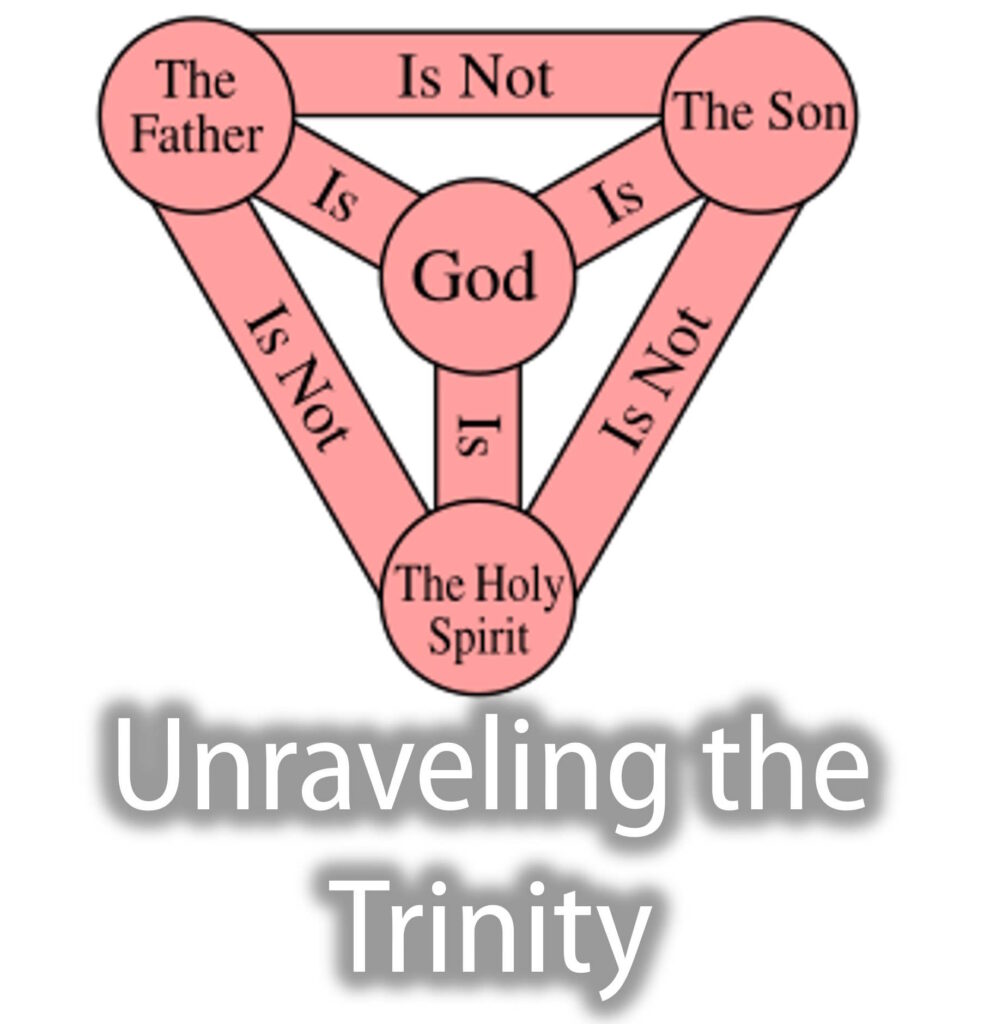
And that is, of course, a huge challenge because, at its core, the Trinity doesn’t make logical sense. The idea of the Trinity is that there is one God, and that God is known in three persons, Father, Son and Holy Spirit. We further say that the three persons of the Trinity, Father, Son and Holy Spirit, are all God. But we also affirm that the Father is not the Son and the Son is not the Spirit and that the Spirit is not the Father.

And that, my friends, does not make much sense. And maybe it shouldn’t, because the nature of God is supposed to be beyond our human understanding.

Trying to Make it Make Sense

But what do we do when we talk about the Trinity? We try to make it make sense. We use various images to explain it. St. Patrick famously used a Shamrock with its three leaves as a picture of the Trinity. Sometimes people talk about how water can exist in three different states: solid, liquid and gas. These images may be nice to contemplate, but they certainly don't present a complete or accurate picture of the Trinity which is far beyond all physical objects.

These attempts to picture the Trinity leave us with the impression that that is what we’re supposed to do with the doctrine – that we are supposed to understand it. It makes us think that if we can just get our minds bent enough out of shape to get them around this idea of God, even for an instant of time, we will have mastered this thing called the Christian faith.

Problems With This Approach

It also creates a problem for many honest Christians who can’t get their minds around this concept. Many will often conclude that, since they cannot make sense of it, they are incapable of having faith. Such people may give up on Christianity altogether.

But the Christian faith is not a logic problem. It is not an exercise in screwing yourself up to believe impossible things. The Christian faith is a journey of trust in connection with a God that we cannot fully understand.

So, my question today is what am I supposed to say to you about the Trinity, other than that it is okay if it doesn’t make logical sense to you?

Trinity Is Not in the Bible

Well, let me go back to something that I said a moment ago but that I did not dwell on. I said that the Trinity is not in the Bible. That may have been a surprise to you, but virtually all churches agree that it is true.

Now, the persons of the Trinity, Father, Son and Holy Spirit, are all in the Bible. It references all of them and their activities, and it even says some important things about how they relate to one another. But you will not find in the Scriptures any clear statement of their unity or triplicity. But there is a connection between what is in the Bible and the later doctrine.

So, how did we get from what the Bible said in the first century to the doctrine that the church finally agreed to over three centuries later?

How the Christians Experienced God

Well, the Bible is, above all, a record of human beings who experienced God and passed those experiences down until someone eventually wrote about them.

And those early Christians experienced God in many and various ways. They experienced God in Jesus of Nazareth. They experienced God in him during his life, and then even more powerfully in encounters with the risen Christ. They didn’t necessarily understand how they had experienced God in this person. They didn’t know how such a thing could be. But that failure to understand how didn’t really bother them. All they knew was that Jesus had presented God to them in a unique way.

And, in the same way, the early church absolutely experienced the presence of God through the Holy Spirit. This was particularly true when they gathered and worshipped together and supported one another.

Somehow, it was plain to them that when they gathered like that, there was a presence among them that they could not explain. Somehow, the whole of the group was bigger than just the sum of its parts. Even more important, they knew that this presence was divine. But again, they didn’t particularly concern themselves with how this could be. They just knew what they had experienced.

Encounter with Greek Philosophy

So, it all started with their experience of God. And as it spread throughout the Roman Empire, the church took the stories of those experiences with it. But the church was now spreading through a very different culture than the one it had started in, a culture that had been shaped by Greek Philosophy.

And Greek Philosophy was not happy with just experiencing things. It had to analyze and categorize. It had to explain everything. And so there was a great clash of ideas that went on for centuries as the Greek philosophical mind tried to make logical sense of the church’s experience of God. It did not succeed because the human mind cannot truly comprehend the nature of God. But it did eventually manage to grapple with it enough to agree to the doctrine of the Trinity.

It was a remarkable achievement. The Trinity, with its internal contradictions and paradoxes, can almost take us to a state of mind where we feel like we just might be able to grasp the nature of God. But it has also left us with the impression that our job as believers is to understand and explain God and it is not. Our job is what it has always been: to encounter the unknowable God.

Setting That Aside

So, on this Trinity Sunday, I would propose that we set aside logic and reason. Put away the shamrocks, the liquid, the solid and the gas and whatever other ways that people have tried to explain it and let us go back to where it all started.

Our reading this morning from Paul’s Second Letter to the Corinthians is the oldest written text that refers to what would come to be called the Trinity. This letter was written, after all, before any of the gospels. Paul was just writing a letter to one of the churches that he had founded, trying to help them sort through their many problems.

As he came to the end of the letter, he was looking for a way to sign off that would be meaningful to them. And so, he wrote, The grace of the Lord Jesus Christ, the love of God, and the communion of the Holy Spirit be with all of you.”

Those are almost certainly the first words referring to the three persons of the Trinity ever written. But Paul isn’t trying to explain the Trinity, is he? He isn’t offering a doctrine. He is giving a blessing to the people of the church – a blessing based on their experience of God.

Living Out the Blessing

That is where it all started. And that blessing, I would suggest, is what really matters. I don’t really care if someone can explain the relationship between the persons of the Trinity. That is not what proves to me that you are a faithful Christian. What matters is that you are living out “The grace of the Lord Jesus Christ, the love of God, and the communion of the Holy Spirit.”

So here is my question for you on this Trinity Sunday. Have you experienced the grace of our Lord Jesus Christ? Jesus is himself the personification of this essential nature of God.

The Grace of Our Lord Jesus

If you have experienced the grace of our Lord Jesus Christ, then you know that you are forgiven and that you do not need to torture yourself over your regrets, your failures or your shortcomings. You can accept that you are enough.

If you have experienced the grace of our Lord Jesus Christ, then grace will also become a part of the way that you look at the world. When you are wronged by someone, you may certainly speak up and demand that justice be done for the sake of all, but you will also not carry around resentment that weighs you down. You will not contribute to creating future pain by demanding vengeance.

If you have experienced the grace of our Lord Jesus Christ, then you will not be scandalized by the thought that someone you disagree with or that you struggle with, or who has a lifestyle that you do not understand, can still be accepted by God. You will learn to appreciate even such people in the name of the grace of our Lord Jesus Christ.

The Love of God

And what about the love of God? The love that is in view in this verse is the kind of love of a father at its best that existed in that ancient world. This is a father who knows how to take care of his children. This is a father who can love them for who they are and yet also can love the potential of who they could be.

 If you have experienced the love of God, then you know that you are accepted for who you are. You know that you have a God who is committed to love you and to keep all of the promises that have been made to you. If you have experienced the love of God, you know that you have worth because of the God who loves you.

The Communion of the Spirit

And that brings us, finally, to the communion of the Holy Spirit. The word that is translated here as communion is a very important word in the New Testament. It can be translated in various ways. It means fellowship. It means sharing, participation and partnership. So, what does it mean to experience the communion of the Holy Spirit? It actually has less to do with feeling some kind of mystical presence and more about living in community with your fellow believers.

So, how do you experience the communion of the Holy Spirit? You experience it by learning to trust the people in your church in practical ways. We experience it by supporting one another when we face challenges or problems. We experience it when we can courageously share our own struggles, needs and fears with one another. Experiencing the communion of the Holy Spirit is what makes us a church community. It is what empowers us to work together as a team to share God’s love with the world.

It is Christians who know these things who are faithful believers. They don’t have to be able to explain using Greek philosophy or logic what the Trinity is because they are living it. That is the true foundation of being a trinitarian Christian.

Continue reading »

The Three W’s of a Successful Church

Posted by on Sunday, May 17th, 2026 in Minister, News

Watch the sermon video here:

https://youtu.be/mXNGzGue9Xw

Hespeler, May 17, 2026 © Scott McAndless – Seventh Sunday of Easter
Acts 1:3-14, Psalm 68:1-10, 32-35, 1 Peter 4:12-14; 5:6-11, John 17:1-11

The Christian church is one of the most successful organizations in the history of the world. From a handful of people – small enough that they could almost all be listed by name in our reading this morning from the Book of Acts – it grew over the next several centuries to become the dominant institution of the Western world and ultimately to dominate the globe.

And sure, in our own day, some of that dominance has fallen off. Apart from some significant exceptions, the church in North America is not experiencing overall growth these days. But it has been quite a run.

Going Back to Where it Started

And if it has fallen off a bit, maybe it is time to go back to where it all started. In our reading this morning, the author of the Book of Acts is telling us that story. He is describing the events that were foundational for the church, that set it up to become all that it was meant to be.

Next week, on Pentecost, we will celebrate the birthday of the church and how, with the outpouring of the Holy Spirit, it came into being. But today, let’s look at the foundational advice that Jesus and others gave to the church to set them up so that they could hit the ground running.

I see three pieces of advice in this passage – advice that is just as relevant today as when this book was written. I call them the three W’s. And I hope that you will leave with all three of them on your hearts as you meditate on what God is calling our church to do today.

Finding Success

Our world has some very clear ideas about success and how it is supposed to be achieved. Endless books have been written about how to were up your organization for it. And these books focus on things like structure and strategy. It often comes down to having a clear mission and making sure that everything in your organization is built around reaching those goals.

So, I guess that is where we should start. Surely the first thing that Jesus gave to the church had to be an excellent strategy and a clear mission statement.

But is that what we see in our reading this morning? Not exactly. After spending 40 days with his followers and giving them all the proof that they needed that he was alive and had conquered death for them, he finally gathered them together to tell them what the next step in the plan was.

Wait

So, this is it, right, the big strategy session. We’re going to get the inside scoop on how the church is supposed to set itself up to gain power and influence people. That is how you succeed in this life, isn’t it?

So, what does Jesus do? He ordered them not to leave Jerusalem but to wait there for the promise of the Father.”

Let me ask you, does that seem like the kind of winning strategy that brings you success in our world? Where are the instructions to set up committees and programs? Where are the organizing principles and the grand mission statements and visioning exercises? Most of all, where is the budget? We all know that you can’t get anything done without a budget!

Contrary to Worldly Wisdom

This goes against everything we are taught about how organizations thrive. We want to get ready, to plan and prepare. We assume that the only way to get ahead in this world is to get busy. What kind of plan starts with wait?

But that is exactly what Jesus says to do. And that, for the most part, is what the first Christians do. It says that they were constantly devoting themselves to prayer.” Their main activity was wait.

What are we to take away from this as we seek to build a strong church? Should we just disband all of our committees, scrap our mission statements and hold endless prayer meetings?

Well, not exactly. I do believe that there is a place for all these things. Having the right kind of structures in place does help you to be ready when whatever you are waiting for actually shows up.

Maintaining Structures

But it is also true that the church has a long history of pouring so much energy and time into setting up and maintaining our structures that we can miss hearing what God is telling us to do.

Every church has tendencies to do this in their own way. I have often seen how Presbyterians do it. Every year, for example, the Presbyterian Church gathers at a General Assembly with representatives coming from across the country.

The purpose of these assemblies, at its core, is to listen to what God is saying to the church. In the Reformed Church, we believe that when the church gathers in this way and when we pray, the Holy Spirit speaks to the church. And I know that that does happen; I have been there sometimes when the Spirit speaks to the church, and it is quite moving.

But when we do meet like that, there is also always a lot of business to do. There are budgets to be approved, committees to form and policies to put in place. And it is always a temptation to let all of that business absorb our attention. We become totally focused on it. And then, when we leave, we congratulate ourselves on having a good assembly if we have dealt with all the business efficiently.

And that is what we do at all levels in the church. We pour our attention and effort into organization, policies and meetings and congratulate ourselves for setting ourselves up for success. This first instruction of Jesus to wait on God’s Spirit gives us an important corrective to that tendency.

Trust in our Structures

Even more troubling, we tend to put our trust in those organizational efforts. Having proper policies and committee structures makes us feel confident that we are building a secure future. But Jesus doesn’t want us to trust in our efforts, does he? He wants us to trust in God, and so Jesus teaches us to wait.

So, the first W is wait. Now let’s turn to the next piece of advice that Jesus gives us. Surely the next thing that we need for success is a good marketing strategy. If we want our churches to grow as the early church grew from its humble beginnings, we obviously need to have some kind of plan to get the word out.

Marketing the Message

And of course, our modern world stands ready with all kinds of expertise in that area. So much of the world around us is geared towards getting out exactly those kinds of messages. We are all surrounded every single day with so much advertising and marketing that we often don’t even realize that it is being fed to us.

And we certainly see churches jumping wholeheartedly into this effort, engaging in multimillion-dollar marketing campaigns such as, for example, the “He Gets Us” campaign that placed $20 million ads in four of the most recent Super Bowls.

And even churches that have nowhere near that kind of money to throw around (like Canadian Presbyterian churches) still feel like they need to invest whatever effort and money they can into things like social media campaigns and even hire consultants to get their message out.

Jesus’ Communication Plan

So, what is the advice that Jesus gives us for this essential part of the plan? Well, here is what he says to the disciples: “But you will receive power when the Holy Spirit has come upon you, and you will be my witnesses in Jerusalem, in all Judea and Samaria, and to the ends of the earth.”

This brings us to the second W for a successful church: witness. Witnessing is a communication strategy, but it is not one that we usually associate with big marketing campaigns, is it? It is more associated with trials and law courts.

Based on Our Experiences

But here is the key thing about witnessing that I think that Jesus is pointing to. Witnesses can only speak about what they have experienced themselves. They have to speak authentically because that is the only thing that can give their message meaning.

That is, in many ways, the very opposite of a slick marketing campaign, which depends on form and style, not on people just being themselves.

What does that mean for the church as it spreads its message today? It doesn’t mean that we can have no communication strategies or that we cannot think and plan about how we want to use things like social media.

Honesty and Authenticity

But it is an important reminder that any message we put out to the world has to be honest and authentic. The church can’t just take polls and give people the message that they want to hear. We need to speak from the heart about what we have experienced of Jesus. That is what Jesus calls the church to do, and it remains the foundation of our success to this day.

So, first we are to wait. Secondly, we are to witness. What is the third W? That is not something that Jesus himself says, but something that is said just after he leaves.

Watching Heaven

Jesus ascends into heaven. The immediate presence of Jesus is being transformed into a more spiritual presence. But then something remarkable happens. “While he was going and they were gazing up toward heaven, suddenly two men in white robes stood by them.”

What were the disciples doing at that moment? They were watching – gazing up toward heaven. And that is an attitude that the Christian church has often adopted throughout the centuries.

We fix all of our attention and energy on heaven and particularly on getting there someday when we die. For many people, that has become the entire point of the Christian faith – that it is only about getting a ticket to heaven.

Why Watch?

Now, the promise of an afterlife is real; I do not mean to suggest in any way that it isn’t. But I would say that when it becomes the sole focus of our faith, we have a problem. And so it is that two angels come to the disciples as they stand there and say, “Men of Galilee, why do you stand looking up toward heaven?”

This is an important warning about the first W. The first W was a command to wait – to wait on God and on the action of the Holy Spirit. But this makes it quite clear that our waiting should not be focused on another world or on a life after death. We are to wait on God for this world – wait on God who will show us where to go and how to bear witness to our experience of Jesus in this world.

In God’s Hands

What comes after this life, we can simply trust that that is in God’s hands. “It is not for you to know the times or periods that the Father has set by his own authority,” Jesus says to the disciples. And the two angels agree when they say, “This Jesus, who has been taken up from you into heaven, will come in the same way as you saw him go into heaven.”

The message is clear. God will take care of all of that and you can confidently leave that in God’s loving hands. But you are here now and you all have some things to do.

And what have you got to do? If you leave today without knowing that, then I will have failed in my job today.

Wait, Witness

You are called to wait on God. You are to be ready to respond to the opportunities to show God’s love in this world that God places before you. You are to wait, expecting that God’s Spirit will lead.

And you are called to witness. You are to be ready to share from your own heart what you have experienced of your Lord Jesus whenever the opportunity arises. And you are to do that in Jerusalem (that is, where you are). You are to do it in Judea and Samaria (that is, where you have some influence). And you are to do it to the ends of the earth (that is, wherever God might send you).

Why Are You Watching?

And every so often, you need to check yourself and ask why you are wasting your time watching heaven. Your heavenly destiny is in the hands of your heavenly Father, and you can trust God for it.

So, will you remember them? Will you ponder them this week? Wait, witness and why are you watching heaven?

Continue reading »

To an Unknown God

Posted by on Sunday, May 10th, 2026 in Minister, News

https://youtu.be/Sefba1eUO98

Hespeler, May 10, 2026 © Scott McAndless – Christian Family Sunday
Acts 17:22-31, Psalm 66:8-20, 1 Peter 3:13-22, John 14:15-21

One argument that you might hear against believing in God goes like this. The atheist reminds the believer that, in the history of the world, people have believed in many different gods. People have worshipped gods like Zeus and Jupiter. They have pledged their faith to Athena, Ra, Odin and Thor, and the list goes on and on.

“But you,” the atheist says to the believer, “You reject all of those gods. You think that all of those people were wrong to believe in them. Well, I just wanted to let you know that I agree with you. I don’t believe in any of those gods either. In fact, we are almost the same. It is just that I believe in one less god than you.”

I Don’t Get It

I don’t know about you, but I have come across that argument a few times, and I have to admit that it doesn’t quite make sense to me. I get the implication. The idea is that the rejection of any idea of God is merely the logical extension of what everyone does when they choose not to believe in Zeus or Odin.

But there are some big assumptions behind all of that that I do not accept. And without those assumptions, the argument falls flat.

Paul in Athens

But rather than talk to you about my assumptions, let me dig into what the Apostle Paul says in our reading this morning from the Book of Acts instead, because I think that we are on much the same wavelength when it comes to these matters.

In this passage, Paul is in the city of Athens, which is the heart of Ancient Greek religion, philosophy and culture. Since the Athenians love to talk and debate about everything, when Paul shows up in the city and starts preaching strange new ideas about a guy named Jesus and about the resurrection, he causes a bit of a stir.

At the Areopagus

And so, he is invited to address a meeting of the Areopagus. The Areopagus was named after a rugged hill in the centre of the city, the hill of the god Ares. Likely originally a place devoted to the war god where Athenians mustered for battle, centuries of peace had transformed the gatherings associated with that hill into more of a debating society where they gathered to talk about the latest and trendiest ideas.

This is a remarkable opportunity. Paul is, both from his Jewish heritage and from his new Christian faith, a monotheist. He believes that there is only one God who is the Creator of heaven and earth and the Father of his Lord Jesus Christ.

A Perfect Opportunity to Criticize

And here he is in the very centre of Greek polytheism – in the city of the goddess Athena and surrounded by ancient temples dedicated to the great gods of the Olympian pantheon. These people believe in so many gods that Paul doesn’t believe in.

So, Paul has a perfect opportunity to attack them for their beliefs. He could do a whole routine. “Are you telling me that you actually believe in a god who turned himself into a <snigger> golden shower to seduce a princess?” “And is the patron goddess of your city so petty that she once turned a woman into a spider because she was a better weaver?”

Yes, Paul could have attacked all of the Greek gods and offered reasons why they were ridiculous. Every religion, including our own, has certain elements that can be attacked in this manner.

Paul Praises

But Paul does not do this. In fact, he begins by praising them for their belief. “Athenians,” he says, “I see how extremely spiritual you are in every way.” And he seems to mean this sincerely. In fact, he points to one particular thing about their spirituality that particularly impresses him. “For as I went through the city and looked carefully at the objects of your worship, I found among them an altar with the inscription, ‘To an unknown god.’”

These sorts of altars did actually exist in the ancient world, by the way. None have actually been dug up in Athens, but they have been found in many other ancient cities, including one in the very centre of Ancient Rome.

Paul doesn’t bring this altar up to make fun of them, though. He is not laughing at them because they have so many gods that they lose track of them or anything like that. He celebrates the fact that they are stretching towards divinity that they do not understand. “What therefore you worship as unknown, this I proclaim to you.”

Unknowingly Worshipping God

That is remarkable when you think about it. Here is Paul, speaking to these polytheists and suggesting that they have been unknowingly worshipping the same God that he, a monotheist, worships. How can this be?

I understand it like this. If God exists – if there is a supernatural being who created all things and is somehow involved in keeping the universe running – that God, almost by definition, is beyond all human understanding.

Human Limitations

We can’t describe or define God. Our human language does not have the words. Nor can we imagine or conceptualize such a God because our human minds are too limited.

That means that whatever we can say or think about God is going to be imperfect and incomplete. And yet, as human beings, we are drawn to God. It seems to be built into our very humanity.

Imperfect Concepts

And so it is that almost every civilization has come up with some concept of the divine. They tell stories and write poetry about beings who are beyond their understanding.

Are all of these ideas that they have about their gods completely true and correct? Did the gods of the Greeks literally live on Mount Olympus? Did the Norse gods ride eight-legged horses over a bridge made out of a rainbow? Of course not. At best these are metaphors and myths that may point to some truths about a universal deity. They represent human attempts at reaching towards a reality that human minds cannot comprehend.

How They Stretch Towards God

And that is what Paul celebrates in the Athenians. They are stretching towards a God who is a lot like the God that he proclaims. In fact, he congratulates them on getting a number of things right about God.

He gives them a quote from one of their own religious poets. He cites the poet Epimenides, who lived in Crete in the sixth century BC. Epimenides wrote, “In him we live and move and have our being.” And then he quotes the Stoic philosopher, Aratas, who wrote two centuries later, “For we, too, are his offspring.”

These two men lived centuries before the time of Christ, so think about what Paul is saying here. He is saying that, for a very long time, the Greeks have carried with them accurate understandings about the same God that he worships.

About Zeus

What’s more, both of these philosophers wrote these words about the Greek God Zeus. So, Paul is actually saying to the Greeks that, by believing in Zeus, they were striving towards belief in the true God. He is effectively saying that they were somewhat right to believe in Zeus for all those centuries.

Of course, he is also saying that their belief was imperfect and incomplete and that he has some better information for them, but he does not say that they were wrong.

Paul Has Better Information

Paul believes that he has better information because of what he has experienced in Christ Jesus. And that is indeed what Christians have claimed ever since – that God has revealed Godself to humanity in a unique way in Jesus Christ.

But does that mean that Paul is saying that he has the full and absolute truth about God, that he has completely comprehended the nature of God? He would not claim that. He, too, is merely reaching towards a God who remains unknowable to mere humans. It is just that he has been assisted in that quest by his faith in Jesus Christ.

We All Get It Wrong

So that is I why I do not really buy the argument of the Atheists who say that they just believe in one less god than I do. Yes, I do not believe in the reality of gods like Zeus and Thor. But I do recognize that the people who did believe in them were reaching towards the same truth that I am reaching towards.

Even more important, I also recognize that my concept of God is also flawed and incomplete. Yes, the Creator of heaven and earth has been uniquely revealed in the person of Jesus Christ, but I have barely scratched the surface of who Jesus really is. And the God that I worship is ultimately unknowable in human terms anyway. That is one of the things that makes God worth worshipping.

Masculine Ways of Imagining God

And all of this speaks very meaningfully to me on this day known as Mother’s Day. I am always made aware of how inadequate our language and understanding of God are on the second Monday in May.

So many of the ways we talk about God, for example, are masculine. We particularly love to call God, “Father.” And not without reason, of course, because that seems to have been Jesus’ favourite way to refer to God.

And calling God a heavenly Father is indeed a beautiful way to speak. It celebrates God’s love and protection for God’s people. It is a helpful way to talk about God, at least for those who have had positive experiences with their own human fathers. But does it mean that God is male in the way that we human beings experience maleness? Of course not.

Father is a metaphor for God – a way of reaching towards the reality of God that is imperfect and limited by our humanity. But other ways of speaking about God can also reach towards that same reality.

Feminine Ways of Imagining God

On this Mother’s Day, I absolutely affirm that it can be very good to talk about God as Mother too. The Bible itself does use mother language to speak about God.  “As a mother comforts her child, so I will comfort you,” God says in the Book of Isaiah. (Isaiah 66:13) And also, “Can a woman forget her nursing child or show no compassion for the child of her womb? Even these might forget, yet I will not forget you.” (Isaiah 49:15)

God is said to be like a mother bear in the Book of Hosea (Hosea 13:8), and like a mother eagle in Deuteronomy. (Deuteronomy 32:11-12) So even the Bible, written in an extremely patriarchal culture though it was, was able to reach towards God by thinking of God using feminine imagery.

God Doesn’t Fit Human Categories

Why can the Bible talk like that? Because God, being unknowable, does not fit into human categories such as male and female or human roles such as mother and father.

Calling God Mother does not mean God is female any more than calling God Father makes God male. But it is a beautiful reminder that our experiences of mothers and the love that they offer can teach us so much about the true nature of God, even if, as it says in Isaiah, God’s love exceeds even the love of a human mother.

The failure of believers to completely define or even agree about the God that they worship is not a problem for believers. It is certainly not a reason to abandon belief in divinity altogether. Far from despising the ancients or those who follow other religions because they do not imagine the divine in the way that I do, I like Paul, am willing to acknowledge that they are stretching towards the same thing that I am. Like Paul, I am willing to learn from their insights and wisdom.

And if I do recognize that they were imperfect in what they found and in the worship that they offered, I also humbly accept my own failure to properly conceive of God and to offer God all the worship that God deserves.

The ultimate unknowableness of God is not a bug; it is a feature. It encourages us continually in our quest to find God.

Continue reading »

And You Know the Way

Posted by on Sunday, May 3rd, 2026 in Minister, News

Watch sermon video here:

Hespeler, May 3, 2026 © Scott McAndless – Fifth Sunday of Easter
Acts 6:8-15, 7:55-60, Psalm 31:1-5, 15-16, 1 Peter 2:2-10, John 14:1-14

According to the Gospel of John, in the middle of the Last Supper, Jesus turned to the disciples and he said, “And you know the way to the place where I am going.”

And what has the church responded to that ever since? “Oh yes,” the church has declared, “we know where you are going, Jesus. You are going to heaven. You are going to a place of bliss.

“And because we know the way to that place where you are going, we will control who gets to follow it. We will tell everyone what the way is and, unless they all listen to us and do exactly what we say, they will never get there.”

Sacraments

The church hasn’t always agreed among its various branches on what that way is and exactly how you have to follow it. Some churches will insist that the way to where Jesus went involves you participating in all of the rituals and sacraments of the church, and if you fail to do them all or to do them properly, or if you haven’t participated recently when you die, well, then you can’t follow in the way.

Knowledge

Other churches have insisted that the way actually involves knowledge. You have to know certain secrets that have been passed down to you through the church, and that is what allows you to follow in the way.

Various churches have pointed to different pieces of knowledge. Some have said that you have to know certain things about yourself, such as that you have a spark of the divine within you. Others say you have to learn things about the hidden structure of the universe. Others keep the mysteries that they say you have to understand so well hidden that no one outside of those church has ever been able to discover them.

But whatever specific pieces of knowledge they will point to, they know that knowledge itself is the way and that they are the ones who have control over who can access it.

Faith

And then came the Protestant Reformation. The Protestants finally figured out what the way was to get to the place where Jesus was going. And they knew that the way was through faith. It was all a matter of what you believed.

And so the churches began to map out the way for true followers of Jesus by writing out all of the creeds and the confessions of faith that you had to believe. And if you didn’t believe the things that the church told you to believe – if you were not a proper Five Point Calvinist or a Pre-Tribulation Post-Millennialist or whatever else your church told you to be – then you could not follow in the way.

Relationship

But that was not the only way that the church came up with. Evangelistic churches finally came along to explain what the “true” way was. They said it was actually about forming a relationship with Jesus. You had to do that by responding to the message of the Gospel in the way that they told you – often by praying a particular prayer.

So, yes, down through the years, the church has certainly decided that it knew exactly what Jesus was talking about when he said, And you know the way to the place where I am going.”

Not Completely Wrong

I don’t mean to suggest that the church has been utterly wrong in the ways that it has told people to follow in the way of Jesus. Obviously, following in the way of Jesus has a great deal to do with questions of Christian practice, knowledge, faith and personal devotion.

But I can’t help but think that we may have made a mistake in so confidently teaching people that we know exactly how they ought to follow Jesus to where he was going. And a big part of that is that we decided that we needed to be in control of who gets to follow in the way of Jesus.

Thomas’ Wise Answer

Thomas was one of the disciples present when Jesus said that. And I note that that was not his reaction. He did not jump up and say, “Oh yes, I know exactly what to tell people to do.” He hesitated to take that kind of control over people.

In fact, he spoke up in true humility to say, “Lord, we do not know where you are going. How can we know the way?” And I cannot help but think that perhaps the church would do well to learn something from Thomas and his response. Thomas seems to have been a pretty smart guy.

What Jesus was Talking About

When Jesus spoke about the way to the place where he was going, it turns out that he wasn’t talking primarily about practices, or knowledge, or even faith or a personal relationship. He was talking about something much more essential than that.

And so Jesus explained, “I am the way and the truth and the life. No one comes to the Father except through me.” And I realize that ever since this Gospel was written, people have assumed that they understood what Jesus meant by that.

They have assumed, in fact, that Jesus meant whatever their particular church has decided that it means to follow in the way of Jesus. But I think it is time for us to step back from all of those assumptions about what Jesus meant and look at what he said. I suspect that the way of Jesus may be somewhat simpler than we have been led to believe.

I Am the Way

Jesus said, “I am the way.” And that means that we need to set aside all of our assumptions about what we have to do to follow in that way. It is not about what we do for Jesus or how we open that way. It is about what Jesus has done for us and about the way that Jesus has opened.

He said, “I am the way.” That means that it is actually not about the destination. Following in the way of Jesus is not about getting you to some heavenly bliss someday. Yes, that may be the final stop on the subway track, but such a destination is not the primary focus.

If Jesus is himself the way, then it is much more about travelling moment by moment and day by day in fellowship with Christ. It is about living your best life with Jesus now and not waiting for something beyond this world.

An Encounter

In fact, if you want to talk about the destination of this way at all, you ought not to speak of it in terms of a place but in terms of an encounter. The end of the way is the encounter with God. That is what Jesus has to mean when he says, “No one comes to the Father except through me.”

But here is the thing about that. That encounter with the Father does not lie only at the end of the way. Jesus makes it clear that you don’t have to wait until the end of the journey to meet the Father because, as he repeats several times, “Believe me that I am in the Father and the Father is in me.”

So, God is not just someone waiting for us at the end of this way. God is the one we encounter on the way. We encounter God in the one who is the way for us.

I Am the Truth

Jesus also says, “I am the truth. That means that following in the way is not dependent on the knowledge you accumulate. Yes, you can study the scriptures in all the original languages. You can absorb vast books of theology. And if those things deepen your appreciation of the way that you are on, that is all wonderful. But you don’t hold on to the truth, no matter how much you know. It is the truth that holds on to you.

Our Illusion of Control

We sometimes fall into the trap of thinking that, if we can come up with a description or definition of something, we control it. I often hear people say that, because they have a concept of God, they know what God can and cannot do. “If God inspires a piece of Scripture,” someone might say, “that Scripture has to be literally true because God can’t lie.”

Do you really think that, because you have a definition of God, you can tell God what kinds of literature God can inspire? It doesn’t work like that. Your concept of God is just that – your concept. It is always going to be imperfect and incomplete because it is a human concept.

That is what Jesus means when he says “I am the truth.” The truth about God, about the world or your path along the way is not limited by your human understanding. It is all wrapped up in the person of Jesus and it is always bigger than anything your human mind can grasp.

I Am the Life

And Jesus also says, “I am the life.” That is good news because it means that your life is not bound by the limitations of your human body or the human experience of time. Your life is as boundless as the person of Christ.

So, Jesus is saying all of that and more in this incredible statement. But we also need to take note of what he is not saying. He is not offering Thomas or any of the other disciples control over who gets to follow in this way.

The One True Church

As I have already noted, Christians down through the centuries have tried to be the boss of who gets to follow in the way of Christ.

There is one old cartoon that illustrates this perfectly. It features a Sunday School teacher standing at front of his class. On the blackboard is a diagram illustrating the history of the church.

There is one original branch, which then divides again and again to represent the various divisions and disagreements of the church over the centuries, until, at the right end of the board, there are so many different churches that the options fill the entire height of the graphic.

The teacher points to one tiny branch on the edge of the board labelled “our church.” He announces to the class, “Fortunately, with the founding of our church, the true and correct way to follow Jesus was finally found. Unfortunately, everyone else has been consigned to hell.”

We Don’t Set the Limits

That is how we have thought about it – as if there is one true way and we have to be the ones to figure out what that way is. But Jesus says, “I am the way.” You cannot limit any person, much less a divine person, with your doctrines, teachings and confessions of faith. As much as we try to limit what it means for someone to follow in that way, if the way is Jesus himself, all our human limitations will only end up making us look foolish.

In fact, whenever we judge anyone and say that they cannot be saved because of our understanding of the way of Christ, we fail to appreciate what Jesus is saying here. Yes, Jesus does say, “No one comes to the Father except through me,” and that might seem to us to exclude all kinds of people.

Jesus Gets to Decide

But again, we aren’t the ones who get to define what it means to come through Jesus. Jesus is the way; only he gets to define that. The Bible, and especially the Apostle Paul, teaches that the only way to come to God is through faith in Christ. But again, we don’t get to define the full meaning of faith, not even with our doctrines and creeds. Ultimately, it is Jesus who gets to decide who is placing their trust in him.

And, from everything that I have learned about Jesus in my studies of the gospels, I believe that he would define that in very expansive and grace-filled ways. I don’t think that Jesus is the sort to exclude someone just because they don’t sign off on some doctrine or even because they don’t claim the name of Christian.

We Are Not the Way

But, of course, that is just my thinking and you may understand it differently. That is okay. My point is that all of our understandings of such things are limited and may be flawed. And that matters less than you might think because we are not the way; Jesus is.

In the midst of the Last Supper, John tells us that Jesus said, And you know the way to the place where I am going.” And the more I think about that saying, the more I find myself sympathizing with Thomas and replying, “Lord, we do not know where you are going. How can we know the way?”

But Thomas wasn’t expressing frustration or anger when he said that. I think he was expressing exactly the kind of humility that Jesus was looking for in those who would join him in the way.

Continue reading »

What the Stranger Gave Them

Posted by on Sunday, April 19th, 2026 in Minister, News

Watch Sermon Video Here:

https://youtu.be/1rRnzHEZ3Fs

Hespeler, April 19, 2026 © Scott McAndless – Third Sunday of Easter
Acts 2:14a, 36-41, Psalm 116:1-4, 12-19, 1 Peter 1:17-23, Luke 24:13-35

Two followers of Jesus are walking down the road discussing the things that they know about him. Everything that they say about him is true; nothing is inaccurate. They know that Jesus was a prophet and mighty in word and deed. They know about his arrest, condemnation and crucifixion.

And they also know about the women who went to his tomb. They are familiar with their reports of seeing angels and not finding his body. And they are aware that the claims of these women have been confirmed by further investigation. And yet, ironically and jarringly, though they know these essential elements of the story that we celebrate every Easter, they find no joy in any of their discussions. They are depressed and walk with sad and downcast eyes.

The Truth

How can this be? They know the truth, and the truth is what matters, isn’t it? All we have to do to change people’s hearts and minds is to show them what is true. But these people know the truth. They know all about it, and it does not seem to be helping them at all. If anything, it seems to only make them feel worse.

A stranger joins them as they walk. He asks of them and receives from them all of the data they have about this man Jesus. He doesn’t give them any new information. And yet, somehow, he seems to change everything for them.

Two-Hour Conversation

And I realize, of course, that some of you are jumping ahead to the end of the story and want to say that this stranger does give them some new information. It turns out at the end that the stranger is himself the risen Lord Jesus. That is a bombshell in terms of new information. But they only realize it after he disappears.

But before that, they are on a seven-mile hike together. That would have made for about a two-hour conversation if they were walking at a reasonable pace. And in all that time, there is no indication that the stranger gives them any new information or evidence.

In fact, he kind of plays dumb. He acts as if he has never even heard of this Jesus of, where did you say he came from again? Nazareeth? He’s never even heard of him before.

How He Moved Them

He somehow takes only their information and is able to spin it back to them so that, even while they are walking and before his secret identity is revealed, their hearts begin to burn within them. With no new information, he can move their hearts from sorrow to joy and from darkness to light.

And that is the effect that I want to focus on today. There are so many in our world who are walking through this life feeling sad and sorrowful. Their sadness is not without reason because they are not lacking in information.

Streams of Information

We are all being fed information all day, every day. Most of us have these little devices in our hands or in our pockets all the time that will, if we let them, be only too happy to feed us a constant stream of information. If we are careful and check where that information is coming from, it might even be accurate information.

We are, in fact, living in the golden age of information – an age when the most accurate truths can be transmitted to a greater number of people more efficiently than ever before.

And what is the result of that? Are more people better informed than ever before? Is the world more united and all on the same page than has ever been possible since the creation of the world?

No, not really. On the contrary, we seem to be more divided than ever before. We also seem to have a harder time agreeing about anything.

More Information Doesn’t Help

So it is clear that more information alone does not lead to more agreement. And, when people already have different opinions, it seems that coming along and giving them more information doesn’t bring people together. It tends to lead them further apart.

To take a simple example, say that you meet someone who believes that the earth is flat, and you say that it is round. If you proceed to offer them evidence – pictures taken from space, experiments that calculate the curvature of the earth, the flight paths of airplanes – what will be their response?

Will the flat-earther simply crumble in the face of your onslaught of truth? Not likely. If you have ever tried to do that, you will have discovered that the more you confront them with conflicting information and hard evidence, the more likely they will be to double down. They will call your facts conspiracy theories. They will reject your sources as corrupt and self-serving.

So, going around and giving people more information is not going to make any of this better and will likely make it worse. So, what do we do? Well, that brings us back to this genius stranger on the road to Emmaus. If he doesn’t bring more information, what does he offer his walking companions to revolutionize their point of view?

What He Told Them

Well, this is what we’re told he did. “Oh, how foolish you are and how slow of heart to believe all that the prophets have declared!” he said. “Was it not necessary that the Messiah should suffer these things and then enter into his glory?”

But he didn’t just tell them this. He actually showed it to them. “Then beginning with Moses and all the prophets, he interpreted to them the things about himself in all the scriptures.” What he is doing here isn’t telling them anything that they don’t already know. What he is doing is taking the information that they have given him and repackaging it within the larger narrative of Scripture.

Interpreting Their Information

He is saying to them, “Yes, it is discouraging that this Jesus was ‘handed him over to be condemned to death and crucified.’ But look at all the stories in the Bible where God has been able to use suffering and death to bring about hope and salvation for his people.

“And yes, this Jesus may not have redeemed Israel in the way that you had expected, by setting it free from the yoke of Rome, but think of all the times when Israel was under the yoke of Egypt or Babylon or Persia, and God was able to save his people in ways that surprised the whole world! What if God is doing the same thing through what looks like a humiliating defeat of this Jesus of yours?

“And yes, I know you think that these women have lost their minds with their talk of empty tombs and visions of angels, but how many heroes of the scripture have spoken such nonsense before. How many of them turned out to be speaking the word of the Lord when it was needed most?”

Providing a Narrative

He is not giving them more information; what he is doing is giving them a radically different perspective on the information that they already have. He is telling them a story about the information. And that is what makes all the difference.

And that is what the world needs today more than anything else, I believe. We don’t necessarily need more information because we have demonstrated rather clearly that we don’t know what to do with information.

We are living in a time where people will fight and disagree over all kinds of information, including facts that were considered settled just a few years ago. We are living in an age where people hesitate to trust the established experts in any field because they are experts. We are living in an age where it is quite common for people to spend a few hours watching videos on the internet and decide, based only on that, that they know more about a given topic than people do who have advanced degrees and expertise.

Using Stories to Bring Us Together

Information isn’t getting us anywhere these days, at least not anywhere where we can all go together. But that doesn’t mean that there is nothing we can do. People have rarely unified over information. What really brings people together is stories.

That is how people make sense of the world – how they have always made sense of the world. People tell stories. They take various facts and information and weave them together into a story that speaks to us much more powerfully than any individual pieces of information ever could.

That is what the stranger offered the travelling disciples on that road to Emmaus. He offered them a story. He took their information about what Jesus had promised, about his rejection and crucifixion and about the strange things that had been observed at the tomb, and he told them a different story about those things. He told them a story about a different kind of messiah than the one that they might have been expecting. And that different story was what made their hearts burn within them.

What We’re Talking About as We Walk

The facts of the world that surround us seem discouraging today. The world has become entangled in a war in Iran from which there is no easy way out. What’s more, the impacts of that war are having devastating effects on a global scale.

On the domestic front, we are dealing with mounting crises: a lack of affordable housing, inflation, an ongoing addiction and mental-health crisis.

These are the kinds of things that people are walking down the road and talking about. And all of these things are disturbing and upsetting people.

The Role of the Church

What then, is the role of the church when this is what people are talking about? We are called to be the stranger who comes alongside people as they walk in that state of anxiety and confusion.

And I know it might be tempting to come alongside people to offer them new information. That is the tendency of our world. We are tempted to say, “Oh look, here are the economic indicators that suggest that things are going to get better.” Or we might say, “This politician or that politician is promising to create this policy that will break us out of this problem.”

Is that going to change people’s mood? I doubt it. That is the kind of information that they have heard a hundred times before and it has only led to more disappointment. No, what they need is a new story that brings new meaning to the facts that they already know. And that is exactly what the Christian faith can offer.

The Stories We Can Offer

We can tell them the story of the incarnation. It is the story of a God who did not avoid the suffering and struggles of this world but actually chose to enter into them. In Christ, God became human so that God might know what it is to live with our fears and our struggles. It is a story that reveals a God of infinite compassion and care.

We can tell them the story of Christ crucified. It is the story of the worst defeat and humiliation possible. But it is also the story of how God used that defeat to turn the way of this world upside-down. God defeated the power of death and despair upon the very wood of Jesus’ cross. God used the weakness of Christ to defeat the powers of this world.

And we can tell the story of an empty tomb – a story not of confusion or of despair as the women thought at first, but a story of life taking the victory in the face of death.

These are the stories that we can tell. And they are stories that can fire people’s imaginations and make their hearts burn within them. These are the stories we can tell because of Easter.

So, the next time you run into people who are arguing or fighting because they disagree about information, or who are filled with sorrow because of what they see in the world, how about you don’t try to give them any new information. Tell them a story – tell them the story. It is the most powerful thing you can do.

Continue reading »

Absent Thomas

Posted by on Sunday, April 12th, 2026 in Minister, News

Watch sermon video here:

https://youtu.be/ZGmb9OquYa8

Hespeler, April 12, 2026 © Scott McAndless – Second Sunday of Easter
Acts 2:14a, 22-32, Psalm 16, 1 Peter 1:3-9, John 20:19-31

Poor Thomas. He always gets a bad rap, doesn’t he? What do people remember about Thomas? Do they remember that he was brave? When Jesus said he was going to go to Judea because Lazarus had died, and things were looking dangerous, Thomas said to the other disciples, “Let us also go, that we may die with him.” But do we call him Thomas the Brave? No, we do not.

What Do We Call Thomas?

Or at the Last Supper, when Jesus said, “And you know the way to the place where I am going,” everybody else just stared at their feet. They had no clue what he was talking about, but none of them wanted to say. And so, guess who spoke up and said what everyone was thinking? “Thomas said to him, ‘Lord, we do not know where you are going. How can we know the way?’”

And if Thomas hadn’t said that, would we have ever gotten one of Jesus’ best quotes: “I am the way and the truth and the life. No one comes to the Father except through me.”

But do we call Thomas the “that’s a good question guy”? Do we call him the guy who says what everyone else is thinking? No, we do not.

You all know what we call him, don’t you? He is forever and always “Doubting Thomas.” And how fair is that? After all, it was really only just that one time.

Not Even Condemned for It

And it is not even as if the Bible condemns him for doubting that one time, nor does Jesus. Yes, Jesus does tell Thomas to stop doubting. But he only says this after he has shown Thomas his hands and his side, which was the condition that Thomas had set in order that he might believe.

We have turned Thomas into a story about the danger of doubt. And, as a result, we have piled guilt and shame onto the heads of anyone who has ever asked a question or expressed a doubt. We told all those people who had legitimate doubts that they should suppress them. We made them hide everything that they were thinking. This has made some people afraid of their own thought processes. And how many, when they couldn’t do that, just abandoned the faith as a result, feeling as if there were no place for them in the church and that they would never belong?

But Thomas is not Doubting Thomas. He is Thomas the Brave. And he is especially the guy who is not afraid to say what everyone is thinking. And we need more of his kind in the church today.

One Thing Wrong

That is not to say, however, that Thomas didn’t get anything wrong. And, because he did, he had to live with his doubts for much longer than was necessary.

Yes, I do have one question for Thomas today. I want to ask him, “Why weren’t you there?” That is the one thing in this whole story that is never addressed. Think about everything that had happened leading up to the beginning of our reading this morning.

At Their Worst

This group of disciples had just been through the worst events of their life. Their friend, and the wisest and best person among them, had been arrested. He had been rushed through a mockery of a trial and crucified.

Not only had they been devastated on a personal level, but they had also had all of the hopes that they had built up around this man dashed at once. He had announced a new kind of kingdom, one in which even people like them could have a place. Oh, they had had extremely grand visions of what that might look like.

But it had all come crashing down around them. And they had fled in confusion and fear. But today, on the third day after all this had happened, the first day of the week, the old gang was getting together. They were gathering, perhaps, to commiserate and to remember the good times. But they were also gathering to work through some disturbing and confusing things that had happened over the past few hours.

Confusing Situation

First, Mary had flown in with a wild accusation that the tomb where Jesus had been laid was open and some mysterious people had stolen his body. Peter and one of the others had gone to investigate, but had come back with nothing clear to report, only more questions. Why would grave robbers bother folding up the grave clothes, or even want to leave them behind in the first place?

And then Mary, looking even more crazed than the first time, had run in to declare, I have seen the Lord.” It seemed as if the people in the group were slowly going crazy, and so they all gathered to try and work all of this stuff out. Except they weren’t all together, were they? One of them hadn’t shown up for the old boys’ reunion. Where was Absent Thomas?

Where Was Thomas?

He probably would have said that he was too busy. He had no time because he had to get his beard trimmed. Or maybe he had a big bet on his favourite team in the chariot races, and he just had to be there to cheer them on. Or, for all I know, he was playing hopscotch or throwing stones in a lake.

The first lesson of time management is that it is not about how much time you have. Everyone has the same amount of time. It is about what your priorities are. If something is important to you, you will make time for it. And if you consistently can’t make time for something that you claim is important to you, it is probably not the priority that you think it is.

They Needed Thomas

So, if Thomas was not there with the others on the first day of the week, it was because it was not at the top of his priority list. And that was a big loss for the other disciples, because they were in a fragile state. They could have used Thomas the Brave and Thomas who can say what everyone is thinking. The power of the group was lessened because Thomas didn’t feel it was important to provide his unique strengths.

They gathered without his calm and rationalistic presence. And yet, despite that lack, they experienced something fantastic. They experienced for themselves the power and the reality of the resurrection of Jesus. It turned out that it was really Thomas who was missing out because he decided that he had other priorities.

Radical Practice

The fact that the appearances of the risen Jesus in the twentieth chapter of the Gospel of John occur one week apart on the first day of the week is not just a matter of coincidence. We know that the earliest Christians very quickly settled on one practice. They met on Sundays.

This was a radical innovation for one reason above all others. Virtually all of the earliest followers of Jesus were Jews who had been taught from the cradle that the proper day for religious practice was the Sabbath day, the seventh day of the week, the day we call Saturday.

And calendars matter to people. They will fight you if you try and change their calendar on them. People do not change their longstanding cultural traditions lightly. Something must have happened that made a big impression to persuade them to do that. And we are told that that really impressive thing was none other than the resurrection of Jesus on the first day of the week.

But it was not just a one-time reality for them. Jesus didn’t just rise that one time. They also discovered that, when they gathered together on all subsequent Sundays, even if there were only two or three of them, the risen Jesus would be right there with them in their midst

Table Fellowship with Jesus

Jesus, during his life, had had the habit, as a sign of the kingdom of God, of inviting all sorts of people to his table. It didn’t matter who they were. They might be prostitutes or tax collectors. They might be rich or poor, outcasts or strangers. All of them would find a place at Jesus’ table.

And so, whenever the earliest Christians wanted to recapture what it had been like when Jesus was around, they would share the same kinds of meals, welcoming all comers.

They experienced more than commiseration, good food and fellowship when they did that. They experienced the presence of their risen Lord. That was how they knew he was risen. Not merely because of the testimony passed down from the apostles. They also experienced it for themselves when they gathered as something that eventually came to be called the church.

And that is what these two appearances, one week apart on the first day of the week, are referring to. This is John’s way of reminding his readers of their own practice of gathering as the church, even though, of course, this practice had not yet been established within the setting of this story.

Thomas Misses the Experience

And with this in mind, Thomas becomes a very important lesson for the church. The church, represented symbolically by the disciples gathering on a Sunday to eat together, collectively experiences the reality of the resurrection of Christ. But, since Thomas is absent, he does not participate in that experience. As a result, he is left in doubt and disbelief.

But when, the following Sunday, the “church” gathers again, this time Thomas is present. This time he too is able to experience the power and truth of the resurrection. He experiences it so powerfully that he cries out, “My Lord and my God!”

Jesus Shows Up

What is the message in that for the church today? Am I suggesting that the risen Jesus is going to show up here one Sunday morning and, if you don’t make it here every week, you might miss it and you’ll regret it?

Well, I wouldn’t put it exactly like that. But there is some truth there. Jesus does show up in the life of the church. He has promised that he would.

I know that he’s not going to show up and go around the room, inviting us to put our fingers in the holes in his hands or our hands in his side. But Jesus does show up here. I know that many have experienced his presence in quiet ways and in powerful ways.

They have experienced a spiritual presence. They have seen Jesus in the face of their brother or sister in Christ. They have been introduced to him in the music, the words or the preaching.

Not About Being Present at a Certain Time

I’m not saying this in order to make anyone feel guilty because they cannot or they choose not to show up to church every Sunday. Don’t get me wrong, I would certainly love it if all of you did that all the time, but I also recognize that modern life is really complicated and that we are all pulled in many different directions for some very good reasons.

And anyway, it is not as if I am saying that Jesus only shows up here between 10 and 11 am on Sunday, because he doesn’t. I have seen Jesus very much present in a kind volunteer helping someone on Food Bank Day. I have seen Jesus show up to provide someone with just the right piece of clothing in unexpected and near miraculous ways through Hope Clothing.

No, there are no rules that you have to be a part of the church in specific ways or at specific times. I’m not going to pile one more feeling of obligation onto the heads of any of you. You already have enough of that in your life.

Experiencing the Risen Jesus

But the message of Absent Thomas is that the experience of the Risen Jesus is something that any of you can have in your life. But Jesus never promised you that it would come to you all on your lonesome. Jesus rose from the dead for the assembly of God’s people, and it is in those assemblies that Jesus makes himself and his resurrection power fully known to his people.

Those assemblies can take the form of high liturgical church services or the prayer meeting of a small group. They can be about believers coming together for works of service, to sing, to share a meal or to do a hundred other things. The one common denominator is that Jesus is there when the church gathers.

And there will be moments when the power of that presence will break through to you. Unless, of course, you are just an Absent Thomas.

Continue reading »

Stumbling Towards the Tomb in the Dark

Posted by on Sunday, April 5th, 2026 in Minister, News

Watch sermon video here:

https://youtu.be/PMYA31qvtvY

Hespeler, April 05, 2026 © Scott McAndless – Easter Day
Jeremiah 31:1-6, Psalm 118:1-2, 14-24, Colossians 3:1-4, John 20:1-18

The Gospel of John tells a slightly different story of Easter morning from the other gospels. The other Gospels tell us about several women coming out to the tomb as the third day after the crucifixion dawns. They may be sad and confused, but at least they are together, and they walk in the early morning light.

But John starts the story like this: Early on the first day of the week, while it was still dark, Mary Magdalene came to the tomb.” John invites us to imagine Mary all alone and stumbling in the dark at one of the hardest moments in her life.

When John tells us this, I do not think that he is trying to contradict or correct the accounts in the other Gospels. He may be aware that there were other women who were there.

Symbolic

This adjustment to the story is more symbolic than literal. Throughout this Gospel, the image of people walking alone in the darkness comes up a few times. It always means that someone is lost, confused and doesn’t understand what Jesus is talking about. That is what John is telling us about Mary at this point in the story. He is also warning us that we might have the same problem this Easter morning.

And Mary’s failure to understand what Jesus is about is put directly on display. She arrives at the tomb and sees one thing and immediately jumps to the wrong conclusion. She sees that the protective stone has been removed from the tomb, and she doesn’t even bother to investigate. She doesn’t even look inside (perhaps because it is still so dark), and just jumps to a conclusion: “They have taken the Lord out of the tomb, and we do not know where they have laid him.”

The Story Mary Tells

We know what that missing stone means, don’t we? It means that Jesus is no longer dead. It means that he is risen and that death has no dominion over him and that because he lives, we may live also.

But what story does Mary tell herself? She tells a story of theft, “They have taken the Lord.” She tells a story of doubt, “We don’t know.” Most of all, she tells a story of a mysterious “them,” a seemingly all-powerful enemy who is intent on destroying whatever hope or comfort she might find in this deeply troubling world.

The story that Mary tells is a false narrative, but maybe we could forgive her for it. She has stumbled upon a confusing situation in the dark. Who wouldn’t jump to the worst conclusion? But, once established, her belief proves remarkably resilient.

After she tells her false story to the male disciples, she returns to the tomb with Peter and another disciple. It is now full morning and, in the light of day, the disciples turn up more evidence for what has happened. They turn up linen wrappings that had been on Jesus’ body, and the cloth that had been on his head rolled up separately.

Evidence of the Grave Clothes

This new evidence goes against Mary’s story. What kind of evil grave robber “them” is going to take the trouble to carefully unwrap and fold the linens? This new evidence apparently convinces one of the disciples to believe something different, though we’re not told what.

But Mary, what does she do with this new information? Is she willing to revise her story? Not for one minute! She has a narrative, and she is going to stick with it.

The two men leave to mull things over, but she remains firmly committed to her story. She remains alone and weeping at the cave, still firmly believing that the insidious “they” have done something cruel.

Heavenly Visitors

The next test of her commitment to her tale comes in the form of a heavenly apparition. She looks into the tomb to see two angels sitting there. Note that John doesn’t say men dressed in white like some of the other Gospels. He doesn’t say that they looked kind of like angels. It was apparently obvious that they were angels.

This is the clearest indication yet that Mary’s story is wrong. Why would angels show up at the scene of a random grave robbery? But is Mary at all willing to revise her interpretation of the events? Not for a moment. Indeed, she repeats the exact same story to the angels: “They have taken away my Lord, and I do not know where they have laid him.”

Why, Nothing Less than the Appearance of Jesus Himself!

By this point, it is clear that Mary is so committed to her story that nothing will shake her from it. I mean, sure, if the risen Jesus himself were to come and stand right in front of her then she would have to admit that her story is wrong, but anything short of…

Wait, what? Are you telling me that that is exactly what happened next, and she still wouldn’t let go of her narrative? She was so lost in her story that she didn’t even recognize the man that she had followed for years. She assumed he was a landscaper and actually accused him of working with “them” in their horrible crime? This I’ve got to see.

Well, what do you know! I guess Mary Magdalene was really that committed to her story.

A Warning About False Narratives

What is John trying to say by telling us the story in this way? As I have already said, I do not think that this is coming out of a concern to relate exactly what happened as it happened. No, he points us to a deeper meaning here. He is warning you, me and all of us that we too are stuck in false narratives.

We come here on this day to celebrate the resurrection. We claim to believe that, on that Easter many years ago, the stone had been rolled away and the tomb was empty. But sometimes we, like Mary, get stuck in our narratives about what these things mean.

Our narratives are not necessarily false. We tell ourselves that this event proves to us who Jesus is – that he is the one who has revealed God to us. And we tell ourselves that, because he rose from the dead, we too may hope to live again after we die. Those are good and comforting truths.

Stories About “Them”

But are we still stumbling around in the dark, failing to appreciate all that it means that the stone has been removed from the tomb? For example, one of the false narratives that Mary embraces in the dark is that some mysterious “them” is still in charge of the story. “They” are stealing and creating doubt.

Who, I wonder, are our mysterious “them”? Who are the ones that we think are taking the incredible victory of Easter and turning it into theft and doubt?

Using the Power of the Resurrection for Control

Some of “them” may be Christians, or at least claim to be. “They” are those kinds of Christians who steal the power of Jesus’ resurrection and use it to control others. “They” say that unless you live out the Christian life exactly as they tell you to and believe what they say you must believe, you cannot be saved.

That is a false narrative. The victory that Jesus won over the grave is a victory won for all. He did not release you from the chains of death only in order to imprison you to someone who claims to speak in his name. The victory that Jesus offers, you can receive on your own terms by simply trusting in him and what he has done.

Those Who Use the Message to Victimize

Or perhaps “they” are those who steal the message of Jesus and use it for things contrary to what Jesus stood for. “They” may hate or exclude the stranger in the name of Jesus. “They” may victimize the poor, the minority or the marginalized and claim that it is only what Jesus tells them to do.

Did Jesus bust out of the tomb so that such things could be done in his name? Of course not! But how many Christians are caught up in thinking that this is what the Christian faith is all about?

Breaking Out of False Narratives

And what will it take to break some people out of such false narratives? You can show them the evidence, the folded grave clothes. You can give them Jesus’ clear teachings about loving your neighbours even when they are hated Samaritans. You can repeat the Beatitudes until you are blue in the face, and they will only accuse you of being too woke.

Why, even if you sent angelic visitors to tell them what the message of the resurrection is, they would still be stuck.

And if Jesus himself were to appear to them in the form of a migrant landscape worker, or someone living rough, or suffering from a mental health crisis, would that convince them? You would hope so, but it doesn’t seem to be happening.

Jesus Appears

Jesus appears in this world all the time. We see that in the famous Parable of the Sheep and the Goats in the Gospel of Matthew. There, Jesus speaks to both groups and tells them that they have seen him. “I was hungry and you gave me food,” he says to the sheep, “I was thirsty and you gave me something to drink, I was a stranger and you welcomed me, I was naked and you gave me clothing, I was sick and you took care of me, I was in prison and you visited me.”

So Jesus does appear to people who hold onto this false narrative all the time. But when he appears, for example, in the form of a migrant farm worker, hard working, but possibly inadequately documented, do they see the risen Christ? No, they only see a gardener and probably a gardener who is dangerous and scary, a gardener no doubt working for the dreaded “they” who are trying to destroy our way of life.

Don’t Be Like Mary

Do not be too hard on Mary. She may have come to the risen Jesus in the dark and, as a result, she embraced a false story of what had happened. And it was a story that she had a hard time letting go of.

We do the same thing. We fail to embrace the full meaning of the resurrection too. We, too, become attached to the false stories that we create. And they are stories of powerlessness, victimization and fear.

Jesus Changes Her Narrative with One Word

But I have good news on this Easter Sunday. Mary is just like us. She came to the resurrection in the dark like us. She clung to her false stories about what had happened, just like we do. But she did not leave that tomb in the dark. And when she left, she left her falsehoods behind.

How did that happen? What made the difference? Only one thing, but it was everything. Jesus said one word to her; he called her name. And suddenly the darkness lifted, and all the truth about what Jesus had accomplished for her came crashing in on her. She knew she had seen the Lord and joyfully shared that good news with the others.

I know that you may be struggling in the darkness today. I know that, as you look around at the disturbing events surrounding us, you have been telling yourselves stories about a dangerous and all-powerful “them.” You have stories of fear, anxiety and powerlessness that haunt the corners of your mind.

Jesus is Calling

But the risen Jesus is calling out to you today. And he is calling you by your name because he has known you from before the foundations of the earth. The only question is, will you hear him calling? Will you drop all of the falseness you’ve been clinging to and cry out Rabbouni” with Mary? Will you let his death and his resurrection teach you better?

The stone has been rolled away from the entrance of the tomb for you. Embrace the whole truth of what that means for you today.

Continue reading »