On Saturday, October 14, 2017, I will be participating in the Cambridge Race to Erase.
The Race to Erase is an annual fundraiser where teams compete in fun-filled challenges throughout their community, all in support of local charities. The Race challenges are designed to be not only entertaining, but to raise awareness and exposure to local businesses and not-for-profit organizations. Teams compete for fundraising prizes (and the top fundraising team is chauffeured in-style in a limo on Race day!) and a trophy is handed out to the team that finishes the race with the fastest time.
I will be on one of three teams that are racing to support "Hope Clothing." Hope Clothing, a ministry housed at St. Andrew's Hespeler Presbyterian Church, assists anyone in our community who needs some extra help clothing themselves and their family. We provide new or gently used clothing, footwear and accessories to anyone needing some help stretching their budgets. Small personal items are often in stock, too. We help out dozens of families or singles, men, women and children every week. If we don’t have something that is needed we will do our best to find it.
Our team name for the Race to Erase will be The Clothes Horses. According to the Urban Dictionary, a clothes horse is
"A person who is passionate about newclothes. A big shopper and consequently, a big spender."
The most stylish person ever?
Okay, that is not exactly who I am. I may not be the most stylish person ever, but I am passionate about making sure that people who live in my community can get the clothes they need to live, work and support their families as best they can. I am passionate about used clothes distributed through Hope Clothing.
Hope Clothing is run by the generous donations from the community. The monetary costs associated with running this program rely completely on donations from St. Andrew’s Hespeler Presbyterian Church, their members and our community. Clothing is given away free of charge. We are truly grateful for any and all donations that we receive because that means we can help more people.
So, would you like to support me and the Clothes Horses as we support Hope Clothing? Any donations to our team are greatly appreciated. One way of doing that, if you will see me before the race, is to pass on your donation directly to me.
But there is an easier way and you can do it right now! Just follow this link:
Click on "Donate" and then search for my name or the team name. It takes less than a minute and you are done! And the best part is that all administrative fees and credit card fees are taken care of by the YMCA and so 100% of your donation will go directly to Hope Clothing. It so easy you can do it right now. So why don't you go ahead and donate? I'll wait....
All done? Great! Didn't I tell you it was easy? Thank you and God Bless.
esus’ Parable of the Mustard Seed is one that that gets brought up a lot these days in certain discussions. If you ever get into an argument with people – either on the internet or anywhere else – about whether or not the Bible is true and trustworthy or not, chances are somebody will bring up the Parable of the Mustard Seed.
The argument will go something like this: “If you really believe the Bible,” someone will say, “then what about what Jesus says about the mustard seed because Jesus says that the mustard seed ‘is the smallest of all the seeds on earth’ but that is actually not true. The smallest seed is actually a certain variety of orchid that is found growing in the tropical rainforest of Bora Bora or something like that.”
“So Jesus got it wrong and the Bible got it wrong. The mustard seed is not the smallest seed. And if the Bible is true and inspired, doesn’t it always have to be correct? If we can find even one small error (like if it says that something is the smallest when it isn’t) then the Bible isn’t trustworthy. It invalidates the entire book because if you can’t trust what the Bible has to say about seeds, you can’t trust what it has to say about anything.”
Now, I am not necessarily one who is overly concerned about arguments like that because I don’t necessarily need for the Bible to always be literally true and the entire Bible does not fall apart for me merely because it gets a few facts wrong here or there. I believe that there are truths that go far beyond literal truths and mere facts and I often find those truths in the Bible.
But there is another reason why it doesn’t really matter that this passage gives us false information about mustard seeds and it has to do with a question of genres. A genre is a particular type of literature. You are already familiar with various literary genres. You can easily recognize, for example, genres such as fiction or fairy tale, you know what a newspaper article looks like and you can read the ingredient list on the back of your breakfast cereal box. All of those are examples of literary genres that you encounter every day.
And we have different expectations of different genres. You would get very angry – and rightfully so – if the ingredient list on your cereal box was not 100% accurate. If it promises that the package contains no peanuts, for example, and you’re allergic to peanuts, well, there had better not be any peanuts. But you don’t expect exactly the same kind of accuracy from a historical novel or a book of science fiction, even though you may indeed learn many worthwhile things by reading such books. So you really need to know what kind of literature you are reading in order to know how to interpret the information that it presents.
This understanding is a very important one to bring to your reading of the Bible because the Bible isn’t just one book. It is a collection of books and different parts of it are written in different genres. The Bible contains history and myth, poetry and prose, gospel (which is not the same thing as history) and correspondence and many other types of literature. To know how to read a particular passage, you need to know what type of literature you are dealing with.
So, when Mark tells us Jesus’ pronouncements on mustard seeds, what type of literature are we dealing with? Because if this passage were some sort of scientific treatise on the mustard plant, we would expect a very high level of accuracy and be very upset if it should contain false information on the relative size of mustard seeds.
So is this a scientific treatise? What would it look like if it was? We don’t have to wonder because we actually have an example of a scientific treatise on mustard written around the same time that the Gospel of Mark was written. It was by a Roman senator named Pliny (who also had a famous son so he is usually called “Pliny the Elder”) and it was an encyclopaedia of Natural History in which he included an entry about the mustard plant. In fact, this is what Pliny wrote for his entry on the mustard plant: “With its pungent taste and fiery effect, mustard is extremely beneficial for the health. It grows entirely wild, though it is improved by being transplanted: but on the other hand, when it has once been sown, it is scarcely possible to get the place free of it, as the seed when it falls germinates at once.”
So that is what a scientific entry on mustard would have looked like at the time when this gospel was written. And you could certainly argue that if Pliny the Elder had gotten any detail about mustard seeds wrong, it would have devalued everything he had to say because Pliny set out to communicate with that kind of accuracy.
But what Jesus was doing was something quite different. He was trying to teach his followers, as he clearly says, not about the nature of mustard plants but about the nature of the kingdom of God. So of course he is going to emphasize and even exaggerate those things about mustard plants that particularly help him to make the points about the kingdom that he is trying to teach them about – like, for example, the relative size of the seeds. It is hardly a problem that the way that he puts it is not strictly correct.
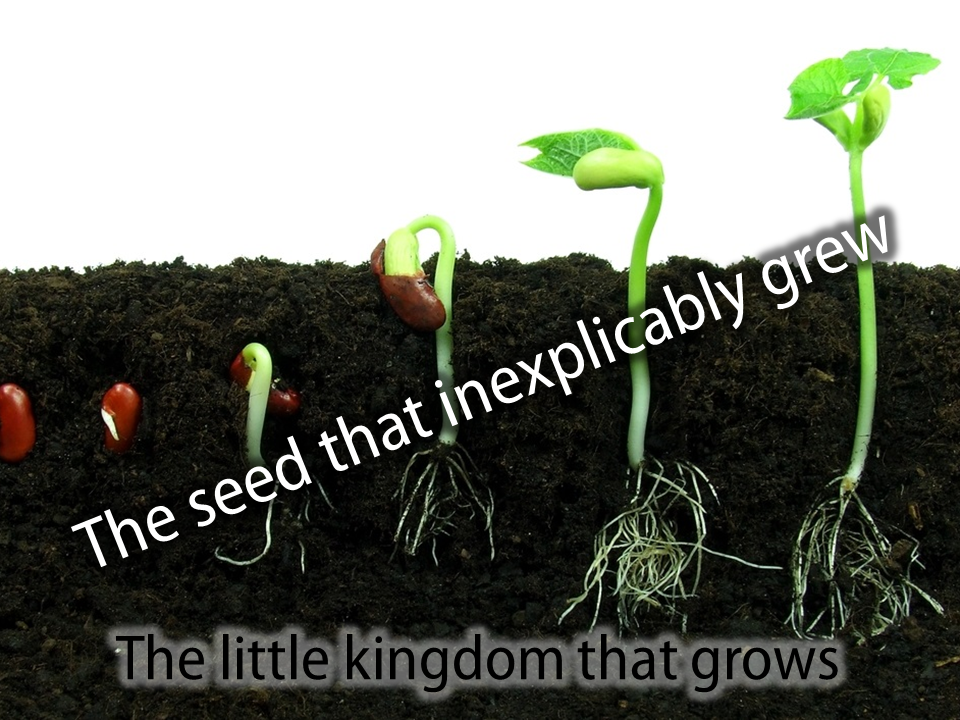
So, if we want to appreciate this parable, arguing over the size of orchid and mustard seeds is to miss the point of it completely. But what is the parable trying to teach us through this image? On one level, the point is pretty simple: Jesus is saying that the kingdom of God is something that grows in somewhat surprising ways. That is a lesson that we have actually found in all of the parables that we have been looking at all this month here at St. Andrew’s. It is a theme that runs through all of the parables of Jesus that Mark has collected together here in the fourth chapter of his gospel.
But what particular nature of that growth is Jesus trying to bring out in this particular parable of the mustard seed, and what might it have to teach us about the life of the church today? Well, for that we need to understand the things that the people who listened to Jesus tell this parable would have brought to what they heard. And for that, it would be kind of helpful to know what first-century people thought about mustard seeds?
Well, fortunately, we don’t need to guess at that. We are incredibly fortunate in that we know exactly what people thought about mustard – that we actually have a scientific treatise on mustard written at almost the same time as this gospel. Pliny the Elder’s book of Natural History tells us exactly what the received first-century wisdom regarding mustard was.
We know from Pliny, for example, that they knew the usefulness of mustard. “With its pungent taste and fiery effect, mustard is extremely beneficial for the health.” They saw it as a useful spice to add taste to food and, even more important, as a medicine in various plasters and potions that they used as folk remedies for various ailments.
They also knew that it was really easy to grow, that it grew wild, in fact, as Pliny says, and farmers had even found ways of increasing its yield by transplanting it. But there was one catch when it came to the growth of the mustard plant. Pliny puts it like this: “but on the other hand, when it has once been sown, it is scarcely possible to get the place free of it, as the seed when it falls germinates at once.”
Pliny is saying that mustard doesn’t just grow well, it grows too well. It spreads so readily that it tends to take over the garden and squeeze out any of the other fruits, vegetables or grains you may have planted. This was, in fact, common knowledge about mustard, not just special scientific knowledge. Pliny is just reporting what everyone knew.
So, did the people who were listening to Jesus know all of this about mustard? They almost certainly did. The crowd would have been full of farmers and agricultural workers who knew very well that you did not let a mustard plant take root anywhere you wanted anything else to grow. And I can well imagine that those farmers and agricultural workers and everyone else were scratching their heads and wondering why Jesus was saying that the kingdom of God was like the most notorious weed they had to deal with in their gardens and that Jesus was even putting emphasis on how extreme the plant’s spread and growth could be.
So what on earth did Jesus mean by comparing the kingdom of God to such a dangerous and generally unwanted weed? Did he just not know what he was really saying – I mean, we are told that he was a carpenter, not a farmer, after all. Maybe he just didn’t know how destructive a mustard plant in a garden could be. No, I think that Jesus knew exactly what he was saying and exactly how shocked people would have been to hear him speak of God’s kingdom in this way.
As I said, all of the parables of Jesus that are collected in this chapter of the Gospel of Mark seem to be saying the same key thing about the kingdom of God – that it is something that grows. Jesus is teaching that growth is as essential to the kingdom of God as water is essential to a fish. To apply that to the church, Jesus is teaching that, if the kingdom of God is present in a church, that church should exhibit growth in some significant ways. But Jesus is also saying that sometimes things can happen that get in the way of the growth that is natural to the kingdom. And so, in each of the parables in this chapter, he is telling us about the things that inhibit that growth.
So what could he be teaching us about what we sometimes do that prevents growth by comparing the kingdom to a grain of mustard? I believe that he intends for people to bring everything that they know about mustard plants into this discussion of the kingdom of God. He is saying that the kingdom of God will grow in this world – will grow wild and out of control just like a mustard plant in a garden and will actually overpower other cultivated plants.
So what, therefore could possibly prevent the growth of the kingdom? The only thing that could prevent it is the same thing that could prevent the growth of a mustard seed – if you never let it take root in the first place.
And, friends, I think that sometimes we do exactly that. We do recognize the explosive growth potential of the kingdom of God in this world, and we’re afraid of it. We’re afraid that it might overtake our whole lives. We’re afraid it might make us make changes that we don’t even want to consider. We are afraid that it will disrupt this comfortable little garden that we have planted by introducing into it plants that are different from what we are used to and might just take over.
First-century gardeners would have shuddered at the thought of introducing a mustard plant into their well-organized garden and Jesus was expecting exactly that reaction. He was saying that one of the things that would prevent the growth of the kingdom of God among us is our own fear of disruption and change within our well-organized lives and our well-organized churches.
I believe that Jesus wants the church to grow – wants this church to grow – as a part of the growth of God’s kingdom in this world. He wants us, like the mustard bush in the parable, to put forth large branches, so that the birds of the air can make nests in its shade. But, I wonder, will our resistance to change and our resistance to disruption be the very thing that prevents that growth? I believe that Jesus was worried about that very possibility.
#140CharacterSermon Jesus said #kingdomOfGod is like mustard seed (a swarming weed). Is he saying that the kingdom grows in disruptive ways?
An annual event where teams compete in fun-filled challenges throughout their community, all in support of local charities.
St. Andrews' Hespeler announces that the "Clothes Horses" are entered as the team to beat in the Race to Erase! Our goal is to fundraise for Hope Clothing in the annual Waterloo Region competition on October 14th. All funds donated to the Clothes Horses go directly to Hope Clothing our missional charity. Our goal this year is to raise at least $2,000.
You can make this dream come true by:
1. Enter a team of four people - ask Joni about signing up
from the homepage select "team" and choose Clothes Horses - Jean Godin and donate 100% donation goes to Hope Clothing
3. Make a pledge Sunday @ fellowship where signup sheets will be available until Oct 8th
4. phone, email or grab Rob Hodgson anytime with your cash, pledge or support 519-658-5237 or [email protected] worship most Sundays
The more funds donated the better chance a select group can ride in a limo and you may win a Clothes Horse tee as above.
The single largest donation to the team "Clothes Horse" wins a Men's Medium tee as shown above. Donate now and often all funds go to Hope Clothing 100%
Look for the donate button on St Andrews site and pick your choice of General, Hope Clothing or Memorial Fund. Current fundraising campaigns can be assigned to the General tab. eg. pay down the debt campaign. Then just follow the directions on site. Current cost $0.30 per donation - a $10 donation sends $9.70 directly to St Andrew's AND immediately sends a charitable receipt to your email address. easy, peasy and economical. This site also allows anonymous donations and monthly payments if you wish too. Credit cards, Paypal accounts and "CanadaHelps.org" gift cards.
f you have paid any attention at all to the news that has come out of Texas in the past month (and there has been a lot of news to attend to) chances are that you heard the name of one Houston religious leader mentioned more than any other. His name is Joel Osteen and he is the lead pastor of Lakewood Church, one of the biggest churches in a city of very big churches.
Osteen’s church caught a lot of flack immediately after the arrival of Hurricane Harvey and the devastating floods that it brought. People were upset with it for its failure to respond – specifically its failure to offer shelter in its large and well-appointed facilities. It seemed all the worse because the church’s excuses changed a number of times in the early days. At first they said they couldn’t offer shelter because the building was inaccessible because of flooding when it clearly was not. Then, once that lie was exposed, they went with the excuse that they hadn’t offered shelter because they hadn’t been asked when lots of other companies and religious organizations had thrown open their doors without needing to be asked.
Now I am not particularly interested in piling on Lakewood Church for what they did or didn’t do after Harvey. It was a crisis situation and, while I hope that I might do better than they did in a similar situationout needinghad been ions had been biaculcome out of th, I recognise with all humility that I might not. But I do have one issue with something that lay behind their actions. I can understand their concerns about their building and about liability, even if I don’t think they dealt with those concerns in the right way. What I don’t get, and certainly don’t agree with, is some of the theology that may have influenced some f their decisions.
Joel Osteen, you see, preaches a very particular kind of Christian message (if it is a Christian message at all) that is known as the prosperity gospel. The promise of this message is that God wants you to be rich – that it is God’s will for you that you should have lots and lots of stuff. That is what Osteen preaches week in and week out. He has also given an excellent example to his congregation of what this is supposed to look like by amassing a personal fortune in excess of forty million dollars.
There are a lot of problems with this prosperity gospel. It certainly contradicts many things that Jesus said. Anyone remember the time when he said, “Blessed are you who are poor,” for example? The whole train of thought also has plenty of potential to lead to abuse as Christian believers are taught a very particular application of the passage we read this morning from the second letter to the Corinthians: “The point is this: the one who sows sparingly will also reap sparingly, and the one who sows bountifully will also reap bountifully.”
This prosperity preaching teaches that the way you switch on the prosperity that God intends for you to have is by giving extravagantly to the church.nd up poorer and convinced that it is their own fault.eats again elng But when the generous givers fail to see the promised millions materialize for themselves, they are made to believe that it must be their own fault – that they didn’t have enough faith or they didn’t show it by giving generously enough and the cycle repeats again and again until somebody gets forty million dollars but a lot of people end up poorer and convinced that it is really their own fault.
I have trouble with this teaching for all kinds of reasons, therefore, but I must admit that I do understand why it has become so popular and why churches like Lakewood have grown so large. Who wouldn’t want to hear that God wants to give you a great deal of wealth? It is also a very pleasant when you are living in a place (such as the City of Houston a month ago) where people are rich or at least have a reasonable chance of becoming rich because the underlying assumption behind it is that, if you become rich, it must be because you have deserved it – you have earned it because of your extraordinary faith or righteousness. And who doesn’t love the feeling that good things happened to you because you deserved them?
So this can be a very successful message when all is going well. But when things fall apart completely and it is looking like they may not get back to normal for a very long time – in the aftermath of a major hurricane, for example – the prosperity gospel might fall a little short and ring a little hollow. So it is not all that surprising that Joel Osteen went through a rough patch recently in Houston, though honestly I don’t worry about him too much. I’m pretty sure he’s going to be just fine.
But there is a question about what we do with all of this. The world is a very frightening place, after all, a place where a whole lot can go very wrong. We have been reminded of that very forcefully in recent weeks – particularly by Harvey and Irma, by massive forest fires and a major earthquake thrown in for good measure. But it’s not just the natural disasters – maybe if it was just them we could deal with that – but the human ones seem more frightening in some ways. For example, the resurgence of white supremacy and even Nazism is more disturbing in many ways.
When we are reminded so forcefully about what is going wrong in the world for so many people, it can seem supremely selfish and self-centred to be concerned with one’s own needs and especially with things like personal wealth and prosperity. I understand that we would all like to be wealthy – who hasn’t dreamed of it at least once or twice – but when people are losing homes and livelihoods and don’t even have a clue about how they might get their life back – how petty does it seem to be asking God for prosperity for ourselves and expecting that God should make it a priority.
Even more important, what sort of message should we offer to the world in such times? One temptation is to be positively apocalyptic. I have certainly heard some of that recently – that these disasters are God’s payback for our sins. This message can come in many forms: hurricanes are brought on by our cavalier disregard for the environment which is directly tied to the rise in ocean temperatures that feeds extreme weather. Or others will position it as God’s punishment for our society’s immorality, assuming that God is outraged at whatever particular immorality the speaker is upset about. Racial unrest such as the resurgence of white supremacy is variously portrayed as judgement for our failure to right the wrongs of the past or for moving forward too quickly in the present.
Now, I won’t say that there is absolutely nothing to these apocalyptic pronouncements.ely nothing to these or for will tie it to ou There are lessons to be learned, I believe, in the midst of a string of disasters. If we, as a society, could actually learn that our actions (or failures to act) have consequences and that it is time to get past the short term selfish thinking that we are so famous for, it would only be a good thing. So, I get where all of this apocalyptic talk is coming from and am somewhat sympathetic to it, but I also think that it is problematic.
For one thing, I have some issues with how we chalk all of this up to God and God’s judgement because the God I have come to know through Jesus Christ takes no delight or comfort from any of it. God feels nothing but sorrow at the sight of people losing their homes or their livelihoods. God does nothing but sow tears of sadness when people are lost in hopelessness or fear – separated from their loved ones and all that is comforting to them.
I think that maybe one of Jesus’ simplest parables is a better way to approach the issue. “The kingdom of God is as if someone would scatter seed on the ground,” he said, “and would sleep and rise night and day, and the seed would sprout and grow, he does not know how.”
The kingdom of God, this concept that was so important to Jesus that he spoke about it all the time, was his way of talking about what God’s best intentions are for this world. (I know that some people often talk about the kingdom of God as if it was only about what happens to people after they die, but if you study everything that Jesus had to say on the topic it becomes quite clear that it was primarily about this world. It might continue on after death, of course, but the place where you were to encounter and enter the kingdom of God was here and now.)
Jesus called it the kingdom of God precisely because he was holding it up as a counterexample to the kingdoms that you encounter in this world – kingdoms like the one that was ruled by King Herod in his day in Galilee. And the stories and parables of the kingdom of God that Jesus told make it quite clear that he believed that God’s intentions for this world are for good and not for fear and suffering.
The kingdom was something that God would do. We could participate in it, but it was ultimately dependant on God’s action. That is what the parable of the growing seed is all about. Ultimately, Jesus is saying, our responsibility is not fix everything that goes wrong in this world. That, I think, is too heavy a burden for anyone to bear. No human can carry all the burdens of this world. But, Jesus says, what you can do is plant seeds.
When you see racial injustice – when you see people who are treating other people as if they were less than human because of the colour of their skin or their faith or their background – you cannot and should not carry years of racial hatred, misunderstanding and evil on your own back. You cannot fix all of that at once, but you can stand up. You can denounce the wrong that you see. I know that is hard for any of us to do, it certainly is hard for me to do, but to do so is to plant a seed for a better world.
When you see foolish thinking, the kind of thinking that just allows people to go on with their lives without thinking of the long-term impacts of their actions. When people are unwilling to make any changes in the carbon they produce, the pollution they leave in their wake because they cannot see anything beyond their next whim or desire, you cannot fix that. You cannot just make people willing to live thoughtfully or with a long view of what the impacts of their actions are. But you can plant a seed, by setting a better example yourself, by supporting government policies that help people to see the benefit in changing and that make it affordable for those with few resources.
You don’t have to fix it, but you can and should sow seeds and I’ll tell you why. Because you never know what God can do with a seed. Someone “would sleep and rise night and day,” Jesus said, “and the seed would sprout and grow, he does not know how.” Of course, we today understand a whole lot more about how seeds grow than people did in Jesus’ day, but the point that Jesus was making still stands. You don’t have to know how the kingdom of God grows among us, you just have to plant the seeds and leave the growing to God because that is always how the kingdom of God always works.
God doesn’t want you be wealthy. God doesn’t want you to be miserable either. God doesn’t want you to lose everything you have ever relied on either. God doesn’t ever want those who don’t follow in his path to suffer in great torment for it. Those ideas are all a perversion of the Christian gospel.
What Jesus does want is for you to plant whatever seeds you can in this world – to stand up for what is right and just, to challenge evil, to engage in initiatives to make the world a better place. Most of all, Jesus wants to teach us to trust in God who can take whatever seeds we do manage to plant and make them grow in this world in ways that we could never even have imagined.
The 4th Annual Race to Erase is back on October 14th, and you can help support a great local charity. Grab three friends, family members or co-workers to form a team of four today. Teams choose which charity they would like their funds to support and all the money raised goes to that local charity - 100% of funds received! Prizes are handed out to the top fundraisers.
On Race Day teams travel throughout their community, competing in a series of fun-filled challenges along the way. The team that finishes the challenges in the fastest time is crowned the Race to Erase champion. Note: this is not a running race! The challenges are a combination of savvy and smarts - no goofy shorts required.
Just a heads up - this will be sent to Session in October for consideration
The M&O Committee has finalized the details for St Andrews’ international mission trip for 2018. We are recommending a co-ordinated mission trip through the Presbyterian Church of Canada. The bulk of the details inclusive of: travel, food and lodging, visa’s, insurance and many other details in Malawi, will be handled by the PCC. This co-ordination allows St. Andrews to join an existing ministry that offers greater security for travelers and out-source the logistical details to the professionals. In compliance with St. Andrews Mission trip policy we are recommending that Session review and approve this offering.
any years ago, I spent a summer in the state of Kerala in South India where we spent a fair bit of time way out in the hill country far from any cities of any size. We stayed with some local people – members of a local Christian church – and it was a very eye opening experience. The region is relatively well-off compared to many areas in India, but it certainly seemed, to our western eyes, as if there were many people living in great poverty. Indoor plumbing was rare. The water was mostly unsafe to drink and, while there was electricity, it was very unreliable and would go off for long periods of time.
For a while, we stayed in a simple farm on some rice fields. At night when the electricity was out, it got incredibly dark. We didn’t have flashlights (we hadn’t thought we would need them) so when we had to go anywhere at night (like, for example, to the bathroom which was in the field) we would generally take a candle with us. And I learned a few things on those nighttime walks that have very much stayed with me ever since.
ny people living in
My first lesson might seem a little bit obvious, but I think that it needs to be said. The first thing that I learned while heading out over unknown and uneven fields in the pitch dark was that a lit candle was extremely valuable. The difference between going out there with a candle and going without one might mean getting completely lost, maybe falling and twisting an ankle or falling into an irrigation canal. At that moment, nothing was more important to me than being able to keep that candle lit.
The second lesson was a bit of a surprise to me. When we went out into those fields, our first instinct was to do what you might do with a flashlight or like what you see in an old movie where someone carries a candle. You want to hold the candle up right in front of you like this. I learned very quickly that that did not work at all.
The problem with doing that is obvious if you think about it. If you hold the candle in front of you, that means that all you can see is the flame. Everything else is completely dark and, in comparison, the flame is impossibly bright. Your night vision is completely ruined by the light in your eyes and you cannot see anything else. So you very quickly learn that you have to make sure that the candle shines anywhere but towards your eyes. One way to do that was to hold the candle up over your head or to the side so you were looking away from it.
But my favourite solution was the one that was shown to me by the people who lived there. You would pick up a broken coconut shellad or to the side so you were looking away from it. But my favourite solution w (they were everywhere) and hold it over the candle between you and where you were going. The locals called it a “Kerala lamp.”Kerala lamp."nd where you were going. The locals called it a "ay from it. But my favourite solution w It worked really well and had the added advantage of blocking the wind somewhat from blowing out your candle.
Now, if you had lived centuries ago – before electricity and at a time when candles and lamps were rare and expensive and difficult to light because there weren’t even any matches, you would probably know everything that I had to learn about walking with a candle at night. But you and I have lived all our lives in a very different world. We may have used candles and even oil lamps before, but because we have always lived in a world where you don’t usually have to depend on such things to actually find your way in the dark, there is a sense in which we don’t actually know how they work even though we may think we do.
That means that, when we hear Jesus talk about lamps and what to do with them, it may not be quite as obvious to us what Jesus meant by what he said as it was to the people who first heard him say it and who never saw an electric light in their life.
For example, when Jesus said, “Is a lamp brought in to be put under the bushel basket, or under the bed, and not on the lampstand?” They would have immediately understood how important a lamp could be. These were people who lived almost half their lives in the light and the other half almost completely in darkness. When the sun came up in the morning, they began to live and work. But when the sun went down their world went completely dark. Yes, they had lamps, but every moment they kept a lamp lit meant burning precious oil that represented many hours of labour growing, picking and pressing olives. It was also oil that, if it wasn’t burned up, represented an essential part of their diet. Every ounce of oil burned was oil that could not be eaten. So you can be sure that these people did not light their lamps lightly or without reason.
Light in the darkness – something that we pretty much take for granted – was something extraordinarily precious and rare to them. And when Jesus started talking to them in a parable about lamps and what to do with them, they would have immediately assumed that he was talking about something very precious and rare.
The thing that Jesus was comparing to a lamp, I think it is clear when you look at the whole context in the Gospel of Mark, was the good news message of the kingdom of God – the message of God’s grace and love and what we do in response to that message. So the people who heard him talk about this lamp would have understood that to receive the message of the gospel was a precious and rare gift.
I wonder how much we recognize how very valuable the knowledge of that message is. We have been told certain things about God and how God deals with humanity. We have been shown, in the person of Jesus Christ, that the power of love is able to overcome the greatest and darkest powers in this world. Do you realize how many people in our society today have no access to such good news – who are simply living out their existence with no reason to hope that anything might ever change in this world?
Now, I am not one to go around saying that we, as Presbyterian Christians, have exclusive access to these truths. I tend to believe that they are truths that God reveals to various people in various ways in our world and that people can perhaps even come to them by various paths and even through different faiths. But I would definitely agree with the sentiment of our reading this morning from the letter to Timothy: “Do not be ashamed, then, of the testimony about our Lord.” We have received a testimony about the God revealed by Jesus Christ that we should not hesitate to be proud of. It is a message that has the power to change lives for the good – even to transform the world. That is the light that we are talking about in this passage.
So the question now becomes, if we have this light, what do we do with it. Jesus says, “Is a lamp brought in to be put under the bushel basket, or under the bed, and not on the lampstand?” Now the very idea of lighting a lamp and then hiding it underneath a basket or a bed is perfectly ridiculous and Jesus knows it. First of all, there is a practical problem that if you put your burning lamp underneath a woven basket you will probably catch the thing on fire and end up burning your house down. But, even more than that, what would be the point of lighting a lamp, burning up your precious oil, and then not even allowing it to shine on anything? It would be a stupid waste of resources.
So what does Jesus mean when he says that you would never do such foolish things? What is he trying to say about the message of the good news about God? That brings me to the second lesson I learned wandering around the pitch black hills of Kerala in South India with nothing but a candle to guide me. I learned that a candle you hold out in front of you as you walk is as good as useless. In the blackness, if you can see the flame of your lamp, you cannot see anything else. In other words, the candle is only really helpful if it shines on other things and people, not directly on you.
I believe that this was the truth Jesus was trying to get at by talking about hiding your lamp once you had lit it. He was pointing out the simple fact that the only reason you would light a lamp was if you were going to let it shine on something. It needed to shine on your book or on your path or on the thing that you were working on or there was simply no point in lighting it at all and it was merely a waste.
What that means in terms of the church and that whole task of being the light of the world is that this incredible message that we have of God’s grace and love and renewal needs to shine on something other than us or we will be guilty of squandering and wasting it.
But let me ask you, how do we usually let the light shine in the life of the church? Most often, I would suggest to you, we do it like I held up the candle the first time I went out walking in the rice fields at night. We hold it up right in front of us. We see this amazing light, we celebrate and worship God for it, and we revel in how God has loved us and saved us and given us reason to hope.
All of that is well and good as far as it goes but there is a problem. So long as you are holding up that light before your own eyes, it is all that you can see. You blind yourself to everything but that light. You cannot see, for example, the struggles that other people are going through, you cannot see the injustices that they have to deal with. And that is precisely the problem that we seem to run into far too often in the church today – the suffering that people outside of the church go through becomes invisible to us. I think that that is what Jesus means when he talks about putting your light under a basket – it means shining the light in a way that it really only shines for your own sake.
What does it mean for us to be the light of the world in the church? It means that we are not meant to keep this light – this message – to ourselves. Instead of shining it in our own eyes, we must hold it up above our heads so our eyes are not on the light but on the world that God so loved. And when we are tempted to keep it only for ourselves and use it only to serve ourselves, we must grab hold of a coconut shell, and set it between us and the light forcing ourselves to look elsewhere. The coconut shell is the example of Christ who came to live the message of life, not for his own sake but so clearly for the sake of everyone else that he laid his own life down in its service.
As you go out into the world following the service today, therefore, I would invite you to take with you the light of the knowledge of Christ that you have obtained in this church and throughout your Christian life. But carry it like this – like a Kerala lamp – so that you may allow the love and grace, forgiveness and hope of Christ to shine on others before it shines on yourself. I’ll warn you, that may mean that you find yourself thinking about the needs of others before you think of your own needs, that you may spend more energy on compassion than you do on judgement and that you maean for us to be the light of the worldhat Jesus means when he talks about the ligng through, the y feel more deeply the struggles of others that you observe. In other words, you might just become more Christlike.
#140CharacterSermon Jesus’ teaching about the lamp under the bushel means we must not let the light of the gospel shine only for ourselves.