m I the only one who reads this morning’s passage from the Gospel according to Matthew and just wishes that everybody would just calm down a little bit? We have, in this passage, a parable of Jesus – a story of a dinner party. In this case, it is a wedding feast given by a king in honour of his son. The basic premise of the story is simple enough. The host of the feast wants lots of prominent guests and so he invites a large number of important people. The twist comes when none of the important people are able to attend the meal and the king kind of panics because, in that society, to give a feast and have nobody show up would reflect very negatively on the host. He ends up packing his dining hall with all sorts of undesirable people in the end.
And that is, basically, the parable that Jesus did tell to his disciples. In fact, if you were to turn over to the Gospel of Luke you would find a version of this same parable where that is all that happens. I have always preferred Luke’s version of this parable for that reason. The story is simple and straightforward without anything extra going on. I’ve always kind of avoided Matthew’s version of the parable because everybody in the story seems a little bit crazy. They all overreact.
We have, first of all, the guests who are first invited to the feast. The king sends his servants out to deliver the invitations because, of course, this was before the days of the internet when you can invite a bunch of people to your party with a few emails and Facebook messages. And the people who receive the invitations, just like in the parable in Luke’s gospel, are unable (or perhaps unwilling) to come. Now, I don’t know about you, but I was always taught that if you are invited to go someplace and you cannot attend, you politely say that you are very sorry. You return the RSVP with a friendly note that expresses your regrets. Is that what these invitees do? No they do not.
They seize the servants who bring the invitations, turture and kill them! I don’t care how much you don’t want to go to a dinner party, there is absolutely no way that murder and torture is a reasonable way to communicate that to your host. So yes, I really wish that the invitees would just calm down a little bit.
But then, as I continue reading, I’m not sure that the king’s reaction is all that much better. The king is upset at how the people he invited to his party treated his servants. That is understandable. But his reaction is very much an over-reaction. He doesn’t just punish the murderers, no. He gathers his troops, attacks the entire city where they live and burns the place to the ground. That is definitely overkill.
So we go from a bloody RSVP to an even worse response on the part of the king. After that, however, the whole thing just becomes bizarre. The king has just filled his banqueting hall with whoever the slaves could find – a crowd that is described as including “both good and bad.” It is clearly a mixed bag and he knew that when he invited them to come in. But then the king comes across one of these guests who is, in his estimation, not appropriately dressed. Well what did he expect?
Nevertheless (and we really shouldn’t be surprised at this point) the king overreacts. He kicks the inappropriately dressed guest out of his party but he’s not even content just with doing that, as excessive as that might seem. No, his instructions are, “Bind him hand and foot, and throw him into the outer darkness, where there will be weeping and gnashing of teeth.” Once again, how is this an appropriate way to respond to the minor ettiquet breach of somebody being underdressed at a party?
So there seem to be all kinds of problems specifically with how this parable is told in Matthew’s gospel. Did Jesus have two wildly different versions of this one parable – one where people acted in a fairly reasonable fashion and one where everyone acted a little crazy – that he told on different occasions? And then did Luke copy one version into his gospel while Matthew copied the other?
That’s one possibility, but it is more likely that, when Matthew wrote down his version of this parable, he was trying to help his readers by making it clear to them what his own understanding of the parable was. And Matthew, plainly, saw this parable as an allegory. An allegory is a special kind of story in which every element represents something else. So, in Matthew’s mind, the king, in this parable represents God. The people invited to the feast are the Jews whom God has invited into his kingdom. The servants are the prophets who bring God’s message to the people of Israel and so on.
When you read it as an allegory, the strange overreactions make a lot more sense. The way that the invitees abuse the messengers is so crazy because it is supposed to represent how the nation of Israel historically rejected God’s message by abusing and killing the prophets.
And by the time that Matthew wrote this gospel, the City of Jerusalem had been destroyed by the Roman army and so Matthew even states that this parable predicted that terrible event by including the destruction of a city by troops in his allegorical interpretation. Again, an event that makes little sense if it is an attack provoked by an impolite response to an invitation to a party but that makes a whole lot more sense if you see it as the consequence of an entire nation rejecting the message of God that was brought by the prophets and by Jesus the Christ himself.
So that is one thing that is going on in this passage: Matthew is turning Jesus’ parable into an allegory. But that particular allegory does not especially help us to understand the part at the end of the parable where the guest is thrown out of the party because he is not appropriately dressed, so let me point out something else about the way that Matthew tells the story. Did you notice one very particularly annoying pattern of behaviour in this parable? Did you notice, in particular, that nobody seems to be able to accept a gift or to be the recipient of generosity?
I mean, the people who are invited to the wedding feast, their invitation was essentially a gift. They were turning down nothing other than an evening of good food, entertainment and conversation. And yet they set the whole story off its rails by being unwilling to receive a free gift and doing so violently. What’s more, I would suggest to you that the man who is not wearing the wedding robe at the end of the story is essentially doing the same thing.
We do not know what all of the customs were around wedding celebrations in ancient Biblical societies, but we can be pretty sure that there were a lot of them. And some people have suggested that one of the customs at important weddings may have been for the host of the wedding to provide his guests with fancy robes to wear at the wedding. If that was the custom, then everyone who heard this story would have seen the man who is not wearing the wedding robe in a very different light.
It is not that he doesn’t have appropriate clothes to wear; he has been provided with the appropriate clothes. It is just that he has refused that gift, perhaps because he thinks that his own, dirty and everyday clothes are good enough. When you look at the parable from this angle, it seems to be all about people who have a hard time accepting generosity from others.
And you wouldn’t think that should be a problem, would you? After all, every single one of us has had times in our life when we were unable to meet all of our needs by ourselves. We all have had times when we get by with a little help from our friends. And given that that is something that literally every human being will have to deal with at some point in their life, you would think that it wouldn’t be hard for anybody to accept generosity from somebody else.
But it is. I’ll bet every single person here knows somebody who just can’t stand to receive a gift or a generosity. You all know people who, if you try to give them something or do something for them, they will drive you crazy trying to stop you. Maybe some of you are like that yourself and you just cannot stand being on the receiving end of a gift.
Why do people do that? Why do we have trouble accepting the help we need when we need it? Part of it is that we believe that we are supposed to be entirely self-sufficient in all things and that, if you are anything less than that, you must have failed in some way. Even if you find yourself in a position of need because of something that was entirely out of your control, you are still made to feel that it must, in some way, be your own fault and so you resist accepting help or, if you absolutely have to take it, you do everything that you can to cover up that fact.
If you are involved in the outreach ministry of this church, or most any church, this is something that you run into all the time. We have the privilige of being involved in giving people things – things like food, clothing, good nutritious meals, counselling – that they would not be able to get otherwise or, in some cases, they would have to give up something else that they also needed in order to obtain it.
And, I’ve got to say, it is a real privilige to be able to be involved in this kind of ministry. The people involved genuinely enjoy being able to give these things away and we also enjoy the people that we give them to. But, of course, few people enjoy havingto receive in this way. Few people want to come in and access the services that we offer. Over time, the people that we serve become our friends and they enjoy coming here because our workers and volunteers create a warm and hospitable atmosphere.
And it is good that we help people to learn to receive because I would suggest to you that none of us can ever achieve our potential as followers of Christ, or as human beings, if we do not learn to receive. We cannot even be followers of Jesus without learning to receive from Christ. Our salvation, our hope and our new life in Christ are all things that we cannot make happen for ourselves. We can only receive them as gifts from God.
The robe in the parable, the robe that the guest refuses to wear, has often been seen as a symbol of those gifts from God. It is the robe of righteousness and salvation and new beginnings and we do not have the capacity of wearing such robes by providing them ourselves. We can only receive them from the hand of God. God gives these things freely but we, foolishly, often have trouble receiving them. We would like to think that we are good enough and strong enough and capable enough to achieve all of these things on our own. Like the guest at the party, we insist on wearing our own robes instead.
But the lesson of the parable is that if you do not learn to receive from God when you need to receive from God, you do not belong at the party. And I don’t actually even think God needs to cast you into the outer darkness where there is weeping and gnashing of teeth because you have already cast yourself out of the party by a simple refusal to receive a gift freely given. It is that important to learn to receive. Our very salvation – our potential to be all that we are meant to be in this world – depends upon it. And one of the ways in which we learn to better receive from God is by practicing receiving from others.
Therefore, I would encourage you, this week, to do one simple thing to deepen your walk with God. This week, when somebody offers to give something to you or do something for you and doesn’t want anything in return, just take it. Receive that gift and do it without feeling guilty for receiving. Receive it, without it hurting your pride. Take it without plotting to pay them back in anyway. Just receive it. Just practice gratitude and say thanks. If you are unable to do this, try to get to the bottom of why you can’t. Receiving can be just as important as giving. It is an act of grace. Practice receiving grace from others and you may just find yourself able to receive more from God and starting to grow more into the person that God has called you to be.
#TodaysTweetableTruth Ask yourself why u have so much trouble receiving from others. Receiving can be just as necessary as giving sometimes.
On May 1, 2016, St. Andrew's Hespeler will be holding an election of deacons and elders for the congregation. We have been working hard this week to prepare packages for all the members to facilitate this process. Thanks to everyone for your help in preparing the elections. In particular I would single out for thanks to our temporary roll clerk, Joni Smith, who did her very best to make sure our roll was up to date and nobody was left out and Isabelle who was wounded in the line of duty with a paper cut!
id you notice that nobody asked Peter to do anything? Peter was in Lydda when a highly respected and well-loved woman named Tabitha died in the nearby town of Joppa. And people had obviously heard something about Peter. He had a certain reputation for healing and for miracles, so they sent for him with an urgent request that he come, but that was the whole content of the message. They didn’t tell him that he was supposed to heal her (it was kind of too late for that anyways). They didn’t ask him to come and doanything – just come, please, as soon as you can.
And when he came, even then, they didn’t actually ask anything of him. They just took him to an upper room where they had laid out Tabitha’s body but they don’t even seem to have pointed her out to him. No, what Peter actually saw and noticed was not her body but a room full of weeping widows. They didn’t say anything, they just wept and showed him their clothes. And that is why they didn’t need to ask him to do anything. The clothes actually spoke much louder than any words ever could have.
The story of Tabitha in the Book of Acts, makes me ask, first of all, one immediate and very important question. If you were Tabitha, what would the widows show to Peter?
I am often called upon, as you would expect, to speak at the funerals of people who have passed away. I have always found it to be true that every person’s life has something profound and beautiful to say to us at such times and I do see it as a great honour and a privilege to be the one who gets to point out some of those profound and beautiful things.
But I have also noticed that there are often things that are deeper and stronger than words at times like that. They are objects or actions that hold special symbolic meaning and they often will prove far more enduring than the words we say about someone who has died. People will cling to something that the deceased gave to them or did for them and find great comfort in that. That was what those widows were doing when Peter arrived.
Widows are, in the Bible, kind of the stereotypical poor person. They were seen as the most helpless and needy people in all of society. Of course, there are problems with that stereotype. I would never be so foolish as to think of a widow (or any woman unattached to a man) in such terms today! In fact, some of the strongest and most capable people I have ever known have been widows or other women who, by choice or by circumstance, navigate this world without a husband.
And even the ancient perception that widows were helpless actually had nothing to do with the capabilities of individual women. It was just that, in that society, women were not permitted to make their way in the world without a dominant male controlling them. They were not allowed to participate in the economy in any honourable way and so they were forced to be utterly dependant on charity.
So these women in Joppa may have been very strong and confident women. They may have even been practicing the freedom of the Christian gospel by choosing not to be married. But they lived in a society that did not allow them to make their own way apart from a dominant man. These women, because they broke the conventions of society, became dependent on the community of the church.
And Tabitha, had been particularly generous to them. But it obviously wasn’t just the fact that she was generous that had moved them. She had made these clothes with her own hands. Her generosity to them had been personal, caring and individual. That’s what made the common, everyday tunics and dresses and robes they were showing to Peter absolutely priceless in their minds. These tunics represent to them everything that summed up Tabitha’s kindness, goodness and love shown to them.
And I don’t know about you, but if that were me and I had died or moved on in some other way, I just think it would be really nice if, after I was gone, someone could just hold up something and point to it and say, “This is something that tells me that Scott was here and that his presence in this place mattered.” So it is a really good question to ask, “what tunics would people show to Peter after you were gone?”
But actually, I have a much more urgent question to ask here today. The story of Peter and Tabitha is a terrific story to read just after Easter because it is a story of resurrection. Maybe I should have said, “spoiler alert,” before bringing that up, but we did actually read the story and you heard how it ended. Tabitha didn’t stay dead. So it would be very easy to take this story and apply it to our post-resurrection hope as followers of Christ.
Certainly one of the reasons why the early Christians remembered and repeated this story was because it reminded them of their Easter hope in a life after death. The life after death that we hope for is not exactly what happens to Tabitha. We don’t expect Jesus to restore us to thislife again after we die, but rather to a different kind of life in a new place that we can scarcely even imagine. But what Peter does for Tabitha is a symbolic reminder of that hope for life after death.
But there is, I think, another way to read this story as a story of resurrection. After all, it is not just people who die. Groups and organizations and institutions, they can die too. And, as a matter of fact, we are living in an age when institutions are passing away more quickly than ever before. Churches and congregations, in particular are affected by this and they are passing away (or amalgamating or changing to such a degree that they are unrecognizable) at an unprecedented rate today. So would it not be a good question to ask, as believers in the power of resurrection, what is the hope for resurrection for our churches and Christian institutions?
If your church were to die (or go through a radical change that might feel like death) what would you like to leave behind from its life right now that would tell the world that it was worth being here? Now, I know that when we think of our churches and the things that make them special to us, we tend to focus on the things that have been meaningful to us personally. We talk about our beautiful buildings and sanctuaries. We talk about memorable moments in worship services and about the things we have done there with our friends. We also have a certain tendency to go on and on about past glories and to celebrate the way that things used to be.
Of course, there is nothing wrong with loving these things about our churches. But the story of Tabitha makes me wonder, when our congregations are dead (or when they are transformed in coming years) what will make people remember them as they were and believe that they were important? This story makes me think that it may not be the buildings or the activities or the musical moments. What if, in the end, what really matters are the pieces of clothing.
I can think of this quite literally because we have, in this congregation, a clothing ministry called Hope Clothing where we are regularly handing out really good quality used clothing to people simply because they need it and can make good use of it. So I do know just how meaningful such a simple act can be. I am in the church often enough when people come in and bring their donations of clothing. Just knowing that it is our intention to give it all away according to need means a great deal to people in the world today – a world where used clothing has become a big business that creates large profits for some.
I also get to hear the stories that they tell me as they bring the clothes in. Not too long ago, I had a woman come in bearing the clothes of her mother who had passed away recently. She joyfully and sorrowfully (it’s amazing how the two of them can go together sometimes) told me very sacred and holy things about her mother and her sense of style and how she dressed and some of the things she had struggled with over recent years. I know without a doubt that it was a healing moment for her to be able to share her mother’s clothes and her stories in that way. And providing that opportunity is absolutely something that will last long beyond the present state of this congregation.
Of course, I also get to be part of it when people come to take the clothes that they need. We could tell you so many stories of people finding just the right piece of clothing at the right time in order to go to a job interview or a wedding or some other really important event. We could tell you stories of the right piece of clothing showing up as a donation only minutes before someone comes looking for that very thing. It is a little shop where minor miracles happen every week. Sometimes you know you’re participating in a miracle when you are just there and ready to respond when someone comes up against an emergency – a house fire, a situation of abuse or whatever it might be.
And let me tell you, if someday our congregation should cease to exist and the Apostle Peter were to drop by and ask me what really mattered about St. Andrew’s Hespeler, I think we could do a lot worse than to show him those pieces of clothing that were shared and the impacts they had on people’s lives. I know he would be moved by that. And of course, it is not always literally clothing but it is the acts of kindness that manifest themselves in concrete things that are shared with others.
For example, last week I preached this sermon at St. Andrew’s Church in Guelph and they don’t have a clothing ministry. They are, however working diligently towards welcoming a refugee family into Canada. I promised them that the concrete things that they do for that family will be of eternal value and will indeed endure beyond the present life of their congregation.
So I hope that this story of Tabitha might make us re-evaluate the things that we feel are really important about our churches and ask ourselves what we really need to spend our time and energy investing in as congregation. Maybe it is time for some of those priorities to change.
But remember that I said that this is a post Easter story. It is a story of the power of Christ’s resurrection and what it can do for us in our churches today. And I do see us living in an age where death is a real possibility for our congregations. Please understand, however, that I am not, in any way, predicting the death of St. Andrew’s Guelph or St. Andrew’s Hespeler. In neither case do I see that as a likely possibility and I am not here as a prophet of doom today.
But I will tell you this: we are living in days of great change for the church. We have a Lord who will not abandon his church in these days. Christ will be with his church through whatever change may come. That’s the good news. The somewhat more troubling news is this: Christ has a particular strategy for renewal in his church and in his people’s lives. And it is not a strategy of incremental change that never makes us feel uncomfortable. Christ’s favourite strategy for change is death and resurrection.
For me that means that maybe even many of our strongest and liveliest churches may be heading for a Tabitha moment – for a time when it may just feel like we have been washed and laid out in a room upstairs and that we are done. I fully expect many of our congregations to deal with moments like that in coming years.
Why would God allow us to go through such painful moments of loss? Not because he has abandoned us. He will send for Peter to come and raise us up again to new life and new beginnings. Christ will not abandon his church. So why would he put us through that?
Well maybe, just maybe, it’s because he wants us – like those widows in Joppa – to realize what really matters about who we are and what we do as a church together.
#TodaysTweetableTruth The widows showed Peter Tabitha’s tunics proving she had mattered. What would they show him after yr church was gone?
Hope Clothing is a key ministry at St. Andrew’s Hespeler and a wonderful resource for our community. Open three days a week on Tuesdays, Wednesdays and Thursdays, we are there to give out clothes, accessories and footwear to every member of the family. We carry a wide range of sizes for babies, children, men & women. If we don’t have something in stock we do our best to find whatever is needed. In the winter we have a good selection of winter coats and boots.
One of the things that makes Hope Clothing great is that it is not a work that stands alone. It is a part of a much larger circle of hope and care that provides a powerful way for us to Live in Christ and Share His Love. This circle includes:
The Thursday Night Supper and Social: From mid-October to the beginning of April, every Thursday evening, we serve a wonderful, nutritious, home made meal to anyone in the community who would like to enjoy some good food and a safe place to visit with friends. This meal helps people in our community stretch their budget while enjoying a friendly and supportive time of fellowship.
The Cambridge Self-Help Food Bank: St. Andrew’s Hespeler hosts the food bank on every second Thursday. Recently the Food Bank did a survey of its services and the Hespeler site received an extremely high rating because of the ways in which Hope Clothing and the other ministries at St. Andrew’s work in synergy with that service. Thanks to this excellent review, the Hespeler site will be receiving more resources to better meet the growing needs of our community.
A-A, Al-Anon, Al-Ateen: St. Andrew’s is the only site in Cambridge where all three groups meet together which offers another wonderful mutually supportive circle.
Cambridge and North Dumfries Counselling: Being able to provide professional counselling to those in need of it one day a week is a wonderful addition to this all-around ministry.
Hope Clothing is maintained with a minimal budget and is not directly supported from the general funds of St. Andrew’s Hespeler. We are definitely on the lookout for ways to continue to support this work, financially and otherwise, to maintain its viability into the future.
Visit standrewshespeler.ca for more information about Hope Clothing and Hespeler's Place of New Hope and to find out how you can help to sustain it.
Here is yet another story that illustrates how important and meaningful the work of Hope Clothing is:
Would you help us share the story of Hope Clothing and what it means. Go to the following link and then click "Share" for various ways you can help us to tell the story.
Note: I have created the backstories of Mary and Joanna that are featured in this sermon. My speculation on these two characters began with the introduction of these disciples of Jesus in Luke 8:2-3 and has spun off in some interesting directions as I have been working on a future book that may be titled something like “The Seven Demons of Miryam of Magdala.”
Luke 23:50-24:3, Luke 24:13-32, Psalm 118:1, 2, 14-24
M
ary Magdalene opened the package of spices and ointments that Joanna had brought back from the market and inhaled deeply. She was suddenly overwhelmed by the scents: cinnamon, cassia, balsam and resin. She could even smell the small amounts of frankincense and myrrh that her dear friend, Joanna, had only been able to afford by selling the very last pieces of jewellery that she had plundered from her abusive husband, Chuza, when she had fled his household to follow Jesus.
It smelled beautiful, but it was also emotionally dangerous for her. Smell is a powerful trigger for the memory. The part of your brain that processes olfactory information is only separated by a few synapses from your amygdala which is the part of your brain where your most powerful and emotionally charged memories are stored. That is why sometimes just getting a whiff of some scent that is connected to your past can transport you back to events that you may have thought you had completely forgotten.
And there was no question that the smells of these spices and resins were connected to many traumatic memories in the lives of all the women who were there in that room. Mary herself was instantly transported back to the day when her intended husband was drowned while fishing on the Sea of Galilee. She remembered the deep grief and confusion that she felt as they carried the body of her promised husband to his family tomb outside the town of Magdala. At that moment it had seemed as if her entire life had been over and, in a very real sense it was.
Beside her, Joanna was reeling from the fact that the same smells had taken her back to the day, so many years ago, when she and her servants had laid to rest the tiny, stillborn body of her only child. She was suddenly filled with a grief that was so raw that it was as if no time had passed at all. And the same was true for every woman who was present as each one of them felt as if a scab had been ripped off the poorly healed wound in her life that had formed when she lost someone whom she loved: a parent, a child, her sibling or cousin or best friend. Life in Galilee could be very brutal indeed. Their new grief at the loss of their teacher, Lord and friend mixed and mingled with so many old griefs.
There was a reason why they all reacted so similarly. Women in that culture had very well defined roles and duties around death. When someone died, everyone always automatically looked to the women to do what needed to be done. They sang the laments and songs of grief. They told the story of the person’s life and death. They led the procession to the tomb. Most especially they washed and prepared the body with the traditional mixtures of ointments and spices and wrapped it in the linen cloths.
Everyone (even the men) agreed that men just weren’t any good at that kind of thing. So heavy were the expectations of so-called “manly” behaviour placed upon them that men could not express emotions like grief or sorrow in any sort of helpful way. So it was always left to the women – one of the few places in public life where they were actually allowed to take a leadership role. So they had all done it so many times before.
It was somewhat distressing to the women that they had not been permitted to prepare the body of Jesus for burial – that a man named Joseph, a secret ally on the council – had taken care of it by quickly wrapping the body in linen cloths and stowing it in some tomb that had no connection with Jesus’ family. But there was no helping that. Not only had there been no time to do things properly as the sun was setting and the sabbath was about to begin, the situation was also far too dangerous for any open displays of grief on the day when he was crucified.
But the women were determined that they would do whatever they could to make it right. A lot of people have wondered why the women would have returned to the tomb where Jesus had been laid on the third day and why they would bring with them the spices and ointments that were commonly used to prepare a body before burial when he had already been buried, even if hastily so. It is not as if they could have unburied him in order to do it all over again. Even if it had not been for the large stone covering the tomb and forming an impossible barrier, such an act would have unacceptably disturbed the dead.
But we do know that there was a custom in many ancient Mediterranean societies – and in ancient Palestine as well – of a special visit to the grave that took place on the third day following a death. It was a celebration that was led, like all other activities around death, by women. The mourners would go out to the tomb where a beloved friend or family member had been laid and they would take with them a simple meal: bread, wine, maybe some fish and olive oil. These things would be taken as a special gift to the dead, so it wouldn’t be all that surprising if women were to take as well such things as burial spices and ointments.
But the point of the third day gathering by the tombs was not merely to honour the memory of the dead with gifts. There was a belief, common among many cultures and, the evidence suggests, also among first century Jews, that when they gathered to share this simple kind of meal by the tomb of a beloved friend or family member, the dead would join with them in that meal. This was something that all of the women who followed Jesus from Galilee would have experienced before. They had gone with other women to tombs and experienced the presence of the dead on the third day.
What exactly had they experienced previously, I suspect, would have been something like the kinds of experiences that people still sometimes report to this very day. I have often had people tell me about the ways that they were comforted after losing a loved one – how they just felt the presence of that person watching over them or saw something that confirmed to them that their beloved was still with them in some very important way. These are not unusual experiences. Many have had them following a death. People doubt such experiences, of course, because it is notoriously hard to prove any very personal experience, but many have been greatly comforted by these things that reassured them that their loved ones were still with them.
So it wouldn’t really be that surprising if these women were preparing to go out to the tomb and minister to their dead Lord and friend with an expectation of finding some kind of reassurance of his presence. They packed up the spices and ointments, some bread and wine and the other elements of a simple meal and they waited for the dawning of the third day. But it seems that they were about to get more than they had bargained for.
The women who went out to visit Jesus’ tomb at the dawning of the third day had all experienced grief and loss before. Everyone in that society agreed that grief was women’s work. So it was all so very familiar to them – the feelings, the smells, the songs that they sang and the atmosphere. And, given that human life was cheap in Galilee, they had all doubtlessly lost people that they loved. It had been very personal before.
But this was different. Jesus hadn’t just been a friend or a teacher to them. He had been a reason for them to start to live again. He had given them hope that things could actually be different. And so, as they headed out to the tomb to share a meal there and bring offerings for the dead, they may have expected to experience the presence of their now-dead Lord in the same way that they had experienced it before for their other loved ones, but surely they were hoping for something… more.
Christians believe that they did experience something more than the commonly experienced reassurance of the presence of the dead. What exactly happened to them would be impossible to describe precisely because even the Bible has a hard time pinning it down. There are four different accounts of what those women experienced at the tomb in the Bible and not one of them agrees in all the details with the others. But I don’t necessarily think that that is a problem because what these passages are describing are deeply personal experiences that changed the lives of the women who had them irrevocably. It wasn’t just about what they saw and felt and heard and touched, it was about what all of that meant on a very personal level.
I imagine, though, that they arrived at the tomb and they told, one more time, the story of how he had died and what his death meant, just as it would continue to be told whenever the church gathered in the years to come. And then, as was traditional at these sorts of third day gatherings, they took some bread and they broke it. And how could that not have made them think of him – not only because of the last meal he shared with this disciples but also because of how he loved to gather and eat with all sorts of people and especially with outcasts and sinners and all the other people that everyone else rejected. That act alone must have made it seem as if Jesus was very near.
But there was more to it than that. As they took the bread and shared it, as they drank wine from a common cup, they knew that he was there – not just in their memory (though, of course, he would always be there), not just in spirit as they may have experienced it with others they had lost, he was there in body, in whole person. Most of all, he was there in reality. It was like the realest thing that any of them had ever experienced.
And that experience, my friends, is the basis of our Christian hope. I believe that those women experienced it there outside his tomb on the third day after his death. That was when it all started. That is not to say that they immediately understood everything that they had experienced. I wouldn’t be surprised, in fact, if it took them years to really put it all into words that could even make sense to people. And, of course, it wasn’t just that one time outside his tomb either. None of it would have probably amounted to anything if people had not continued to consistently experience the reality that he was alive.
Each experience of the risen Christ was unique, but clearly one of the ways that people continued to experience him was when they shared these same kinds of simple meals of bread and wine and common foods when they gathered. They were often surprised that he was present in those meals with them just as the women had experienced.
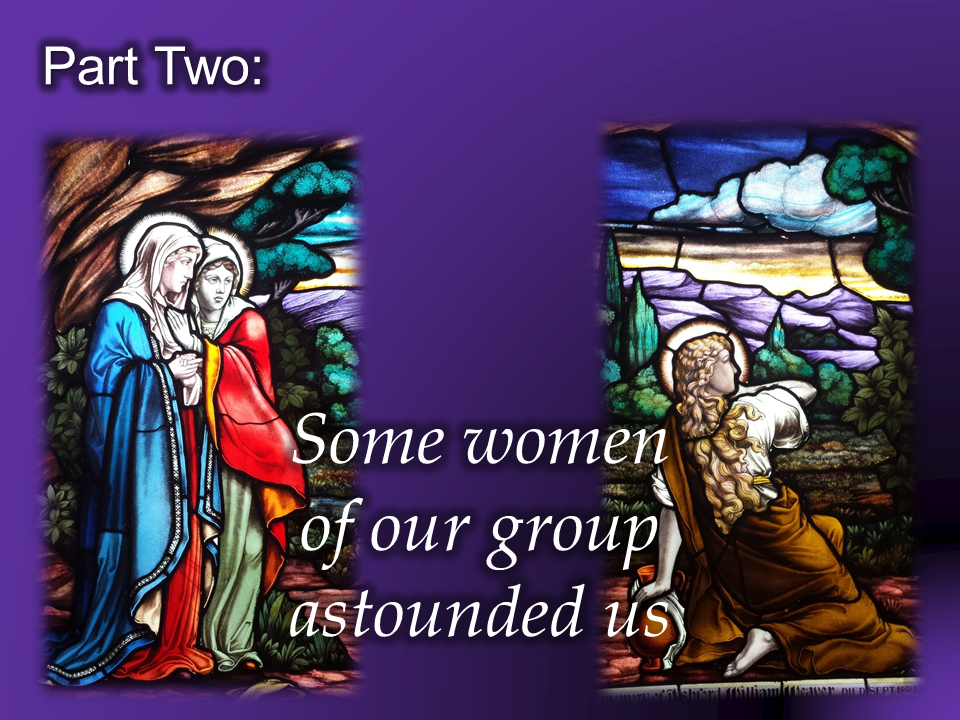
That kind of process is described to us in the story from the Gospel of Luke. It takes place on Easter day when two disciples are walking to Emmaus. They have heard about what the women experienced at the tomb: “Moreover, some women of our group astounded us,” they say. “They were at the tomb early this morning, and when they did not find his body there, they came back and told us that they had indeed seen a vision of angels who said that he was alive.” They know about what the women experienced, but they don’t seem convinced – not until they experience it for themselves as the stranger with them breaks the bread and shares some wine and they are suddenly part of the same feast that the women shared outside the tomb.
And that is what Easter is really about. It is not just about what they experienced, as real as that was. It is an invitation to all of us to share in that experience together. It is an invitation to share a bit of bread and some wine and to know that this is an event that is not limited to this particular place and time. If you are open to it, it is a meal that can transport you back to the moment when those women gathered on the third day outside his tomb. I pray, and I hope that you join me in this prayer, that at least some of us here today might find some small taste of that in this simple shared meal. That is why we do it.
#TodaysTweetableTruth #Easter isn’t about their experience at the tomb. It is an invitation to experience an event unlimited by time & space


 On May 1, 2016, St. Andrew's Hespeler will be holding an election of deacons and elders for the congregation. We have been working hard this week to prepare packages for all the members to facilitate this process. Thanks to everyone for your help in preparing the elections. In particular I would single out for thanks to our temporary roll clerk, Joni Smith, who did her very best to make sure our roll was up to date and nobody was left out and Isabelle who was wounded in the line of duty with a paper cut!


 On April 10, our Youth challenged the session of St. Andrew's Hespeler to a "friendly game" of Heads Up.


 A-A, Al-Anon, Al-Ateen: St. Andrew’s is the only site in Cambridge where all three groups meet together which offers another wonderful mutually supportive circle.