hy did Jesus have to die? That is, you might say, one of the most central questions of the Christian faith. And if you ask that question of most practicing Christians you will likely get an answer along the lines of this: “Jesus had to die for my sins,” or “Jesus had to die to save us” or “so that we could go to heaven.”
And some people will be happy enough with that answer. But every so often you’re going to come across a really annoying person like me who isn’t satisfied with that simple answer and starts to ask really some tough questions. “Well,” the annoying person says, “I thought that you said that this God of yours was all powerful – that he could do whatever he wanted. And I also thought you said that God was full of mercy and lovingkindness. If God wanted to forgive you and let you go to heaven, couldn’t he just do that? I mean, sure, you may have sinned but God doesn’t have to let something like that stand in his way if he wants to forgive you, does he? Why would the bloody and painful death of Jesus be needed for that?”
And if you ask questions like that long enough, you’ll eventually find someone who’ll give you a fuller explanation. And the standard Christian explanation these days goes like this: Yes, God is loving and merciful and wants very much to be forgiving to us but there is just one thing: God is also just. In fact, God is so just that he cannot simply let any injustice or sin slide without there being some sort of payment made. God’s justice has to be satisfied with due punishment.
And that’s where Jesus comes in. God looked around to find someone who could pay the price and take the punishment in our place so that he could forgive us and it turned out that only one person would do. Only someone who was perfectly innocent (and so didn’t need be punished for their own sins) would be able to play that role. So God turned to his only begotten son, Jesus, and chose to send him down, live a perfect life and die as an innocent man. Jesus’ suffering and death would be enough to satisfy God’s need for justice and therefore allow God to forgive us for our sins.
That, as I say, is the standard explanation these days. The name for it, in case you want to know, is the substitutionary theory of atonement. It is called that because the key element is that Jesus substitutes for us – takes our place and suffers the penalty that we deserve. It is a good theory, really. It makes good logical sense and is a compelling story. It is so compelling that many now think that it is the only way to understand the meaning of the death of Jesus and that it has always been how Christians thought. But that is not true.
The substitutionary theory of atonement has only been around for about 1000 years – only half the length of time that Christian faith has been around. Where did the theory come from a thousand years ago? Well, it happened like this:
The year 1066 ad is the only date that all English school girls and boys know off by heart – the most significant date in their country’s history. That was the year that England was invaded and conquered by the Normans who took over the entire government and local administration of the country. The Normans came from France and they spoke a unique dialect of French but they weren’t actually French. They were Norsemen – Viking raiders who had merely settled in France for a little while. And as Vikings, they had their own unique ideas about good government. Every Norman lord was master and judge of all within his domain. He settled all disputes, judged all crimes and punished every offender.
And it was not an easy thing to appear as someone accused before a Viking lord because they were particularly prickly when it came to judging people. Vikings were famous for many things, but I am afraid that mercy was not one of them. And so mercy was not something that was easily found in a Norman court. Viking lords were very protective of what they saw as justice. They felt that no offence – not even the smallest – could be pardoned without due payment being made in some form or another. Their judicial motto was, “justice must be satisfied.”
Now what, you might ask, could the Norman conquest of England possibly have to do with the Substitutionary Theory of Atonement? As it turns out, everything. About thirty years after the conquest, the second Norman king of England appointed a man named Anselm to be the Archbishop of Canterbury. And, a few years after that, Anselm of Canterbury wrote a book. He wrote it, he said, to defend the Christian faith against all those who would scoff at it – in particular the Jews and the Muslims. He called his book Cur Deus Homo in Latin. In English that translates as “Why did God become a human being.” In other words, he was trying to answer the question why did Jesus have to live as a man and why did he have to die.
The book is important because in that book Anselm gave for the very first time in history the answer that we’ve been talking about – that Jesus had to die in our place to satisfy God’s unyielding justice so that God could forgive us. Anselm invented the substitutionary theory of atonement. It is very interesting to note that, although Christianity had been around for about 1000 years before that, nobody had managed to come up with that theory until Anselm came along.
And there is a reason why only Anselm could have come up with that theory. As I said, the theory requires a very particular image of God – a God whose sense of justice is so inflexible that he can only forgive when he has been completely satisfied (even if he has to will the death of his only son to be satisfied). How is it that for the first thousand years of Christianity it never occurred to anybody that God would be that inflexible? And then Anselm came along and (as Archbishop of Canterbury) spent a lot of time in the courts of Viking lords watching them make their judgements. It’s not that hard to guess where his strange new view of God came from.
That’s why it seems to me that the Vikings have muddled up our understanding of the meaning of Jesus’ death. If we buy into Anselm’s explanation of why Jesus had to come, we end up with a God who resembles a Viking lord. And I realize that almost all of the images that we use to talk about God are based on one human model or another and that we can’t really even talk about God without saying, “Well, he’s kind of like this” or “kind of like that.” But I just think that there are some better models for talking about God without imagining him as a Viking lord. The Bible uses many images when it talks about God: a father, a near eastern king, a kind master, a loving mother (yes, that image is used of God in the Bible) and all of those sorts of people were much more ready to exercise mercy in their relationships than your average Viking lord. And it goes without saying that the Bible never describes God as a Viking lord. But somehow, with the substitutionary theory of atonement, that is the idea of God we end up with.
And so I suggest to you that it is time for us to get past our obsession with Anselm’s substitutionary theory of atonement. There are other ways of understanding what Jesus has truly accomplished for us without starting to imagine God as a Norman lord. The Bible does indeed talk about Jesus dying for us and about him dealing with the problem of sin for us but such talk has little to do with satisfying some Norman sense of justice.
Instead, the Bible most often talks about the death of Christ as a sacrifice. And sacrifice had nothing to do with substitution in the ancient world. When a family in the ancient world took its year-old calf up to the altar for a sacrifice, there was no sense in which they understood that that calf was somehow taking the place of a family member. Nor did they see the death of the animal as some sort of punishment taken in their place. That is why I wanted to take the time during this season of Lent to understand how sacrifice functioned in the ancient world.
On a practical level, it was all about providing a means for the people to safely eat meat once in a while. The sacrificial system provided a humane means of slaughtering animals and a professional, well-trained guild for safely butchering them. These people were called priests. And, most important, the system also provided a safe means of disposing of those parts of the animal that they would not or could not eat by burning them up on the altar.
But sacrifice was not just about meeting those practical needs. It also had a very important spiritual function. The sacrifice brought the worshippers together with one another and with their God. The shared sacrificial meal where the family ate the good cuts of the meat while God shared in the meal by means of the fat, bones, blood and other inedible parts that burned up on the altar was the basis of their relationship with their God. In the sacrifice they came to know their God in ways that would not have been possible otherwise.
And that is how I have come to see the death of Jesus – as a sacrifice. In his death Jesus does tackle the problem of our sin which is, at its foundation, a problem of separation between us and God. We had wandered far from God and didn’t know how to find our way back but Jesus’ death brought us back into relationship with God just like an ancient sacrifice renewed the ancient worshipper’s relationship with their God.
We shouldn’t think of Jesus’ death as a mere substitution – Jesus taking our place and suffering our punishment – because Jesus didn’t speak of it as substitution. He spoke of it as participation: “If any want to become my followers, let them deny themselves and take up their cross and follow me.” That is not Jesus’ responsibility in your place that is your responsibility in imitation of Jesus. If you want to be a follower of Jesus, you have to realize that that means following in the path that he has led. That is where the real transformation begins.
And, to attempt to answer Anselm’s question, “Why the God-Man,” why did Jesus have to become flesh and dwell among us, I think that the key answer is this: Jesus came to show us the grace and compassion and love of God. He knew that words weren’t going to be enough and so he had to show us what those things looked like. But the world cannot tolerate such love. The world cannot stand to be shown how wrong it is about everything. And so the response to Jesus was predictable. He was bound to end up on a cross sooner or later.
But Jesus took that terrible and tragic death and, with God’s help, transformed his death into something much more meaningful – a sacrifice – the kind of sacrifice that can renew any and all relationships. In particular, he transformed his terrible death into a sacrifice that is able to renew our relationship with the living God – a sacrifice that is effective for all times and for any person who participates in it by taking up their cross and following him.
After leading a Study of "Body, Mind and Soul" within my congregation, I asked the participants what sort of feedback they wanted to give to the Justice and Church Doctrine Committees They asked me to send a summary of our discussions and observations into those committees. I have done that. Since we did not hold an additional meeting to share the report together, I just want to post it here so that the members of the group can read it.
A group of members of St. Andrew’s Hespeler Presbyterian Church met together in five sessions from January 13th to February 3rd to discuss the study produced by the Justice and Church Doctrines committees. The committee has authorized me to summarize our reflections and thoughts and send them back to the committees to include in their deliberations.
The first thing that I would note is that our discussions were very interesting and engaging. The discussions were held in an atmosphere of mutual respect.
We did not agree about what course the church ought to take in regards to the place of LGBT people among us. There were people who strongly felt that we should not change our present positions in any significant way. There were people who strongly felt that it was time to make a change. Those positions did not change in the course of our discussions; that was not what this process was about as we understood it. Nevertheless I think most of us would say that we’ve learned things through the process and came to appreciate a great deal more about the positions that people take and what they are based on.
We want to let the committee’s know that we will be praying for them as they attend to prepare reports for the coming General Assembly and continue to guide the church in other ways. We recognize that they have a very difficult task in front of them.
As we can hardly say that we agree on what the best course of action might be, it is hard for us to give the committees any concrete advice or direction, but we would say the following:
We hope that the church can find a way to continue moving forward together despite the diversity of opinion on this and some other issues. There is a richness in such diversity and we would hate to lose that.
We would encourage the committees to take their time and do the best job that they can in this process. We recognize that there is a sense of urgency for many people to settle this one way or the other and get on with things, but we, in our little group anyways, felt okay for now living in a dialog.
Despite having some strong disagreements on what course the church ought to take, here are a few things that we, perhaps surprisingly, found ourselves agreeing on:
oThe present positions of the Presbyterian Church in Canada are not necessarily coherent. The various decisions that the church has made don’t necessarily follow a consistent logic. This is certainly not very helpful.
oWe agree that none of us has any desire to simply conform to what society and culture around us believe. We all agree that the church needs to take important stands and not simply fall into line with what the culture is saying. The fact that we all agree about this, however, certainly doesn’t mean that we agree about what the place of LGBT people should be in the church.
oWe agree that leaders in the church should be excellent examples morally and ethically. For some that is the main reason why they would exclude practicing LGBT people from such positions. Others don’t have a problem with that. It is a little bit difficult for some of us to understand the positions that the others take on this one.
oWe all agree that sexual morality is very important and that the church has very important things to say to society on the subject.
oWe all agree that we would like to channel of the energy of the church and helping people to develop and maintain mutually helpful and nourishing relationships that are marked by respect.
This year our special Lenten project in Sunday School is to fill up our Jar of Awesome.
Each week we will add something to the jar that celebrates the good news from our week. By celebrating all of the good things in our lives we will stay positive and we will be reminded about the Good News that Easter brings us.
This week we celebrated things like: having French Toast for breakfast and getting some chocolates for Valentine's Day.
This morning we celebrated some more CLUB 10 awards.
Whenever a Sunday School students comes to our Sunday School class 10 times (not necessarily in a row) they get to choose something from the Treasure Chest.
Way to go everyone!
Choosing something from the Treasure Box. Lots of choices!
1 Corinthians 1:18-31, James 3:1-12, Matthew 7:1-11
I
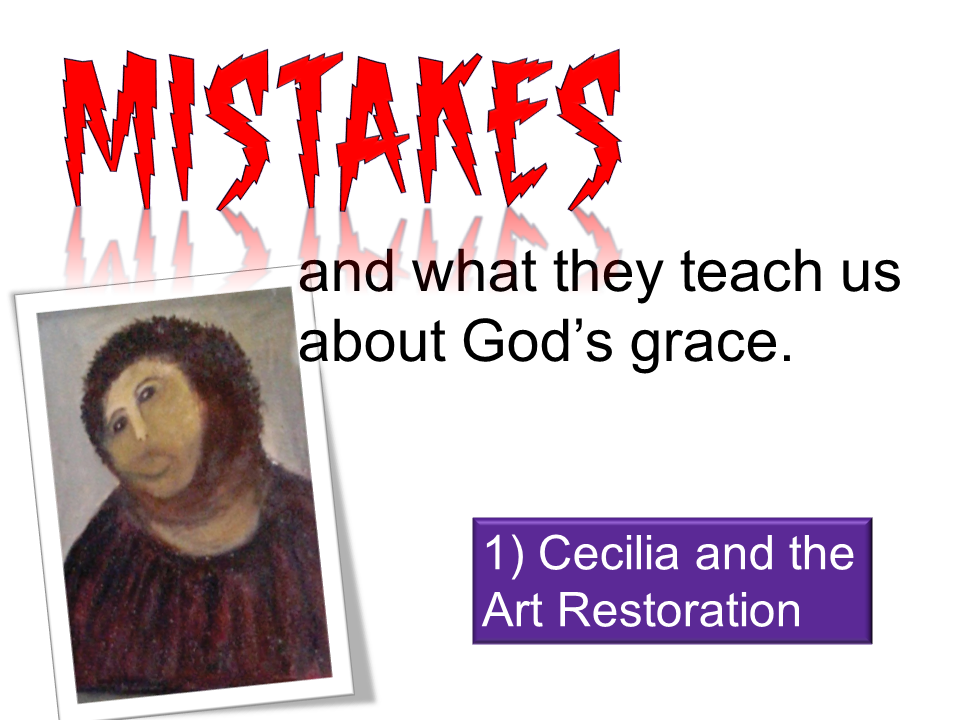
n the summer and fall of 2012, the attention of the whole world was suddenly captivated by the events that had taken place in a small town in Spain with a population of less than 5000. In this town of Borja, it seemed, somebody had made a mistake. It wasn’t just your everyday, run of the mill kind of mistake either. It was a mistake that was so big that it was like nobody could look away.
In that town there was an ancient Roman Catholic Church and in that church there were various pieces of artwork such as you might find in such churches. One of them was a fresco that had been painted in the early 1930’s by a visiting artist.
The painting was a traditional piece of very common Roman Catholic art called the “Ecce Homo,”which is Latin for “Behold the Man.”It is a depiction of Jesus, crowned with thorns as he appeared before Pontius Pilate just before being sent off to be crucified.
The fresco was quite beautiful (in the traditional manner of such pieces) when it was first painted, but by 2012 it was not in good shape at all. Due to dampness in the walls the paint was fading and flaking away and it no longer looked at all as it once did. The poor state of the painting particularly saddened one of the members of the parish – a very devoted woman over the age of eighty named Cecilia Giménez. She knew that the parish did not have a lot of money to take on an expensive restoration and she was an amateur artist. She decided that she would take on a restoration of the artwork all by herself.
It was the results of Cecilia’s work that got everyone so interested. Armed only with her faith, her best intentions and limited talent, she pretty much botched the job. People criticised her and blamed her for what was clearly a terrible mistake. Cecilia took the criticism that was leveled at her so hard that she went and hid herself in her house – cutting herself off from community and church alike. She was deeply hurt, though, some would say, not without some good reason because, well, look at what she had done.
I think, therefore, that the story of Cecilia Giménez is an excellent place to start our journey during the season of Lent thi
s year because I want to focus on the idea of mistakes. Cecilia made a mistake. All evidence seems to indicate that it was a well-intentioned mistake and that it wasn’t malicious in any way. But none of that prevented all kinds of wrath and recriminations from raining down upon her.
I find the contrast between the work of the original artist and the work of Cecilia to be interesting. Both of them described the work that they did as an act of devotion. The original artist, in his own words, said that Ecce Homo was “the result of two hours of devotion to the Virgin of Mercy.” I take that to mean that the man was visiting the church – a church that was devoted to the mother of Jesus and to her mercy – and decided to donate a couple of hours of his time for the creation of a piece of art.
Cecilia, for her part actually made a very similar devotion. She saw a piece of art in a very bad state of repair and, in an act of devotion that she saw as dedicated to the Virgin Mary, she set out to repair it. And she put in the time in the effort – actually more time and effort that the original artist had done. There was no fault in her effort or in her desire – only in its execution. She simply did not have the level of training and experience that the original artist had had. But which one’s devotion was more acceptable in the eyes of the Lord? Did the artist’s devotion have more value because of his skill and training? Or did Cecilia’s pure heart count in the eyes of the Lord?
So this story gives us an excellent example of the problems that are created by our focus on mistakes. Mistakes cause a lot of damage, but I’m not talking about the damage caused by those well-intentioned souls who sometimes make mistakes. I’m talking about the damage that comes out of our reaction to them. Think of Cecilia. She was absolutely devastated by the reaction. She withdrew from the church. She hid in her home refusing to come out of it. She became a virtual hermit in her own town. It was personally devastating to her.
She said that she did not understand. She had only been well-intentioned. She had acted openly and not hidden her work in any way. She felt targeted and deeply hurt. I’m not saying, of course, that the people who were criticizing her didn’t have any justification. She had effectively destroyed an irreplaceable piece of art. What’s more, it would be almost impossible to calculate the monetary value of what could be called her act of vandalism.
So I’m hardly trying to suggest that her critics were wrong to say what they did. But, just because you can justifiably say something, does not always mean that you should say it? And does it mean that you need to say it in a way that hurts a person? That is an important question in any context, but I would suggest it is extremely important in the context of the church. The church is supposed to be, after all, a place of grace.
I’m not sure how grace-filled the people in that church were. But I do know one person whose grace never fails. And that is the most interesting part of Cecilia’s story. Cecilia’s mistake and the reaction that her neighbours had is not the end of the story. Today there are very few people in Borja who are angry at Cecilia. You see, there’s a reason why we know the story of Cecilia even though it just happened in a small town in Spain. We are living, after all, in the age of the internet and, thanks to the internet, a small event that takes place in a small town can sometimes come to the attention of the entire world. And that is what happened with Cecilia’s painting. Suddenly her picture was everywhere. At first, it is true, everyone was just laughing at her and her story. What a fool they all said.
But then something else started to happen. I’m sure that, at first, it was just a lark. People said, “Why don’t we go to Borja and see Cecilia’s artwork for ourselves? Why don’t we go and have a laugh and take selfies there and post them on the internet?” But then, before you knew it, it became a thing. Everyone started doing it.
And soon, this minor town that had been teetering on the brink of economic collapse had an amazing tourist industry on its hands. The town’s economy was saved and it wasn’t the only thing to revive. The little church also started to charge a little fee for people to see it and take their selfies. It seemed as if Cecilia had saved both her town and her church from possible extinction.
And then there was the work of art itself. No, the art critics never learn to love it or anything like that. But at least some of the observers noted that the piece of art made them think and feel in ways that the traditional art of the Catholic Church had never done. Some noted, for example, that, while the original artwork depicted Jesus lifting his eyes towards heaven, in Cecilia’s work, the Saviour turns his eyes towards you. Perhaps Cecilia had managed to make at least some people think a little bit differently about their Saviour and hers. Art, after all, doesn’t always have to be beautiful in order to help us to see something meaningful that we never saw before.
In his First Letter to the Corinthians, the Apostle Paul explains what I think is the great principle that is at work in the story of Cecilia and her art restoration: “God chose what is foolish in the world to shame the wise; God chose what is weak in the world to shame the strong; God chose what is low and despised in the world, things that are not, to reduce to nothing things that are, so that no one might boast in the presence of God.”
You see, we all think we are so smart. We have our plans and our strategies and they can often be very successful. Someone could have come up with a plan, for example, to revive the economy of the town of Borja. In fact, there actually were some such plans in place. And some highly paid consultant also could have been brought in to revitalize Cecilia’s parish church. Such well laid plans could have brought about many good things. And, of course, God does sometimes bless such plans because God wants towns and churches and people to do well.
But if the town was saved by some plan that was brought forward like that, who would get the glory? I’ll tell you who: the planners, the designers and maybe the politicians who paid for the project. That is, according to the letter to the Corinthians, why God likes to step in and shower with blessings the Cecilias of this world – the people who may try to get it right but often get it wrong. That way, not only is the blessing bigger and better than what anyone else could have planned for, it is also abundantly clear who the glory really belongs to.
It just seems to be God’s favourite way of acting. That is probably why no matter what we plan for in the life of the church, it never quite goes exactly as planned. At least, I’ve never seen it. We may make our plans and bring in our consultants and get to work and yet you can be sure that, at some point, some little thing will just go wrong and threaten to blow the whole thing out of the water. But here’s the crazy part: later, when you look back on it, you will realize that it was that moment when it all went wrong that led to some of the most helpful outcomes. It is another case of the foolishness of this world being more effective than all the wisdom and the planning of the wise.
We have a kind of a mistake-o-phobia in the church, it seems to me. We are too afraid of making mistakes and so sometimes avoid even trying something that might be a little bit different. Recognizing that God does bless and even prosper the mistake-makers is something that can set you free to try new things without any fear of what you might get wrong because that is how God wants you to live.
The other way our fear of mistakes comes out is in the criticism we heap upon those who do make mistakes – the Cecilias of the world. And you know how devastating that was to Cecilia. It almost destroyed the woman. And, since we all do make mistakes, that leaves us all vulnerable to such criticism. It can do so much harm. And it can so easily change the environment of the church from a place where we build each other up to a place where we tear each other to pieces. That, I know, God doesn’t bless.
So God sends mistakes into our lives and into our churches and into our towns and he loves to use them to challenge our assumptions about what really matters. Next time you make a mistake – or the next time you see someone else making a mistake – take it as a challenge. God is asking you to imagine what great thing he might have in store for you, or for the church or for some other worthwhile project, in what you or somebody else just got plain wrong.
oday we are going to finish our series where we’ve been looking at the words that we use in the church that may be the same words that are used in the world outside the church but that often have a very different meaning here. So far we have looked at words like sin and faith and repentance and I hope you have discovered something about what those words mean and what they can mean for us as we work out our Christian lives.
Today, as the climax of this series, I have a very special word for you. It is so special, in fact, that it is two words for the price of one. The two English words that I offer to you today are justice and righteousness.
Now, I imagine that those are two very different words in the minds of most of you. Righteousness is a word that we most often apply to people or to their actions. A righteous person is a person who always does the right thing, who makes correct and moral decisions.
We usually talk about such righteousness as a good and positive thing in the church because, of course, we do try to encourage people to live in the right ways and to make good moral decisions, but righteousness is not always seen as a good thing outside these walls.
For most people outside of the church (and, let’s face it, a good number of people inside the church) – righteous is a synonym for stuck up, prudish, hypocrite, wet blanket and spoilsport. It means somebody who is too good to be of much use to anybody. If you describe somebody as righteous, the most common reaction will be for people to not really want to have anything to do with that person. The notion of righteousness has, in our modern society, definitely fallen on hard times.
The other word I want to look at today is justice. Justice is a much more positive word in our modern society. It is most often defined in terms of crime and punishment. When a crime has been committed, that is when you most often hear people making calls for justice to be done. And, of course, there is a great deal of satisfaction to be found when something terrible has happened and the persons who are responsible receive what seems to be fair punishment.
Such justice is not always completely satisfying, of course. If a terrible crime, such as a murder, is committed, we may be glad to see the perpetrator punished but we also recognize that even the sternest of sentences – even the death penalty where it still exists – cannot entirely satisfy. After all, no punishment, no matter how severe, can ever bring back a murder victim. For most of us, justice may be a good thing, but it is really only a way to make the evil of the world a bit better. It doesn’t make the evil go away.
So there you have two words, righteousness and justice, about which we may have some mixed feelings. We would see them, however as two very different words with quite different meanings. Now, what if I were to tell you that the Bible only has one word? There is a word in the Bible that is sometimes translated into English as righteousness and sometimes as justice, but is just one word in the original languages. This is true both in the Hebrew of the Old Testament where the word is tsedeq and in the Greek of the New Testament where it is dikaiosunē.
Think about that for a few moments. Every time you are reading in the Bible, and you come across the word righteousness, the people who translated that verse made a choice and could have used the word justice. And every time you see justice, it could have been righteousness. How might that change how we read some of our most well-loved passages?
But an even more important question is what did that word – the original Hebrew or Greek word – really mean to the people for whom the Bible was written? And I think that that question can best be answered by taking a look at our Psalm reading this morning. Psalm 82 is, in many ways, one of the strangest chapters in the entire Bible. It presents what appears to be a meeting of what is called the divine council. God – the God of Israel – is there and is clearly presiding over the meeting. But there are other figures at this meeting and the strange thing is that they are all identified as gods. This is something that marks this Psalm as very strange in the biblical tradition which is generally quite insistent that there is only one God and that any other gods that people identify are merely false gods or idols.
There are, however, a few biblical texts like this one that speak of the relationship between the God of Israel and the gods of other nations in the way that we see in this psalm. It is perhaps a throwback to older ways of thinking before that strong strain of Jewish monotheism fully developed. Or perhaps it was never really intended to be taken literally. After all, remember that a psalm is poetry.
The message of the psalm is very serious, whether you take it literally or not, because in it we see God judging the gods of these other nations of the earth and condemning them – even threatening them with death. Why? There is really only one reason: justice, that very special word that is, in Hebrew, tsedeq. God condemns the gods of the other nations for their failure to act in justice. So, when God tells them what they have done wrong, we have a perfect description of what, in God’s eyes, justice is really all about. “How long will you judge unjustly, God asks, “and show partiality to the wicked? Give justice to the weak and the orphan; maintain the right of the lowly and the destitute.Rescue the weak and the needy; deliver them from the hand of the wicked.”
So here we see what tsedeq – justice and righteousness – really means to God. It is not primarily about individuals being upright and pure and moral, though it does include that. And it is not primarily about criminals being fairly punished for crimes either, though it does include that as well. The justice that God is particularly talking about is mostly about how certain groups in society are treated – specifically the weak, the orphans, the lowly, the destitute and the needy. That is what God is criticising the gods of these other nations about, their failure to protect and provide for those sorts of people.
So tsedeq (justice and righteousness), as defined by the Bible, is first and foremost about how people are treated in society. It is about treating people fairly and as equally as possible. And since there are some people in society (such as the rich and the powerful) who have certain advantages and often prosper at the expense of the less powerful, justice often looks like someone going out of their way to protect or support the weakest, poorest and most marginalized members of society.
This kind of justice also has its basis in the very nature of God. The reason why, in the psalm, the God of Israel is able to criticize the gods of these other nations is not because his nation is stronger than theirs. On the contrary, Israel was a rather insignificant nation in world affairs at that point in history. Nevertheless, God may judge and condemn the gods of these other nations because God knows what real justice is. In fact, the very definition of justice is found in the nature of God.
The Prophet Amos understood that that was what God really wanted. He looked around at the people of his own day and this is what he saw. He saw people who were trying to look righteous. They were doing the kinds of things that made them feel like they were better, more religious and more pious than other people. They were doing the things that, they thought, would make God approve of them – things like observing holy festivals and solemn assemblies to talk about righteous things. They were offering burnt offerings to demonstrate how good and righteous they were. But they were not doing justice. In fact, Amos observed that they were doing the very opposite of justice as God saw it because they were profiting and enriching themselves at the expense of some of the poorest and most marginalized people in their society.
That is why Amos knew that he could speak to them and rebuke them in the name of God. He told them what God thought of their so-called righteousness: “I hate, I despise your festivals, and I take no delight in your solemn assemblies.Even though you offer me your burnt offerings and grain offerings, I will not accept them.” God clearly doesn’t care for what this world often thinks of as righteousness – at least, not for the outward showiness of it all. What God does desire, Amos says, is clear, “But let justice roll down like waters, and righteousness like an ever-flowing stream.”
Just realizing that there is only one word in the Bible that is translated sometimes as justice and sometimes as righteousness is something that can actually revolutionize the way that you read your Bible. For example, take this well-known and well-loved verse that we read this morning from the Sermon on the Mount in Matthew’s Gospel. We read it in a translation that is probably quite familiar to most of us. Jesus says, “Blessed are those who hunger and thirst for righteousness, for they will be filled.”
You know, I always thought that I knew what that verse meant. It meant that if you sought to be righteous – if you did your best to always do the right thing, to be pure and spotless and maybe better than other people, you would be rewarded. You would get the righteousness you were looking for and you would receive a reward from God for your dedication to what was right. And yes, it does mean that. But is that what Jesus (and the gospel writer) primarily meant for us to understand?
Remember that that word that is translated as righteousness is the word dikaiosunē– the Greek equivalent of the Hebrew word tsedeq. That means that the verse could have equally well been translated as, “Blessed are those who hunger and thirst for justice, for they will be filled.” That is to say that those whose greatest desire is the kind of justice that God was demanding from the gods of the other nations in Psalm 82 – the kind of justice that particularly consisted of protecting the weak and helping the poor and saving those who had no one to help them – that these are the ones who are blessed. Somehow I think that Jesus may have had more of that side of the idea of justice in mind when he said this.
I mean look at what Jesus went on to say from there. Jesus ends this whole part of his sermon by saying, “Blessed are those who are persecuted for righteousness’ sake.” And, once again, the word that is translated as righteousness there is the Greek word, dikaiosunē. Now what, exactly, did Jesus think that people might be persecuted for? Was he predicting that you would be persecuted for doing the right thing, for being pure and better than everybody else? Well, sure, perhaps. That might happen sometimes.
But isn’t it a little bit more likely that you will run into persecution because you are working for justice? Think, for example, of Martin Luther King Jr. thrown in the Birmingham City jail. Why was he put in there? For his excessive righteousness – for being too pure. No, not him. He actually had some problems along that line. But he sure was thrown in jail for standing up for and demanding change for a certain group that were systematically disempowered in American society. He was persecuted for justice – biblically understood justice – and not really for righteous.
And I think that this is exactly the kind of situation that Jesus had in mind when he spoke about persecution. That’s why I think that he had the same thing in mind when he spoke of those who hunger and thirst for justice and promised them satisfaction.
I think that the practical applications of this one are pretty clear and straightforward. We have spent too much of our corporate Christian lives in the pursuit of righteousness. And I don’t mean righteousness in the sense of being the best people that we can be and doing the right things as much as is humanely possible. There is nothing wrong and everything right about pursuing that kind of righteousness. No, the kind of righteousness that gets us in trouble is the kind that makes us go through motions of religiosity and then makes us feel like we must be better than other people because of it. I have it on good authority from Amos that God hatesthat kind of righteousness.
We need to let go of that and pour our hearts into the pursuit of justice for the sake of the displaced, the homeless, the weak and the forgotten. That is what will bring us closest to the heart of God. This week, your assignment is simply to do that. Find someone who, for whatever reason, is marginalized or disempowered in our society. Look around, I don’t think that such people are too hard to find. Do one thing, however small, to demonstrate God’s love to them and do it without judging them in any way. That is what God is looking for. It is what God calls justice.