News Blog

This week at St. Andrew’s (June 26)

Posted by on Thursday, June 23rd, 2016 in News


Week after week, we always have important and meaningful things going on at St. Andrews. Even though Summer has now officially begun that is still true for June 26. This Sunday:


  • We will welcome three more members into our congregation. Three weeks ago we had seven new members, but there were three who were unable to be present because of important family reasons. We rejoice to welcome them this week!
  • Martin Bohl will be filling in at the organ this week and next. Martin is a very talented organist and we will certainly be blessed by his musical leadership
  • We will honour the work of Amy and Laura with our youth and thank them for their contribution to the life of Christ's church.
  • The minister will begin a new summer series of sermons focusing on ancient commandments and asking what it would look like if we applied them to life today. The first commandment: "Thou shalt not take the name of the Lord thy God in vain."

Continue reading »

Save the date!

Posted by on Wednesday, June 22nd, 2016 in News


The Jeff-a-thon

In memory of Rev. Jeff Veenstra


Sunday, October 16th, 2016 at Crieff Hills Conference Centre.  Registration will begin at 1:30 pm, the walk/run to start at 2:00 pm.  Fun & Food afterwards!

To donate online you can go to:
 https://www.canadahelps.org/en/charities/st-andrews-hespeler-presbyterian-church/
If you like, you can choose a specific person to sponsor. The church who raises the most money (in the Presbytery of Waterloo-Wellington) will win a lunch, so please help us!

Continue reading »

Why I am Running

Posted by on Tuesday, June 21st, 2016 in Minister

I am not a runner. I never have been.

Yep, that was me.
Do you remember that kid, the one back in middle school who, every time the class was told to run a few laps of the track or to head out across country - that one kid who fell right to the back of the pack, who pulled up with a stitch in the side, who was panting like a dog?

That kid was me.

To this day, though I enjoy being active, I probably would not choose running as an enjoyable activity. I've heard of people who derive a great deal of pleasure from running. I have heard of what is called a "runner's high," but I can't say I have ever experienced it. Nevertheless, I am planning to run 10 km this fall.

Why am I running?

The Event


I am running because the Rev. Jeff Veenstra Memorial Walk-a-thon in support of Presbyterian World Service and Development (Better known as the Jeff-a-thon will be held on Sunday October 16, 2016 at Crieff Hills Community in Puslinch, ON,

The Man and his Passion for a Better World


I am running because this event is being held in memory of a really extraordinary man and (though I didn't know him for long) a good friend. There were many great things about Jeff Veenstra, but one of them was definitely the great passion he had to build a better world. He believed in the work of Presbyterian World Service and Development and was committed to their dream of a world where justice, sustainable development and hope could thrive. His passion for the work inspires me to do what I can to support it.

The Cause


The particular cause that the Jeff-a-thon will support is a Child and Maternal Health project in Malawi and Afghanistan.

Read more about the initiative HERE

I am very excited to be supporting such a project because it is with mothers and their children that the creation of a better world can begin, especially in such parts of the world where women, in particular, have so much going against them. This is a project that will demonstrably make a difference in tangible ways and help to build a much better future. What's more, the project is also supported by the Canadian Government which means that many donations will be matched by the government, effectively doubling our impact.

So here is what I'm going to do


I'm going to run.

I will run in the Jeff-a-thon on October 16. I have a lot of work to do before I can manage to run for 10 km. My body will have to learn a lot about strength and endurance. Maybe I'll even discover what a runner's high is between now and then. But I want to do it so I am going to work towards that goal.


And here is what (I hope) you're going to do


Well, first of all, you can run or walk too. Everyone is more than welcome to participate in the Jeff-a-thon. For information on how to sign up, look HERE.

Secondly, whether you participate yourself or not, you're going to sponsor my run, aren't you? You're going to sponsor it because chances to do so much good for the world so easily don't come around that often, do they? You're going to sponsor me because you want to find out if I can run 10 km too, don't you?

How are you going to do it?


Well, if I'm going to see you between now and next October, I'll have a sponsorship sheet with me and you can sign up with me when I see you. Donations of $20 or more will be receipted on request.

If I'm not going to see you face to face, though, you are not out of luck. Just follow this link:

https://www.canadahelps.org/en/charities/st-andrews-hespeler-presbyterian-church/

Select "Jeff-a-thon: Scott McAndless" from the drop-down box, fill in your amount and credit card information and your are done. Canada Helps will take care of receipts and everything. It is so easy you could do it right now. In fact, why don't you just go ahead and do it. I'll wait.

...

Hi, welcome back. Wasn't that easy?

Thanks so much for your support!
Continue reading »

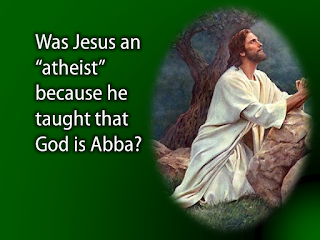
Was Jesus an “atheist” because he taught that God is Abba?

Posted by on Monday, June 20th, 2016 in Minister

Hespeler, 19, June 2016 © Scott McAndless
Galatians 4:1-7, Luke 11:9-13, Psalm 103:1-14
            Long before the time of Jesus, it was not uncommon for people to use father language to talk about God and about various gods. Take the Romans, they loved to use father language to talk about their gods. The ruler of all the Roman gods was a fellow named Jupiter and his name actually meant “Father God” in primitive Latin. In addition, the Roman emperors were also worshipped as gods by the Romans because they were the so-called fathers of the nation.
      But when the Romans spoke about their gods as being fathers, they had a very particular idea of fatherhood in mind. Fatherhood, in ancient Rome, meant one thing above all: authority. The Latin name for a male head of a family was paterfamilias: father of the family. And a paterfamiliaswas not just a warm and fuzzy dad figure sitting in a La-Z-Boy, wearing slippers and reading a newspaper. For the Romans, he was a man who had ultimate authority over every single person in his household.
      And when I say ultimate, I mean ultimate. A paterfamilias could expect complete and utter obedience from everyone under his charge. If he didn’t get it, he was not just permitted but actually required to discipline family members with what we would call torture. He could do things like beat them, whip them, imprison and starve them and be praised for it. In fact, if he chose to kill them, that was considered to be his business. All of this makes me feel like maybe Father’s Day was not the really the fun lighthearted event in ancient Rome that it is for us. Rather than sending cards that said, “Happy Father’s Day to the world’s greatest dad,” they probably said, “Revered Patriarch, please don’t kill me today!”
      So, when the ancient Romans and many other ancient peoples (including ancient Jews) spoke of God using the word Father, the word carried all of that baggage with it. When they addressed their Father God, they were speaking to a God who was a tyrant, a God who ruled over his people with an iron fist and who didn’t pull back from torturing and even smiting them. It was God as paterfamilias.
      And when people address God as Father to this very day, the word may still carry a lot of the same baggage. I certainly do know some people who feel very uncomfortable with the idea of addressing God as Father. In some cases, of course, that may be because they have had some very negative experiences with the father figures in their own life. You can understand that, of course. If the only experience you have had with a father is abuse or violence or worse, you are not going to take any comfort from calling God your father. You’ll probably have a hard time believing that God is any better than the fathers you have known.
      But that’s not the only problem that people have. You may have had nothing but the best experiences with your own father but you could still have some good reasons not to want to call God by that name just because of all the ways in which male dominance in society have kept women down and treated them like second class citizens. Addressing God as Father can certainly make him into the figurehead of that whole system of male dominance and so responsible for all of the ills that have come out of it.
     Jesus used Father imagery all the time when he was talking about God. But there is good reason to think that, when he called God Father, he did not mean what most of the people of his age meant by the word. For one thing, Jesus didn’t use the normal word in his language for Father when talking about God. The usual word for father in Aramaic, the language that Jesus spoke, was ab, and it had all the associations with authority and power that a word like paterfamilias had in Latin. But Jesus didn’t call God ab, he called him abba.
      How do we know that? Of course, it is hard to be sure what word for father Jesus used because we don’t have his words in his original language. The Gospels were written in Greek and so most everything that Jesus said was translated into Greek. And most of the time, when Jesus says Father in the gospels, it is translated with the usual Greek word for father. But once, in the Gospel of Mark (when Jesus is praying in the Garden of Gethsemane) the word just isn’t translated. Jesus’ original Aramaic word, Abba, suddenly and unexpectedly appears in his prayer. There are very few Aramaic words that appear in the New Testament, so it is very significant that this word appears at this very moment when Jesus is at his most vulnerable and honest, praying to God.
      There is another indication. Twice in his letters, the apostle Paul tells us about a prayer that was prayed by the early church, and the prayer went like this: “Abba, Father.” What he is telling us is that even after Christianity spread into areas where the only language was Greek – where nobody could even understand a word of Aramaic, the church continued to address God as Abba even though nobody knew what the word meant and so they appended the Greek word for Fatherso people would at least understand. Why would they do that, why would they continue to use an obscure Aramaic word unless it was something that had been passed down to them from Jesus himself. These are the things that tell me that Jesus was in the habit of calling God abba. I also believe that he was the first one ever to dare to use that title for God.
      So, what is the significance of Jesus using that word. As I said, abba was not the usual word for father. It was the familiarword that you would use in your family when you were speaking to your father. You may have had people tell you that it was a word that only a small child would use for his or her father – the equivalent to the English “Daddy,” or “Papa” – but that is not quite right. Abba was not exclusively used by infants. Unlike “daddy,” it was commonly used by children of all ages (including adults) to speak to their fathers.
      Sometimes (thinking that abba meant daddy) people have suggested that Jesus used the word abba in order to imply that our relationship with God is one of childlike dependence and intimacy. Although there is an intimacy to his use of the word, it is actually not meant to imply an infantile dependence.
      So what did Jesus mean by the word? What I see is this: Jesus went out of his way to avoid using the common and general word for a father in his society when he was talking about God. I believe that he did that precisely because that word was closely associated with the patriarchal system of absolute authority and power vested in male figures. Jesus was convinced that God had no support for such systems. It was why, for example, he urged his followers to “call no one your father on earth.” (Matthew 23:9) So, by refusing to use the usual word for father that people usually used when talking about God, Jesus was making a strong statement that God had no part in such a system of dominance, authority and power.
      That is the first thing that Jesus means by using this word abba, it was a way of saying who God was not. But there is also a positive meaning in Jesus’ choice to use this word. It was the word, as I said, that was commonly used by families within the household to refer to the father of the family. And I think that, as a household word, it may have been chosen to direct our attention towards a different role that a father had in that society.
      Though it is true that ancient Jews, like most ancient Mediterranean people, tended to think of fathers primarily as those authority figures who had absolute power even over the lives of every person in their household, there was another side to the role of a father in Jewish tradition. Not only did he have authority over the household, he also bore the burden of the wellbeing of the entire household.
      Families were very large and very complicated in Ancient Israel. A typical family was not made up of a simple nuclear family of mother, father, and children that we are familiar with. A family would often include many generations and many branches of an extended family all living under one roof. In addition, servants and any livestock were also considered to be members of the family. And the father of the family, the householder, was the one person who had care for all of those people.
      It was the job of the householder to ensure that every person under his roof had what they needed to survive and thrive. Can you imagine how difficult a job that was? It wasn’t just a matter of equally sharing out the resources of the household because, of course, there are always those who have special needs and requirements if they are going to be their best. Being a father, therefore, was a heavy burden of care and hard decisions. And there was a strong tradition in Ancient Israel of speak of God as one who took that kind of care of all his people – the householder of a entire nation. As it says in the Psalm, “As a father has compassion for his children, so the Lordhas compassion for those who fear him.”
      So, when Jesus chose to use the name Abba, the name used exclusively inside the household for God, I suspect that he was making a point of portraying God as that kind of householder – one who takes tender care of the needs of every person in his household. This is exactly how Jesus portrayed God at every opportunity – a God who provides for the needs of his people, who takes care of them and looks out in particular for those who are in special need: the poor, the sick, the disadvantaged. This is how he taught his disciples to trust in God as their Father: “Is there anyone among you who, if your child asks for a fish, will give a snake instead of a fish? Or if the child asks for an egg, will give a scorpion? If you then, who are evil, know how to give good gifts to your children, how much more will the heavenly Father give the Holy Spirit to those who ask him!”
      So, while Jesus was very comfortable addressing God as Father, he seems to have gone out of his way to present an understanding of God as Father that was at odds with the patriarchal assumptions of the society around this. I’ve got to admit that I have some trouble with how some people promote the idea of God as Father – especially if they are using it as a way to impose male dominance in society. It is refreshing to know that, even in his day, Jesus resisted that idea.
     
#TodaysTweetableTruth Jesus called God Abba – a rejection of patriarchy and control, an embrace of the image of the caring householder.
       
As to the challenges of being a father today – of caring and giving support to the people under your care and charge, I find encouragement from Jesus’ use of the image. Fathers you aren’t alone, you have someone who understands your struggles to take care of the people under your charge. Fatherless, you aren’t fatherless – there is one who is looking after you. Those abused or kept down by systems of patriarchy or sexism, you are not neglected either. Whether or not you are  comfortable thinking of God as father or not, there is a householder who truly cares about what you need.
      If you were like me, you were appalled and distressed and maybe depressed when you heard about the terrible events that unfolded in Orlando, Florida one week ago. The largest mass shooting in American History not carried out by the military. And one of the worst things about it is that it seems as if the crime was specifically targeted at a sexual minority group which had specifically gathered in one of the few places where they felt safe in society – destroying any sense of that safety.
      I’m wondering, what can Jesus’ teaching about God as “Abba” say to us about such a terrible tragedy? Let me suggest this: if our God were merely a father – a kind of heavenly paterfamilias – who was all about authority and power, all about right and wrong, then I would be particularly discouraged today because that would mean that our only response to such a tragedy would be judgment and punishment. Some, I know, would be inclined to judge the victims in their minority status. I cannot do that. I cannot see (especially right now) how Christian judgement of sexual minorities who do not harm or rape anybody has made the world a better place. Judgement in that case only seems to make things worse. Some would focus on judging the criminal assassin and the communities that he has been associated with. That is little better, perhaps, but it is not good enough and as far as I can see and judgement alone will not make anything better.
      But if God is “Abba,” how can that change our response? If God is Abba, if God is the householder who is burdened with the wellbeing of everyone within his earthly household, then God’s first question when looking at each one of us is not, “What have you done wrong that I may punish you?” It is, “What do you need. What are the special challenges you are dealing with that keep you from thriving?” That is a very different question and provides a very different orientation to us as we seek to make a difference in our world, especially with groups that have been targeted because of who they are and what makes them different. If God is Abba, this is something that gives me hope for a better world.

Sermon Video:

Continue reading »

June 19 at St. Andrew’s Hespeler.

Posted by on Thursday, June 16th, 2016 in News

As usual, there are lots of good reasons to be at St. Andrew's Hespeler on a Sunday morning. June 19 will be no exception. Here are some highlights:

  • We will, of course, be celebrating Father's Day, praying for and seeking God's blessings on the fathers among us and who have shaped our lives.
  • In response to the terrible hate crime perpetrated in Orlando last Sunday, we will pray and resolve to work for a better world and an end to the power of hatred for marginalized groups including LGBT people.
  • Special musical guest: Robert Dwyer.
  • Please note that, contrary to what was announced last Sunday, we will not be receiving new members this week. An important family matter for two of our candidates has meant that this will have to be postponed until June 26.
  • Our sermon, "What Jesus an "atheist" because he taught that God is Abba," will look at the surprising things that Jesus taught about God when he called God "Abba. Turns out that abba doesn't mean what you may think!
Continue reading »

Posted by on Wednesday, June 15th, 2016 in Clerk of Session

Interesting factoids from St. Andrews Hespeler COS Blog

Country                                                   Page views


United States
168
Canada
31
France
1
Netherlands
1


Well seem to be a hit in the USA > have to kinda dismiss this as computer bots searching the internet for tidbits and big data trends.

The France/Netherlands hits are cute.

Pageviews all time history is a welcome indication someone's reading > always a writers concern?


Page views today
5
Page views yesterday
168
Page views last month
222
Page views all time history
925

Continue reading »

Hallelujah, Benediction Song

Posted by on Wednesday, June 15th, 2016 in Minister

This Sunday I will complete a series of sermons where I have been examining some of the strange and wonderful things that Jesus taught about God. I'm not sure how many have noticed this, but as a part of this series I have been writing a benediction for each service to be sung by the congregation. Each benediction has gone with the radical teaching of Jesus (or his disciples) that we have been talking about.

All of these have been sung to the tune of Sinclair's Hallelujah (#294 in the Presbyterian Book of Praise).

Here is a YouTube video of the music (though we sang it much faster than that!): Sinclair's Hallelujah

As the series now comes to an end, I would like to present all of the verses that I have written. I keep singing them, I hope you might too:

1. God is Spirit so we worship
God in spirit and in truth.
Holy places are wherever
God our wounded hearts does soothe.

2. God is Father, Son and Spirit,
Three in one and one in three,
Like a dance that spins forever
Throughout all eternity.

Hallelujah, Hallelujah, Hallelujah, Hallelujah,
Hallelujah, Hallelujah, Hallelujah, Hallelujah,    

3. God is calling us to mission:
“Clothe the naked, Feed the starving.
Then your healing times are coming
And your darkness is dispersing.”

4. God’s not watching from a distance
 God is present, here belonging.
 When we pray we know God hears us
 And joins in our deepest longing.

Hallelujah, Hallelujah, Hallelujah, Hallelujah,
Hallelujah, Hallelujah, Hallelujah, Hallelujah,    

5. God’s committed to the outcasts,
The forgotten and the poorest,
To a kingdom where the lowest
Exchange places with the greatest.

6. God is Abba, like a Father
Who will all his family nourish,
Giving to each one according
To their needs that they may flourish.

Hallelujah, Hallelujah, Hallelujah, Hallelujah,
Hallelujah, Hallelujah, Hallelujah, Hallelujah,    


Continue reading »