Here is yet another story that illustrates how important and meaningful the work of Hope Clothing is:
Would you help us share the story of Hope Clothing and what it means. Go to the following link and then click "Share" for various ways you can help us to tell the story.
Stories of Hope Clothing #3
It’s Garage Sale Time!
It's finally spring and that means Garage Sales.
Plan to attend our Annual Garage Sale to see what treasure you might find!

Gala Dinner Event!
Tickets are now on sale for the
Thursday Night Supper & Social
Gala Dinner Event.

“Preparing the Spices” — “Some Women of our Group Astounded us”
Note: I have created the backstories of Mary and Joanna that are featured in this sermon. My speculation on these two characters began with the introduction of these disciples of Jesus in Luke 8:2-3 and has spun off in some interesting directions as I have been working on a future book that may be titled something like “The Seven Demons of Miryam of Magdala.”
Hespeler, 27 March, 2016 © Scott McAndless – Easter
Luke 23:50-24:3, Luke 24:13-32, Psalm 118:1, 2, 14-24

| M |
ary Magdalene opened the package of spices and ointments that Joanna had brought back from the market and inhaled deeply. She was suddenly overwhelmed by the scents: cinnamon, cassia, balsam and resin. She could even smell the small amounts of frankincense and myrrh that her dear friend, Joanna, had only been able to afford by selling the very last pieces of jewellery that she had plundered from her abusive husband, Chuza, when she had fled his household to follow Jesus.
It smelled beautiful, but it was also emotionally dangerous for her. Smell is a powerful trigger for the memory. The part of your brain that processes olfactory information is only separated by a few synapses from your amygdala which is the part of your brain where your most powerful and emotionally charged memories are stored. That is why sometimes just getting a whiff of some scent that is connected to your past can transport you back to events that you may have thought you had completely forgotten.
And there was no question that the smells of these spices and resins were connected to many traumatic memories in the lives of all the women who were there in that room. Mary herself was instantly transported back to the day when her intended husband was drowned while fishing on the Sea of Galilee. She remembered the deep grief and confusion that she felt as they carried the body of her promised husband to his family tomb outside the town of Magdala. At that moment it had seemed as if her entire life had been over and, in a very real sense it was.
There was a reason why they all reacted so similarly. Women in that culture had very well defined roles and duties around death. When someone died, everyone always automatically looked to the women to do what needed to be done. They sang the laments and songs of grief. They told the story of the person’s life and death. They led the procession to the tomb. Most especially they washed and prepared the body with the traditional mixtures of ointments and spices and wrapped it in the linen cloths.
Everyone (even the men) agreed that men just weren’t any good at that kind of thing. So heavy were the expectations of so-called “manly” behaviour placed upon them that men could not express emotions like grief or sorrow in any sort of helpful way. So it was always left to the women – one of the few places in public life where they were actually allowed to take a leadership role. So they had all done it so many times before.
It was somewhat distressing to the women that they had not been permitted to prepare the body of Jesus for burial – that a man named Joseph, a secret ally on the council – had taken care of it by quickly wrapping the body in linen cloths and stowing it in some tomb that had no connection with Jesus’ family. But there was no helping that. Not only had there been no time to do things properly as the sun was setting and the sabbath was about to begin, the situation was also far too dangerous for any open displays of grief on the day when he was crucified.
But the women were determined that they would do whatever they could to make it right. A lot of people have wondered why the women would have returned to the tomb where Jesus had been laid on the third day and why they would bring with them the spices and ointments that were commonly used to prepare a body before burial when he had already been buried, even if hastily so. It is not as if they could have unburied him in order to do it all over again. Even if it had not been for the large stone covering the tomb and forming an impossible barrier, such an act would have unacceptably disturbed the dead.
But we do know that there was a custom in many ancient Mediterranean societies – and in ancient Palestine as well – of a special visit to the grave that took place on the third day following a death. It was a celebration that was led, like all other activities around death, by women. The mourners would go out to the tomb where a beloved friend or family member had been laid and they would take with them a simple meal: bread, wine, maybe some fish and olive oil. These things would be taken as a special gift to the dead, so it wouldn’t be all that surprising if women were to take as well such things as burial spices and ointments.
But the point of the third day gathering by the tombs was not merely to honour the memory of the dead with gifts. There was a belief, common among many cultures and, the evidence suggests, also among first century Jews, that when they gathered to share this simple kind of meal by the tomb of a beloved friend or family member, the dead would join with them in that meal. This was something that all of the women who followed Jesus from Galilee would have experienced before. They had gone with other women to tombs and experienced the presence of the dead on the third day.
What exactly had they experienced previously, I suspect, would have been something like the kinds of experiences that people still sometimes report to this very day. I have often had people tell me about the ways that they were comforted after losing a loved one – how they just felt the presence of that person watching over them or saw something that confirmed to them that their beloved was still with them in some very important way. These are not unusual experiences. Many have had them following a death. People doubt such experiences, of course, because it is notoriously hard to prove any very personal experience, but many have been greatly comforted by these things that reassured them that their loved ones were still with them.
So it wouldn’t really be that surprising if these women were preparing to go out to the tomb and minister to their dead Lord and friend with an expectation of finding some kind of reassurance of his presence. They packed up the spices and ointments, some bread and wine and the other elements of a simple meal and they waited for the dawning of the third day. But it seems that they were about to get more than they had bargained for.
The women who went out to visit Jesus’ tomb at the dawning of the third day had all experienced grief and loss before. Everyone in that society agreed that grief was women’s work. So it was all so very familiar to them – the feelings, the smells, the songs that they sang and the atmosphere. And, given that human life was cheap in Galilee, they had all doubtlessly lost people that they loved. It had been very personal before.
But this was different. Jesus hadn’t just been a friend or a teacher to them. He had been a reason for them to start to live again. He had given them hope that things could actually be different. And so, as they headed out to the tomb to share a meal there and bring offerings for the dead, they may have expected to experience the presence of their now-dead Lord in the same way that they had experienced it before for their other loved ones, but surely they were hoping for something… more.
Christians believe that they did experience something more than the commonly experienced reassurance of the presence of the dead. What exactly happened to them would be impossible to describe precisely because even the Bible has a hard time pinning it down. There are four different accounts of what those women experienced at the tomb in the Bible and not one of them agrees in all the details with the others. But I don’t necessarily think that that is a problem because what these passages are describing are deeply personal experiences that changed the lives of the women who had them irrevocably. It wasn’t just about what they saw and felt and heard and touched, it was about what all of that meant on a very personal level.
I imagine, though, that they arrived at the tomb and they told, one more time, the story of how he had died and what his death meant, just as it would continue to be told whenever the church gathered in the years to come. And then, as was traditional at these sorts of third day gatherings, they took some bread and they broke it. And how could that not have made them think of him – not only because of the last meal he shared with this disciples but also because of how he loved to gather and eat with all sorts of people and especially with outcasts and sinners and all the other people that everyone else rejected. That act alone must have made it seem as if Jesus was very near.
But there was more to it than that. As they took the bread and shared it, as they drank wine from a common cup, they knew that he was there – not just in their memory (though, of course, he would always be there), not just in spirit as they may have experienced it with others they had lost, he was there in body, in whole person. Most of all, he was there in reality. It was like the realest thing that any of them had ever experienced.
And that experience, my friends, is the basis of our Christian hope. I believe that those women experienced it there outside his tomb on the third day after his death. That was when it all started. That is not to say that they immediately understood everything that they had experienced. I wouldn’t be surprised, in fact, if it took them years to really put it all into words that could even make sense to people. And, of course, it wasn’t just that one time outside his tomb either. None of it would have probably amounted to anything if people had not continued to consistently experience the reality that he was alive.
Each experience of the risen Christ was unique, but clearly one of the ways that people continued to experience him was when they shared these same kinds of simple meals of bread and wine and common foods when they gathered. They were often surprised that he was present in those meals with them just as the women had experienced.
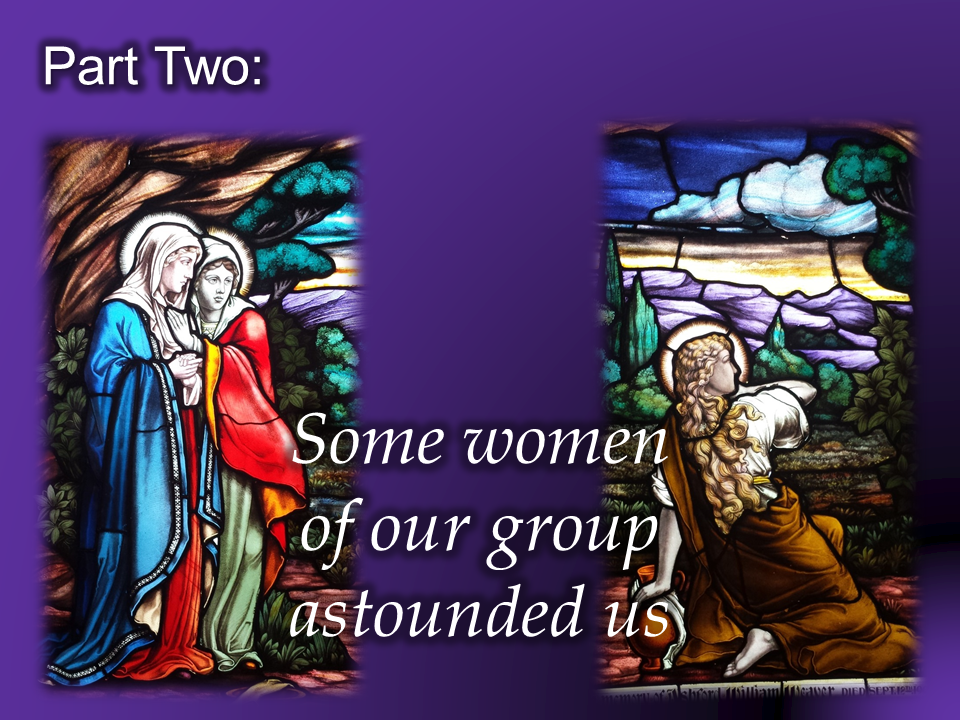
That kind of process is described to us in the story from the Gospel of Luke. It takes place on Easter day when two disciples are walking to Emmaus. They have heard about what the women experienced at the tomb: “Moreover, some women of our group astounded us,” they say. “They were at the tomb early this morning, and when they did not find his body there, they came back and told us that they had indeed seen a vision of angels who said that he was alive.” They know about what the women experienced, but they don’t seem convinced – not until they experience it for themselves as the stranger with them breaks the bread and shares some wine and they are suddenly part of the same feast that the women shared outside the tomb.
And that is what Easter is really about. It is not just about what they experienced, as real as that was. It is an invitation to all of us to share in that experience together. It is an invitation to share a bit of bread and some wine and to know that this is an event that is not limited to this particular place and time. If you are open to it, it is a meal that can transport you back to the moment when those women gathered on the third day outside his tomb. I pray, and I hope that you join me in this prayer, that at least some of us here today might find some small taste of that in this simple shared meal. That is why we do it.
#TodaysTweetableTruth #Easter isn’t about their experience at the tomb. It is an invitation to experience an event unlimited by time & space
Sermon Video:
Holy Week & Easter services
Please plan to join us for our Holy Week and Easter services.


 |
| Come for a short time, or as long as you like. Devotional materials will be available. You will have the opportunity to light a candle while you keep watch and write down a prayer and place it in the prayer box. |

No Shortcuts to Easter
Hespeler, 20 March, 2016 © Scott McAndless – Palm Sunday I
n the Gospel of Mark we are told that, as Jesus was approaching the city of Jerusalem, he stopped and he pointed at two of his disciples and asked them to do something for him. He told them to go into the village just ahead of them, find a donkey, and untie it and bring it right back. He said he needed it in order to make his big entry into Jerusalem. It doesn’t say which two disciples he sent in the gospel. I’ve always wondered about that. Who were they? Surely, if it were two of the famous twelve, they would have been identified. If it had been Peter, James, John, or even Bartholomew, wouldn’t Mark have wanted to tell us?
“I heard that too,” said Donald. “But that’s not all. I heard that he’s going to get the Romans to pay for the wall. And if they give him any trouble, he just said that the wall got ten feet higher.”
| I |

#TodaysTweetableTruth As Jesus comes to Jerusalem, they cry #MakeJudeaGreatAgain Jesus knows there’s no shortcut to change the world needs.
Sermon Video:
Mistakes and what they teach us about God’s grace 5) John and the Game
St. Andrew's Stars Episode:
Hespeler, 13 March, 2016 © Scott McAndless – Lent 5
Isaiah 53, Luke 23:13-25, Psalm 22:14-24
E |
very year the National Hockey League, the NHL, pauses in middle of its season to celebrate its very best players. The All-Star game has always been a big fan favorite – a chance to celebrate the players that the fans love most. And, in January of this year, the league really needed a successful All-Star game as it found itself in the midst of a season that many fans seem to find rather uninspiring. Instead what it got was a bunch of really bad mistakes. And I know that you may not think that the story of an All-Star game has much to teach us about the Biblical truths, but I hope you’ll stay with me for a little bit here because I think that it can.
The first mistake that the NHL made was to include the fans in the selection process of the All-Star team. Now, that was not a new mistake this year. Fans have been helping to choose team members since 1985, but a lot has changed since way back then. Today fans are connected to each other through social media in ways that could never have been dreamed of back in 1985. And this year someone somewhere on the internet decided to disturb the NHL’s plans for a nice little, brand-boosting All-Star game.


A social media campaign was started to get people to vote John Scott onto the team under the hashtag, #VoteJohnScott. I’m not sure why someone started this campaign but it seems that people lashed onto it as a way to get back at the league for all kinds of reasons. Scott was a player who really had no business being on the team according to any regular measures. Some people have suggested that he had no business being in the NHL at all. Playing for the Arizona Coyotes this season, he has spent as much time in the minor AHL league as he has in the NHL. He had only played 11 major league games, scored no goals, had only one assist and spent about a half hour in the penalty box. An enforcer and big brawler on the ice, he seemed anything but a good representative of what is good in the game.
But the campaign really took off and before long Scott had not only got on the team but came in ahead of all the other top players. The fans made him captain of the Pacific Team. Clearly the NHL had made a mistake in letting the fans have the kind of power that they could use to sabotage the league’s plans. But it probably would have been alright if they had just left well enough alone. They did not.
The league (and I think that most people have blamed everyone’s favourite commissioner, Gary Bettman) decided that it would be too embarrassing to allow Scott to play. None of this is proven, mind you, but it seems that they tried any and all means to get him off the roster. They tried to bribe him to decline. They even went so far as to tell him that his children would be ashamed of him. When that didn’t work, they got mean. He was suddenly traded from Phoenix to Montreal and no sooner had he arrived that the Canadiens immediately sent him down to their minor league farm team in Newfoundland. The argument was that since he could no longer represent either the Coyotes or even the NHL because he no longer played for either.
So all of a sudden, in the middle of winter, Scott and his family are moved from hot and sunny Arizona and into exile in deepest darkest Newfoundland. But, I have to ask, what did John Scott do to deserve such treatment? He is, by all accounts, a really nice guy who loves hockey and loves his kids and is only dangerous if you meet him on the ice. He also didn’t make any mistakes. If anyone did, the league did. But it looked as if he and his family were going to be the only ones to pay the price.
But isn’t that the way it always goes. It is a story as old a human society. It is certainly as old as the Book of Isaiah. There are a series of passages in the Book of Isaiah that are sometimes called the Songs of the Suffering Servant. These songs are found in Isaiah 42, 49, 50 and 53. We read the final song of the Suffering Servant this morning.
All of these poems tell the story of an unnamed figure who is simply called the Servant of the Lord. This is a man, called to serve God in the world and to do much good and no wrong, who is nevertheless terribly abused over and over again. As it says in our reading this morning, “He was despised and rejected by others; a man of suffering and acquainted with infirmity; and as one from whom others hide their faces he was despised, and we held him of no account.”
In all likelihood, when the prophet talks about this figure, he is thinking about somebody he knows personally – someone in his nation whom he has seen God use to do good but who has been terribly mistreated. He may even be talking about himself, in a roundabout way, and how he has been abused despite being a prophet of God. But whoever the prophet was initially thinking about, there is something universal about his description of the Servant of the Lord. He is describing something that seems to have happened over and over again in the history of the world when a good person is unjustly punished for doing good.
Christians have taken these passages, for example, and applied them to the story of Jesus and his death upon the cross – and rightfully so – for there is no question that Jesus’ story is absolutely a working out of the same theme that is found in the Book of Isaiah. In fact, I would go so far as to say that the suffering and death of Jesus is the definitiveexample of somebody living out this pattern. Jesus lived out the universal story of the suffering servant more perfectly than anyone else in history both before and since. And, since the death of Jesus is an eternal event – an event whose impact far exceeds the moment in time when it happened – it is even possible to say that the Songs of the Suffering Servant in the Book of Isaiah are based on the story of Christ even though they were written long before his time. That is one of the things that it means when we call them prophecy.
But, as I say, the story of Jesus is just the most perfect example. It is far from the only one. And I told you the story of John Scott this morning because I also see it as an echo – perhaps a dim echo, but an echo nonetheless – of the same universal story. Of course, I would never suggest that Scott’s abuse was anywhere near what was suffered by Jesus or even what was suffered by Isaiah’s Suffering Servant. To suggest any sort of parity would be ridiculous. But Scott’s story is a reminder that nothing really changes in the world – the pattern remains the same. The powers of this world, whether they be kings or priests or commissioners or sports franchises, have their plans. And a key part of their plan is that they don’t really have to suffer for their own mistakes – they’ll always find a way to get someone else to pay the price. That’s what the John Scotts and the Suffering Servants and the Jesuses of Nazareth are for.
To give another rather egregious example from recent events, when Michigan State officials made the very serious mistake of choosing to save some money by drawing the City of Flint’s water from the terribly contaminated Flint River, who paid the price? Not the officials but the ordinary people of Flint who, for generations, are going to be dealing with the effects of lead poisoning.
But the best part of the universal story of the Suffering Servant is that it doesn’t end there. It doesn’t just end with John Scott finishing his career playing for the St. John’s IceCaps in the AHL. It doesn’t end with Jesus on the cross. If it did, we might get mad and enraged, but we would in no way see our need for justice satisfied.
Let me just quickly tell you how John Scott’s story ended. The fans didn’t buy the excuse that he couldn’t play in the All-Star Game because he was no longer in the NHL. They said, “We don’t care, let him play.” On twitter, the hashtag was #FreeJohnScott. The fans said it so loud and so insistently that the league really had no choice. And Scott went and he played as beautiful a game as he had ever played in his whole career. Everyone could see that he had made the game. Yet, despite that, the league wouldn’t put his name in on the ballots for Most Valuable Player. Do you think the fans cared about that?
No they did not. At the game they started chanting, “John Scott” and “MVP” and before you knew it, John Scott, despite not even being on the ballot at all, had taken the whole thing as a write-in candidate. All of this led to the most beautiful moment when Gary Bettman, commissioner of the NHL and the guy that most people blamed for the whole debacle, had to stand at centre ice and smile and pretend that he was happy as he handed John Scott a check for one million dollars.
I have heard people predict, in the midst of a rather unimpressive NHL season, that perhaps the one thing that people will look back on and see as the high point of 2015-16 season will be the All-Star game and it is all because of John Scott. We will see, of course, once we get into the post season, but I think that it might be true. John Scott, the guy that they tried to get rid of, may end up redeeming the entire season.
But, once again, I think that story is most interesting because it contains the merest echo of a story that matters on an eternal scale. Jesus was the ultimate victim of this world’s systems of power, privilege and domination. And they thought that they had beaten him – that they had put him exactly where they wanted him, upon a cross. But it was in the very moment of his defeat that, we believe, Jesus actually defeated the dark powers of this world. The truth of what Jesus accomplished for us is perfectly spelled out for us in the Book of Isaiah: “The righteous one, my servant, shall make many righteous, and he shall bear their iniquities. Therefore I will allot him a portion with the great, and he shall divide the spoil with the strong; because he poured out himself to death, and was numbered with the transgressors; yet he bore the sin of many, and made intercession for the transgressors.”
For that is how our God operates. Yes, the powers and authorities of this world will lay their plans. They will decide that they do not need to pay for their own mistakes, their own sins and their own errors. That is what the “little people” for. And they may even get away with it for a season. They may seem to thrive and get richer and stronger and feel ever more secure. But we have a God of justice. He will not let that stand forever.
But God has a particular way of making his justice work out in this world. He doesn’t necessarily go for that straightforward confrontation with the powers of this world. That kind of clash often doesn’t make things better and can often make things worse. God’s plan is to stand with the victims, the lost and neglected, those who are not allowed to prosper in this world. And God has a sense of humour – I’m sure of that, because he loves to use those very downtrodden and abused people and win the victory through them. Jesus showed us the absolute power of the seemingly powerless victim and he is the model for all the rest.
When this world has got you down. When you start to be discouraged and to believe that the weak will just continue to be used and robbed, hold one picture in your mind: John Scott holding that check at centre ice. Sure, but maybe even a better picture – one that gives the model to all the others – Jesus, taking on the powers of this dark world, doing it by dying before their very eyes. He wins, not just the battle, but the entire war.
This is the message of Easter – the message we get to celebrate in a couple of weeks. And it is a message that brings us hope by exposing the weakness and emptiness of this present world’s power system.
#TodaysTweetableTruth The powerful tried to make #Jesus pay for their #mistakes. Jesus, as #victim, exposes how empty this world’s power is.
Sermon Video:
Feeling a little nostalgic?
I found some more photos from the past.
It's fun picking out some of the familiar faces!


Mistakes and what they teach us about God’s grace. 4) Peter being Peter
St. Andrew's Stars Episode
Hespeler, 6 March, 2016 © Scott McAndless Lent 4, Communion
John 18:15-18, 25-27, John 21:15-19, Psalm 85
H |
ave you ever made one of those mistakes that just kind of haunts you, the kind of mistake that lurks there in your memory waiting to pounce on you? You can just go along with your life and engage in ordinary activities and, when you get absorbed in what you are doing, you can even forget about that one big mistake that you made for a while. But then you come to a moment when the activity stops and you are alone with your thoughts and the memory is just waiting there for you. You wince, you may physically shudder and think to yourself, “I just cannot believe that I did that thing. How could I have been so dumb?”
I’m sure that just abou t every single one of us has a few mistakes like that in our personal histories. We’ve all made them and, like it or not we carry them around with us. In one sense, it is probably good that we remember them and even feel bad about them because, of course, remembering your mistakes is one way of making sure that you don’t repeat them. But in another sense, the mere fact that we carry these things around with us can be very destructive to us. As we brood upon them, they can begin to define us and to limit us and what we think we can do or be.
I am certain that that was exactly how Simon Peter felt about the matter. For days he had been unable to think of anything else. He just kept replaying the scenarios in his head. When his Lord had been arrested, Peter had wanted to run and to hide like the others, but as he saw them taking Jesus away, he had found a small reserve of courage in himself and he had followed, staying at what seemed to be a safe distance.

When Jesus was taken into the high priest’s house, where the Sanhedrin often met, for an initial questioning before taking him before the Procurator, Peter found himself unable to follow – stopped by the slave who tended the door. He dared not seek admittance for fear that someone might ask him to identify himself, and so he just lurked by the door. Eventually one of the other disciples, who had some connections in the household, came over to try and get him in. All was going well until the woman on the door held out her hand to stop him. “You look familiar,” she said as Simon Peter felt himself break out in a cold sweat. “Weren’t you one of those who came down from Galilee with this man they have put on trial?”
And, in the moment, it had just seemed so easy to justify what he said. Surely Jesus would not have wanted him to just throw away his life like that. Surely Jesus would understand just how terrified he felt in the moment. So when he said, “Sorry, you must be thinking about somebody else,” it had just seemed like the right thing to say.
It got easier. The next time he was challenged it almost slipped out without him having to even think about it. The third time, to deny even knowing Jesus seemed like an obvious thing to say – it almost felt true. But then the cock had crowed and everything that Jesus had said at the supper came flooding back to him. Jesus had told him that he would do this even while Peter had protested and said never, not in a thousand years. And now, just a few hours later, it had happened just as Jesus had promised.
And the words had been said. There was no taking them back. Maybe the actual sound of them would dissipate and fade away, but Peter had the sense that the words themselves would echo on throughout eternity. It certainly felt like they would echo in his own skull for at least that long. There is no coming back from something like this.
And surely that was why, after he was crucified and after the reports came out of people seeing him alive again, Peter found that he had no desire to see Jesus again. He still loved him, still believed in everything he’d stood for. But if he really was back – and how could he believe that he could be back? – then it was better that Peter stay far away. The mistake stood between them. Never again could there be any kind of positive relationship between the two of them. And so he went away – went back to the old, simple life of a fisherman he had once known. He tried to act like the last three years with Jesus had never even happened.
I know that we’ve all been there. We have all made mistakes that made us feel that embarrassed. And you’ve probably all known at least one person who has made that kind of mortifying mistake that they feel that there is no coming back from. All of us can feel sympathetic to Simon Peter. But my question today is this: how would you help him? What do you think would be most helpful for someone in that kind of situation to help them get through it and move on with their lives?
I know what my first impulse would be, and that would be to seek to comfort him by minimizing the mistake. “That’s okay, Peter, it was just a momentary lapse. You didn’t mean it. And it’s not like Jesus probably even knows that you said it. I mean, he was kind of distracted with other things. Your denial was hardly the worst thing that happened to him that day, after all. I’m sure it will be fine – just go up to him and act like nothing ever happened he probably won’t even mention it.
At least that’s how I’d be tempted to react after a serious mistake like that. And I don’t think I’m alone. Most of us don’t like conflict. We don’t like that awkward feeling that you have disappointed someone. Our most common reaction is just to wish the whole thing forgotten as soon as possible. But, though that is a common impulse, it often only has the effect of making things worse.
The wonderful thing is that in the Gospel of John we have an example, from Jesus himself, of a much better way of dealing with it when you have a big mistake ruining your life. Jesus, first of all, doesn’t let Peter get away with running from his mistake. When Peter runs back to his old life of fishing on the Sea of Galilee, Jesus follows him – chooses that his next appearance will not be in Jerusalem where he has been previously seen but in Galilee where Peter has fled. What that tells me, first of all, is that running and hiding from your mistakes is not going to work – not in the long run anyways. You may succeed, for a time, in putting it out of your mind, it might seem like it has been forgotten, but a wise person learns that that you can’t just hide from your mistakes. So long as they are not, in some helpful way, dealt with, they will follow you wherever you go.
So Jesus shows up by the shores of the lake where Peter has fled. And it is there that he helps Peter to deal with his mistake. What Jesus does for Peter there is clearly connected to his mistake – his denial. Three times Peter has denied even knowing Jesus and three times Jesus asks him the same question. It is obvious to everybody that this is no coincidence.
And none of this is particularly comfortable – in fact it’s downright awkward. By the third time that Jesus asks the question, we are told that Peter is feeling hurt and his response is clearly one of exasperation: “Lord, you know everything,” – in other words, why are you torturing me with this uncomfortable line of questioning? But Jesus continues on because he knows that there are things that are more important than avoiding awkwardness – his friend, and helping his friend to get over his remorse for his mistake is more important than avoiding awkwardness.
And then there’s the question that Jesus focuses on. You know what we tend to do when somebody makes a mistake or when somebody gets something wrong: we tend to focus on the mechanics of the thing. We focus on procedure. In fact, we do that an awful lot, particularly in the church. I don’t know how many times I’ve seen it in a congregation or a meeting of a presbytery or some other church court. You see some people get into a disagreement over something – for example, say that you have one group of people over here who want to bring in a refugee family and another group over there who have a problem with that. You know, there is a substantial difference of opinion that is, at the very least, well worth discussing. But I’ve noticed that, in the church, we don’t discuss the difference of opinion.
What we tend to do instead is argue over procedure – the opponents to welcoming refugees might complain, for example, that the people who want to bring them in failed to seek the proper approvals or something like that. And we spend all of our time arguing over that rather than about the substantial, and I would say very important, issues about welcoming refugees. I don’t know if you realize this, but we do that kind of thing all the time.
Did you notice the Jesus doesn’t do that with Peter? In fact, he doesn’t even bring up the specific action that Peter got wrong. Jesus doesn’t ask him, “Peter, um, have you ever met me? Do you know me?” That is what we would likely focus on. But Jesus knows that that is not the issue and goes directly to the heart of the issue. We could learn a lot from Jesus at this point. Deal with the real issues rather than getting hung up over procedure.
The real issue, apparently as far as Jesus is concerned, is love: “Simon son of John, do you love me?” Jesus doesn’t care about the particular things that you’ve gotten wrong or the particular mistakes that you have made near as much as he cares about where your heart is. That is always where he will direct the question and that is always where the healing that he wants to perform in your life will begin.
So, basically, Jesus communicates to Peter that he understands what Peter has done, that he cares and that he’s not going to beat Peter up over what he got wrong – that he cares more about what Peter’s underlying motives are than he does about the particular things he got wrong.
But then, Jesus does something truly amazing. He gives Peter an assignment: “feed my sheep.” It is at this point that God’s grace shines through for Peter. For Jesus, with eyes wide open and knowing completely what Peter has done wrong and why, is calling Peter to be a leader. And he is not calling Peter to be a leader in spite of his mistake. He seems to be calling Peter to be a leader becauseof his mistake.
This is how God operates. He knows that you’ve made mistakes. He knows that you’ve gotten things wrong. But he also knows if you love him and if you desire to serve him. Jesus chooses not to hold your mistakes against you and he chooses to entrust you with leadership in his church. And here is the secret: there is no leader anywhere in the church for whom that is not true. It was true right from the very beginning – right from Peter. It was true for some of those giant figures of church history. They all got things wrong. They all fell short in one way or another. They were no different from you and Jesus would love to use you too.
Mistakes mess us up. They hurt our relationships, make us feel bad about ourselves and make us feel like we are disqualified from doing anything that really matters. Basically, what Jesus told Simon Peter by the side of the lake that day was that he had come back to tell him and all of us that that is no longer true. Jesus rose from the dead to set us free from the tyranny of our mistakes. All you need to do is claim the freedom that Jesus’ resurrection gives you.
Sermon Video (poor quality video gets better):
News from the Annual General Meeting February 28, 2016

In accepting the 2016 budget as presented, changes to staff schedules are outlined below:
Due to some of the budget decisions made last week at the Annual Meeting, there have been some changes in staffing arrangements at the congregation. In particular, we will see these reductions:
One effect of this change will be that the office will not be open on Fridays. If staffs are in on Friday, they may be able to welcome visitors, but we cannot promise to open the doors. We suggest you call first if you need to come by on a Friday.
If you would like to know more, or offer advice, either Rev. McAndless or Rob Hodgson are available as always.
In accepting the 2016 budget as presented, changes to staff schedules are outlined below:
Due to some of the budget decisions made last week at the Annual Meeting, there have been some changes in staffing arrangements at the congregation. In particular, we will see these reductions:
· The Church Custodian will work, on average, 23 hours a week
· The Youth Coordinator will work, on average 6.5 hours a week.
· The Administrative Assistant will work 24 hours a week.
The session would like the congregation to know that these reductions are a reflection of financial reality and should not be seen as a reflection on the job performance of our dedicated and much appreciated staff.
One effect of this change will be that the office will not be open on Fridays. If staffs are in on Friday, they may be able to welcome visitors, but we cannot promise to open the doors. We suggest you call first if you need to come by on a Friday.