Daily Devotion for January 20, 2021
What was Nathaniel doing underneath the fig tree?
Hespeler, 17 January, 2021 © Scott McAndless
1 Samuel 3:1-20, Psalm 139:1-6, 13-18, 1 Corinthians 6:12-20, John 1:43-51
I really just have one question as I read our passage this morning from the Gospel of John. What on earth was Nathaniel doing underneath that fig tree? Because, whatever it was, it seems to have been really important. The simple fact that Jesus saw Nathaniel under there and was apparently able to deduce something essential about Nathaniel’s character from what he saw simply blew Nathaniel away. It led him to make one of the most extraordinary confessions about who Jesus was that you will find in all the gospels as he declared that Jesus was both the Son of God and the King of Israel!
But even more than Nathaniel’s response, I’m very curious about what it was that Jesus saw in what Nathaniel was doing because, whatever it was, it revealed to him that Nathaniel was, “truly an Israelite in whom there is no deceit!” The word that is translated as deceit there, also has a sense of cunningness and wiliness. It doesn’t merely mean a tendency to lie, but also a tendency to manipulate the truth in a self-serving way. The old King James Version translated this verse as, “an Israelite in whom there is no guile,” and that was also a pretty good translation, or at least it would be if people still used words like guile.
Now let me tell you something, I am getting a little bit tired of guile and deceit. I’m getting tired of those who use guile in order to hold onto their power or their wealth. I’m getting tired of leaders who seem to have decided that the people’s perception of the truth is far more important than what the actual truth is. I’m getting tired of political leaders who are like Eli in our Old Testament reading this morning, who knows very well that the people underneath them are breaking the rules – are taking the trips that no one else is allowed to take or are profiting from their positions – and yet are content to put forward a convenient fiction that they were simply not aware. I’m tired of promises that people make and have no intention whatsoever to fulfill. We seem to be living in a world where guile and deceit have been elevated to a science and I am getting very tired of that.
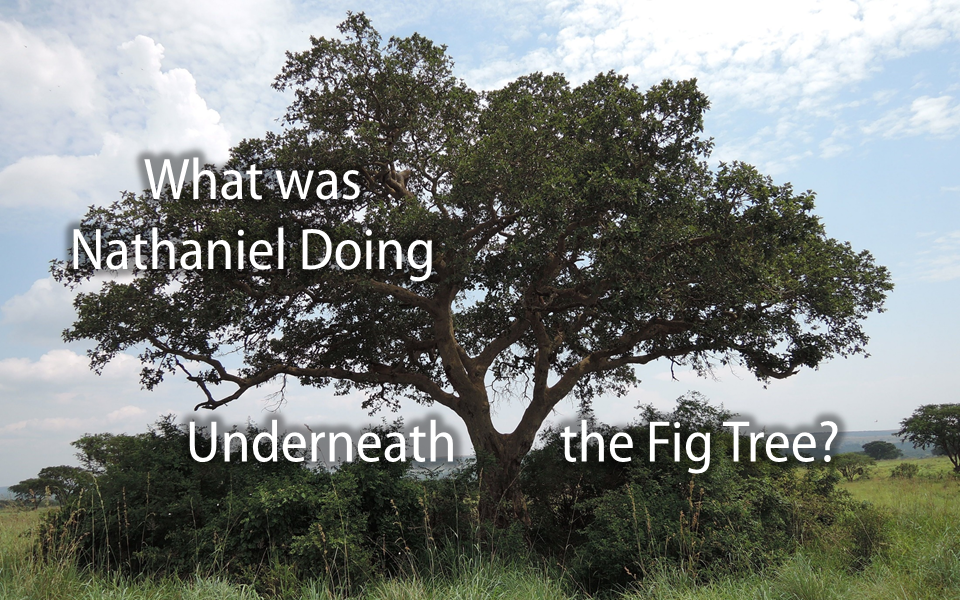
So wouldn’t it be really helpful if we could just have a way of looking at someone while they sat underneath a fig tree and be able to know just from that that here is a person in whom there is absolutely no guile or deceit? Why, instead of carrying out job interviews or political debates, we could just make people sit under the tree for a little bit and we could all just know that here was somebody who had integrity and complete honesty. Just think of the incredible benefit of such a straightforward test!
Now, some people might say that that could not work for ordinary people. I mean, sure, Jesus might have been able to discern something about the character of Nathaniel by seeing him under a fig tree, but that’s Jesus. Jesus, as Nathaniel himself confesses, is the very Son of God! Surely Jesus can see things that other mere human beings cannot. But Jesus himself says that it is not extraordinary that he saw this, which suggests that it really was something that was visible to anybody.
So what was Nathaniel doing under that tree? We have one possibility that comes to us from the traditions of rabbinic Judaism which developed strong traditions around the study of the Torah, that is to say of the law in what we would call the Old Testament. In rabbinic Judaism, there is a strong tradition of people (traditionally men) gathering to discuss the Torah. They will read the scriptures and then get into these extended discussions and arguments about the meaning and the application of various passages.
These sorts of discussions are famously contentious, so much so that it became a proverb that when you have two Jews you will have three opinions. But this is not seen as a negative thing, it is seen as a way of people engaging with the text and wrestling with that variety of opinions. And it is believed that deeper truth is always found by engaging in that kind of contentious discussion. What’s more, it is seen as a great blessing to be able to engage in such an activity, as Tevye sings in Fiddler on the Roof:
“If I were rich, I’d have the time that I lack To sit in the synagogue and pray. And maybe have a seat by the Eastern wall.
“And I’d discuss the holy books with the learned men, several hours every day. That would be the sweetest thing of all.”
So this way of studying the Torah is a longstanding beloved Jewish tradition and apparently, back in the Middle Ages, this activity was sometimes referred to using an odd phrase. It was called sitting underneath the fig tree. And so it has been suggested by some that that is what Nathaniel was doing, studying the Torah, when Jesus saw him. And there is something to be said for such an interpretation. That would be the kind of activity that might just indicate something about Nathaniel’s character.
But there is just one problem. There are no indications that this kind of activity was a part of common Jewish life in the time of Jesus. The study of the Torah became much more popularly and widely practiced only after the temple was destroyed in 70 AD. While the temple still existed, the focus of Jewish life was on that instead of on the scriptures which few could read (as literacy was very low) and even fewer could possibly obtain a copy. So it’s unlikely that Nathaniel was engaging in that specific activity, at least not as it later came to be practiced.
But I still think there might be a connection to that. Where, after all, did that figure of speech – speaking of studying the Torah as sitting under a fig tree – come from? It must come from the Scriptures themselves, specifically from a promise that is repeated a few times in the Old Testament. The promise goes like this: “They shall all sit under their own vines and under their own fig trees, and no one shall make them afraid.” (Micah 4:4) In many ways, that is one of the key promises of the Old Testament. It envisions a nation where every family has its own little piece of land with the iconic fruit trees that are common in that part of the world. It envisions an agricultural society where everybody has the basics of survival.
I know that might not quite sound like a utopia to us – we would probably look for a bit more than just the basics, but I guess that just shows you how tough life could be back then if their big dream was just to be able to have their own vine and fig tree. You know how we sometimes talk about the American dream, well that was kind of the Israelite dream. And apparently, as a part of that, their big dream for a bit of leisure time was to be able to sit down underneath their own fig trees for a while.
And that’s why it later became an expression for discussing the Torah. When, in later ages, Jewish men became prosperous enough to have a little bit of leisure time they, like Tevye, decided that the very best way to use that time was to spend it discussing the Torah. But, like I say, that was all in the future. What might it have looked like in Jesus’ day when literacy was rare and Torah scrolls even rarer?
I would suggest that, before people had to argue over the written words of the Torah, they just struggled with living it. In Nathaniel’s day that most basic Israelite dream of every Israelite family having a fig tree and a vine to live under had become way out of reach for huge numbers of people. People had lost their family farms and vines and fig trees. Huge numbers in the population were consigned to living as slaves or just getting by working as day labourers. But maybe what Jesus had seen in Nathaniel was that he was trying to keep that ancient Israelite dream alive.
It’s kind of interesting that Jesus refers to Nathaniel as an Israelite. Do you realize that that word is rarely used in the New Testament? It had become out of date, kind of like the dream of everyone having their own vine and fig tree had gone out of date, in Jesus’ day and the normal word that would have been used was Judean or Galilean – which is to say that they had begun to call themselves what the Romans called them. But Jesus sees Nathaniel as an Israelite sitting underneath a fig tree.
Nathaniel, I suspect, has been doing what he can to keep that dream alive. He has been reminding people of God’s promise – that “They shall all sit under their own vines and under their own fig trees, and no one shall make them afraid.” And clearly Nathaniel has not just been looking out for himself and his own fig tree, he has been shouting to all who will listen that it is God’s intention and plan that every family should be able to have that. He has been demanding what God has been demanding and he has been demanding it for everyone.
Nathaniel was clearly someone who didn’t hesitate to say what was on his mind. When Philip told him, “We have found him about whom Moses in the law and also the prophets wrote, Jesus son of Joseph from Nazareth.” Nathanael came right back with, “Can anything good come out of Nazareth?” Those are not the words of somebody who lets the worry that they might offend somebody get in the way of speaking his mind! So when he saw all of the ways in which the nation no longer functioned as God had intended, you can bet that Nathaniel didn’t stop to calculate how dangerous it might be for him to speak up about that.
That is what Jesus saw – that is what he was referring to when he said that he saw Nathaniel underneath the fig tree. But, if we understand that, are we any closer to finding the secret method to discover the individuals among us – maybe especially the leaders and potential leaders – who are without guile and deceit?
Well, it likely never is going to be easy to discern. The human heart has ever been creative at finding new ways to deceive, but I believe that one thing we can do is be on the lookout for people who remind us of this character of Nathaniel in this passage. We need, first of all, someone who is believes in the promises of God – that is to say, someone who has not given into the cynicism of this world, who has not stopped believing that, even if it seems unlikely right now, there will be vines and fig trees for all, that God can make it happen. We need that kind of faith.
And we also need Nathaniels who are not in it just for themselves – not just for their own fig tree but who are willing to hold out for the whole community to have what they need to survive. Oh, how much we are in need of that these days!
And, yes, we need Nathaniels who are not afraid to speak up and share the truth as they see it – even if it is the truth about Nazareth that no one wants to hear – no matter what it might cost.
We need Nathaniels and the truth of the matter is that we can’t really wait for one to show up. We need to be looking for them underneath the fig trees of this world, which means we need to start spending time under those fig trees ourselves. That is why Jesus found a kindred spirit in Nathaniel, he was doing the same thing. To find Nathaniel, we need to be Nathaniel.
Daily Devotion for January 14, 2021
Daily Devotion for January 12, 2021
Daily devotion for January 7, 2021
Daily Devotion for January 6, 2021.
Daily Devotion for January 5, 2021
By Another Road
When the Crazy Man Grabbed Mary’s Baby
Watch the YouTube video version here:
Hespeler, 27 December 2020 © Scott McAndless
Isaiah 61:10-62:3, Psalm 148, Galatians 4:4-7, Luke 2:22-40
It has been over twenty years, but I remember very clearly what it was like after the birth of our firstborn. Everything that led up to it had been frantic and chaotic as is often the case. For the birth, we had to rush to a hospital that was about two hour drive away. And then there was all of the stress and strain and frustration of dealing with the labour and birth, things that were completely unknown to us. And then came the struggles and the worries about feeding. It was all just so disorienting. I mean, don’t get me wrong, it was wonderful and it was joyful, but you just have this sense of your entire world being turned upside down.
And so, what did we first-time parents crave once things began to settle down after all that? We craved some sort of return to routine and normalcy. We wanted to establish regular feedings, baths and bedtime routines. And we wanted to make sure that our child got everything that she was supposed to get in our culture. We wanted to make sure that our child’s first Christmas was just perfect. We insisted on that photograph with Santa Claus even if she was totally not into it. We wanted to make sure that our child had all of the right children’s books and children’s toys of the day. And of course, we had to take those monthly pictures to show how our child was growing. I mean, those were the kinds of things that parents did twenty years ago. I realize that the priorities might change in different eras of time, but that desire to make sure that your child gets all of the normal things that every child gets seems to be there for a lot of first-time parents.

And I suspect that this has been true for human parents since the dawn of time. I suspect that it was true for Mary and Joseph. After all of the chaos and disruption of traveling from Nazareth to Bethlehem in the midst of a census, after all of the frantic worrying when they discovered that, when the time came for his birth, they had no place to lay their child and they had to resort to putting him in a feeding trough, after the strange visit from the shepherds who babbled how about visitations from singing angels, I suspect that they were looking for some way to establish some normalcy for their firstborn child.
And, in fact, that appears to be a central focus to our reading this morning from the Gospel of Luke. In this passage, we are told that Mary and Joseph took their son up to the temple in Jerusalem, just a short journey from where they had been staying in Bethlehem. And the obvious question is why. Why did Mary and Joseph do that at that time? And actually, that’s a question I really don’t need to ask, do I? Because Luke doesn’t just tell us once why they did this. I counted; he tells us five times why they did it. Five times in one pretty short passage.
He says that they did it, and I quote, in order to act, “according to the law of Moses,” that it was what was “written in the law of the Lord,” that the sacrifice was “according to what is stated in the law of the Lord,” that they brought the child because it was “customary under the law,” and that, when they were done, “they had finished everything required by the law of the Lord.” Hmm, do you suppose that what they were doing had anything to do with fulfilling the requirements of the law?
Now let me tell you something about reading the scriptures. When, in the Bible, something gets repeated even just once, that is significant. You can be sure that biblical authors are trying to draw your attention to something when they repeat themselves. So I can tell you for certain that it is not by accident that Luke tells us five times that they were there because it was required of them in the law.
So the question is why does Luke want us to notice that? What point is he trying to get across? I suspect he is trying to tell us a few things. For one thing, he doesn’t want us to miss the fact that Jesus was raised as a Jew just like any other Jew of his time and place. It is possible that, by the time this Gospel was written, a number of Christians had started to forget that. He wanted his readers to understand that the foundation of their faith in the Old Testament scriptures should never be forgotten.
He was also trying to make the point that the Apostle Paul makes in our reading from his letter to the Galatians, that “when the fullness of time had come, God sent his Son, born of a woman, born under the law, in order to redeem those who were under the law.” Jesus had to know what it was to live under the law in order to offer liberty that can in some way transcend the law.
But I also get the sense from this story of poor Mary and Joseph, both still reeling from all that they have experienced over the last little while, looking to find some sense of normalcy in their life by just engaging in the normal cultural practices of their people and making sure they do them right. It feels like a very human parenting moment to me. And I’m sure that they were really just looking forward to blending in, to the anonymity of the crowd at the temple – to just be like any other parents who had come to do what was required under the law and then to just be on their way.
And so, can you imagine what they must have felt when, all of a sudden, a crazy old man just started walking towards them and calling out to them. His name was Simeon, but they didn’t know that. He was old, so old that he literally expected that he might just drop dead at any minute. But he had been waiting for something and, somehow, he had had a vision or heard a voice or dreamed a dream that told him that if he got up and went into the temple on this day, he would see what he’d been waiting for all this time. Like I said, a crazy old man. And it’s hard to imagine that Mary and Joseph thought anything but that had he just walked up and took the child out of Mary’s arms.
It doesn’t say that he asked for permission to take the child, just that he took him. Did you notice that? You can bet that Jesus’ parents did. And as he stood there holding the infant, can you imagine how Mary hovered around and maybe tried to tell him how to support the baby’s head and be careful not to startle the boy? And then Simeon looked down at the child and essentially said, “Okay I am ready to die right now.” I can’t imagine that set their hearts at ease! I’ll bet Joseph asked himself if he shouldn’t demand that this nutcase put down his baby this instant!
And while all this was going on, another person came running up – a woman who, if it is possible, looked even more ancient than the man. She at least didn’t try to grab the baby but she, oddly, didn’t even speak to the parents. She just took one look at the boy and turned around to speak to everyone else who had come to the temple that day to tell them that the boy, this tiny little child, would bring about the redemption of Israel. Any thought that Mary and Joseph may have had of a retreat into normalcy and anonymity was going to be a lot harder than they had imagined.
So, does all of this have anything to say to us where we are right now? I think we all have moments in our lives when we, like young parents after all the excitement of the birth, crave a little bit of routine and a little bit of normalcy. That is natural. I think it is something that we’re all craving a fair bit right now. After celebrating a most unusual Christmas, after enduring so many months of unusual life, I think we would all like to find a way to get back to some sense of routine. And I do believe that God graciously does offer us times like that in our lives because God knows that we need them.
But the story of Mary and Joseph in the temple teaches us that there are times when God wants to guide us into a new way. The two people who come up to Mary and Joseph in the temple represent two ways in which God prompts us into new directions. Simeon, we are told did not usually hang around the temple, but he had been specially prompted by the Spirit to go there because God had something to show him. So Simeon represents the leadership of the Spirit.
I truly believe that God’s Spirit does have ways of doing that to us. God’s Spirit acts within us, ever prompting us to step out into new directions and to take new risks. I know we often don’t want to hear that voice speaking within us, we would like to play it safe and just go with what we know. But Simeon teaches us that great wonders and glory are to be found by listening to that disrupting voice within.
Anna, the old woman, is different. She is no stranger to the temple, in fact she basically lives there. She has done so ever since her husband died after seven years of marriage and she has been a widow for a very long time. But her presence there has had a very important purpose because she is a prophet. And that means something very particular. For centuries, the prophets in Israel have been those people who sat near to the institutional authorities – near to the kings and governors and priests – and who confronted those authorities to challenge them when they were wrong and to correct them.
So Anna may have spent her days in the temple, but I can almost guarantee to you and that she was not loved by the priests or other temple authorities. She was there to goad them and to speak the inconvenient word of the Lord. As a prophet, Anna was also different from Simeon in that she was not only dependent on that inner voice of the Spirit, but also on the traditions and laws that demanded that the people act better and especially that they take care of the most vulnerable among them.
Like I say, a lot of people are very uncomfortable around prophets like Anna. And it is precisely because they do not allow us to do what Mary and Joseph were trying to do – just get on with the routine of life and not think about the bigger questions that need to be addressed. But God sends us Annas. God challenges us with big ideas like, “the redemption of Jerusalem,” that Anna spoke to all the people about. This is not because God is angry at us, but rather because God loves us so much that God wants us to be the best that we can be, both as individuals and as a society together. So God will send us prophets to call us to work for these grand ideas.
I know that we are all like Mary and Joseph today. We would like to put aside the disturbing wonders of the times in which we live and just go back to ordinary life. But God will continue to speak to you through the Spirit and prompt you to step out and to risk.
I would counsel you to listen to that voice of the Spirit. You may have already heard it, but you have tried to suppress it and tamp it down. Give that voice a chance. And, while you’re at it, open your heart to listen to the Annas who are speaking in the world today and who are challenging us to address some of the injustices and systemic problems of our society because redemption is still needed for our city.
You might think that it is a bother and annoyance that God would ask these things of us, just like Mary and Joseph found Simeon and Anna to be a bother and annoyance, but it is actually a great privilege to receive such messages and to be given the opportunity to be part of the incredible things that I promise you God is actually doing in our world today.