Today’s daily devotion
Here's Scott's daily devotion.
Continue reading »
Watch the sermon video here (Note, the sermon was initially removed from YouTube for violations. I appealed and it has now been restored!):
Hespeler, 31 January 2021 © Scott McAndless
Deuteronomy 18:15-20, Psalm 111, 1 Corinthians 8:1-13, Mark 1:21-28 (click to read)
I imagine that, by this point, we have all seen far too many viral videos that go something like this. Somebody walks into a store and he (let’s just say that it’s a he) is not wearing a mask while everyone else around is. One of the employees, a minimum wage clerk, comes up to him and politely and respectfully asks him to put on a mask – even offers to give him one free of charge.
And it is this that sets the person off. We’ve all heard the speech in some form or other by this point, so we all know how it goes. “You’re not going to get me to put on one of your stupid masks,” he shouts, “because I know the truth. I know that this whole virus thing is nothing but a hoax. It was cooked up by Bill Gates and George Soros in a laboratory in Wuhan China for the sole purpose of making sure that everyone is implanted with a microchip by making them get a vaccination. I know that the numbers of cases have been artificially inflated and that the deaths are not real. I know that the virus is actually caused by the erection of 5G towers.
“I know that you just want me to put on a mask so that it cuts off the oxygen to my brain and keeps me from seeing the truth. You’re not going to get me to put on a mask and you’re not going to force me to take one of your vaccinations because I know my rights.
“I also know that the vaccination is the mark of the Beast and that if I get it, I will never get into heaven. I know I don’t need a mask and I don’t need a shot because I know that Jesus is enough to protect me and I know you cannot deny me my religious freedom.”
Like I say, we have all heard people talk like that or seen videos or heard reports of it. And how do we react? There is, I know, a lot of anger and frustration at such people and with good reason. These are people who, with their attitudes and actions, are making this whole pandemic situation worse. We’re also aware that if too many people listen to these kinds of weird ideas, we might not get enough people vaccinated to achieve the herd immunity that we need to get out of this thing.
We may also feel a certain level of embarrassment when such people bring up their Christian affiliation and Christian beliefs. How embarrassing to know that there are Christians who believe such things and use their faith to justify such irresponsible behavior. Why would anyone want to be associated with people who do things like that?
But apart from our emotional reaction, we also need to think practically about people who talk this way. There is just too much that is too problematic in such ideas going around. But what can we do about it? What kind of response is really going to make a positive difference?

Take a moment to listen to one of these diatribes because there is something going on there that is really important. The people who say these kinds of things are talking about what they know. They know things about the pandemic. They know things about the vaccine and about certain political agendas. Most importantly, they know things that you don’t know.
And, I know, you are thinking yeah, but the things that they know aren’t true, they’re based on half truths, distortions and fantasies. But, you see, on a certain level, that doesn’t matter, because they know them. They have access to what they perceive to be secret knowledge. And this leads to an inevitable result as they become puffed up on knowledge. Knowledge, especially secret knowledge, is quite a drug. It doesn’t matter who you are or where you come from, it doesn’t matter if you’re rich or poor, well educated or a school dropout, if you have secret knowledge you can see yourself as better than everybody else.
And so, people who have secret knowledge can feel completely justified doing socially or even morally unacceptable things because they know what other people don’t know. That doesn’t just apply to conspiracy theories about the pandemic but, as we’ve seen, conspiracy theories about elections and Q Anon and many other things. In fact, in many ways, the very idea of having secret knowledge is one of the main problems we seem to be facing in our society at this particular moment. So it would be really helpful to have some way to counter this dangerous trend.
It is actually the same kind of problem that they had in the church in Corinth. They weren’t arguing about masks, of course, but they were arguing about meat. You see, in ancient times, they didn’t have grocery stores or butcher shops like we do. There was really just one place to get meat. All of the animals that were slaughtered in the city were slaughtered as sacrifices in the temples dedicated to various gods.
But, fortunately, the gods didn’t really require very much of this meat to eat. In fact, generally only the parts that people couldn’t eat – bones, fat and various organs – were actually burnt up on the altars. The rest of the meat was available for people to eat. Most of it was eaten by the worshipers themselves, of course. And a generous portion went to the priests who so expertly butchered the animals. And what the priests and their families couldn’t eat, they generally sold out of the back door of the temple.
But that meant that the only meat you could buy in a city like Corinth came from the temples of pagan gods. And there were some Christians there who knew something. They knew that, since they had decided to follow Jesus, they were not supposed to have anything to do with any other gods. So they vowed that they would never eat meat anymore. What’s more, they sharply denounced and argued with other Christians who did eat meat because they knew that they were honouring these other gods by doing so.
But here was where the problem got a little complicated. The other Christians – the ones who were eating meat also had knowledge. They knew that all of these pagan gods like Zeus and Apollo and Dionysus weren’t real gods. And if they weren’t real gods, if they were nothing more than idols, then what did it matter if the hamburger I want to eat for supper was originally dedicated to such a false god before it was butchered? And so, these Christians, based on what they knew, went ahead and ate their burgers with a clear conscience.
So, what we had in this church in Corinth was two groups of Christians, both of whom were sure that they knew better than the others, and they were arguing on the basis of that. And, quite obviously, this continual claim heard from both sides that, “We know the truth,” was not making anything better but only making things worse.
And the Apostle Paul heard about what was going on and, in his letter, attempted to guide them out of what had become a dead-end argument. And it is in that context that Paul offers this wonderfully profound but simple piece of advice: “Knowledge puffs up, but love builds up.” You see, Paul understands that knowledge is a good thing. Knowledge that is based on good evidence and sound reasoning can indeed lead us towards all truth. But he also understood that knowledge had this effect of puffing people up.
Paul knew that when people argue over who knows best, all they really accomplish is puffing themselves up while they seek to deflate others by proving that their knowledge is unsound. But the problem is that that is an argument that nobody wins, and that people can only lose.
You see, if you are convinced that you know something that somebody else doesn’t know, whether your knowledge is sound or not, that has the effect of making you feel puffed up, better than others. But the other person who also feels that they know best also feels puffed up.
Now, in the argument that follows, we may think that we are arguing over facts and evidence, but that is not usually what goes on. People generally only argue in order to feel good about themselves, in order to continue to feel puffed up or to feel even more puffed up. And when that is all that it’s about, well, it really ends up being all about so much hot air. Because knowledge puffs up, knowledge alone is rarely able to resolve these kinds of disputes.
And so it is that Paul counsels the Corinthians to take another course – the way of love. He’s basically telling them that, while they will not win people over with facts, they may with love. Now, what he is asking of them is hardly easy. It is way harder to love someone that you disagree with than it is to argue with them. He even suggests that, out of love, they may even need to compromise and bend. But, he argues, it is really the only way that anything might change in the toxic circumstances in which they find themselves.
Now, I don’t want to go into the specific advice that Paul gives to resolve the situation in Corinth, but I would like to take his basic principles and try to apply them to the toxicity that we see in our society in these extremely divisive times. If you have people in your life that you care for who have fallen into dangerous or destructive conspiracy theories, you have probably already figured out that there is little to no point in arguing with them over the facts. When they are puffed up with knowledge, Paul is right, that never works.
As a result, what people tend to do is not engage. When you see a social media post based on some conspiracy theory, you just quickly scroll on by, not daring to question them, or maybe we even block them out of our social networks entirely. Sometimes, sadly, we feel like we have to block people that we love right out of our lives.
Now, there is some rationality to that response. It is true that there is little to no point in engaging such people on the level of knowledge. But that doesn’t necessarily mean that there is nothing that we can do. Here are some things that we can do.
First of all, there can be a time and place to challenge the false knowledge you encounter. When you see a blatantly false social media post, for example, there can be a place for you to respectfully offer up a different point of view and to back it up with some facts. But understand that there is really only one reason to do that.
You are quite unlikely to change somebody’s mind if they are all puffed up with knowledge. But, by not allowing the falsehood to stand unchallenged, you may prevent it from spreading further by making sure that somebody else, who hasn’t yet bought in to the secret knowledge, doesn’t see it without it being challenged. So, you can post the facts, but then you are probably best not to try and engage further.
But where you can engage and actually possibly make a difference for those who have fallen into false knowledge, is only when you can engage in love. And that is not easy. It can be an awful lot of work. It may mean putting in the effort to try and understand some of the things that are going on in somebody’s life that are making them seek for meaning or purpose in what they see as secret knowledge. It may mean engaging their fears or even their hatreds from a loving point of view. It’s not an easy thing for anyone to do. But, Paul would tell us, it is the only path to real change.
There has been a lot of talk in recent weeks of people finally giving up a certain conspiracy theories. Those who believed in Q Anon or other related election conspiracy theories had been so certain, after all, that Joe Biden would never become the president. The mere fact that that now has happened did lead, for some of them, to some real soul-searching and to asking themselves whether or not they might have been duped.
That is a somewhat promising development, though it is hard to know where it will lead. But I do know one thing, if all people who begin to question the false knowledge that they were so certain was true are only met with derision and a massive chorus of “we told you so,” chances are that they will only retreat back into their old certainties or that they will find some new conspiracy theory to hold onto.
But if they are met with some compassion and understanding, if they are met with love, as costly and difficult as that may be, what possibilities might there be then? Because knowledge may puff up, but love really does build up.
Hespeler, 24 January, 2021 © Scott McAndless
Jonah 3-4, Psalm 62:5-12, 1 Corinthians 7:29-31, Mark 1:14-20
The one thing that everybody knows about Jonah is the big fish incident. Everybody knows that he got swallowed by a fish (or maybe it was a whale because it’s not like the ancient people of Israel knew the difference between fish and marine mammals) and that he survived and came out three days later. Many people think that that is the most unbelievable part of Jonah’s story, but they’re actually wrong. There is something that would have been far more fantastic for ancient Israelite readers than the whole whale of a tale. But in order to understand that, you need to understand more about Jonas’ story.
Jonah stood just outside the massive gates of the city of Nineveh. He looked through them and out over what seemed to be an endless sea of houses and industries, streets and a constantly churning crowd of people and beasts of burden. There were more people than Jonah had ever seen together in his life before.
His nose was assailed by terrible odours – the smell of tanneries and latrines, manure and burning pitch. But actually, the smell wasn’t what bothered him the most. To tell the truth, it was a bit of a relief to smell something that wasn’t the stench of rotting fish that he had been totally unable to get out of his clothes and skin and hair. No, he didn’t hate them because of the smell, had hated them because they were Assyrians.
These were not people, they were bloodthirsty animals, all of them. Just looking at them he could tell that they all loved nothing more than raping, pillaging, looting and killing. And, what’s more, he knew in his heart of hearts that they would never change. They had spread like a cancer over the face of the earth.
They had destroyed the Kingdom of Israel and taken its people away into exile. They had come this close to doing the same to the Kingdom of Judah. And those were just two examples. How many other tribes and nations and peoples had suffered under the genocidal Assyrians? And yet Yahweh, the God of Israel, had sent Jonah to preach to them. “Go at once to Nineveh, that great city,” God had said, “and cry out against it; for their wickedness has come up before me.”
It was all the same to Jonah, of course, if his God wanted to destroy the Assyrians. He had been praying for that for years. But he worried about the reason why God would want him to warn them. He knew that Yahweh was “a gracious God and merciful, slow to anger, and abounding in steadfast love, and ready to relent from punishing.” The thought that his God might just squander that kind of grace and mercy on the bloody Assyrians – well that just made him feel sick! He wanted nothing to do with it.
So Jonah had gone in exactly the opposite direction – had found a ship heading for Tarshish and got onboard. As he watched the shores of the Promised Land recede, he had been so sure that he was free, that he had escaped the presence of Yahweh.
He had been so wrong. He knew that what had happened to him next would haunt his nightmares, likely for the rest of his life. When he closed his eyes sometimes, he could still feel the movement of the unceasing waves in the storm. And the beast that had swallowed him, the sight of it would remain etched in his memory for the rest of his life just like the stench of it, he suspected, would never leave him.
And so when, by some miracle that he would never understand, he actually survived and saw the light of day again, he knew that active disobedience was no longer an option. But surely there was another way for him to make his feelings clear. Oh, he would go and he would do as he had been ordered, but God hadn’t said anything about how the job was to be done.
So here Jonah stood outside the gates of the great city. The message he had been given was clear and succinct. And, as a prophet who had often preached the word of the Lord to the people of Israel, Jonah knew a thing or two about how to speak persuasively and convincingly. He determined to forget everything he had ever learned about that.
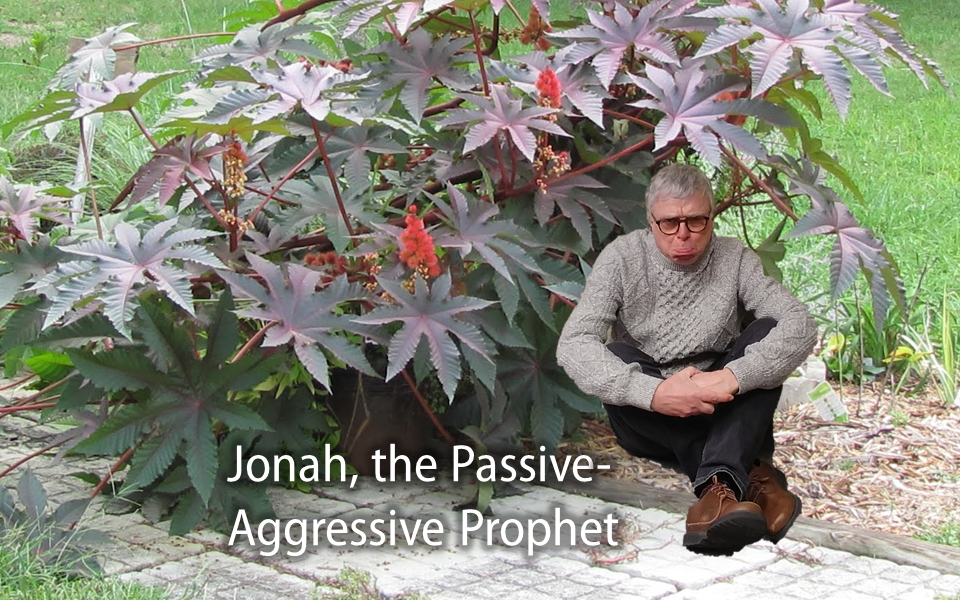
So Jonah took a deep breath, straightened his tunic and took one step into the steady stream of foot traffic passing through the gate and... immediately stumbled into a burly trader. “Hey, watch it buddy. I’m trying to walk here!”
Jonah sprang back embarrassed and confused. He just felt so disoriented in the midst of such a mob of people. He mumbled a few words of apology which, of course, only seem to offend the trader even more. “Speak up, you Israelite hick. Don’t you know how to speak to your betters?”
Now that got Jonah mad and there really is nothing quite like an angry Jewish prophet. “Oh yeah? Oh yeah?” he yelled, “Well, you know what? Um, uh, forty days more, and Nineveh shall be overthrown!”
The man just laughed, but Jonah, it seemed, had his message. He realized, with a prophet’s certainty that those were the words that Yahweh had sent him to deliver. But, there was nothing in his contract that specified how those words were to be delivered. So this is what Jonah did. He continued to walk into the bustling city and, as the day went on, he had various encounters with the locals and just sort of slipped the line into his conversation.
He purchased a little bit of street food at a small counter – it was nasty Assyrian stuff to his Israelite palate, but he was hungry so it would have to do. He haggled for a price and was sure that the savvy vendor was cheating him, and so, as he walked away he just casually said it over his shoulder. “Oh, and by the way, forty days more, and Nineveh shall be overthrown!”
By the end of the afternoon, he had given the message to about 20 people. He was feeling tired and parched and so he found a nice little ale house on a corner. He went inside to discover that it was filled with some locals who were taking a break. Jonah figured that he had been working pretty hard too, so he pulled up a stool and joined them.
About an hour and several rounds later, Jonah was feeling as if he was surrounded by a bunch of new friends. But, Jonah intended to be outside the city gates before nightfall so he swallowed the drags of his ale pot and sadly bid them adieu. “Hey, friends, it was nice to meet you. It almost makes me sad to know that...” And with that the entire room joined in the chorus, “forty days more, and Nineveh shall be overthrown!” The laughter echoed as he went back out into the streets.
And that was it. The city of Nineveh was so huge that it took three days for anyone to cross it. Jonah had barely made it into the business district and had come nowhere near the royal palace and the heart of the government. He didn’t care. The orders that he had been given had been carried out to the letter and only to the letter. He had gone into the city and he had spoken the warning of the Lord. And now Jonah was determined to do one thing. He would wait and he would see it all happen. He would watch Nineveh burn and he would enjoy it.
But, inside the gates of the great city, something was happening that Jonah would never believe. Somehow all of the people who had met with Jonah during that strange day remembered what he had said. And they told a few friends and their friends told a few friends. Before long the words that Jonah had said so casually, “forty days more, and Nineveh shall be overthrown!” seemed to take on a truly menacing tone, as people overheard it being passed around on the streets and marketplaces. A few people started to become alarmed. Maybe there was something to this crazy warning?
Word began to spread to the upper classes and, before long, it was brought even into the palace of the great king. By this point it had also become mixed up with various rumors, that always seemed to swirl about the city, of the attack of this or that enemy. People began to openly speculate about whether the Assyrian Empire had finally gone too far in inflicting pain and suffering upon the nations of the world. And so, by the time it came into the king’s court, the king felt that he had no choice but to do something that would stave off the panic that was beginning to form. He could not afford another time of unrest.
So the king put on sackcloth and sat in ashes and made a show of repenting of many of the destructive policies of the empire. A fast was proclaimed throughout the city and people began to talk about a new beginning for the people of Assyria.
Jonah was ignorant of all this however. His message proclaimed, his assignment accomplished, he could have left and returned to his own country. But Jonah was not about to do that. Did I mention how much he hated the Assyrians? He had vowed to himself that he was not going anywhere until he had seen the complete and utter destruction that he had foretold. He found a nice spot on a hill overlooking the great city and built himself a small shelter. He settled in to wait to see it all come to pass.
Now, forty days is a very long time to wait for anything, but Jonah didn’t care. The sight of Nineveh in flames would be recompense enough for everything that he had put up with throughout this whole miserable affair. Oh yes, Jonah would wait.
But then, when forty days had come and gone, and the city was still standing, Jonah kind of lost it. “O Yahweh! Is not this what I said while I was still in my own country? That is why I fled to Tarshish at the beginning; for I knew that you are a gracious God and merciful, slow to anger, and abounding in steadfast love, and ready to relent from punishing. And now, O Yahweh, please take my life from me, for it is better for me to die than to live.”
He sat and he sulked. And while he sat there feeling oh so miserable, a castor bean plant grew up and sent its vines to climb on the shelter that Jonah had built. And, when it spread its broad leaves, they sheltered Jonah from the sun and made his day almost feel pleasant. But then, the very next day, the castor bean plant turned brown and shriveled and died away. And on that day Jonah felt the heat of the sun all the more keenly. And that’s when Jonah got really angry and he cried out to God in frustration, “If you are going to treat me like this, then kill me now!”
Yes, Jonah was that angry. But even as his anger burned, a question began to bother him. Why was he so angry? He was angry about a plant – a plant that didn’t even exist a couple of days ago and he was angry that it was dead. It didn’t make any sense, but he really did care. He cared about that castor bean plant that had made one day of his life just a little bit less miserable.
And he began to wonder, if he could care that much about a bean plant, enough to want to die because it was dead, then was it really so ridiculous that the God of Israel might care about the people of a city, maybe especially the common people and even the animals who really had nothing to do with the policies of the Assyrian king and his armies – was it really so ridiculous that God might be willing to spare their lives?
I think it is perfectly clear that the ancient people of Israel for whom the Book of Jonah was written understood that the story was a fantasy. What would have convinced them of that? Not the part about the big fish. There was something far more ridiculous than that in the story. The most unbelievable part of the story was the mere idea that the Assyrians might have repented of all their evil.
They were almost universally despised, hated and feared. And they never showed any sign of having any regret for what they had done. They never repented and, in the end, they suffered destruction by the Babylonians in their turn. So the people who first read this story knew very well that it hadn’t happened and that it couldn’t have happened.
So what is the point of the story? I suspect the author is asking his readers to ask themselves a difficult question, “How great is the grace and mercy of our God and could it possibly even extend to people as evil as the Assyrians, if they were to repent? And Jonah, in all his passive aggressive anger, is the representative of the readers of this story who are scandalized at the very idea of God’s grace and mercy.
This book is meant to make us think long and hard about the hatred we hold for those who have hurt us or who have hurt the people we love. It is meant to teach us about how the grudges we hold eat away at us and keep us from being our best selves – how they trap us underneath a miserable shelter as we put our lives on hold waiting for the kind of punishment of our enemies that really serves no good purpose and only takes a little bit of the pleasant shade out of our world. This story is there to make you think again about the hatreds that you hold close to your heart and how very useless they are.