Maundy Thursday Service
Plan to join us at 7:30 pm, this Thursday.
Continue reading »
Hespeler, March 24, 2024 © Scott McAndless – Passion Sunday
Mark 11:1-11, Isaiah 50:4-9a, Psalm 31:9-16, Mark 14:43-52
There is one small incident in the Gospel of Mark that I have always found fascinating. I’m not the only one. People have debated for centuries about the meaning of the strange appearance of the young man in the garden who is wearing only a linen cloth and who then runs away naked.
The incident is mentioned in none of the other gospels, but it stands out with such distinctiveness in this one that people can’t just ignore it. It has led to endless speculation.
Some people suggest, for example, that this young man is an appearance of Mark himself, the author of the gospel, and that the author is saying that he actually was there either historically or perhaps symbolically. It is an interesting idea to be sure, but there’s really no evidence that that is who it is supposed to be.
Other people have noted that the appearance of this young man may be symbolic of the early Christian practice of baptism. Apparently, the common practice in the earliest church was for candidates for baptism to present themselves dressed in a simple white linen cloak and that, after the baptism had been completed, the robe would be stripped off and the newly baptized person would leave in the nude as a symbol of new birth. Interesting idea to be sure. I’m not going to suggest that it is a practice we ought to revive though!
People have also noted a very odd resemblance between this man in the garden and the young man who appears dressed identically in the tomb of Jesus at the end of Mark’s Gospel. Surely that cannot be a coincidence! Mark must want us to make the connection.
So, there is a lot of speculation, but no clear answer. And so, I set out to figure out what this strange streaker is doing in the garden. Scholars have written a lot about it over the years. So, I did a lot of reading and some of it was helpful.
For example, I read this one paper in which this scholar argued that this guy is in the story as comic relief. And, you know, after reading it, I think I kind of agree, he is there to make us laugh. But do you want to know what the funniest part of all of that was? The scholar[1] took 14 pages of dense theological and literary argument to come to the conclusion that this episode is comic relief. And when it takes that long to explain a joke, you have to wonder how funny it really is!
The paper argued that the keyword in the little story may be the first verb: “was following,” as in, “A certain young man was following him.” The word is important because it is a keyword, repeated often in this gospel. “Following,” it could be argued, is the most important thing that anybody does in this gospel. The choice to follow Jesus is what makes all of the disciples into disciples. And that also seems to include the women who are said to have followed Jesus to Jerusalem. So, the mere fact that this youth is following Jesus puts him in important company.
But there is more than that. Mark uses a particularly intensive form of the verb here – a form that essentially means to follow closely. He only uses that word in one other place in his gospel when he refers to three key disciples, Peter, James and John, following Jesus into the home of Jairus. This suggests a particularly close connection with Jesus.
And then there is the tense of the verb. It is in the imperfect tense which, in Greek, refers to an action in the past that is continuous. In other words, this youth did not just follow Jesus once on this occasion. It was something that he had been doing for some time. It can also refer to a habitual practice. It could even be saying that he was kind of obsessed with following Jesus.
All of this makes me suspect that Mark does not want us to underestimate the importance of this young man or to think of this incident in isolation. We need to see it as an essential part of his overall narrative. And so that made me wonder where else this young man’s following of Jesus might have intersected with the story of Jesus told in Mark’s Gospel.
Imagine that you are the person who is next in line to be baptized by John the Baptist when Jesus goes down into the water. Even though the place by the Jordan River is far away from any human settlement, people have come here from Jerusalem and all Judea to hear what the Baptist has to say and to receive his baptism of repentance. And nobody wants to be baptized by one of John’s disciples. They want the authentic experience and so they wait in line for hours to each get their few minutes in the river with John.
But when Jesus is baptized, everything suddenly grinds to a halt. There are some who say that clouds in the sky are ripped apart. And when a dove flies down from a nearby tree, many read that as a great omen as well. There are some who insist that they hear a rumble of thunder, which others identify as the very voice of God. But whatever signs each one sees, and however they interpret them, there is an immediate consensus that there is something different about this Jesus. Even John is rendered silent as he stares at the man walking out of the stream and, if you know anything about John, that is a wonder all its own.
And you are there next in line after Jesus. You have come out from a town in Judea. Ever since you have heard about what John is doing near the Jordan, you have been intent on coming. You even purchased a fresh white linen cloth – a symbol of the repentance and new beginning that John’s baptism represents – and wrapped it tight around your body. But now as you come to stand before John (whose mind is clearly still trying to process what has just happened) and John rather robotically goes through the motions of baptizing you, it does not really go as you had imagined.
But you do not mind in the least. You, like everyone else, are totally focused on the man who was just baptized. And so, as you come up out of the water, without even pausing to take any of your possessions, you set out following Jesus as he climbs the riverbank heading towards the wilderness.
And now it is later. It is hard to say exactly how much later because the timeline in Mark’s Gospel is far from clear. But a lot has happened. And all this time you have followed Jesus as closely as possible. You are not one of those disciples that people talk about. You are not a Peter or James or a Mary Magdalene. But you have listened to everything that he has taught. You’ve tried to do your best to follow.
When, for example, Jesus had that encounter with the rich young ruler who wanted to know how to enter the kingdom of God, and Jesus told him that he needed to “go, sell what you own, and give the money to the poor, and you will have treasure in heaven; then come, follow me,” (Mark 10:17) the rich young man could not handle such a demand. He chose not to follow.
But you did. You didn’t necessarily have a whole lot to sell and give away, but you gave what you could. You gave what you had left. And if it left you wearing little more than a linen garment wrapped around a naked body. But you were okay with that.
And now he has come up to Jerusalem. And things have been looking real bad for about a week. When you are all together in the garden at Gethsemane, it finally comes to a head. There is an entire crowd with swords and clubs, from the chief priests, the scribes, and the elders and they are coming for him.
This is finally it. This is the great test of what it means to follow Jesus. And as you stand there, trembling with terror, you look to those big-name disciples. You look to Peter, James and John, and you see that they are all shaking with the same fear that you feel.
But surely, you think to yourself, as terrifying as this situation is, they will not abandon him. He called them to follow him and that means even at moments like this – maybe especially at moments like this. But as you stand there, mouth agape, they do it. They break and they start to run in every direction. They are gone.
And you stand there amazed and terrified. Could it be possible? Could you really be the only one? And you feel a determination come over you. Yes, you will follow. You have to follow especially now. As they start to drag him off, you move with determination to follow closely.

He turns and for a moment he catches your eye. And in that moment, you understand that he sees you, that he knows of your commitment and love for him. He knows that you will follow him anywhere. He nods his head in blessing, but then he shakes it, and you understand him to be saying that here you cannot follow. Not yet.
That is the moment when one of the ruffians in the crowd notices you trying to follow. There is a cry. Several hands reach out to grab your loosely wound linen garment. You turn and, as you turn, you can feel the cloth unwinding. In a moment you are free. You are running naked in the garden. The men cry out to you with mocking and cursing. But, perhaps unsurprisingly, none of them seems inclined to set out in pursuit. You are free, perhaps freer than you have ever been.
You know that, as you run, there are all kinds of things that you should be feeling. You should feel the shame of public indecency. You should feel the humiliation of being on display. But you feel none of it. Having let go of your last possession on earth, you feel as if every weight has finally dropped away. You feel as if you have come newborn into the world.
The next couple of days are very difficult. There is no place you can go where people will not reject you. You dare not go into the city or any settled habitation. You end up walking through the pathless wilderness and find a place to sleep in the hedges. The next days are spent wandering about, always being careful to avoid being seen by any passing humans.
Eventually, you are so desperate to find a little bit of shelter that late into the night you decide to head for the burial ground outside the city. Very early in the morning, before the sun has even started to rise, you look around the graves and are able to dimly make out what looks like a newly hollowed-out tomb.
Amazingly it seems to be open. The stone that would normally be placed at the entrance to keep out wild animals is rolled off to one side. And so, you enter in, glad to find the shelter. And there, in the place where a body would be laid – should be laid – you find nothing but a folded white linen cloth. Grateful to find something to wear, you quickly take it and wrap it around your body. For the first time in days, you feel almost normal.
That is when you hear footsteps approaching. A small group of women are coming to the tomb. You are amazed to recognize them. They are women who also followed him up to Jerusalem. As they approach, everything comes together in your mind and in your spirit and you know what you need to say to them.
Who was the strange young man in the garden who ran away naked? We may never know. But I don’t think that he is meant to represent the author of the gospel, nor any particular disciple. I suspect that Mark wrote him into the Gospel as a stand-in for you, the reader. He wanted you to imagine yourself in the scene. He wanted you to ask yourself what you might have done.
In particular, he wanted you to ask what it might mean for you to follow Jesus – to truly follow Jesus – and what that might mean in your life. This young disciple is all of us – or at least who all of us could be if we choose to follow him closely as a habit in our lives.
[1] Stephen B. Hatton, Mark's Naked Disciple: The Semiotics and Comedy of Following
Hespeler, March 17, 2024 © Scott McAndless – Fifth Sunday in Lent
Jeremiah 31:31-34, Psalm 119:9-16, Hebrews 5:5-10, John 12:20-33
Can I be honest with you for a moment? This Sunday is not really every minister’s favourite Sunday in the calendar year. After worship today we will be gathering as a congregation for our annual meeting. And annual meetings are really important because it is important that the people of the church be given a voice and decision-making power on significant things in the life of a congregation – things like the budget, trustees, leadership and policy.
But, of course, in order to allow that to happen, we have to create some space in which dissenting voices can be heard and where people are allowed to disagree with one another. This, again, is healthy, normal and an essential part of a constructive meeting, but it is not always comfortable. And it can be particularly uncomfortable for those who serve as clergy. We know that things will be discussed that might affect our stipend and other aspects of our life that are very important to us just like they would be to anyone else.
So, as I talk together with my fellow ministers, we will often commiserate around days like this. That’s why the words of Jesus in our gospel reading this morning kind of spoke to me as I thought about what I would preach during this hour. “Now my soul is troubled. And what should I say: ‘Father, save me from this hour’?”
And I hardly mean to trivialize the very great challenge that Jesus knew he was facing. I hardly mean to create a false equivalence between what he suffered and the difficult hours that you or I may face.
He certainly wasn’t just dealing with the prospect of a meeting where people might say things he didn’t want to hear. No, Jesus had come down to Jerusalem and had a very reasonable expectation that he would be arrested, convicted, and killed in the most painful way possible here. When he feels troubled and considers asking to be saved from the hour that he faces, it gives us all a different perspective on any of the difficult hours that we have faced in our lives.
But, at the same time, I don’t want to minimize any of these troubles that we do face. If you are suffering for any reason, you have every right to your feelings and your distress and you shouldn’t let anyone minimize it.
And you might get the impression that you should if you read this passage in the Gospel of John alone. I mean, yes, Jesus speaks about the trouble in his soul and his desire to be saved from the hour, but he certainly doesn’t seem to wallow in such feelings for very long at all. He immediately goes on to say, “No,” no I will not ask to be saved from this hour because “it is for this reason that I have come to this hour.” Does that mean that any negative feelings we may have or any desire to be spared we might express are all illegitimate? Is Jesus saying we shouldn’t feel or want such things? I am not so sure.
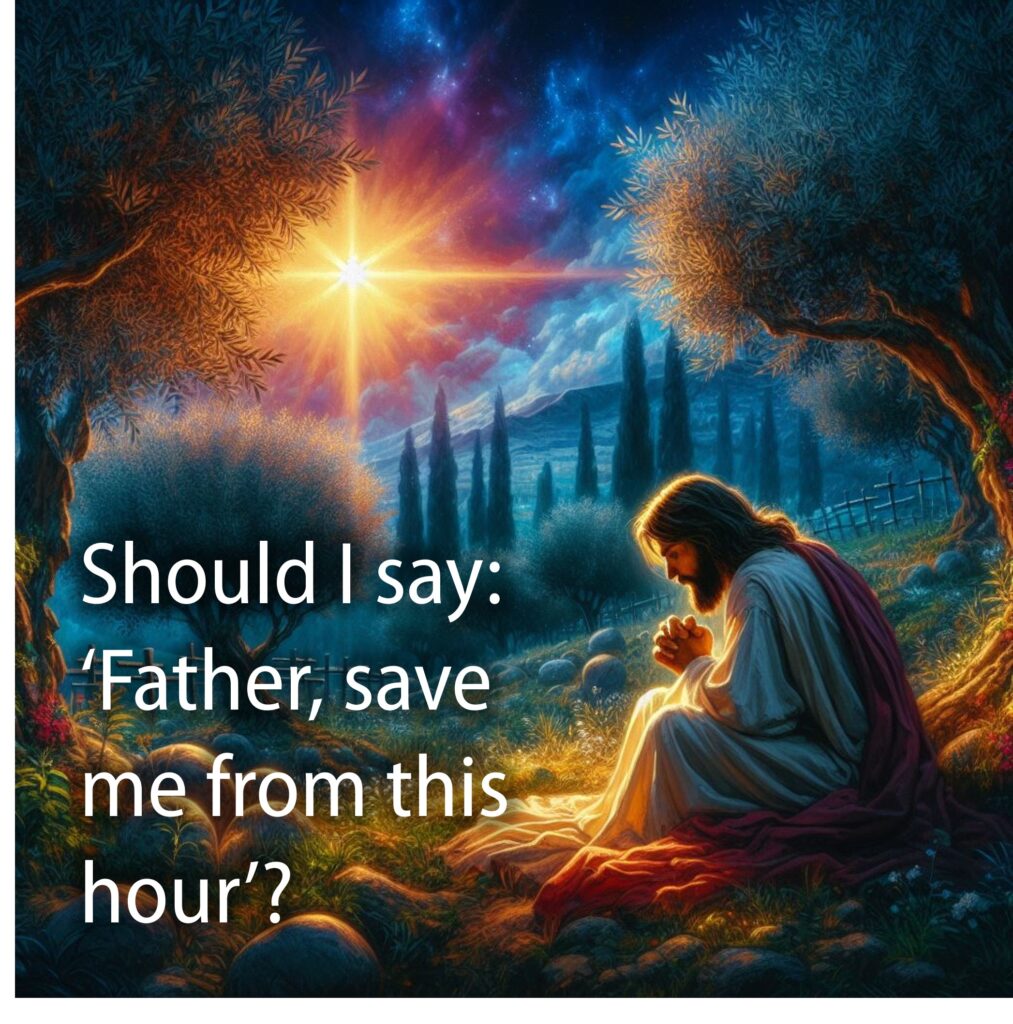
In the other gospels, Jesus expresses similar sentiments when he is in the Garden of Gethsemane. He says to his disciples in eerily similar words, “My soul is deeply grieved, even to death.” (Mark 14:34) And then Jesus goes over by himself to pray and ask very specifically that he might be spared from the hour that is coming, saying, “Abba, Father, for you all things are possible; remove this cup from me.” (v.36)
So, we have almost exactly the same words that we find in John. But where in John, Jesus’ soul only seems to grieve for a moment and he quickly rejects the very idea that he should ask to be spared, in the other gospels Jesus remains in that grief and that desire to escape for a very long time – for an hour at least. And it is an hour of complete and utter agony as Jesus wrestles with God over what is going to happen to him.
And yes, he always ends his plea by saying, “yet not what I want but what you want,” (v.36) but you certainly do not get the impression that he comes to that reconciliation easily or quickly. His hour in the garden has got to be one of the worst hours of his life – only to be overshadowed, of course, by what is about to come!
You may well ask how we are supposed to reconcile what Jesus says here in the Gospel of John with the accounts of the Garden of Gethsemane, but I don’t necessarily see this as a contradiction. Sure, John may not want to dwell on Jesus’ desire to escape the fate that awaits him, and he skips over it immediately, but that doesn’t mean that Jesus didn’t dwell in it in the garden. The agony in Jesus’ heart was real during that hour. It is just that John wants to look at the agony of Jesus from another angle because he wants to teach us something very important about those difficult hours in our lives and how we can navigate them well.
In particular, John wants us to understand where Jesus landed after that hour of agony and how Jesus became to be reconciled to what came next. You see, there is always a temptation when you face a difficult hour. Your natural inclination, if it simply cannot be avoided, is just to grit your teeth and clinch your fists and get through it so that you can forget about it as quickly as possible as you get on with your life. We attempt to minimize those moments. That may be understandable, but it is not what Jesus does.
Jesus explains to the crowd that such hours have a purpose and that they are meant to bring you to a place where you finally understand one of the deepest truths of this life, a truth that he sums up like this: “Very truly, I tell you, unless a grain of wheat falls into the earth and dies, it remains just a single grain, but if it dies it bears much fruit.”
Now, it is pretty clear what this means in the light of what we all know that Jesus is about to face. He knows that he is heading towards something that will bring his death in a very painful way. And he also knows, and this is made clear many times in this gospel, that he will be raised from the dead. And so, he is the grain of wheat that dies and comes back in new life.
But part of what Jesus is saying here is that his death and resurrection is not just for him. The new sprout that will come from the seed that dies in the ground is not just a new chance at life for him. The new life he is obtaining is for the whole world and for us as well.
At the same time, though, this is not just about what is going to happen to Jesus or what he accomplishes for us. Jesus is here proclaiming a universal principle and one that is central to the Christian faith.
The truth is that we as Christians only have one model for renewal, and that model is death and resurrection. Jesus has shown us the way, but we are all called to continue to walk in it. And that is the particular challenge we are given whenever we face a difficult hour, crisis or trial. We are called not merely to survive it but to have the faith to pass through it by dying to what we need to die to and being raised up to new life.
Have you ever faced a difficult time in a key relationship in your life? Relationships are not easy and if any relationship is authentic, there will be times when you disagree or fight or even struggle to love the other.
And because such times can be so difficult, the temptation may be to merely survive them. You may avoid the conflict. You try not to talk about it, change the subject when the point of disagreement comes up. You think that if you ignore the conflict, it will go away on its own. And maybe sometimes it even seems to, but I’ll guarantee you that it will come back in some new form sooner or later!
Another strategy you may resort to in such a circumstance is using dominance and power (whatever power is available to you) to browbeat your relationship partner into just giving in to eliminate the point of conflict. Again, that may seem to make the difficult time go away, but it doesn’t really solve anything and only means that the times that come get worse as you go along.
No, if you really value your relationship, what you have to do is enter into a possibly even more difficult time when you risk yourself, where you choose to die to something in yourself that has been malignant in your relationship. Only in such death can new life be found for your relationship.
That is just one example, of course. I know we all face difficult hours in our lives and each one presents unique challenges. They may come in terms of health issues or medical treatments. They may come in difficult work-related issues or financial struggles. We’ve all been there and we will all be there again.
I think it would be helpful for all of us to hold onto the formula Jesus gives us in the Gospel of John. It is usually not helpful to just try and avoid such hours. Rather than seeking to be saved from them, we find our way through them, asking what we need to die to in order to be raised to new life.
This brings me back to where I started and the attitude that clergy may bring to annual meetings. Do they need to be difficult hours that we should seek to be saved from? Of course not.
And there’s no reason to think that this meeting will be a difficult one. Indeed, I do not expect that. My desire to be saved from such meetings is more based on past trauma than on the reality of our current situation. But that being said, it is not as if we don’t have some difficult questions to deal with as a congregation.
And the reality is that, when that is the case, we might enter into such an hour with a “Father, save me from this hour” kind of attitude. Such an attitude might lead us to simply brush over or even ignore those issues that could cause tension among us.
In my experience, churches can be really good at doing that kind of thing. Whenever the hard topics come up, we just kind of change the subject.
The other temptation, the one that we often resort to when we are feeling personally vulnerable, is to become aggressive and maybe even take a bullying approach with others. We think that if we can just beat others in submission, we can impose a better situation for ourselves.
And then there are others whose instinct, whenever something feels a little bit controversial, is simply to back down and become completely passive.
These kinds of reactions may feel as if they work for us as if they are getting us through a difficult hour. But I do not believe that they lead to where we need to go and that is new life. We don’t need to be saved from a difficult hour, we need to be raised to new life.
So, this is what I would challenge us all to do, including myself, as we move towards an hour that could have some uncomfortable moments. Ask yourself what you need to die to in order to find new life.
As a congregation, I think there may be some attitudes that we need to die to. We need to die to an assumption we often easily make that we are somehow better than some other congregations, perhaps because they are dealing with struggles that we’re not right now. As a congregation and as churches around here, I suspect we need to die to the assumption that we can thrive on our own and that the loss of other ministries doesn’t affect us.
And maybe above all, we need to die to our tendency to think only in terms of what we can get from the church so that we can be born again to a new attitude concerning what we can all give to the work of Christ through the church together.
But understand this, whatever we may have to die to, there is a purpose. When the grain of wheat falls into the ground and dies, that’s not the end of the story. That is the new beginning. That is what Jesus was promising us. So, I will not pray, ‘Father, save me from this hour.’ I hope you don’t either.
Hespeler, March 10, 2024 © Scott McAndless – Fourth Sunday in Lent
Numbers 21:4-9, Psalm 107:1-3, 17-22, Ephesians 2:1-10, John 3:14-21
I really appreciate the opportunity that we have been given to focus on the important and necessary resources that are provided to people who are dealing with end-of-life care in our region through the hospice.
I would just like to spend a few moments in reflection on end-of-life care from a Christian perspective. We talk a lot about healing in the church – and for good reason. Many people are struggling with various illnesses, ailments and lacks. And when someone is wounded in mind or body or spirit, our default Christian response is to pray and to ask God for healing.
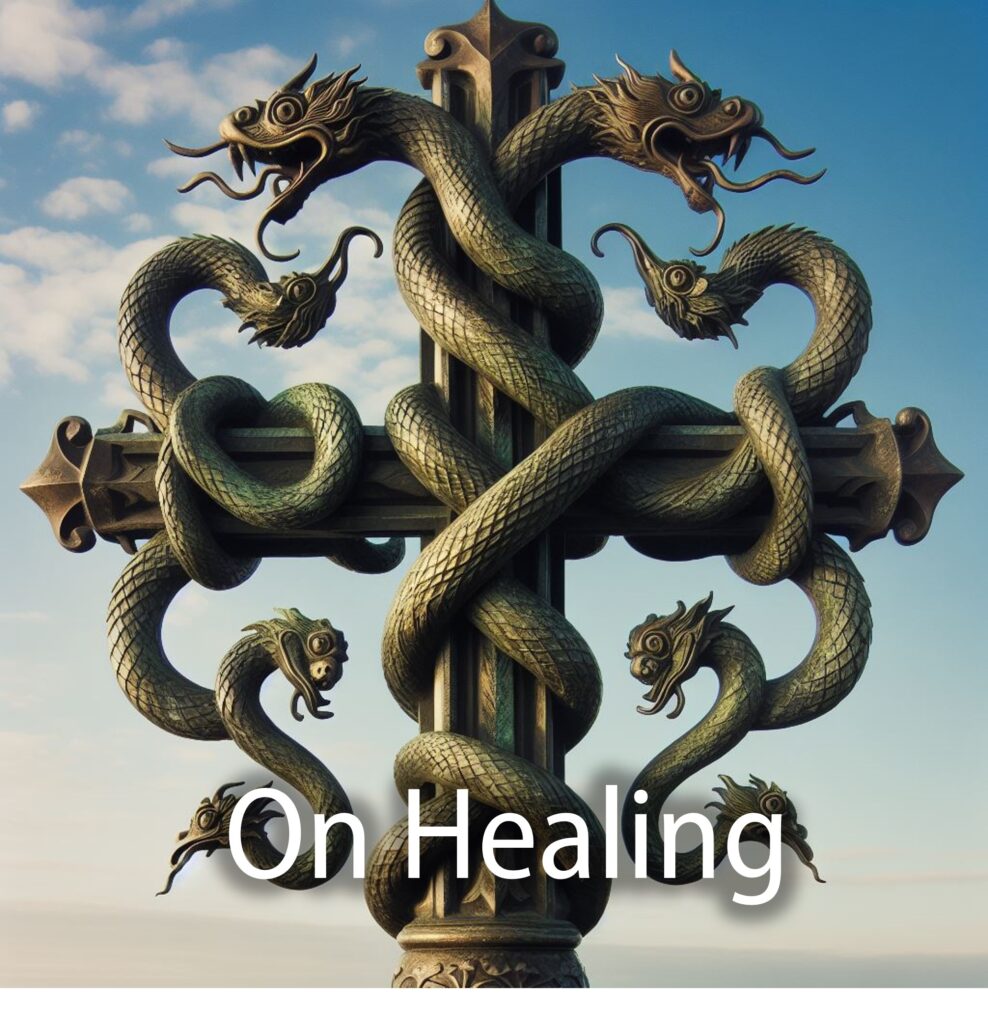
The story we read from the Book of Numbers this morning is a perfect illustration of that. The people of Israel are afflicted with a dreadful and frightening illness as venomous serpents spread through the camp and people are bitten and fall ill and die. And they cry out in despair for what? For healing. And Moses creates a powerful symbol for healing by making a serpent out of bronze and placing it on a staff. That symbol should be familiar, by the way. To this very day, the symbol of intertwined winged snakes on a staff is the international symbol for medicine.
And the promise of the story, of course, is that when people ask for healing, when they turn to the symbol of healing that Moses gives them, they will be healed. In our Gospel reading, that idea is taken and turned into a metaphor for the salvation we can access by turning and looking to Jesus.
And I am so glad to be able to turn to God and seek healing – to pray for and ask for God’s help. But, at the same time, I think we all recognize that healing – at least the kind of healing we may be craving for someone – is not always going to come. Sometimes someone has a condition that is almost certainly terminal. Sometimes people’s conditions are so bad that we simply don’t want them to keep on suffering. And, sure, miracles may happen, but I’m pretty sure we all understand that they don’t always happen just because we pray no matter how hard we believe. On top of all that, we have the undeniable truth that nobody lives forever.
So how can we confess a belief in a God who heals and deal with the realities of end-of-life care? Well, let me put it this way: I do believe that God can always heal. But the healing that God brings, is not always the healing we are seeking. And it’s certainly not always the same thing as a medical cure.
What’s more, we tend to think of health in one dimension, as a condition of the body. But God always sees us as more. God sees the whole person, mind and body and spirit. God sees us within our relationships and community. And God, treating us as a whole person, is always able to bring healing, even in the valley of the shadow of death.
Even when somebody’s situation is dire, even when they’re undoubtedly heading towards death, I do believe that we can pray to God for their healing. And I believe that God heals. But the healing comes in different ways for different people.
For some people, the healing they need is some reconciliation with people in their lives. I have seen some amazing miracles where people found forgiveness and love that was able to overcome past hurts in their last days. That is vital healing. For some people, it might just be a little bit of peace and a little bit of relief from their pain.
For many people, healing is as much about coming to terms with the dying process, either for themselves or for their loved one, in some kind of comforting way. But wherever people are on that inexorable journey from birth to death, God’s healing power is able to meet them where they are. I believe that.
And that is why I am so glad to be able to celebrate the work of Hospice Waterloo. In the programs and the facilities they offer, they make possible and create the space where so much healing can happen as people deal with the end of life. God is present in those places for healing. Sometimes acknowledged, perhaps sometimes not, but healing happens and for that I think we can all be truly thankful. And we certainly pray for the continued healing work of Hospice.