Worship
Worship begins at 10:00 am
Continue reading »
November 17, 2024 © Twenty-Sixth Sunday after Pentecost
1 Samuel 1:4-20, 1 Samuel 2:1-10, Hebrews 10:11-25, Mark 13:1-8
I would like to invite you into the opening scene of our reading this morning from the First Book of Samuel. A family has come down to the Temple at Shiloh. They have come to sacrifice.
The whole family comes. The father of the family is Elkanah. And he brings with him both of his wives Peninnah and Hannah. He has two because that is just how things are done in this world. And he also brings with him his sons and his daughters, all of whom are the children of his wife Peninnah because, it seems, Hannah cannot have children.
These, together with household servants and extended family make a very large company that goes down to Shiloh. And they bring with them the young ram that they have raised all year on their little farm. This animal has been part of their family ever since its birth. They have nurtured it, taken it out to graze and kept it safe from any predators.
They have loved this animal. The children even gave him a name. Rambo, they called him. But, at the same time, they have never forgotten that they raised this sheep for one purpose only: for this sacrifice.
It is a holy thing when this happens when a living being gives its life so that a family can eat and be strong. That is why they do it so rarely – often no more than once a year. That’s also why the animal must come to the temple. It is something to be done in a holy setting.
The Sacrifice
And so, they take the ram to the old priest, Eli, who inspects it and declares that it is healthy and fit for a sacrifice. The whole family approaches and lays their hands on the head of Rambo, giving thanks to God for this bounty and to the animal itself, as the priest draws the blade across its throat.
Later, after the priest has taken the animal and butchered it properly, the family gathers around the altar. Those parts that the family will not eat – the fat, the blood, a number of the organs and other bits – are burnt in the fire. That is how Yahweh, the God of Israel, joins the family in their feast. It creates a precious fellowship with God, making everything all the more holy.
But then what happens? Elkanah, the patriarch of the family, is given the rest of the meat, all perfectly cut and arranged on a slab. And they take it and put it in one of the great cauldrons that are provided for the worshippers at Shiloh. They boil up the meat with various herbs and vegetables that they have brought with them to create a hearty stew.
Ah, but then comes that awkward moment. Elkanah, as patriarch, has the right to distribute the stew. After the priest has come to claim his portion as payment for safely slaughtering and butchering the meat, Elkanah takes the rest and carefully doles out the portions.
Into the bowl of his wife Peninnah, he carefully ladles one big scoop. Then he goes on down the line to his sons and his daughters and for each he measures out the same amount. Then he gives the same amount to each of the servants and workers and some extended family that have come along for the sacrifice.
Finally, he comes to Hannah. He smiles at her for a moment, but it is kind of a sad smile. There seems to be some pity in it. And then he takes out the big bowl, much larger than any of the others and places it before her. He fills it up with scoop after scoop of rich stew before finally filling up his own bowl with a similar serving.
Now, how do you feel sitting at that table? You smell the savoury broth and you long to dig in and scoop up the meat that you have been craving for months. You can hardly control yourself.
But hunger is not the only powerful feeling at the table, is it? You can practically feel the resentment seething from every person present as they cast baleful glances towards Hannah where she sits at her end of the table.
And Hannah, she is, if anything, more upset than anyone else. Large tears roll down her face as she stares at the stew before her as if it were poison. She knows she should eat it – that she needs the meat as much as anyone. It should make her stronger, healthier. Who knows, it might even make her fertile. But she doesn’t feel as if she can stomach it.
How could she when she knows that it causes Peninnah, who could be like a sister to her, to hate her? How could she when she knows that it puts a distance between her and the children whom she could love and care for in other circumstances?
And worst of all is her husband sitting right beside her who, by the look on his face, thinks that he has done a wonderful thing. “Eat up, honey, he says as he shovels the food into his mouth. It’s delicious!” She knows what he is going to say next because he says it all the time. It always makes her cringe.
“Hannah, why do you weep? Why do you not eat? Why is your heart sad? Am I not more to you than ten sons?”
I know that the opening chapter of 1 Samuel is all about the birth of the Prophet Samuel and about how God brought it about and saved his mother Hannah from the shame and scorn of being an infertile woman. It is an amazing story full of hope and possibility.
But I don’t think you can really appreciate the good news in that story without understanding just how messed up that opening scene really is. It shows us just how dysfunctional that particular family was. But it is also a reflection of how the human family often deals badly with the challenges and problems that come with life in this world.
I think that many of us, for example, are like Peninnah. She is a woman who is able to do the one thing that women were valued for in that society – she can have children. And she is valued for what she can produce.
There are many people just like that. In this society, where everything seems to be measured through productivity, there are many who seem to have decided that their entire self-worth is measured by how much they earn, their place on the corporate ladder or their relative wealth.
But there are perils that come with such a way of thinking, aren’t there? Peninnah may have fulfilled her purpose as seen in that society, but she doesn’t seem particularly happy.
Indeed, we are told that she torments her husband’s other wife, Hannah. She “used to provoke her severely, to irritate her,” it says, “because the Lord had closed her womb.” Is that kind of aggression indicative of someone who has a happy, well-balanced life? Of course not.
And haven’t we all met people like that – people who seem to have achieved success as this world defines success, but they love to rub other people’s noses in it? Why? Because they are trying to make themselves feel good by putting somebody else down.
Here is a life tip for everybody. If you need to put somebody else down to feel good about yourself, there is something wrong. There is something deep inside that is making you feel inadequate.
And we know what is making Peninnah feel inadequate. What she produces may be valued, but she is not valued for who she is. She is not loved.
And how many people in the world today are caught up in that mad scramble to earn love through what they produce? And no matter what you do, no matter how good your work is, it will never be enough. Peninnah, sitting at that table, is symbolic of the flaws of a society that values productivity over everything else.
But then there is Hannah at the table too, isn’t there? And she hardly seems better off. She has the love. Her husband claims to be devoted to her. So, what is missing for her?
She lives in a society in which women are really only given one way to contribute. And she is not able to contribute in that way. And so, though she is loved, she has been robbed of a sense of being significant.
The two women in this story are miserable because some of their most essential needs are not being met – the need for love and the need for significance. And the really odd thing about that is that they each have the one thing that the other wants most.
It is so easy, isn’t it, when you are struggling in yourself to look at something that somebody else has and to be jealous – to think that, if only you had what they have, your life would be okay. But the mere fact that neither of these women is okay puts a lie to that way of thinking.
The solution is rather to work on yourself – to aspire towards what is truly meaningful to you, to be sure. But it is also to recognize that the reason why you feel inadequate is not because you are inadequate but rather because the expectations that have been placed upon you are baloney. How much happier would both Peninnah and Hannah have been if they had just realized that.
And let us now turn to the third so-called adult at the table – Elkanah, the patriarch of the family. I’ve got to say that I am not particularly impressed with his efforts to improve anything about the whole situation. His favouritism to Hannah only sets her apart from everyone else who might give her support.
And when he says, “Am I not more to you than ten sons?” it makes me cringe so I’m sure it did Hannah too. He essentially dismisses her needs and self-centredly thinks that he can fulfill her on his own. That, let me tell you, never helps somebody who is struggling.
So what is wrong with Elkanah? Why is he such an abysmal failure at bringing peace and functionality to his family? It is because he does not deal with the real issues at the table. He does nothing to address Peninnah’s bitterness and anger – apparently thinking that, if he ignores it, it will just go away.
And when he sees Hannah’s deep sadness, he does not help her to address the unrealistic expectations that society has put upon her. He does not even bother to assure her that her worth and value are not dependent on meeting these expectations. All he does is essentially try to make her put on a smiley face by bribing her with extra portions of meat and professions of affection.
May I suggest that if you ever find yourself giving some leadership to a family or other group that is malfunctioning in any way, do not follow the example of Elkanah. Don’t make it all about yourself. Don’t just try to deal with the surface issues – with the appearance of things. Don’t assume that serious issues will just go away if you don’t talk about them. Dig in. Get to the heart of the matter and the real hurts and wounds that people are carrying.
I’m not saying that it will be easy. It might well feel much more uncomfortable before it starts to feel better. But it is worth the effort and the discomfort.
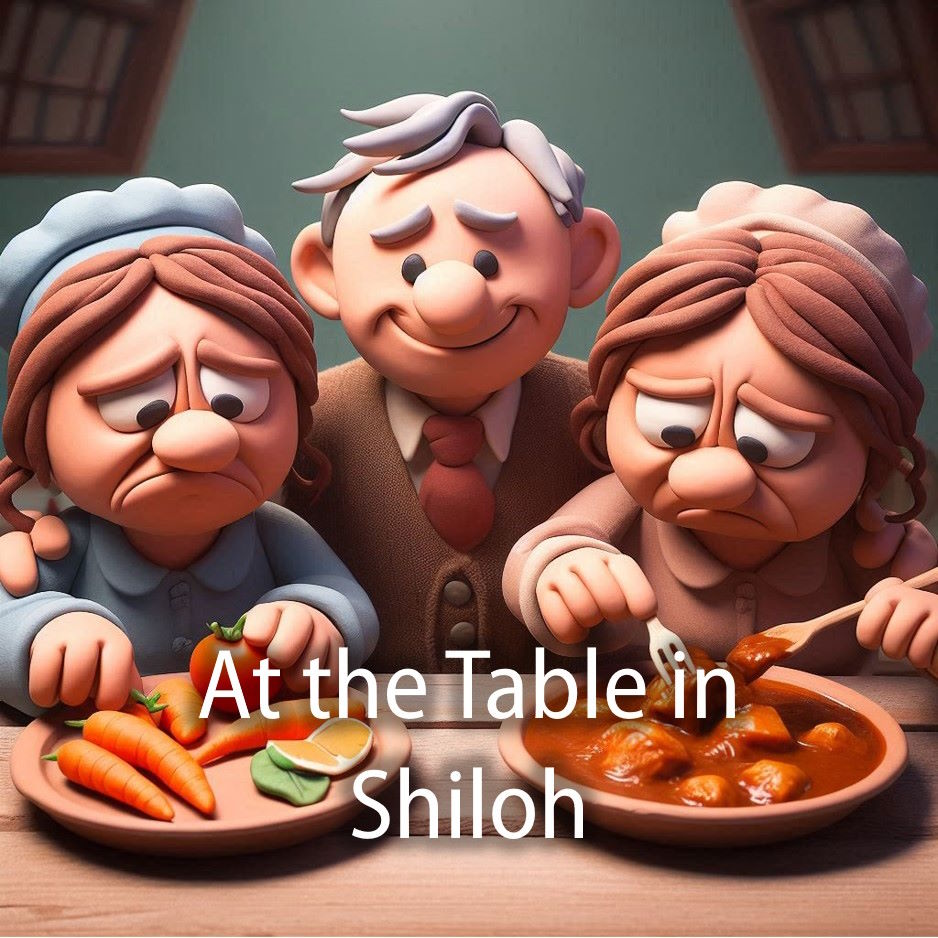
And so, we have three people feasting at Shiloh. None of them are happy; none of them are fulfilled. And I will bet that each one of us can find ways in which we, at some point in our lives, would have identified with at least one of them, if not all. They are a reflection of the dysfunction of this world and its ways.
And where, you should be asking me, where is the hope? The hope is found in getting past our habit of ignoring problems and hoping they’ll go away, in a willingness to get to the heart of what is really dragging people down. It is found in honest communication. And it is found in God.
When Hannah goes to God and God finally gives her the thing that she desires: a son, it is not just the end of her infertility that heals her life. It is also her encounter with a God who hears her and is willing to overturn the entire system that had subjugated her. God saves her by turning the world upside down:
“The barren has borne seven, but she who has many children is forlorn. The Lord kills and brings to life; he brings down to Sheol and raises up. The Lord makes poor and makes rich; he brings low; he also exalts. He raises up the poor from the dust; he lifts the needy from the ash heap to make them sit with princes and inherit a seat of honour.”
And that is where the real hope is found. That is what we celebrate in the season that is to come.
Hespeler, November 10, 2024 © Scott McAndless – Remembrance Sunday
Genesis 13:2-12, Psalm 146, Hebrews 9:24-28, Mark 12:38-44
Tomorrow at 11 o’clock we will solemnly remember an event that no living person can actually remember. It happened 106 years ago. There are maybe about half a million people alive today who are over 100 years old, but only a small fraction of them would be over 106. And of course, none of them would have been old enough to be aware of what happened on November 11, 1918.
What happened then? That was the day that the bombing and the shooting and the killing stopped following the most devastating war that the world had ever seen. And I don’t think that any of us could possibly imagine the feeling of relief that swept over people as the eleventh hour of the eleventh day of the eleventh month tolled and the fronts that had been filled with so much death finally fell silent.
And you might find it odd that we still observe an armistice that no one can remember. And part of that is, I know, that the meaning of that day has transformed since then to become a day to remember those who have served in many wars that came after the “War to End All Wars.” It has become a day to pray and work for peace for all.
But I also think that it is significant that we celebrate that particular armistice and the Treaty of Versailles that codified the peace about a year later. Treaties matter; they shape our world. In fact, I would argue that the treaties of the past have had more influence on the world we live in today than the wars. And that is certainly true for the Treaty of Versailles (which was not particularly successful at ending all wars). I would suggest that we ignore treaties to our peril.
So, I would like to tell you about a treaty that you may have never heard of, but that I believe we are all called to honour today. When European settlers first came to this place, as you know, they found it to be already inhabited. That did not prevent them from claiming the land as their own possession, of course. They had this false “Doctrine of Discovery” that allowed them to dismiss the inhabitants as mere “savages.” But their first concern was not really for the possession of more than little bits of land. Their first concern was for that constant goal of Western civilization: profit.
And they definitely saw the indigenous people here as a useful tool for driving that profit. They persuaded the indigenous people to go out and use their considerable skills to extract valuable resources from the wilderness around here, most valuable of all being, of course, the furs and the pelts.
This strategy of wealth production was enormously successful. It was most successful, as always, for the European investors. But the indigenous people also did very well and were able to gain valuable trade goods, at least at first. But as also often happens, problems began to crop up. In the beginning, the resources were abundant, but the drive for profit soon began to see them dry up. Some species were pushed into extinction in easily accessible regions. This forced people to hunt and trap farther afield. It also pushed First Nations into competition with each other. It also led to environmental destruction and to war between the various nations.
I know that we are not generally very aware of these fur wars because the settler colonists weren’t really directly involved. But, like all wars, they were devastating both to the people and to the natural environment. The need for peace for all those who were involved became extremely urgent.
That is a part of the history of the place where we are now sitting. Well, you’re sitting and I’m standing but you get the idea. One thing that particularly strikes me about that history this morning is that it strongly parallels our reading from the Book of Genesis. It tells the story of two men who have come to the land of Canaan from far-off Mesopotamia. Their names are Abram and Lot.
And, like the colonialists who came to this place, they came to get very rich. They measured their wealth in terms of herds and cattle instead of furs, but it is basically the same old story. And just like what happened around here, they didn’t do the manual labour themselves. They hired the local indigenous population to be their herders. Indeed, the story explicitly mentions, while talking about problems among their workforce, that “at that time the Canaanites and the Perizzites lived in the land.”
But there was a problem. And it is a problem that often arises when we pursue ever-growing profits as more important than anything else. The Bible puts the problem like this: “the land could not support both of them living together because their possessions were so great.”
When we relentlessly pursue extraordinary profit, the result is often that the land cannot bear it. Natural resources begin to be stretched. And this has devastating effects on the land. In their case, the resources being stretched were not beaver and bison pelts but rather ground water and grazing land, but apart from that, the story is very much the same and, again, is as old as time!
And what was the result of that in old Canaan? Exactly the same as what happened here: strife and conflict – not between the wealthy men but amongst those who were working for them. “Thus strife arose between the herders of Abram’s livestock and the herders of Lot’s livestock.”
Now, to Abram and Lot’s credit, they recognized that this was a problem. Even though they were not the ones suffering, they decided to fix the problem, and they did so by creating a treaty between the two of them. It wasn’t really a treaty that solved the root problem because they just decided to separate so that they could continue to relentlessly exploit the land. But at least they did something to alleviate the suffering among their indigenous workforce.
Things didn’t quite work out so well in this area. The lords of the fur trade, it seems, didn’t mind the strife among the various First Nations who were providing them with their furs. As good capitalists, they probably thought that the competition was good for their bottom line. And so, the strife spread.
In this area, the Mississaugas, an Anishinaabe Nation, were pushed out of their traditional territories by the Haudenosaunee and fled north and west. But then, a few years later they return in alliance with the Odawa and the Chippewa and it seemed that open war against the Haudenosaunee was inevitable – a war that would quickly spread and would be devastating to all indigenous nations.
But wisdom prevailed and a treaty was made. This treaty was not created by the wealthy fur companies like what happened in Canaan. In fact, they did not like the idea at all and never officially recognized the treaty.
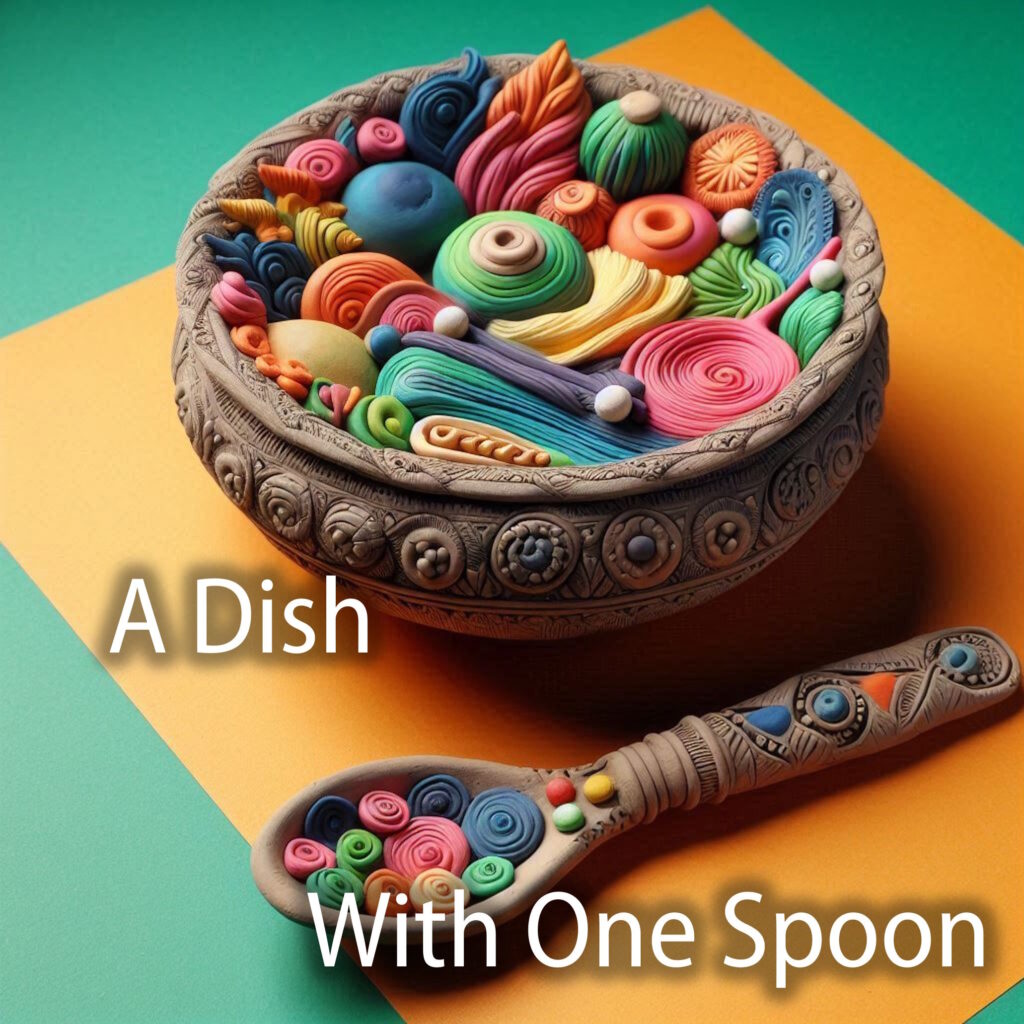
No, the First Nations understood that they would have to make their own peace. And they did so according to an ancient indigenous concept: a dish with one spoon. There is evidence that the idea of a dish with one spoon may be at least a thousand years old. It is one of the foundational concepts that governs Indigenous people’s relationship to the land.
Now, I am not an indigenous person, and I would not presume to speak for them. Indeed, I would love to hear more about this from native elders some day. But my pretty basic understanding is this. They see the land as being like a dish. And all the things that the land produces are there to feed and support people and animals. And everyone can have a share of that bounty.
But they recognized that, if everyone takes from the dish without limit, especially in a relentless pursuit of profit, that would not be sustainable. That’s where the one spoon comes in. Instead of everyone eating at will with their own, consumption would be limited by the need to share one spoon. It is a simple concept, but a very powerful and important one. It had been foundational to how the indigenous peoples lived on this land.
So, the First Nations made a treaty which they called, fittingly, the Dish With One Spoon Treaty. The treaty was formally adopted in Montreal in September of 1700. They did not sign the treaty in the European fashion. Instead it was solemnized in the traditional fashion by the creation and presentation of a wampum belt.
But even if it was adopted in Montreal, it changed everything here. It brought peace. As part of the treaty, the Mississaugas, who had claimed this land where you sit since ancient times, agreed to give up their exclusive claim and share it with all nations according to the law of the Dish with One Spoon.
I know that the world has changed a lot since 1700. About eighty years later, this land right here was given away by the British Crown to the Iroquois of the Six Nations (a Haudenosaunee people) as a part of a treaty for another war – the American War of Independance. The Crown did not own the land that it gave – it had been shared with all by the Mississaugas in the previous treaty, but apparently the crown was not concerned about that.
Have you ever thought about that – that there is an incredible history of various peoples living on and relating to this land where we have our houses, do our work, and live our lives. And these treaties are a very important part of that history. I know we often only think of treaties as applying to the indigenous people. Their ancestors entered into these treaties but they are still bound by them. But our ancestors entered into them as well. Are we not also bound by them? If we live on land that was shared or given by treaty, is there not some sense in which we ought to be living according to that treaty, or at least according to the spirit of that treaty?
And yes, I know that our history has made that question very complicated, especially those parts where our ancestors did not keep the treaties that had been made. But I think that there are some very important lessons that we ought to take to heart from the story of the treaty made between Abram and Lot, and the story of the Treaty of a Dish with One Spoon. Let these treaties remind us that our relationship with the land that we live on is fragile. If we exploit it in ways that forget the dish with one spoon ideal, if our only concern is a relentless pursuit of profit, we may well find, like the two patriarchs did, that the land cannot support us.
And the result of that is that it will lead to conflict and suffering. And who will suffer? Abram? Lot? The wealthy fur barons? No, don’t worry about them; they’ll be fine. It will be the people of the land who will suffer – the herders, the indigenous nations, the low-wage workers and ultimately the great majority of people.
I hope that the stresses we continue to put on the land through the relentless pursuit of profit will not lead to new conflicts and the need for new treaties. I just know that that is what has happened many times before. But could we perhaps avoid that eventuality by deciding to learn from the biblical treaty between Abram and Lot? And perhaps we could avoid that by learning from the treaty that saved this very land from becoming a field of slaughter over 300 years ago, by teaching us that this land is a dish and that we all need to share the spoon.
Hespeler, November 3, 2024 © Scott McAndless – Twenty-Fourth Sunday after Pentecost
Ruth 1:1-18, Psalm 146, Hebrews 9:11-14, Mark 12:28-34
In the Book of Ruth the two sons of Naomi have rather odd names. They are named Mahlon and Chilion. These are, of course, Hebrew names, so you may not have thought much about them. But wait until I tell you what those names mean in Hebrew. Mahlon means “sickly,” and Chilion means “frail.”
Think about that for a moment. How could they have ended up with such names? What mother would name her child “sickly”? What father would choose to call his son “frail”? But these are apparently the names that they got. And, while we are imagining, think about Orpah and Ruth, meeting such men as prospective husbands. What would you think if your future spouse bore such a name? I can’t imagine that they would have been very thrilled.
So, the names do not make a lot of sense in practical terms. The names do make a great deal of sense, however, in terms of the story that is being told. They are, in fact, perfect names from the narrator’s point of view because they give a strong signal to the reader of what is going to happen to these two young men. No sooner are they introduced, and they are barely married, than they both die. Hmm, do you think that their wives should have taken their names as a bit of a warning?
So, what’s the real story behind the naming of these young men, Frail and Sickly? And, yes, I am going to just forget about their Hebrew names that no one ever remembers anyway and call them who they are: Frail and Sickly. That is, after all, basically their entire identity in this story.
Is it possible that the author of this story just made up the names of these characters – kind of like when Shakespeare created the character of Desdemona (whose name means ill fortune) in his play Othello? That does seem possible. It is generally thought that the Book of Ruth was written centuries after the original events, so maybe he had no record of their names and had to make something up.
But I usually prefer to think that, if something is there in the Bible, it’s not just there by accident. No, I prefer to think that, rather than just making a name up to cover up what he doesn’t know and is hoping we won’t notice, I think he chose these names very intentionally. Frail and Sickly are there to teach us something. But what could that lesson be?
The Book of Ruth is a book about a major shift. The book is set, as it says in the opening words, “In the days when the judges ruled.” This was a time when the people of Israel were little more than a collection of tribes living in the land. Each tribe basically took care of their own affairs. There was nothing like a united national government.
But when the tribes were faced with something that they couldn’t handle on their own, like invaders or raiders, they would band together and a judge would be appointed to lead them, to call up the tribal militias or do whatever else was needed to counter the threat.
That was the system. It was likely not perfect, but it had allowed the tribes to maintain their independence and to survive for about as long as anyone could remember. But the Book of Ruth is not really about the tribal system. It is about the transition to something new.
The book ends by telling us that its main character has a child who will become the grandfather of the great King David. This book is about the transition from a tribal to a national, monarchical government.
And major transitions like that do not come out of nowhere. People are generally conservative about such things. They know that big changes will cause much disruption and chaos, and so they tend to resist them. It takes a lot to make people want a transition.
And yet we are told in the Bible that the change to a monarchy only came because the people demanded it. The Prophet Samuel and even God warned them that the change would be costly to them, but they insisted, and so God gave them what they wanted. That’s how the story is told.
I suspect that is what the author of this book is trying to address with these two characters, Frail and Sickly. They are ancient Israelite tribesmen – Ephrathites from Bethlehem in the tribe of Judah. They represent the insular tribal past – a past that clearly had its strengths and its benefits. But the world was changing and, because the world was changing, the old institutions had become frail and sickly.
The reason why the Israelites demanded a king, we are told, was because they wanted to be “like other nations.” (1 Samuel 8:4) But you need to understand that this was not just a matter of feeling jealous of what other nations had. It had more to do with the fact that neither threats and problems nor economic opportunities could be managed by the old system anymore.
If that is what these two characters represent, then I think it is very important for us to reflect on them. I would suggest that we are also living in times of great transition. And what often happens when you are living through transition is that you find that the institutions and leadership that were set up to manage and meet the challenges and opportunities of the way things used to be no longer quite work in the same way anymore.
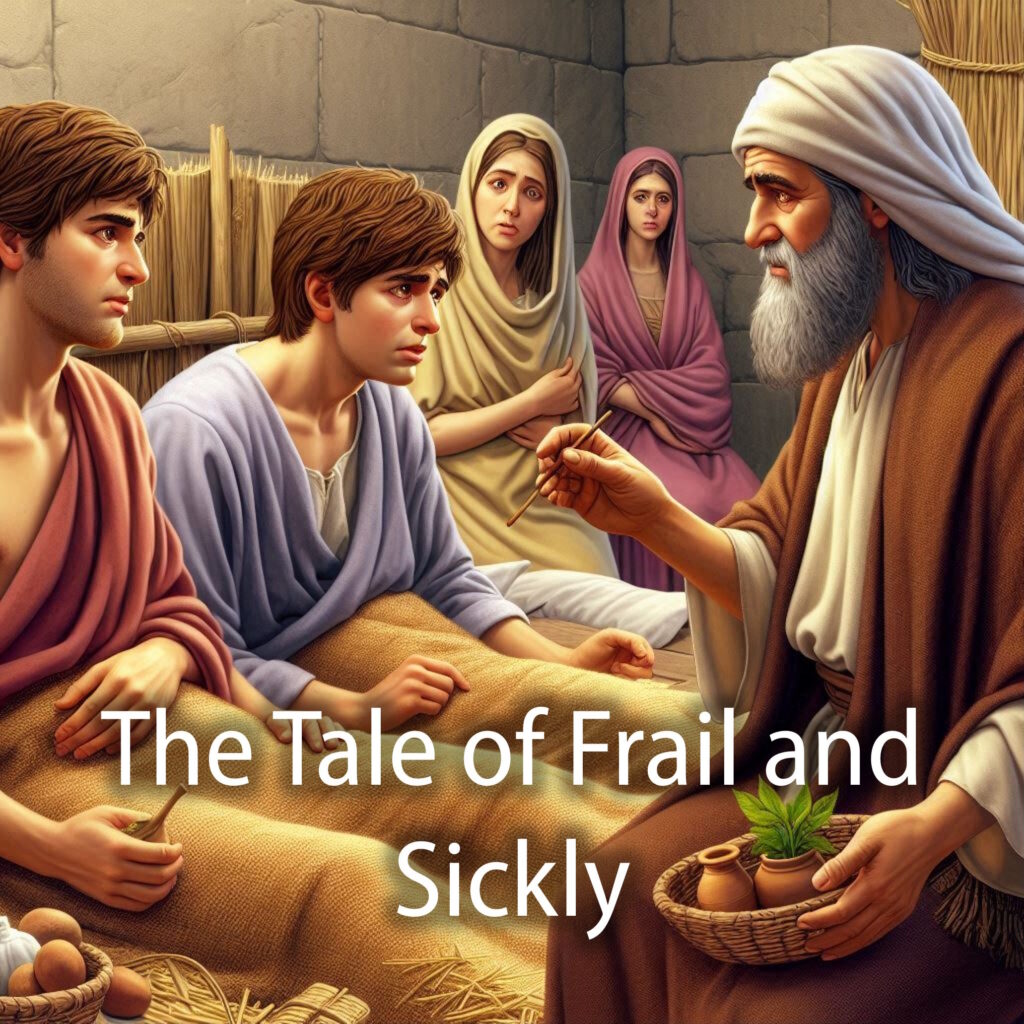
Instead of being strong and robust to meet the challenges of the day, we discover that they are surprisingly frail and sickly. I realize that that is somewhat inflammatory language. But I’m not choosing that language, it comes from the author of the Book of Ruth.
We see that in our times as various institutions no longer quite seem to function as well as they once did. Political systems break down. Policing, education and financial institutions are no longer as effective as they once were. We seem to have been experiencing a lot of that kind of thing recently.
But let me speak of this in terms of something we can relate to – the recent history of the church in this area. This congregation was founded and built in a very different world from the one where it finds itself today. It was built in a small industrial village. It was built at a time when the closest Presbyterian churches in places like Galt, Preston and Doon were a good 60 minutes away across country roads on horseback.
More recently, this congregation built up its strength at a time when the professional clergy drove the church. It thrived at a time when every congregation (or at least a couple of congregations together) could call and afford to pay a full-time minister who would lead the charge and set the policies. And all of our government and systems were optimized to benefit from that sort of church.
Have you noticed that that is not really the same situation where we find ourselves today. Thanks to the construction of the world’s busiest highway right on our doorstep, distances between churches are not what they used to be. And many of those churches that are now so much closer are facing crises in terms of calling and affording ministers to lead them.
Those are just a couple of the major changes that we are dealing with as congregations. I’m sure you could name some others. But that is enough to make us realize that, if some of the systems and policies and leadership that were put in place and that led our congregations so effectively in a previous situation may not be working as well today. They may even feel a bit frail and sickly when it comes to meeting our present challenges and we have to prop them up in order to maintain the illusion that nothing needs to change.
So, I do think that the two sons of Naomi may speak to us as we live in times of transition today. But I want to be clear here that I am not saying that the church is or will necessarily become frail and sickly. It is something that may happen if we cannot let go of old patterns and old ways of organizing ourselves, but it is not our destiny; it is not inevitable.
The Book of Ruth starts with evidence of the old system breaking down under the weight of a changing world. But it also shows us what we need to do about it. And the first step is clearly to move away from a narrow and insular view. When Naomi’s family can’t deal with the crisis of the moment, which comes in the form of a famine, they decide to seek for a way to cope elsewhere.
“They went into the country of Moab and remained there,” it says. And that doesn’t actually seem to make much sense at first glance if the problem they are dealing with is famine. Moab wasn’t really all that far from Judah. It seems reasonable to assume that, if there was a famine in Judah – something usually caused by a drought or some other ecological disaster like a locust swarm – the crops would have been no better in Moab.
So, there must have been something else, something other than the natural environment, that offered an advantage to being in Moab. What could that have been?
I think the answer to that is clear. There was something about Moab, about the people there. Certainly, there was something in the two that we meet: Orpah and Ruth. They were women of extraordinary wisdom, commitment and industry.
And, as the story continues, we discover that Ruth – who is the one who decides to return to Judah with Naomi – is more than a replacement for the two sons, Frail and Sickly, who die in Moab. She almost singlehandedly saves not only the family of Naomi but the tribe of Judah. Ultimately her decisions will save the entire nation of Israel.
And I believe that there is a message there for us as we navigate living through times of transition. What do we do when we find that our systems and ways of doing things don’t quite seem to be working very well in a changing world? Often the impulse is to focus back inwards on our own needs.
We turn in on ourselves and focus on our own little place of Ephrathah, on our tribe of Judah. We work harder and invest more on keeping the old systems on life support. The result is often frail and sickly institutions that aren’t up to meeting the challenges of the day. We may end up spiraling ever downwards.
The Book of Ruth teaches us to look outwards, to look to Moab. And that feels frightening. That feels dangerous. In fact, it is exactly the kind of focus that is condemned often enough in the Bible.
There are several stories in the Bible about how young Hebrew men should definitely not marry foreign women including specifically women from Moab. They were feared as a dangerous, foreign influence who might bring with them ties to other gods.
And maybe there were times when that kind of approach worked for the people of Israel, but when times of transition came, this Book of Ruth makes it very clear that there was a need to change that approach. It shows us that true strength, especially in times of transition, can only come when we cast our eyes outwards and seek strength outside of our tribe.
And I believe that that is where our moment of transition will lead us as well. I don’t know exactly what that future will look like, but I do believe that we will find it by thinking outside of the box of our own congregation. I believe we will find it by working creatively with others and sharing strengths together. This possible new connection with Knox Preston could be part of that and let us all pray for wisdom in discerning that, but even that has to be only a part of a wider vision.
I personally think that we need to find ways of thinking about our Christian ministry on a regional level – bringing congregations together in new partnerships where we share resources. We can’t afford just to think in terms of what is good for our congregation in Hespeler anymore.
And if any of our present systems are feeling frail or sickly today, above all I would not take that as a defeat or a failure on our part. It is a symptom of the transitional times in which we live. Naomi and her husband and her sons, Frail and Sickly, took a risk and found new strength for their family outside of what was familiar and comfortable. Will we have the courage to do likewise?
If you are a tiny bit curious, why not come out for 2 hours to see what this is all about?

