Hespeler, 4 April, 2021 © Scott McAndless – Easter, Communion
Acts 10:34-43, Psalm 118:1-2, 14-24, 1 Corinthians 15:1-11, Mark 16:1-8 (click to read)
I can’t be the only one to feel a little bit dissatisfied with our reading from the Gospel of Mark this morning. I mean, it starts out really well. The women come to the tomb on Easter morning. They are worried that they will not be able to get in and anoint the body of Jesus because they know that the tomb has been sealed with a massive stone.
But then they get there and, wonder of wonders, the stone has already been rolled away and the tomb is empty. There’s a young man dressed in white (he’s got to be an angel, right?) who tells them that Jesus isn’t there and that he has indeed been risen. He even tells them that they should go and tell the others this incredible news.
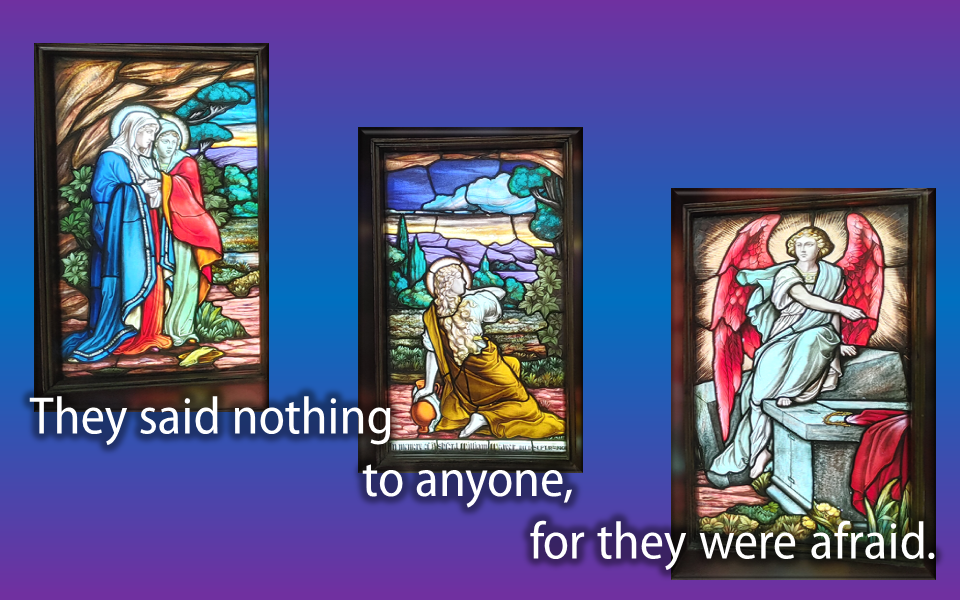
That is all fine and what I expect to hear on Easter Sunday morning. It is the next bit that comes as a surprise. For this is how the Gospel of Mark ends: “So they went out and fled from the tomb, for terror and amazement had seized them; and they said nothing to anyone, for they were afraid.” Surely you thought what I thought when we read that – that that can’t be the end of it.
Something seems to be missing
I mean, where is the part where they took a deep breath and thought about it a bit and changed their minds and decided to go ahead and tell everybody? Where, for that matter, is the part where they actually see the risen Jesus because, at this point, we’re actually talking only about second-hand knowledge, what you might call hearsay in a court of law? The young man may have seen some evidence of the resurrection, but all the women have seen is an empty tomb. And the resurrection of Jesus is a pretty important event so wouldn’t we all like to have just a little bit more evidence? Something seems to be missing at the end of the Gospel of Mark.
If you thought that, I just wanted to tell you this Easter morning that you are not alone. In fact, people seem to have been thinking that ever since the Gospel of Mark was written. But that is, as far as we can tell, the actual ending of the Gospel of Mark. The final thing that we are told is that the women said nothing to anybody.
Manuscripts of Mark
At least, that is how the very best, that is to say the very oldest, manuscript copies of the Gospel of Mark end. And the way that we know that people were not happy with that ending is that there are other manuscripts of this gospel, that are not quite as old, that have added other endings. You can find these other endings in the footnotes of your Bibles, but they were pretty clearly not written by the original author.
The so-called longer ending, for example, seems to be completely based on the final chapter of the Gospel of Luke. So, pretty obviously, some of the people who made early copies of the Gospel of Mark were very dissatisfied with how it ended and actually went so far as to try and fix the problem by constructing their own endings.
Was the last page lost?
People were very uncomfortable with the ending of the gospel right from the very beginning. So you are not alone if you have some trouble with it. So, the question is what happened here? Some have suggested, down through the years, that perhaps Mark did write a longer ending and that it was somehow lost.

These gospels were originally written on scrolls of papyrus and when you publish a book like that, if any part of the book is going to become ripped off, it’s either going to be from the beginning or the end of the roll. So, it is possible that the last page of the gospel just got ripped off. It would have had to have happened pretty early on, like before any copies had been made and spread around too far, but it is the kind of thing that sometimes happened in the ancient world. So that is one theory that people have put out there to explain the strange abrupt ending of the Gospel of Mark.
But I would like to ask you to consider today that there might be another explanation. What if Mark intended to end the gospel exactly as we have it today, which is to say that he intended to make us feel uncomfortable with that ending.
The oldest resurrection story
Let me ask you, what do you think is the oldest written account of the resurrection of Jesus? Of all the stories of Jesus being seen after his death that still exist, which was written down first? Usually, when you ask that question, people will respond by saying that it must be one of the gospel accounts – you know, maybe in Matthew, Mark, Luke or John. But, actually, that doesn’t seem to be the case.
Most scholars agree that the earliest gospel was not written until at least 70 ad, about 40 years after the death and resurrection of Jesus. And there are writings in the New Testament that are older than that. The Apostle Paul almost certainly died several years before 70 ad, so anything written by Paul has to be older than any of the Gospels.
Paul’s resurrection account
And do you know what that means? That means that the passage we read from Paul’s first letter to the Corinthians this morning is actually the oldest written account of the resurrection. And what a fascinating and important account it is!
Paul introduces it by saying this: “For I handed on to you as of first importance what I in turn had received.” This indicates that what Paul is about to say is not merely his own story. It is, in fact, a fixed tradition that he has received from others and has transmitted in his turn. Now the first letter to the Corinthians is usually dated to sometime around the year 54 ad. And what the Apostle appears to be telling us is that, sometime before this letter was written, there was already an official account of the resurrection of Jesus that had been circulating in the churches.
Then, even though he has told it to them before, Paul goes on to repeat that account. It starts with the basic sequence of the events: “That Christ died for our sins in accordance with the scriptures, and that he was buried, and that he was raised on the third day in accordance with the scriptures.”
The witnesses
But the next part is of particular interest because Paul goes on from there to list the people who witnessed the reality of the resurrection of Jesus. He lists first an appearance to Cephas (which is probably the original Aramaic form of the name of the man we know as Peter), – so Peter, and then the twelve (presumably the disciples listed in the gospels), then a group of five hundred, some of whom, Paul stresses, are still alive as he is writing, then James (presumably the brother of Jesus), then all the apostles and finally Paul himself.
This, my friends, is huge. Just think of it, only a couple of decades after the time of Jesus’ death, there was an official account of his resurrection, that included a list of the witnesses, that was circulating through the churches. And it was circulating even while some of those witnesses were still alive and people could go to them and ask for themselves whether it was true. This, for me, points to something fundamental about the early Christian Church: they knew the reality of the resurrection of Jesus, and they knew it firsthand.
Barring the invention of a time machine, there is really no way that we could scientifically prove that Jesus actually rose from the dead. That remains a matter of faith. But I really think that there is no denying the simple truth that the early Christians did experience the reality and power of the resurrection of Jesus for themselves. That experience was transformative for them and, I believe it remains absolutely transformative for the world to this day.
The second account
So that is the first written account of the resurrection of Jesus. Let us never forget it’s importance. The second account, however, is probably the one that we read this morning from the Gospel of Mark. Most scholars today believe that Mark was the first gospel written and that it was written sometime around 70 ad.
We know it was around that time because that was a very difficult year in Judea, a year in which the entire countryside was laid waste by the Roman army, in which the city of Jerusalem and the temple were destroyed and thousands upon thousands of people were turned into refugees. There are numerous hints in the gospel itself that these were the things that were going on as it was being written.
So that was the context in which the second resurrection account was composed. And it is quite a different account, isn’t it? As we have already noted, it seems to end very strangely without any direct appearances and with the only witnesses saying nothing at all. But what we need to understand is this. Mark wrote this account about fifteen years after Paul wrote his letter to the Corinthians.
Mark would have known the well-established tradition
And we know from the letter to the Corinthians that there was a well-established tradition about the people who had seen the risen Jesus. We have to assume that Mark knew that tradition. And if Mark knew about that tradition, then maybe he could take it for granted that his readers would know about it as well. And so, when Mark came to write his story of the resurrection, his concern was not to offer that evidence through the witnesses. His readers already knew about witnesses! Mark was trying to do something else.
Mark highlights the women
He chooses to tell the resurrection story from the point of view of a group of women. This is kind of the opposite of giving us eyewitness testimony because women were not generally accepted as being trustworthy witnesses in that world at that time. So, no, we are not to think of these women as witnesses, they are something else.
I believe that Mark wanted his readers to actually identify with the women in the story. They were kind of in the same situation. These people in Mark’s church identified as followers of Jesus. They were also struggling with grief and loss like these women because they were living through some very traumatic times as armies attacked, people fled for their lives and cities were destroyed. They had also received the testimony that the women receive from the young man dressed in white, that Jesus was not dead and that he had risen – the same testimony that Paul refers to in the letter to the Corinthians.
Mark writes to a struggling church
And Mark writes this account for them because you know what these Christians were struggling with at that very moment? They were struggling, not because they hadn’t heard the testimony, but because they were afraid. I mean, can you blame them? They were probably running for their lives. Of course they were afraid! And so, if Mark chose to end his Gospel with the words, “and they said nothing to anyone, for they were afraid,” he probably intended his readers to take that very personally.
Now, just before Mark tells us that the women were afraid and didn’t say anything, he also tells us that they were given a very specific piece of instruction: “But go, tell his disciples and Peter that he is going ahead of you to Galilee; there you will see him, just as he told you.” But then he tells us that this message was not passed on. How could it have been if they said nothing to anybody?
What Mark is saying to his church
So, what Mark is actually doing here is passing on to the church of his own day a message that he is telling us has been lost or forgotten. He is saying, look Jesus really has risen from the dead and yes, you have heard the testimony of the witnesses, but I understand that you are dealing with some really rough times so I’m going to offer you something more than just a testimony. I’m going to offer you an invitation. I know you’re on the run but, because Jesus has gone on ahead of you and he’s gone to Galilee, if you go to Galilee, you can experience the power of that resurrection for yourselves.
The power of Easter
You see, that is the real power of Easter. The Easter story isn’t just something that happened a long time ago and that certain other people witnessed. I mean, it is that, but it is also so much more. Easter is something that keeps on happening. It is something that became very real to Mark’s audience when they first received this gospel and its author invited them to go to Galilee and experience the risen Jesus for themselves. I don’t know if he was talking about the literal geographical Galilee or some other metaphorical Galilee, but that was the promise that he was giving them and I believe that that promise was fulfilled.
But the promise wasn’t just for them, it is also for us. We are living in a time of great confusion and of fear. We are living in a time when we don’t quite know what to do and how to manage this particular crisis. Yes, we have heard the testimony that Jesus Christ has risen from the dead and that is the good news of this day. But Mark is telling us that we can and should expect more. The power of the resurrection is for all of you today. Go to Galilee and he will meet you there. And no, I’m not talking about the geographical Galilee. I’m asking you to go to that place of quiet meditation in your life and think on this truth. I believe that Jesus will meet you with the power of resurrection there. That is the promise of Easter.