Mindfulness, Meditation and YOU
Join us on November 18th
Continue reading »
Hespeler, October 15, 2023 Twentieth Sunday after Pentecost
Exodus 32:1-14, Psalm 106:1-6, 19-23, Philippians 4:1-9, Matthew 22:1-14
Weddings are supposed to be the happiest of all occasions, but we all know that they can sometimes be fraught affairs. They are high-stress events, and this can bring out the worst in people. Couples may clash over the details. They may find themselves in arguments with their future in-laws. Families, being complicated as they are, can often become very hurtful to one another. We’ve all heard stories of weddings that went very wrong.
But what if I were to tell you a story of a wedding that was organized entirely by the groom’s father? What’s more, this father seems to have had absolutely no regard for the wishes of his son, or the bride and what she might like, that doesn’t even come up at all.
So, it already sounds like that wedding is not going to go very well, doesn’t it? Well, you have no idea! This wedding is so bad, that even before it begins, hundreds of people, maybe even thousands, will die because of it.
Messengers who are sent out with the invitations will be tortured and murdered. Whole cities will be attacked and burned to the ground. But, despite all this slaughter, is the wedding called off? Is it even postponed? Not at all. The guest list is updated, and the guests arrive, once again with absolutely no attention being paid to the bride or the groom.

Then before the wedding feast even begins, one of the wedding guests finds himself being bound hand and foot and cast into the most disturbing place imaginable. And this is supposed to be a joyful celebration of two people pledging their love? What would you think of such a story?
Even more important, where would you think to find such a story? In the latest season of the wedding disaster reality television series, Bridezillas? Would you expect to find it in a book written by George R.R. Martin? No, this incredibly disastrous wedding is described in the Bible.
Jesus once told a parable about a great feast. This parable is found in two different gospels – Matthew and Luke. But Luke’s version of the parable has always been more popular. In Luke, the story is pretty straightforward. A man organizes a great meal – not a wedding, just a feast – and invites some friends.
But the guests can’t come when the meal is ready. They offer their various excuses, but they can’t make it. And so, the host, not wanting all his food to go to waste, decides to fill his banqueting hall with all the outsiders of society instead – the poor, the blind and the lame.
That is it, that’s the whole story in the Gospel of Luke. Nobody gets murdered, no cities are burned to the ground, nobody gets bound hand and foot and left to die. It’s kind of dull by comparison when you think of it. But I think that’s the parable that most people remember. And when they read the version of the parable in the Gospel of Matthew, the murder wedding version, the impression of the simpler parable is so strong that I think we almost skip over all of the death and destruction.
So, what is really going on here, and why do we have such a radically more violent version of the parable in the Gospel of Matthew?
It seems to me that there is no question that Jesus told a parable that had an important twist ending. He wanted to put into people’s minds a very particular image of the kingdom of God – an image that made a point of including all the marginal outcasts, the people who lived on the fringes of society and who everyone else despised. And, at the same time, he wanted to put forward the image of a kingdom where the elites, the privileged and the hyper-religious missed out.
But the problem was that that kind of thing simply didn’t happen in his world, just like it doesn’t in ours. Whenever anything nice happens, we all know, it is the rich and the privileged who get the front row seats while the people who live on the fringe are left out in the cold. And so, Jesus had to come up with a somewhat convoluted tale of a banquet that ended with a ridiculous situation where everything normal was all topsy-turvy.
And I suspect that this crazy image of the kingdom of God that Jesus was trying to get across was really hard for people to get their heads around. I’m sure they were constantly saying things like, “Jesus doesn’t really mean that those people who live on the fringes are going to have all the best seats in the kingdom of God, does he?” So, they struggled with this story and retold it to try and make it make sense for them.
For the writer of the Gospel of Luke, I guess it was enough for him to understand the story by realizing that the wealthy and important people of this world often have so many demands on their time and attention. “I have bought a piece of land, and I must go out and see it… I have bought five yoke of oxen, and I am going to try them out… I have just been married...” (Luke 14:18-20) These were the kinds of busy demands that were put on wealthy people’s time. So, it kind of made sense to Luke that, amid all the busyness of their important lives, they might fail to notice the priorities of the kingdom of God.
Meanwhile, the poor and marginalized folks, as far as Luke knew anyway, had nothing but time to pursue the kingdom’s goals, so that helped him to understand how they might end up in preferred positions in the kingdom.
So that was how Luke presented the parable of Jesus; it made sense to him that way. And he wasn’t wrong in the interpretation. That was certainly a good part of what Jesus was trying to say about how the rich and the poor responded differently to the challenge of the kingdom of God.
But there is clearly something a little bit different going on in Matthew’s version of the parable. I think, in fact, that he might have understood some of the deeper meaning of the parable. In Matthew, the reason why the elites don’t make it into the kingdom isn’t because they are too busy with other matters.
They aren’t part of it because they find the very idea of the kingdom of God – a kingdom where they don’t get to be in charge – to be ridiculous. “But they made light of it and went away,” is their initial response. They mock the very idea and find it silly!
But then, when, despite their mockery of the ideals of the kingdom, it persists, the elites soon turn violent. “While the rest seized his slaves, mistreated them, and killed them,” it says.
This is making a very important point about Jesus’ message of the kingdom of God. It is not just a nice idea. It is not just some idyllic vision of a world that is different and that includes outsiders and marginalized people. It is a threat because it calls into question the existing world order. And the powerful of this world do not take such threats lightly.
Where are we, at this particular moment in time, in terms of this parable? I think that we are somewhere between the mockery and the threat of violence. At least this is how I’ve been experiencing it.
We seemed to have been getting someplace in our society in terms of including some marginalized people. Indigenous people, people of colour, sexual and gender minorities were at least starting to get a voice within the larger society. A few years ago, I would have said that that was where we were going, and it seemed to promise something for the future.
But now we have seen a growing backlash to such ideas. And it started, just like in Jesus’ parable, with mockery. People made fun of what they called wokeness and the woke agenda as if there were something foolish about listening to minority groups and their concerns. Is the next step in terms of maintaining the privileges of certain groups and the status quo going to be violence against those who are different? This parable certainly suggests that that is where it could go next, and it certainly does sometimes feel that way.
In any case, I think that that is why Matthew’s version of this parable takes such a dark and bloody turn. He seems to recognize the inherent threat of the kingdom of God to the ways of this world and he understands how the world will react.
But there is one more aspect of Matthew’s version of the parable that has always puzzled me – a part that is completely absent from Luke’s version of the parable. It is the part at the end when the banqueting hall is filled with all the misfits, outsiders and despised people in a perfect vision of the nature of the kingdom of God.
But one of the guests, despite having been accepted and given a place as he was, has decided not to wear the wedding garment that has been provided for him. For this reason, he is thrown out of the feast and into the outer darkness.
While the rest of the parable seems to be about how the world at large reacts to the nature of the kingdom of God, this part seems to be directed specifically at the church. The church, after all, is supposed to be a reflection, however partial, of the true nature of the kingdom of God. It is to be a place where all are welcome regardless of who they are because we all recognize that we are outsiders and marginalized when it comes to living up to God’s righteousness.
The wedding garments seem to represent the basis upon which we can all claim to have a place in the church. They represent the righteousness of God that is imparted to us, not because we have earned it, but because of what Jesus has done for us.
But unfortunately, we sometimes forget the basis upon which we gained entry to the church. We can become proud and start to think ourselves better than others who have not been around so long. We can become judgmental of those who do not fit in. We can become angry or resentful at those who threaten our comfortable status quo within the church.
That is when we take off the robe of righteousness that has been given to us because we begin to feel as if we have earned our place by our own righteousness. That mistake is reflected in the foolish guest at the end of the parable.
I’m not saying that God is going to bind us hand and foot and cast us out when that happens. I don’t think God treats us like that. But, in many ways that is what we end up doing to ourselves when we fall into such a state of being. We exile ourselves from the truth of the kingdom. That is what the end of the parable warns us against.
So, this parable, particularly as it is told in the Gospel of Matthew, tells us two important things about the kingdom of God. First, it reminds us that its inclusive vision – welcoming and valuing all the outcasts and rejects of society, all the ones that we struggle to accept – is a threat to this world’s order. The world reacts with mockery and ultimately with violence to such a threat.
But second, this parable is there to remind us of who we are supposed to be as followers of Christ. We are to be those who learn to live in the reality of the kingdom despite the world’s rejection of it. We do so because we recognize our own unworthiness and do not turn away from our own failings. We welcome the robe of righteousness given to us by Christ because we know it is a gift.
And having so freely received that gift, we are empowered to exercise that same grace towards others – welcoming them as they are. Valuing them even if the world despises them. Making a place for those whom the world passes over. For we, in our own small way when we gather, are to live out that reality of God’s kingdom and show the world that it is possible.

Hespeler, 8 October, 2023 © Scott McAndless – Harvest Thanksgiving
Exodus 20:1-4, 7-9, 12-20, Psalm 19, Isaiah 49:8-13, Matthew 21:33-46
In our plan for this year, I committed myself to spending some time preaching during this month of October about valuing and including people in the church, especially people who are different from us.
I started out last week by focussing on how Jesus challenged the religious folk of his day by telling them that the tax collectors and prostitutes would be ahead of them in the kingdom of God. I suggested that Jesus would likely seek to challenge us in the same way.
But, even as I preached that last week, I recognized that I couldn’t afford to let myself off the hook too easily. As I said, Jesus would challenge each one of us individually to think about welcoming and valuing the very people whom we would most struggle to do that for. So, who would be that person for me?
I think I am a fairly empathetic person. I do not quickly judge many of the people who are easily rejected by others. Though I may have some trouble with the moral choices people have made, I am usually quick to understand that they may have some good reasons – or at least some good excuses – for how they have chosen to act. I know that the world can be a hard place and that many people are just doing their best to find themselves and make their way.
I don’t say this to suggest that I am better or less judgemental than other people – I’m not. It’s just that, because of my own personal backstory, I tend to judge a bit differently from some people. And there are people that I do struggle with.
Over the last several years, we have seen the growth of a certain group of people who I do struggle with valuing and welcoming. I suspect that some of you do too. Since about 2016 and then accelerating greatly after 2020, we see more and more people in our society who get caught up in conspiracy theories. Now, I remember a time when conspiracy theories were just these harmless little hobbies that sometimes people got caught up in.
But more recently, many of them have taken a turn in a very dangerous direction. Today, as a result of the proliferation of such theories, people don’t just believe untrue things, they believe some very dangerously untrue things.

You are probably familiar enough with these theories, but just to give a few examples, you have people today who believe that when they give you a COVID vaccine, they inject you with a microchip, who believe that they are putting litter boxes for students in school bathrooms, that hospitals in Canada perform genital reassignment surgery on children, that 15 minutes cities are a nefarious plot to control everywhere you go instead of a city planning idea that has been around for ages, and the list goes on and on.
These conspiracy theories, and many others like them, are quite untrue. It can be demonstrated very easily that they are untrue. But people believe them.
And, again, I don’t really have a problem if people believe things that aren’t true, so long as they don’t do anybody any harm. But many of these conspiracy theories are starting to do harm in various ways. We see them being used to target and marginalize vulnerable people. We see it causing the deadly resurgence of once nearly eradicated diseases like measles. We see some of these conspiracy theories leading people down paths toward dangerous radicalism.
So, yes, I will say it. I do sometimes struggle in terms of valuing and accepting people who get caught up in conspiracy theories. I have had, at times, people come into this church and talk to me. It hasn’t really happened on Sunday mornings but on other days of the week.
They seem like very nice people, and we can chat contentedly for a while. They might even show interest in the life of the church. And, of course, I will invite them to come and visit us on a Sunday morning. But then we get into discussing some conspiracy theory that they are invested in.
When they bring it up, I might gently correct them and say that some point they have raised is simply not true. I don’t do it in a confronting way, I just want to explain that I don’t necessarily agree with them. The conversations have ended cordially.
But I will confess that, once the conversation is over, I often leave it with the inner desire that they don’t show up to church, that they don’t start sharing their conspiracy theories among us. I fear it might cause some harm.
So, there is a real question about how we can relate to and accept those who do get caught up in various conspiracy theories. How can we accept them, love them and value them for who they are?
This morning we read a portion of the Book of Isaiah from the forty-ninth chapter. I think it is a passage that can greatly help us navigate our present moment. It was written at a time when the nation of Judah was coming out of a series of disasters, and the hard times were hardly over.
They were returning from a devastating time of exile, trying to put their lives back together and dealing with ongoing crises like out-of-control inflation and attacks on their sovereignty by hostile nations. It reminds me a lot of the kinds of challenges that we are dealing with today.
And so, you can well imagine that a lot of the people were deeply traumatized by everything that they had gone through and, like always happens under such circumstances, they were probably not dealing with it very well. Some of them probably even got caught up in conspiracy theories about the governor or some of the surrounding nations. But what we have in this passage is God’s response to everything that the people were going through at that difficult moment.
This is the response of God that particularly strikes me in this passage: “Sing for joy, O heavens, and exult, O earth; Break forth, O mountains, into singing! For the Lord has comforted his people and will have compassion on his suffering ones.”
Think of what that is saying. In times of change and uncertainty, how we often react is that we start to call for everyone to agree or get on the same page. We demand that nobody stir things up with their unreasonable demands or conspiracy theories. God does none of that. God’s response is comfort and compassion for the afflicted and suffering.
And if we want to find joy and hope in our uncertain times, we must follow God’s example. And so, I am working on learning some compassion for the conspiracy theorists among us. And I do believe we can find it.
Yes, I know that many of the things that some people believe are simply untrue and potentially very dangerous, but I am also coming to understand the suffering that has fed such beliefs.
Let’s take vaccines, for example. Everything I have read has convinced me that the COVID-19 vaccines have been safe and effective, but I am also learning some compassion for those who hesitate to take them. I don’t necessarily think that industry and government were always as transparent as they should have been and that quite understandably did not inspire trust in some.
I think that we all had a hand in downplaying and dismissing risks when it probably would have been more honest to speak of some relative risks and put them in the context of the greater risk of getting the disease. We promised too much in terms of protection and when our promises didn’t quite live up to the hype, yes, some people understandably lost faith in the system.
Does that mean that the pharmaceutical companies were injecting us with microchips and the government had an insidious plan to implement social control? No. The beliefs that some have embraced are not literally true, but there is a certain sense in which they are emotionally connected to some of the things that are truly wrong with our systems and their deep dysfunction.
It is true that pharmaceutical companies are more concerned with their own profits than they are with public health, that they are doing things like investing way more money into stock buybacks (which only benefit shareholders) than they are into researching life-saving drugs, for example.
It is true that our individual freedoms are being eroded and that social control is growing, it’s just that it is not necessarily being carried out by shadowy government entities so much as it is the stated goal of some of our largest and most powerful corporations.
Many of the other conspiracy theories that we hear are connected to the rapid pace of change within our society – change that is understandably hard for some people to deal with.
If people are going around and saying that schools are putting out litter boxes for students and encouraging students to change their genders on whims, they are of course wrong on the facts of the matter.
When they say that genital surgery is available to children in Canada, they likely know nothing about actual medical policy. And it is hugely problematic because those kinds of beliefs are putting very vulnerable people at risk – in particular, kids who dare not be open with their parents about the things that they are struggling with because they know that it will lead to their total rejection.
But, at the same time, I don’t necessarily think that it helps anybody to fail to acknowledge the things that people are feeling about how the world is changing, how old certainties and old binaries that once made things seem so simple, are fading away. And, yes, it is true that the old certainties and binaries were never as simple as they appeared to be – it was just that we didn’t even let people talk about that complexity – but now it has become so confusing to many people. We need to find ways to acknowledge what people are feeling without compromising in terms of protecting vulnerable people.
And I’m not entirely sure how we can accomplish that, but I know it has to begin with some basic compassion for everyone who has suffered.
Over the last several years, our society has become increasingly polarized. It’s not just that people disagree; people have always disagreed. It’s that we seem to have decided that we cannot even communicate anymore because we do not see things in the same way. I am appalled at some of the conspiracy theories that people believe, especially when they are used to justify hateful actions and attitudes.
But at the same time, I do think that many who have fallen down such rabbit holes have done so because they are dealing with a feeling that is quite legitimate – the feeling that things are not right in our society.
And when we don’t allow people to express that feeling, when we shut down all criticism of how things are, people will look around to find someone who will take seriously what they are feeling. And often that means that they will take refuge with conspiracy theorists because they are the only ones who will validate what they are feeling.
But if we can learn some compassion for what people are feeling, I’d like to think that we could short circuit some of that. Compassion, by the way, does not mean feeling sorry for people. That is just condescension. It means actually listening to people where they are and respecting them for who they are. And, if anyplace, the church should be a place where that kind of compassion is found.
I don’t really have any easy solutions to any of this. I’m sure that most of us do encounter people who believe things that we have a hard time with. But perhaps we can appreciate what they are feeling – that there are some things that are seriously wrong with our society.
We seem to be so afraid of some people’s unease about how the world is that we drive them away and into the arms of others. But Jesus knew that all was not right with the world – that is why he came to save it and why he proposed the alternate reality of the kingdom of God.
There is supposed to be a place for everyone in the church – a place where we can bring our real fears, real worries and real concerns. Our feelings should be validated here, and nobody’s feelings should just be dismissed. I can’t help but feel that if we can find the compassion to allow that to happen here, things will begin to change for the better.
Hespeler, October 1, 2023 © Scott McAndless – World Communion
Exodus 17:1-7, Psalm 78:1-4, 12-16, Philippians 2:1-13, Matthew 21:23-32
In the gospels we are told that, when Jesus went down to Jerusalem for what turned out to be the last week of his life, he spent a great deal of time in and around the temple being challenged by various religious authorities. They would come up to him with these impossible questions, questions like, “Should we pay taxes to the emperor?” or “Who would be the husband of a woman married seven times in the afterlife?”
They didn’t really ask because they were sincerely looking for an answer to these conundrums. They were asking because they were sure that he would not be able to answer or that he would a mistake in his answer. They wanted to catch him, to put him in his place and show themselves as smarter than him. But, in a stunning display of wisdom and cleverness, he came up with the perfect answer every time, often putting them in their place instead.
But that long series of challenges finally comes to an end in the reading that we had this morning from the Gospel of Matthew. And what an end it is! In this passage, Jesus finally turns the tables on all his challengers. They tried to burn him, and he gives them third degree burns instead.
He does that first of all with a question about John the Baptist that he knows they cannot answer. He asks them whether John’s teaching and baptism came from God or human sources. It’s the same kind of strategy that they had tried against him with the tax question. No matter what they reply, they know that they will get in trouble. But where Jesus was smart enough to get out of their trap, they aren’t. They just have to admit that they don’t know and do so in front of everybody! Man, do you need some ice for that burn?
But it is what Jesus says after that that particularly interests me here today. He ends this whole series of stories with a real challenge that I do not think is only directed at his immediate antagonists. I suspect that this one is directed at us as well.
He does it – and isn’t this typical of Jesus – by telling a story. It is a story about two sons that ends with a question: “Which of the two did the will of his father?” And the thing is that that is not even a difficult question to answer. The answer is obvious, and they get it right away. The first son actually did something that his father asked and the second one didn’t. It is clear that the first one did the will of his father, and they immediately say so.
But of course – and this is also typical of Jesus – there is a complication in the story. Because it turns out that the second son may not have done what his father asked, but he did say the right thing. He didn’t have the reality of correct action, but he did have the appearance of it. He may not have had the substance of obedience, but he had the form.
And the problem is that, in our world, we tend to put more importance on saying the right thing than doing the right thing. We are more interested in appearance than reality and we applaud form over substance. For proof of that, just look at the way that we celebrate celebrities and how we respond to the promises and platitudes of politicians. They are all about form and appearance and saying the right thing, rarely about substance, reality and doing the right thing.
And so, Jesus is calling out the shallowness of his challengers with this little story. He is letting them know, in particular, that they are rejecting some people, treating them as less valuable and important than them and they are doing it for unimportant and surface reasons.
You should not listen to this story without allowing it to challenge you to rethink how you – probably without even thinking about it – judge and reject other people for reasons that are unimportant and based merely on appearances and surfaces.
But perhaps the story doesn’t have quite the impact on us as it did on the people in Jesus’ time. After all, not too many parents today expect their children to do work in the fields for them. So perhaps we need to update the story to something that we can relate to a little easier.
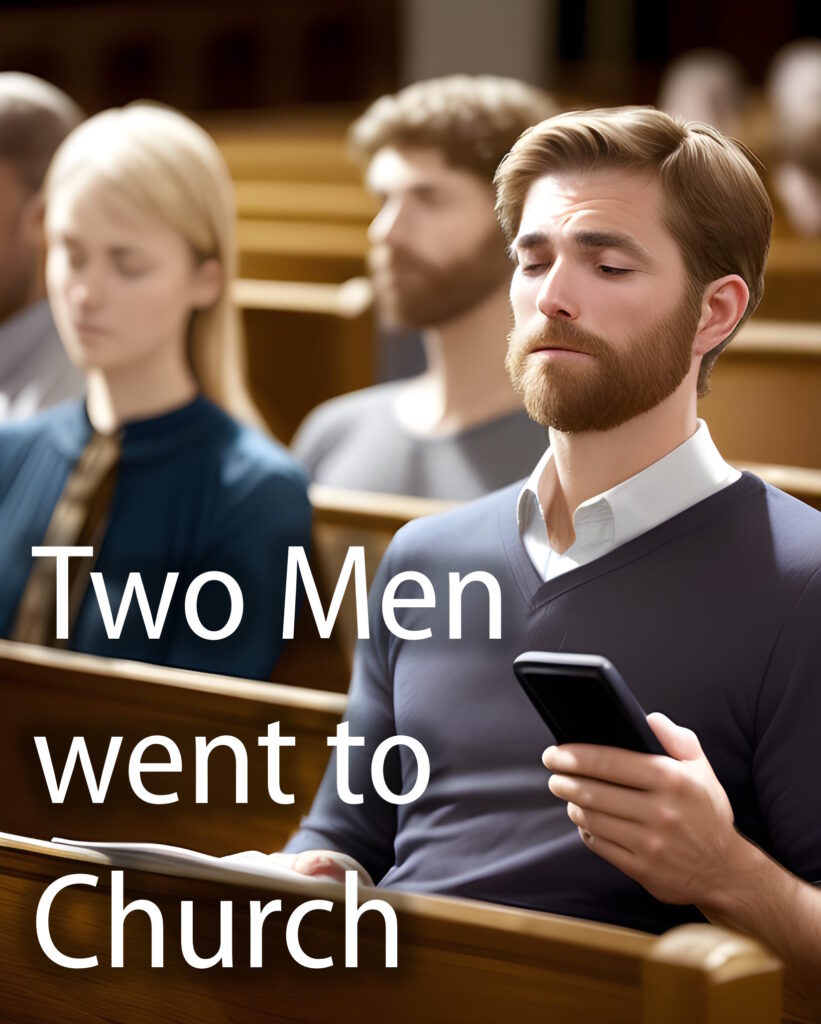
So, what if Jesus told the story like this: two men went to church on a Sunday? The first man, a very distinguished gentleman, was perfectly behaved. He stood when everyone else stood and then sat when he was supposed to. When there were hymns to be sung, he stood and held the hymn book at a perfect 30⁰ angle and mouthed the words in perfect sync with everyone else – not actually singing, of course, so it’s not to draw any attention to himself.
When the service was over, he politely greeted a few people and shook a few hands and left. After leaving, he never said anything about where he had spent his Sunday morning hour to a single soul and did his best to make sure that nothing that had been said or sung during the worship service had an impact on the way that he lived his life.
When the second man entered into the church, the first thing he did was take out his cell phone and post where he was on social media. Right before the start, he was still taking a few selfies of himself in front of the organ pipes and one of the stained-glass windows that he tagged as being particularly “rad.” He then rushed to his seat as the service began to film the people singing the opening hymn.
The people sitting near him particularly noticed how he was constantly looking down at his phone while the preacher was preaching. They tisked to one another behind his back, but I don’t think that they noticed that he was posting some of his favourite quotes from the sermon on his twitter feed as he listened.
When the service was over, he tried to speak to practically everyone who was there, asking them (most intrusively some of them thought) how they were going to put the Gospel lesson of the day in practice over the next week. When he finally left (much to the relief of the woman who had the job of locking up for the day), he said that it was because he had to go and do what the Gospel had said.
So, let me ask you, which of those two did the will of his lord and saviour Jesus? The answer should be clear, right? Obviously, it has got to be the one who shared his experience of the word of God and who tried his best to live by it. That’s exactly what Jesus was looking for in a disciple.
But who, do you suppose, would we be more inclined to see as a good Christian? Most churches I have known would be much more inclined to recognize the first man as a good Christian than the second.
Most churches seem to frown on the use of cell phones during the service, some outright banning them, in an effort to protect the reverence of the occasion. And most churches that I have known have struggled with finding a place for anyone who challenges the way that things have always been done or disturbs the status quo.
But when we think that way, what are we focussing on, on surface matters or on what is actually going on in someone’s heart? And it goes deeper than that. Our obsessions with maintaining proper reverence in worship may be killing us.
We’re living in an age, after all, when information does not spread like it once did. All of the ways in which people once became involved in churches – by seeking them out when they moved into town or when they came to some transition in their life – don’t really work in the same way anymore.
Most people (and especially younger people) make their first contact with churches in the same way that they connect with most things: online, and especially through social media. And, while churches are creating more and more content in digital format these days, members seem hesitant to share that content with people outside the church. Yes, we could probably learn a great deal from the second worshipper in my story. The question is, will we?
So, Jesus challenges his opponents to rethink how they focus on the things that don’t matter to God – the surface things – when they judge other people. But if you think he would let them off easy with just that challenge, you’ve got another think coming. What he says next really must have hit them hard.
“Jesus said to them, ‘Truly I tell you, the tax collectors and the prostitutes are going into the kingdom of God ahead of you. For John came to you in the way of righteousness, and you did not believe him, but the tax collectors and the prostitutes believed him, and even after you saw it you did not change your minds and believe him.’”
And I would just love to have been there to see how they squirmed when he said that to them. He just named the two groups of people who, as far as they were concerned, were the worst members of their society. For them, a tax collector was the worst thing that a man could be because he collaborated with the hated Roman occupiers. And a prostitute was the worst thing that a woman could be because of what she trafficked in. And yet Jesus has just said to them that these very people will proceed them when it comes to entry into God’s kingdom when it arrives.
There is no question that Jesus made this statement in a way that was calculated to upset his listeners. He wanted to disturb them with the very idea that the people that they thought were unacceptable were completely acceptable to God, certainly more acceptable than them. And that raises the question of how we ought to read this saying of Jesus today.
We, obviously, would not have the same reaction to the phrase “tax collector” that they would have had. We might all have various reactions to people who are employed at Revenue Canada. I realize that many of us do not really enjoy paying our taxes. But we do not think that there is anything essentially morally objectionable about people just because they work for that agency.
Some of us might have a negative reaction to the idea of sex workers, but even there, we today tend to be more sympathetic to people who are employed in that industry than people were in Jesus’ day. We are a bit more inclined to get upset at those who purchase their services or profit from them than the workers themselves.
So, the literal words to his opponents here, certainly do not have the same emotional impact on us today that they did on the original crowd. But I’m just warning you that I don’t think that we should let ourselves off the hook because of that. If Jesus were among us today, he certainly wouldn’t do that for us.
No, the Jesus that we encounter in the scriptures would probably put his finger on the very group of people that each and every one of us would be most scandalized to think that they might be ahead of us in the kingdom of God.
There are certainly some Christians today in our world that I am pretty sure Jesus would look straight in the eye and say to them, “You know, the people in the LGBTQ community are going into the kingdom of God ahead of you because they choose to be true to who I created them to be, even at great cost.” And then he would step back and watch as they sputtered and complained and protested about their own righteousness. That was exactly the spot that Jesus loved to put people in.
But, at the same time, I also know that Jesus wouldn’t be about to let those Christians, and there are many of them, who don’t have issues accepting people in the LGBTQ community off the hook. I wouldn’t be surprised if Jesus went up to them and said, “You know, all of those people who get caught up in conspiracy theories around vaccines and election fraud and the World Economic Forum? They will be ahead of you in the kingdom of God, not necessarily because they believe all the right things, mind you, but because they have at least realized just how messed up the world’s system is.”
Jesus, you see, was an equal opportunity offender. He was always ready to say the thing that would shake you into understanding that he and God were much more open to accept someone different than you are. And, though I suppose we’ll never quite catch up to Jesus and God by being that accepting, never forget that he told these parables and said these things to push us in that direction.
Who are the last people you could imagine getting into the kingdom of God before you? Well, today, with this scripture, Jesus is giving you a little bit of an elbow and whispering into your ear. “Hey, did you know that that person is actually ahead of you in line for God’s kingdom?” And he may leave you to figure out why that is, but the main reason is that God’s grace is always much bigger than our wildest imaginations.
Hespeler, September 24, 2023 © Scott McAndless – Seventeenth Sunday after Pentecost
Exodus 16:2-15, Psalm 105:1-6, 37-45, Philippians 1:21-30, Matthew 20:1-16
You know that there had to be at least one in the crowd. I’m not saying that this person was a wealthy landowner themselves. For the most part, it seems as if the people that Jesus attracted and who filled his crowds tended to be on the lower end of the economic scale.
They were the ones who loved it when he said things like, “Blessed are you who are poor.” (Luke 6:20) But even in such a crowd, there are always some who are extraordinarily sympathetic to the concerns of the landowners and the wealthy, sometimes so much that they can forget the needs of other people who struggle like them.
And so, I suspect that this person, whoever they were, struck up a conversation with somebody else as they left the crowd following this particular parable. “You know,” they said, “that is all well and good. In that parable of Jesus, at the end of the day, all of the people who had worked in the vineyard went home with one denarius in their purses.
“And I know that one denarius is not really a huge amount of money, but the thing is that it is enough. It is enough for one person to get by for the day – to put some food in their belly and perhaps have a decent place to sleep for the night.
“I want them to have that as much as anybody else. Lord knows that I appreciate it when I have a denarius in my purse at the end of the day! But there is just one problem with how Jesus told that story. He said it took place in the kingdom of heaven. But I’m wondering if that foolish landowner still found himself living in the kingdom of heaven the next day.”
With that, the critic cleared his throat and began to do a passable imitation of Jesus’ manner of speaking when telling parables.
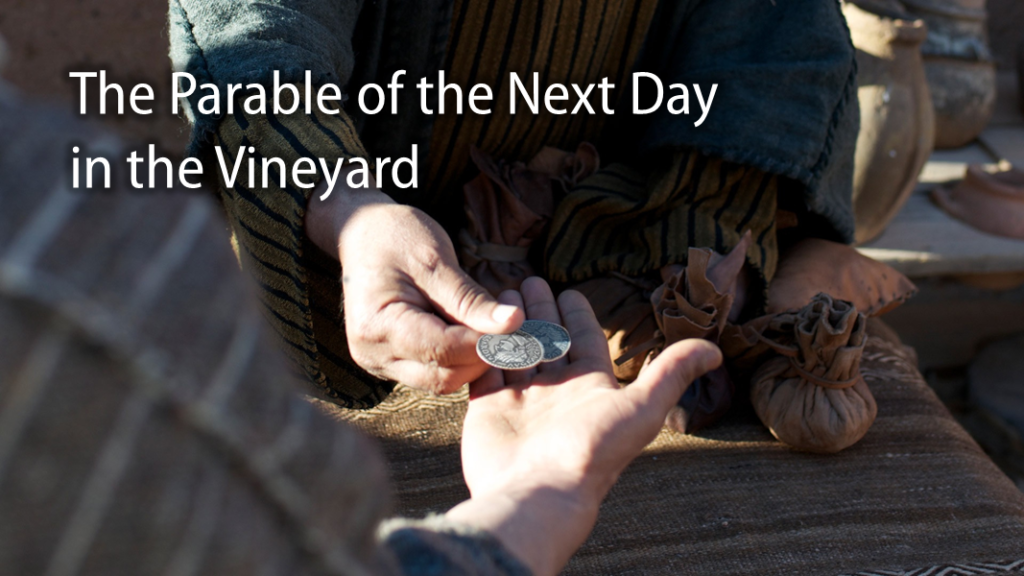
“Ahem, for the kingdom of earth is like a landowner who was a very successful vintner. He had done so well selling his wines that he had been able to purchase many vineyards. And so, after one very successful day of paying unskilled transient workers to gather his grapes, he was hardly done! The next day there was another vineyard that was just perfectly ripe and ready to harvest.
“And so, he went out early the next morning to hire labourers for his vineyard. He went directly to the place in the market where it was customary for those who were looking for work to gather. And, much to his surprise, he saw that not one single person was there.
“He didn’t think much of it at first. He just assumed that, maybe after they had all been paid a full denarius the previous day, they had eaten too well and then slept better in a decent bed. Maybe they had just slept in a bit. He decided to come back a little bit later.
“When he returned at nine a.m., however, there was still no one to be found. Much to his consternation, he also found the same thing at noon and then at two p.m. The landowner began to worry. The very thought of all of his beautiful grapes at the peak of ripeness hanging from the vines in the heat of the day disturbed him. Surely many of them would be at risk of spoiling and being useless to him!
“Finally, he returned to the marketplace one last time at five o’clock. And what do you think? There were so many workers there looking for a job that he suspected that they had come from many of the surrounding towns as well.
“And what could the landowner do? He had no choice but to hire them all for a denarius and send them out into his vineyard. But it was too late, and the sun soon set. Despite there being so many workers, they had barely managed to gather even a quarter of the grapes and the rest were lost.
“And the landowner grumbled against the workers saying, ‘Verily it is true that nobody wants to work anymore!’”
I would suggest to you that, if you want to appreciate Jesus’ original Parable of the Workers in the Vineyard, you need to understand that there is also another parable – what I like to call the Parable of the Next Day in the Vineyard, that we need to listen to.
And make no mistake that the Parable of the Next Day in the Vineyard is a story that is being told. It is being told constantly in our media, in our think tanks and on just about every level of our society. In fact, the story is so pervasive that we just assume that it is not a story at all, that it is just a statement of how things are.
I mean, you hear that story, and you say, “Well, of course, that is exactly how it would turn out. If you actually decided to pay everyone in society the same amount – basically enough money to live on – and you made it clear that you would pay them the same no matter how much or how little they worked, we all agree that the inevitable result of that would be that everyone would work as little as possible.”
We also know that other similar stories that we tell are true in the same way. We all “know” that if you give people who are unhoused a large amount of money, they will just spend it all on drugs and alcohol. We “know” that if you let office workers do their jobs from home they will definitely slack off work. We also have various stories that we tell about minority groups – stories that I won’t repeat here because they contain some very damaging ideas – but they are also stories that we think of as true in much the same way.
But, despite all of this, we need to understand that these are stories – not established facts. And, yes, they are stories that sound true and plausible. They have a certain logic to them that we can follow. They especially make sense to us because they fit with the worldview that we have already accepted. But all of this doesn’t necessarily make them true.
In 2017, as you may recall, the Liberal Government of Ontario set up a Basic Income Pilot Project. The idea behind this project was to give individuals $13,000 a year and couples $19,000 over three years to see what happened.
It was not an enormous amount of money. It was sort of like a denarius a day in Jesus’ world – enough to cover the basics, but little more. But participants in this study would receive that amount whether they worked or not and no matter how much they worked (at least with only a small amount being clawed back from their earnings).
In many ways, that pilot project would have been a way of figuring out whether Jesus’ Parable of the Workers in the Vineyard or my Parable of the Next Day in the Vineyard was a better reflection of reality. We could have found out what really happens when you pay people enough to live on no matter how much they work. We could have found out whether it was reality or just a story.
But, as you probably also heard, we did not get to find out. The government changed and the new government (despite having promised otherwise) cancelled the pilot after it had only run a few months. The government explained it by saying, that “instead of putting money into the experiment, which cost an estimated $115 million over three years, it would “focus resources on more proven approaches.”
And, I don’t know about you, but that sure sounded like good news to me. What, do you mean to tell me that there are proven approaches that can be applied in order to lessen the problem of poverty in our society and the government knows what those approaches are?
If that is the case, though, then how is it that over recent decades the problems of poverty and income disparity have only gotten worse in our society? If we have proven approaches, either we aren’t using them or they aren’t working, so that hardly makes it seem as if they are proven!
But there is, of course, another possibility. Is it possible that the pilot was cancelled because people have already decided that they know what is true – that The Parable of the Next Day in the Vineyard isn’t just a story, but the truth?
There is another study that was recently completed by the University of British Columbia that involved giving homeless people a lump sum of $7,500. Now this study is not absolutely conclusive. Some people have raised some questions about how the participants were chosen. But the overall conclusions at the very least certainly called into question the story that our society had generally accepted about the housing crisis.
The people who received the money did not act according to our society’s dominant story. They did not waste the money on drugs or alcohol. They used it to do sensible things like pay off debts, secure housing and put themselves in better positions to get jobs.
All of this makes me wonder whether the dominant stories that we tell about poverty and the housing crisis, about addiction and “nobody wants to work anymore” are just fairy tales that we tell to make sure that nothing really changes in the way we have organized society and to make us feel okay about that. Most of all, it suggests to me that we just don’t want to know that those stories may not be entirely true. We’d rather just keep believing our comfortable stories.
And this is where I want to bring us back to the amazing genius of the man we call our Lord and Saviour Jesus Christ. When he came along preaching about something he called “the kingdom of God” or “the kingdom of heaven,” he was actually questioning everything about how his society was organized. The kingdom of God was not merely about how things would be someday in heaven, it was about how things could be radically different here on earth right now.
But his greatest genius was in how he chose to present such a radical message. He knew that it wouldn’t work just to say radical things like, “We shouldn’t just organize our entire society around the needs of the wealthy landowners who want to make profits from their vineyards.” Or “We should make sure, no matter what, the people have enough to live on.” People would have just laughed and dismissed him as a dangerous radical.
That is exactly why Jesus told stories instead. Stories have this incredible power; they can help us to imagine how the world could be different.
And, yes, it is true that no story can answer all of the problems that come with imagining a different world. Yes, it is probably true that you couldn’t build a functioning economy just by paying every worker a denarius a day no matter how much work they did. You would probably have to build some incentives into the system.
But, at the same time, by telling a story of how things could be different, of how things could look completely different when you saw them from the point of view of the workers in the field instead of the wealthy landowner, the story that Jesus told called into question the way that things had always been seen.
I certainly recognize that the economic issues around poverty and the housing crisis that we face in our society today are complex. There are no quick fixes. But I also believe that these are problems that cannot truly be addressed until we challenge some of the stories that we tell about wealth and poverty in our society. Jesus did that by telling an alternate story.
He invited us to dream of a different way of doing things, something that he called the kingdom of God. And he did all of that just by telling a few stories.
I think that that leaves a challenge for us. There are absolutely dominant narratives in our society that need to be challenged. It sort of looks like they won’t be challenged by doing things like running pilots on basic universal income or studies that include just giving homeless people some money. Those studies seem promising, but I’m afraid it won’t happen because people are afraid to challenge the dominant narrative.
So, what are we left with? We need to be telling a different story, the story of the world as it could be. We are left with the challenge of doing what Jesus would do.
Hespeler, September 17, 2023 – Sixteenth Sunday after Pentecost
Exodus 14:19-31, Exodus 15:1b-11, Romans 14:1-12, Matthew 18:21-35
I began my serious biblical studies in the late part of the last century – so long ago, in fact, that you might say it was in a different world. And, in that different world, I learned to interpret Jesus’ famous parable of the two debtors.
One thing I learned about it, back in the last century, was that the amounts of money in it were completely ridiculous. The first debtor, for example, owes 10,000 talents. Given that the average worker at that time earned about one denarius a day and there were 6,000 denarii in a single talent, that would mean that the average worker would have to work <calculator keys clacking> about 200,000 years and save everything that they earned with no expenses in order to pay such a debt back.
Ridiculous, right? That is just an unimaginable amount of money. If we put that in terms of the average modern Canadian wage, we are talking about approximately 11 billion dollars!
And so, I was told and I read, obviously Jesus is speaking about a wildly unimaginable amount of money here. The very idea that someone could ever accumulate such a debt, much less dream of paying it off is clearly unthinkable. The notion that any creditor could possibly forgive such an amount, equally ludicrous.
So obviously, the conclusion went, this parable was not talking about practical earthly realities. It had to be about sin and the forgiveness of sin, and it could not possibly be any sort of critique of such things as the modern banking and financial system.
And there was even a somewhat sympathetic interpretation of the actions of the first debtor that went along with it. It was said that the reason why he refused to forgive the debt of the other fellow – the one who owed 100 denarii or about a third of a year’s earnings (placing him in what we might recognize as the middle-class today) was because he simply could not believe that his 10,000 talent debt had been forgiven.
He thought he still owed it and only had got what he had asked for, more time to pay. He thought he had to collect his debt in order to pay his creditor. That led, of course, to an application of the parable that taught people to accept that their own sins had been forgiven so that they could learn how to forgive others as well.
And, don’t get me wrong, that is a perfectly acceptable application and use of the parable, it may even be at least part of what Jesus intended. It’s certainly what the author of the Gospel of Matthew understood it to be saying.
But I do not believe that parables only have one interpretation or application. That’s one of the things that makes them so powerful. They continue to surprise us with the various ways that we can understand them and apply them.
And besides, everything that I was told about this parable in the 1980s and ‘90s and early aughts turned out to be completely wrong anyway. Oh, you think that the amounts of money in this parable are so exaggerated that such a thing could never happen in the real world? Really? Then you probably have been hiding under a rock over the last couple of decades. What if I were to tweak Jesus’ story just a little bit, would you still find it to be impractical?
The slave had a problem. Let’s call him Max because he had a problem of maximum size. Max had invested his company’s money into some pretty shady deals. He was particularly invested in loans and mortgages that were so bad that it was practically guaranteed that the people who had taken them out would default on them.
But Max had figured that that would be okay because when they all defaulted, he would just foreclose on them and sell their property again for even more money. It was foolproof.
And, in order to safeguard these investments, he had bundled them all together into what he called mortgage-backed securities so that, even though they were individually almost worthless, when you put them all together and pooled the risk, they seemed like rock-solid investments.
Indeed, he even had another slave friend certify that the mortgage-backed securities were very safe investments with little risk so that everyone else wanted to invest in them too. Things were going great, and he was making tons of money – living the high life.
But then things suddenly crashed. Interest rates went up and all of a sudden it seemed that everyone couldn’t pay their debts and mortgages all at once. But since all of the houses and properties were seized at once, the market was flooded, and nobody was buying. All of the seized properties and houses were practically worthless! And even those who managed to hold onto their houses found that they lost their value too.
And so, almost overnight, the clever slave went from being extremely wealthy to being in debt? How much was he in debt? Was it ten billion dollars? Was it maybe eleven billion? Ha, that’s chump change! Max barely would have lost any sleep over an amount like that! But this was, he had to admit, a bit more! He was 700 billion dollars in debt!
When the king heard that his slave had somehow managed to rack up such a massive debt, he was concerned. He summoned Max before him and demanded some explanations.
And when the slave came, he made a great show of regret and repentance. He put on sackcloth and ashes on his head as a sign of his deep repentance. He said that he was sorry, but he just wouldn’t be able to pay off his debts.
The king was a wise man who understood the consequences of things. He realized that this was actually a bigger problem for himself and for his subjects than it was for the slave. If Max’s various businesses and enterprises – which were deeply integrated into every part of the economy – failed, it would create so much chaos and disorder that people everywhere would suffer. Max’s impact was so maximized that he couldn’t be allowed to fail.
And so, the king heaved a big sigh and said, “Alright, I’ll do it. I’ll cover your debts.”

Now, how do you suppose it was possible for the king to take the hit of such an unimaginable debt? Well, of course, he had the theoretical ownership of all the assets of the kingdom. He merely needed to borrow against that.
The big problem, however, was that this would have many trickle-down effects on the very people who had already suffered so greatly from Max’s machinations. It would lead to rising prices while they saw their wages restrained. Their savings – if they actually had any – would also lose their value.
In fact, the problems that this would cause were so far-reaching that it was hard to even predict what they would be. It would be bad, there was no doubt of that, but nobody could say exactly how. And that uncertainty just seemed so much less urgent than the disaster that was looming in the moment. So what could the king do? He bailed his indebted slave out.
He did make an effort, to be fair, to set up a few guardrails in order to make sure that this kind of thing couldn’t happen again. But that was about all that he could do.
As the newly debt-free slave left the presence of the king, he quickly took off his sackcloth and brushed the ashes from his hair, absently tossing the rough clothing and dirty brush to his assistant who hovered nearby.
Did Max believe that his massively impossibly large debt had truly been forgiven? Of course he did! He knew from the beginning that this was exactly how it would work out. And now that the unpleasant grovelling was over, he quickly turned his attention to the fun part.
Max started with generous bonuses for himself, and everyone had set up this whole scheme. Next, he started paying off the lawyers and the lobbyists who would make sure that any of the king’s guardrails were quickly demolished.
He had basically just brought his king and many people in the kingdom to the very brink of utter ruin and yet somehow only managed to end up richer and more powerful.
He knew, of course, that someone in his organization would have to be a sacrificial lamb. Some low-level person would get charged, maybe fired and possibly even thrown in prison, but that hardly affected him.
He was busy thinking about where he could go from here. What would be his next conquest? How could he become even more fabulously wealthy?
Sometime later, another problem began to arise in the kingdom. Many of the king’s slaves, in order to do the specialized work of the kingdom, had received, at their own cost, specialized education.
They had been required to take out heavy loans just to afford it. But then, once they were done, their wages were so depressed and housing and other costs were so high as a result of all the fallout of Max’s affair that they just couldn’t pay off their debts, some of which were in the tens of thousands of dollars.
They began to petition the king for some debt relief, and he was making some very sympathetic responses and even prepared some legislation.
But then Max heard about it. Max knew that if the workers got some relief, it would make them less reliant on him and his industries and might even put some upward pressure on the slave wages that he paid.
And so, he and his friends began to put out a media campaign that condemned any debt relief measures for student loans. They complained that it made no fiscal sense, that it would cause inflation and that it would reward the bad behaviour of people who took out loans that they couldn’t pay back.
Finally, with their lawyers and lobbyists, they managed to quash the debt relief legislation altogether.
And what happened when the king realized what Max had done? Did he summon him and say to him, “You wicked slave! I forgave you all that debt because you pleaded with me. Should you not have had mercy on your fellow slaves who were suffering, as I had mercy on you?”
And in anger did his lord hand him over to be tortured until he would pay his entire debt? I certainly hope that he did.
I must say that, ever since the 2008 financial crisis, I just cannot hear that parable of Jesus in the same old way. The crisis basically proved that everything I had been taught about the parable was just plain wrong. The amounts of money in it, far from being wildly exaggerated for effect, turn out to be just a little bit on the small side.
And, in fact, if you want to read it as a parabolic commentary on our modern economic system and priorities, it turns out that it is actually quite believable. It turns out that people who have massive, unbelievable amounts of debt find it so much easier to have their debts wiped clean than do those who have to borrow just little a bit to get by. That is unquestionably the world that we live in.
In fact, the only part of the story that really seems a bit hard to believe is where the rich debtor who gets his mistakes bailed out actually gets punished for opposing some basic debt relief for his poor fellow slave. I mean, when have you ever seen that happen in our world?
But, of course, that it why Jesus told the parable – to show us where the priorities of God actually lay. To promise that the ridiculously wealthy, the too big to fail, will indeed face the consequence of their actions. That is the kind of God that Jesus proclaimed.
And, though I know that we are not going to be able to completely overturn the economic priorities of our society today, I think it’s important to remember that we are called to stand up for the belief, for the possibility, that things could be different – that priorities could be more aligned with God’s vision of economic justice.
And maybe we shouldn’t be afraid to speak the words of Jesus in this story – the words I think he was saying are the words of God – to those who have contributed so much to our present economic mess: “You wicked slave! I forgave you all that debt because you pleaded with me. Should you not have had mercy on your fellow slave, as I had mercy on you?”