You are welcome to worship with us
every Sunday morning
Continue reading »
Hespeler, February 4, 2024 © Scott McAndless – Fifth Sunday after the Epiphany
Isaiah 40:21-31, Psalm 147:1-11, 20c, 1 Corinthians 9:16-23, Mark 1:29-39
Hey, do you want to hear what is wrong with the Christian church these days? I can tell you, you know. Or maybe let me rephrase that a little bit. I have people tell me all the time what they think the problem with the church is today. And they are always so sure that they are right that it must be so, right?
For example, I have been confidently assured that the problem with the church today is Sunday shopping. Yes, the real problem that the church has is that people have the possibility of going out and buying their groceries or picking up a nice new outfit to wear at some point in time between 9 am and noon on the first day of the week.
Oh, but there is more than just the hours of business at the local shopping mall. It is also sports leagues. Yes, the other problem with the church is that sports organizations schedule their games and practices and rent out their ice and fields at any hour on Sunday mornings. Can you imagine that?
Oh, but there is more to it than that. No, I can give you a whole litany of the problems with the church. It is also that people don’t want to sit on committees, and they don’t want to join the various groups in the church.
And, if I can be frank here – and remember that this is all assured data that has been fed to me consistently so I guess it must be true – it is particularly the fault of the younger generation. Yes, whereas previous generations were only too happy to come out and attend these long meetings and participate in women’s groups and bake pies and cookies and all kinds of other things to support the work of the church, apparently these younger folks today just say they don’t have the time.
Oh, and there’s more. Shall I go on? Another big problem with the church today is that people don’t like the right kinds of music. And they don’t like big wordy long prayers and they’re not even appreciative enough of hardwood benches that might be a little hard to sit on but are beautiful to look at.
That, I have been confidently told again and again, is precisely the problem with the church today. And, no, I am not saying that those are the things that people at St. Andrews are always telling me. I get it from various places and even from people who never go to church themselves.
And, yes, I probably did exaggerate what I often take to be the subtext underneath many of the comments that people make. But I am pretty sure that many of those kinds of sentiments sound somewhat familiar to you. They are part of our litany of lament as we think about some of the problems that are facing the church today.
But I wanted to reflect them back to you for a moment because I think those kinds of comments are emblematic of the way that we do think about the problems that face the church. And I want you to notice how I phrased them.
Absolutely nothing in what I just said to you was about what the church does or fails to do. Everything I said was just a complaint about what everyone else does or doesn’t do. And I suggest that that is how we tend to think of the problems that face the church today. We are usually only too happy to focus on what we see as the deficiencies of the society or the changes that we don’t like.
Now, it is not as if there is nothing to any of these laments that we raise. There is no question that society has changed in some very dramatic ways over the last few decades and that those changes have created challenges for the centuries-old institution which is the Protestant church – an institution that has not proved itself to be very good at dealing with change.
But I’m sure you can see the problem with this mode of thinking. If the root problem facing the church is that the world has changed, then the only possible cure for the church is for the world to just spontaneously decide that everything should go back to exactly how things used to be. And, even if there were some good things about how things used to be, what do you suppose is the likelihood of that happening?
That is why I find the approach of the Apostle Paul to be so refreshing. Paul dedicated his life, once he had met the risen Jesus, to building up the Christian church and to tearing down the barriers that kept people away from Jesus and his message. He pushed to include all sorts of people – people that others objected to – into the life of the church. And he seems to have been extremely successful in all of this, founding several churches all over Asia Minor and the Greek peninsula. He did this despite a great deal of opposition from fellow Christians, Jews and even many local officials.
So, I can’t help but think that we might be able to learn a few things from Paul and how he approached his work. He explains his approach in our reading from First Corinthians this morning. And do you want to know what I noticed first when I read it? I noticed that Paul spent no time at all talking about what the society around him needed to change in order to help his work.
He didn’t call on the emperor to shut down the local market or the chariot races on Sunday mornings. He also didn’t complain about people not being available to sit on committees or about how they didn’t want to listen to his sermons the way he liked to preach them.
Instead, Paul describes his strategy to us. “To the Jews I became as a Jew, in order to gain Jews. To those under the law I became as one under the law (though I myself am not under the law) so that I might gain those under the law. To those outside the law I became as one outside the law (though I am not outside God’s law but am within Christ’s law) so that I might gain those outside the law.”
The message could not be more clear. Far from blaming other people for being where they are, Paul makes a point of meeting them there. And he does this in spite of his own sense of identity. He is willing to suspend his Jewishness and his sense of what law he is responsible to in order to meet the people exactly where they are.
But he goes even further than that. You see, the church has often fallen into the temptation of thinking that its failures are the result of other people’s weaknesses. We like to say that it is because other people lack in commitment or faith or faithfulness or just because they don’t want to do the work that the church has failed. The church, in a classic display of projection, is unwilling to see its own weakness and so it projects that weakness onto others.
Complaining about other people’s weakness can often feel satisfying and it is certainly habit forming, but Paul offers the perfect antidote: “To the weak I became weak, so that I might gain the weak. I have become all things to all people, that I might by all means save some.”
Paul is telling us that whenever we are tempted to perceive someone else as weak, what we need to do is put ourselves in their position. It is like the Indigenous North American proverb that says that you must never judge another until you have walked a mile in their moccasins.
And the truth of the matter is that, once you do that, what you usually discover is that what you perceived as weakness was something very different.
When, for example, people are struggling with economic difficulties, it is often very easy just to write them off and accuse them of being lazy. “People just don’t want to work these days,” has become a common refrain. But I honestly believe that there are few who are truly lazy in that sense.
People often have some pretty good reasons for why they are not working or not working enough to cover their bills. Sometimes, wages have been set so low that people can’t actually afford to live in a place and do the work because they cannot afford the rent and cost of living. Therefore, for them to take that job would be to choose to fall even more behind economically speaking.
I think this is certainly true when it comes to the work of the church. I really do think that people are motivated to contribute to the important and meaningful work that the church is doing. They would love to be a part of spreading good news and helping people out as they face the struggles of life. What more meaningful work is there than that?
So, if people are not doing that, I don’t really think it’s because there’s something wrong with them. It’s because other barriers are in the way. It is because the church has conceived itself and its activities in a way that does not fit into people’s lives and sense of priorities.
And so if, for example, younger women aren’t interested in joining missionary groups or other similar organizations in the church, it has little to do with them not agreeing with the goals of those organizations.
It certainly has a lot to do with an economic situation that forces almost all adults to take on full-time careers in addition to taking care of substantial family needs just in order to break even. And it probably also has a great deal to do with how they order and organize their social world. But it certainly doesn’t have anything to do with a deficiency or weakness.
That is why what Paul writes to the Corinthian church ought to be emblazoned on the door of every one of our churches. “I do it all for the sake of the gospel, so that I might become a partner in it.” The job of the church is not to simply continue to be what it is always been and expect everyone else to conform to its way of doing things. The job of the church is to become a partner with anyone who is able to share in the good news.
For that reason, the church needs to be adapting itself to the needs of its partners rather than demanding that those partners adapt to the needs of the church. The simple recognition, for example, that families these days are often stretched to the limit could go a long way. They are on the run earning what they need to survive five or six days a week. They are on the run providing for the needs and the development of their children. They are doing the right thing.
That doesn’t mean that they don’t recognize that the church is a part of doing the right thing for their family. But it does mean that the church may not fit into their lives in the way that has worked for other generations. As the church finds ways to partner with such families where they are in their lives, we will discover new strength.
And I will confess that that is something that this church is still working on, but I do think that how we have been finding ways to allow kids to be kids in our worship service, to be a part of our worshiping life, has been a really good step in a good direction.
There are many challenges facing the church today. But whenever you are tempted to explain away all of those challenges by laying blame on the society outside of the church, you are not going to get anywhere. That is a non-committed conversation, and, as we learned last week, those will get us nowhere. It is in our commitment to meet people where they are, to love them as they are, and partner with them in a way that values them and the challenges they are dealing with, that we will find the greatest strength for the church.
Hespeler, 21 January, 2024 © Scott McAndless – Third Sunday after Epiphany
Matthew 7:7-11, Matthew 13:44-46
As many of you know, last week I was given the privilege and honour of preaching at the funeral of my father: William L. McAndless. And I know that a few of you came out to that funeral all the way over in Scarborough and some more of you watched the service online. That meant a lot to me.
But I’m hoping you will indulge me in something. I’d like to preach what I preached there for you again today. I don’t want to do that merely to honour my dad, though of course I do that, but also because I think it would be a good way to give you all an insight into my own faith journey and how I came to be the kind of Christian I am today. So, with some apologies to those who have heard it before, I am going to share what I said.
I have been given the privilege and honour of speaking at many services like this for many different people over the years. And I can assure you that every single one has been special; every one has been unique. But this one, I confess, seems particularly special and particularly unique.
But in all those years of preaching at funerals, I have come to an understanding of what it is that I am here to do.
You see, I don’t believe that it is my job to proclaim the Christian gospel on these occasions. I don’t even think that is up to me to promise you anything in particular about the afterlife. That’s because there is somebody else – somebody other than me – who is in a much better position to preach to us about those things.
I believe that every individual, every single life, has important things to teach us about the kingdom of God. My job is simply to find that lesson in the life of the person we are celebrating and share it so that we can all grow a little closer to the kingdom. And in all the funerals and memorials I have ever preached, I have never failed to find that lesson in someone’s life.
I have certainly not failed when it comes to reflecting on this life.
When Jesus came among us and taught us about God, he was in the habit of referring to God in a very particular way. He liked to call God, Father. He even taught people to pray and to say, “Our Father who art in heaven…”
And while Jesus was hardly the first person to speak of God as Father, he seems to have brought a special intimacy and familiarity to how he said it. He called God Abba, an Aramaic word for father. But it wasn’t the common everyday word for the patriarchal figure recognized by society. It was the word that was only used inside the family by children of all ages to speak about their father – sort of like we use the word “Dad” in my family.
But what did Jesus mean when he called God, “Abba?” Did he mean it literally? Was he saying that God is male, or that God is a biological progenitor of all people? Of course, not. It was a metaphor, sort of a one-word parable. He was saying that, in some very important ways, God was like a very good Dad.
One day, when Jesus was trying to get people to understand God’s relationship with them, he invited his listeners to think of it in terms of their own experience of fatherhood. “Is there anyone among you who, if your child asked for bread, would give a stone?” he wanted to know. “Or if the child asked for a fish, would give a snake?” What he was saying was that God, in some sense, is like a good father who knows how to give good things to his children.
Now, I am very aware that this kind of father imagery for God doesn’t work for everyone. The sad truth is that not all fathers do know how to give good things to their children. Not all fathers are present for their children, some are too caught up in their own woundedness. Some can also be so much worse than neglectful. And so there are definitely some people who, when you call God father, can only imagine a God who is mean, vindictive or abusive. Such language does not help them and often hurts their image of God.
But what Jesus is also saying is that we, who have not seen God and have not the human language to describe God in any literal sense, are kind of stuck. We can only understand God – can only even speak of God – as extensions of what we have seen and experienced. And, yes, if calling God father does not help you to have a healthy image of God, you need to find a different metaphor.
But I just want to tell you today that I have a very good image of God. Deep down in my soul, I believe in a God who is kind, gracious, forgiving and generous. I am even able to believe in that God despite all of the problems, failures and downright evil I encounter in this world. I can see it all and still believe that God will find a way through it – that (as Martin Luther King Jr. paraphrased) “The arc of the moral universe is long, but it bends toward justice.”
Now, why do I believe in that God? I could give you the correct theological answer and say that it is because of what I have seen and experienced in Jesus Christ. That is true enough. But the real answer goes much deeper. I believe that because I experienced a father who knew how to give good things to his children.
He was not perfect; no human father is. But he never acted in any way that made me doubt the essential truth that there was goodness in the universe. I came to believe that God knows how to give good things to God’s people because I had a good Dad. What I came to know about God through Jesus certainly confirmed that, but I don’t mind saying that my image of God started with my Dad.
Are there some problems and issues and shortcomings that come with that? Sure. For some inexplicable reason, when I imagine God, the God that I picture, might usually be found sitting in the armchair in the living room exhaustively reading the Toronto Daily Star, because that was where I usually found my Dad when I was growing up. There probably are times when my view of God is imperfectly tainted by my experience of my Dad, but overall, I think I am very fortunate for the view of God that I grew up with.
So, my Dad gave me an amazing starting image of God. And here is what he has to teach all of us today about the kingdom of God.
Jesus seems to have spent almost all of his time talking about this thing that he called the kingdom of God. But, curiously, he never quite said what it was. It’s kind of the same thing when it comes to describing Godself. We really don’t have the human words to describe what the kingdom of God is, and so all Jesus could do was say what it was like. And he did that, mostly, by telling stories and parables.
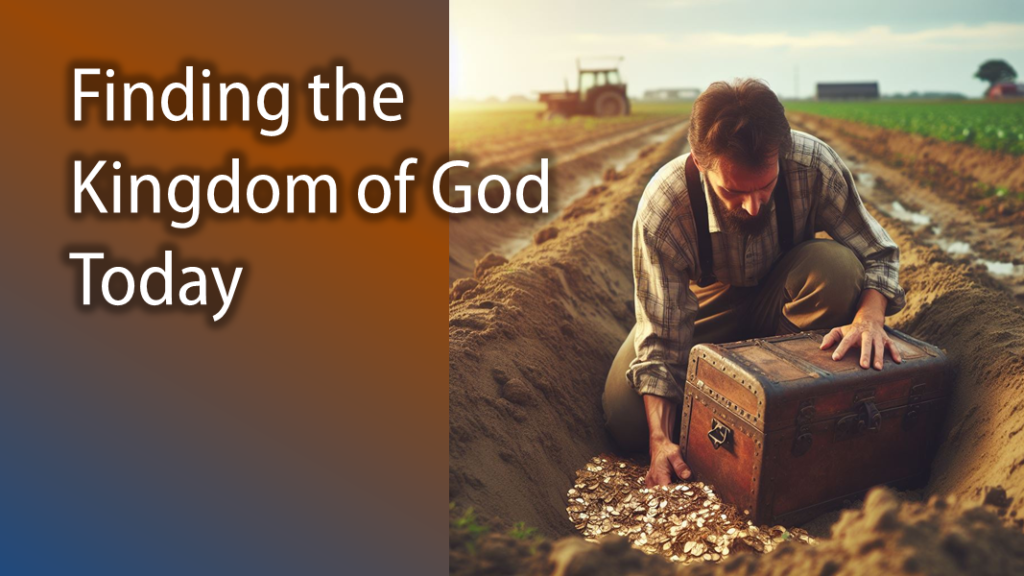
And one of the stories that he told went like this. The kingdom of God, he said, is like what happens when this guy, let’s call him Bill, is walking along one day. He is crossing a strange field, a field that belongs to somebody else, when he stumbles across an amazing discovery. There, hidden in the field where nobody has ever seen it before, he discovers buried treasure of immense value.
What an amazing thing! But no sooner does he discover this treasure than he realizes the problem that comes with it. He doesn’t own the field, so how can he claim the treasure?
The obvious solution, of course, is to just buy the field, but he hasn’t got the money. And so, Bill comes up with a plan. He sells everything that he owns, divests himself of absolutely every possession until he has nothing left. And he goes out and pays an absolutely ridiculous price to buy that field from the poor sod who owns it and has no idea what is buried in it.
And Jesus said that that is what the kingdom of God is like. What on earth is that supposed to mean? How is that supposed to illustrate to us what God’s kingdom is like?
We could struggle to answer that question for a long time, but we don’t need to. We don’t need to because this man that we celebrate today has demonstrated so clearly what Jesus was trying to say.
Bill McAndless was a man who recognized real treasure. He knew what was really valuable. And, despite being a banker for so very long, he knew that the truly valuable treasure of this world was not to be found in bank vaults.
He recognized the treasure that was hidden, and that other people might have walked by a thousand times and never even noticed. When he met a young woman named Doris May Heron, my Mom, he knew that here he had found a pearl of great price – a treasure of unsurpassed value.
But, even more important than that, he knew what to do when he discovered such treasure. He decided to give up everything he had and everything that he was in order to share his life with that incredible woman of great value. He would not let anything stand in his way – not even the odd beetle hiding under the meringue.
Okay, that’s a bit of a story from family lore. The first time my Dad came over to my maternal grandparents house, my mother’s little sisters told him that my mother had created the entire supper. It wasn’t true, but they were trying to fix him up with her. The dessert was lemon meringue pie. My father’s favourite! But, in my father’s piece of pie, there was a giant dead beetle hiding underneath the meringue. My father, ever the wise man, simply put the beetle aside and kept on eating. That’s what I mean when I say that he understood what was more important.
And fortunately, of course, Doris made the same discovery of hidden treasure in him – hidden even in things like his silence on their first date – and made the same decision to give up everything she had and everything she was to share her life with him.
But, more than that, this was not just a one-time thing in my Dad’s life. It was a pattern that he continued to repeat over and over again. When his children came along – when we came along – he absolutely saw the unique value and treasure that was in each one of us. We all know deep down inside that we matter, that we have value because he recognized that value in us and gave everything that he had and everything that he was for our sake.
And, of course, he did that with his grandchildren as well and his great grandchildren when they came. And I’m willing to bet that every single one of us can say that we know we have worth and value because we learned that from this incredible man.
And of course, that was not limited to his family (though we always came first). He did the same thing with his mother, his sisters and brother, with friends. And he knew the great value that was in his church community and joyfully gave his all to support that as well.
And Jesus said that, if you can do that, if you can recognize what is truly valuable and give your all for the sake of that, you have understood the kingdom of God. That is why I can boldly declare that my father understood the kingdom of God and may have understood at least some aspects of it better than many a theologian or preacher.
He lived that kingdom and it showed in every aspect of his life. And if he knew God’s kingdom here and now, as we all can, we can certainly take great comfort today in the knowledge that he has entered into the fullness of that kingdom and that he is with his Lord in an existence that we can scarce imagine or dream of.
This, for me is the sermon that my father’s life has preached to us, and I am honoured to be the one who gets to reflect that back to you today.
Hespeler, January 14, 2024 © Scott McAndless – Second Sunday after the Epiphany
1 Samuel 3:1-20, Psalm 139:1-6, 13-18, 1 Corinthians 6:12-20, John 1:43-51
Could you possibly find a more alarming outlook on the status of religion than the one that opens our reading this morning from First Samuel? “The word of the Lord was rare in those days; visions were not widespread.” Yes, I know, people come to religious sanctuaries for a variety of reasons. Some are looking for a brief escape from the troubles of life. Some are happy to be seen there by others so that they will be well-regarded. Some may just enjoy the nostalgic feeling of being there.
That is all well and good. But if there is not a moment, at least from time to time, when the voice of God just breaks through and people receive a vision or hear a word and they know that it has come from God, then what is the point? But we are told that “The word of the Lord was rare in those days; visions were not widespread.”
Is that not an indication that faith in the God of Israel had become irrelevant? Sure, there were still some people who came out to the sanctuary and went through all the proper motions of the worship of Yahweh, but it had become just a matter of tradition and habit. People are not having an encounter with God. So, what was the point?
That description of the problem particularly struck me when I read it because it seemed familiar. Is that not precisely the complaint that many raise about the state of the Christian church in our society today? It is irrelevant! People are just going through the motions! People just don’t get from it what they really need.
I don’t necessarily agree that all of that is true, but the complaints are raised often enough that we cannot just brush them off. So, let us take a look at what had gone wrong at the sanctuary at Shiloh in the days when Samuel was a child there. Maybe there will be some other points of connection that speak to our situation.
So, why was “the word of the Lord was rare in those days; visions were not widespread.” We have an indication almost immediately after the problem is stated. It says of Eli, the priest in charge of the sanctuary at Shiloh, that his “eyesight had begun to grow dim so that he could not see.” And I know that you could just understand that as a description of a common age-related disability back when things like cataract surgery and eyeglasses were undreamt of. But I think that a careful reading of the story makes it clear that this is not just about a visual impairment.
For one thing, the note about Eli’s eyesight comes so quickly after the statement about visions not being widespread that you can’t help but make the connection. Eli’s problem is not that he has a physical disability. The state of his eyesight is symbolic of a deeper, much more spiritual problem that he has.
And this is borne out as you continue into the story and if you read the larger context. There are clearly many things at the sanctuary at Shiloh that Eli isn’t seeing, but the reason has nothing to do with his eyesight. Above all, he chooses not to see what his sons are doing.
Hophni and Phinehas, his adult children, have taken over priestly duties from their father. But they have made it a habit to abuse their power. They are using their authority as priests over the sacrifice to extort the best cuts of meat from the worshippers for themselves. And, much worse, but distressingly familiar, they are using their positions to rape and abuse the young women who participate in the life of the sanctuary.
I know that you sometimes get the impression that the whole phenomenon of religious leaders using their power and authority to abuse the people who are placed in their spiritual care is a modern problem. It never used to be discussed; it never even came up. Whereas in more recent years, we’ve seen it happening everywhere. So much so, that I’m probably safe to say that every major denomination and religious group has had its own share of scandals in this regard over the last few decades.
But, as the case of Hophni and Phinehas should make clear, this is not because abuse of spiritual authority is a modern invention. It has always happened. Whenever a certain group of people are given an extraordinary amount of power over others, there will be a certain proportion who will be tempted to abuse that power.
As we’ve seen, it can happen in almost any organization. There have been lots of scandals in hockey and other sports, in the business world and in various youth organizations. We might like to think that churches should be exempt, but they’re clearly not. In some ways, the spiritual dimension of religious authority does have a way of amplifying the potential.
So, what the sons of Eli have been doing with their priestly authority is horrific. But they are not the biggest problem, at least not as far as this story posits. The problem is the blindness of Eli. Not his physical blindness, but his refusal to see what his sons are doing and to put a stop to it.
God says that explicitly to Samuel: “For I have told [Eli] that I am about to punish his house forever for the iniquity that he knew, because his sons were blaspheming God, and he did not restrain them.”
That is the real sign of a sick institution. It is not the evil that some individuals do, it is the failure of the institution itself, which is what Eli represents, to safeguard everyone the institution touches. When we prefer blindness, when we refuse to see or to challenge what some powerful people are doing in any organization, that is the root of the problem.
And if it is at all true of the church today that the word of the Lord is rare in these days and visions are not widespread, that has to be part of the reason. The church has wanted to pursue power and authority and has enabled its most influential leaders to that end. Some of those leaders have used that power and authority to serve themselves. Thus, the church is brought into disrepute, and it can no longer speak the word of God.
But if we can learn some humility, and if we can learn to shift from protecting our own privilege and authority to protecting vulnerable people, I do believe that, as we make ourselves vulnerable to God, God’s voice will break through to us. When we stop looking after ourselves first, we will be set free to look for the visions that God will send us. That is where the healing begins both for Shiloh and for us.
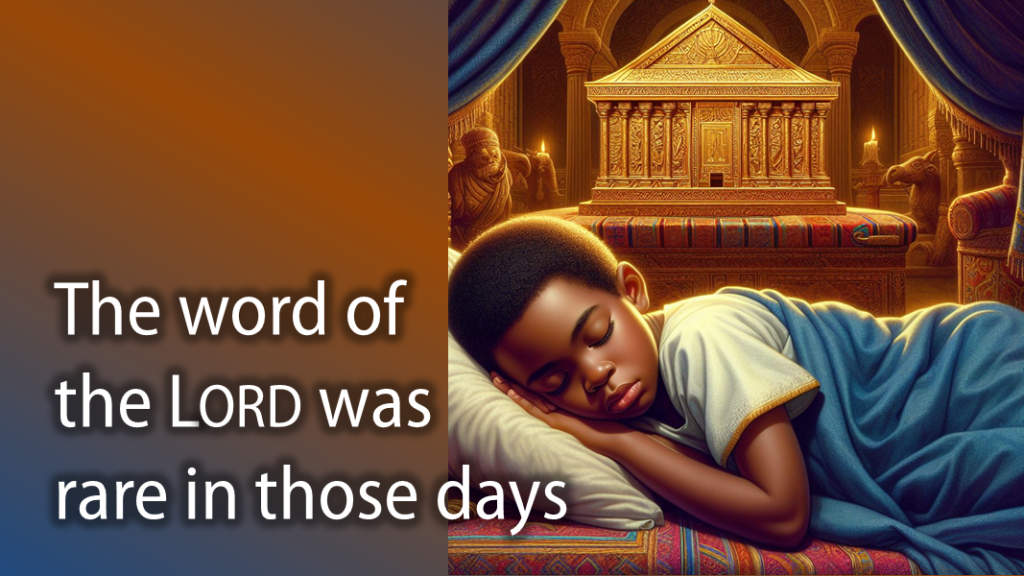
But that is not the only reason why the word of the Lord was rare in those days and visions were not widespread. We see another big indication of what had gone wrong in the story itself. Samuel, this young boy who has been devoted to service in the sanctuary by his mother, is apparently sleeping somewhere in the temple complex and he is in the same room as the Ark of the Covenant.
Now, I don’t know if that set off alarm bells for you when you read it, but it certainly did for me. If you are at all familiar with the Ark of the Covenant, you know that it was the primary symbol of the presence of God with the people of Israel. According to what it says elsewhere, the Ark was to be kept in a special chamber in the temple (or at this point in time in the Tabernacle) called the holy of holies. God was said to be more present there than anyplace else on earth.
How holy was it? It was so holy that no one ever entered the place except one day a year, the Day of Atonement. On this day and only this day, the High Priest was to enter into the presence of the ark only after carrying out an atoning sacrifice.
But even then, they took special precautions. Before the High Priest entered, the temple servants would tie a rope around his ankle just in case God decided to strike him down. That way they wouldn’t have to wait an entire year for the next High Priest to go in and remove the body. Now, we don’t actually know if that rope story was true or just a legend that spread. It’s not actually in the Bible. But, true or not, it is certainly an indication of the kind of respect that they had for the Ark and the care they took when in its presence.
But there seems to be none of that reverence or expectation in this story. The Ark seems to simply be in some random room in the temple complex – a room that also appears to be a dormitory for acolytes like Samuel who serve there. There seems to be no indication whatsoever of any expectation that this cultic object could allow someone to have an encounter with God. They have either forgotten or they never knew that such a thing was possible.
Which is why, when it actually happens, it takes so long for anyone to even recognize it for what it is. Samuel just assumes that it is Eli, the revered elder priest, who is calling out for assistance in the night.
You can’t really blame Samuel for that, of course. He’s just a child and has never had any reason to even dream of such things. No, the real person to blame is once again poor blind Eli. If only he could have seen – and I am not talking about the physical sight that had failed him but the more important inner sight that had failed – if only he could have seen, perhaps the voice of God would have broken through sooner. But, no, it takes three tries – three times when God calls out to the sleeping Samuel – before Eli finally figures out that something else might be going on here.
Now what does any of this have to do with the crisis we face in the church where we seem to be living in days when the word of the Lord is rare; visions are not widespread? I am a firm believer that God has never ceased to speak to God’s people. Visions have never ceased to be sent. But if we do not expect them, will we receive them? And if, like Eli, we suffer from inner blindness, it will be all that much harder.
And what does that inner blindness look like for us? What might be preventing us from detecting the words and actions and power of God at work among us? Often, I suspect, it is because the eyes of our hearts are diverted and looking for meaning elsewhere. For the church as an institution, our focus may be fixed on our own standing within society as we mourn a loss of power and influence.
As individual believers, we become distracted by the temptations of our consumer society. We get caught up in the endless scramble to build wealth or flee from poverty which has become the only concern of our capitalist society. Above all the voice of God gets drowned out by the incessant noise of our social media-driven perpetual misinformation machine and confirmation bias.
All of these things mean that we do not expect God to speak to us or send us any visions that might contradict what we have already decided to believe. That is why the word of the Lord is rare in our days; visions are not widespread. It is not because God does not speak but because we will not listen.
But there is still hope for us. Eli, as blind as he was, figured it out eventually. And when he taught Samuel to respond and say, “Speak, Lord, for your servant is listening,” I don’t think he was just trying to teach the boy. He was trying to teach himself as well. He had finally gotten to the place where he was willing to hear what God had to say no matter what it cost him – and it did cost him a great deal. That is what finally allowed the voice of God would break through. That is what will allow it to break through for us as well.
Hespeler, January 7, 2024 © Scott McAndless – Baptism of the Lord
Genesis 1:1-5, Psalm 29, Luke 2:22-40, Mark 1:4-11
Last week, on New Years Eve, I decided to preach on the gospel passage from the lectionary for the day – the story of Mary and Joseph and the month-old Jesus in the temple. But, if you were here last week or if you have listened to the sermon since, you will know that I really didn’t get very far into the story at all. In fact, I didn’t even get past the first three verses.
That is okay as far as I am concerned. When God is speaking to you through even just a few words of scripture, I think it is always wise just to stop and stay with those words for a while so that you make sure you don’t miss anything that God might have to say.
But none of that is to suggest that the rest of the story – the part after the first three verses – isn’t important. After they had gone to the priest and made a sacrifice of two turtle doves, Mary and Joseph turned around and went back out into the large open space that was known as the Court of the Gentiles.
I want you to try to imagine the space. On any given day, you would expect to find it just packed with people. Many had come, of course, to carry out the prescribed sacrifices and religious observances. But that was hardly the only reason why they came.
Many were seeking for God in some way and instinctively knew that this was the place where they might find God or hear God’s word. In the porches you could hear poets, prophets and philosophers giving their public speeches to the curious crowds. Scribes would also be teaching about the law and its application. And the people gathered around eagerly hoping to learn and grow. But people also sought to hear from God in a more direct way.
Take, for example, that man over there. He does not come all the time to the temple like some do, but when he got up this morning he just felt as if he had to be here. He was a man who was deeply troubled by the state of his nation. He felt as if it had lost track of what it was supposed to be. And now, because of its failures, the nation was occupied by foreign invaders.
And so, he had implored God to console the nation and to send God’s anointed one who would lead it into liberty and hope for the future. And after praying for this hope for a very long time, he had become convinced that God had heard his prayer. He would see the Messiah that he longed for before he died.
Oh, but the wait had been so long. And now he was getting very old, and he had begun to fear that he would not live to see it all come to pass. But today, when he rose, he was filled with this overwhelming sense that, if he came to the temple, God would show him something. God would give him hope.
So that man, his name was Simeon, was just entering into the courtyard from the main gate into the temple. He was looking around expectantly but did not yet know exactly what he might see.

There was another revered elder there. Her name was Anna. She was one of the many prophets who were constantly present in the temple, proclaiming the word of God to any who would listen. Anna was a widow. Married young, she had lived with her husband only for seven years until he died. Ever after, she had remained a widow. So long now that no one could remember whether she was eighty-four years old or if she had been a widow for eighty-four years! (Yes, the original Greek text is ambiguous on that point.)
But whichever it was, everyone had great respect for this woman and her wisdom. So much so that they would often bring her gifts of food and drink so that she did not even need to leave the temple precincts. She remained there night and day and was constantly in prayer and often fasting. For Anna was not just there to speak the word of the Lord to the people. She was still searching for answers for herself.
She, like Simeon, was discouraged about the state of her people. She was looking for God’s help and consolation. She had not only come to look for an answer today like the other man. It was as if she lived in constant expectation that at any moment God would act.
And somehow they knew – they both knew – that God had answered when they saw the most ordinary of things in the temple court. They saw a young couple carrying their month-old child away from the place of the sacrifice for purification. There must have been dozens of such families in the temple most every day.
What was it that marked this family as different? Traditions of Western Art aside, they couldn’t have had literal halos over their heads. There could have been nothing that would have been evident to everyone else. It must have been something that happened inside both Simeon and Anna simultaneously – what Luke calls the action of the Holy Spirit. They were suddenly just sure.
But what I am particularly interested in today is not how they knew that God was doing something. My particular interest is in what they did with what they were suddenly so sure about. Because these two people had so much in common. They were both old. They were seeking the same thing from God. They both came to the same sudden realization when they saw the small family. But they each reacted so differently.
Look at Simeon. He got to the family first. And the first thing he did was snatch the boy right out of his mother’s arms. I hope that he asked first, but it doesn’t say that he did. But then, once he had the child in his arms, what did he do? He prayed to God: “Master, now you are dismissing your servant in peace, according to your word, for my eyes have seen your salvation, which you have prepared in the presence of all peoples, a light for revelation to the gentiles and for glory to your people Israel.”
And I know it is all very pretty and poetic, but I hope you don’t let the fancy words make you miss what he is saying here. He’s saying, “Look, I have done my part. I have prayed. I have waited. I have been looking for the consolation of Israel for all these many years. And now, finally, God is stepping up and starting to do something great. So now, I am checking out. I am donezo. Let me die now.
Now, I don’t believe that Simeon is literally asking God to strike him dead. He may be old, but I don’t think he is expecting that he is going to go home and breathe his last. If he were that frail, would Mary have allowed him to hold her baby? No, what he is saying is that he feels as if he has done his part. He has kept the faith. He has prayed for the consolation he has hoped for. But now it seems that he is tired, and he is done.
In fact, he explicitly says that it is up to others to take over where he is leaving off. He says to Mary, “This child is destined for the falling and the rising of many in Israel and to be a sign that will be opposed so that the inner thoughts of many will be revealed—and a sword will pierce your own soul, too.” So it apparently falls now to the child to do all the hard work and face the opposition. And Mary herself will have her share of suffering too.
So, Simeon has clearly decided that he has finished contributing. And I can totally appreciate how he feels. In all my work in the church, I have known so many saints who have given so much for the work of the church over the years. And then they look up and, like Simeon in this passage, see that there is big change coming on the horizon. They appreciate the change, maybe even welcome it, but they also aren’t ready to deal with it directly. They step down and they look to others to carry on.
And clearly this is sometimes the right decision. I will always honour anyone who has given long and faithful service. I also recognize that sometimes people cannot deal with certain changes well. It just sucks all of the energy out of them and, because their vision is limited to what they have seen before, they can’t implement the changes needed. And of course, sometimes their decision to step down can empower someone else to step up. Sometimes that is how we find the new leadership that we need.
But at the same time, Simeon’s response is not the only response. Remember Anna? She has just had the same insight that Simeon has. She recognizes with clarity that this little child is the fulfillment of all her hopes and dreams. She is also pretty much as old as Simeon. Maybe, if you read it as saying that she has been a widow for 87 after being married for 7, she is even more than 100 years old!
But Anna, despite having all the same reasons as Simeon to check out, give up and retire, doesn’t react like that at all. Instead of prompting her to quit, the sight of Jesus spurs her to action. She “began to praise God and to speak about the child to all who were looking for the redemption of Jerusalem.”
Simeon was overwhelmed by the change that the coming of the Messiah had brought – overwhelmed in a good way, but it still caused him to withdraw. But look at what it did for Anna. It energized her. Why, you could barely contain her as she ran about telling everyone in the crowded temple courtyard about the amazing thing that God was now doing.
You know, I am thankful for the Simeons that God has given us in the life of the church. I am thankful for the men and the women who have served long and faithfully – who have held onto their faith in times of trial and testing.
It has not always been easy for them in the life of the church. There have been times of worry and anxiety. There have been times when people got angry and tempers were frayed. But they continued on, not because it was easy or always fun, but because it mattered. They continued because they believed that God would come and would redeem his people.
We are all thankful for such faithful service and when people come to the point when they feel the need to step down because they can’t manage the next step in change, let us celebrate them with joy.
But thank God for the many Annas – both men and women – that God has sent us. They are energized by the new thing that God is doing among us. They can’t wait to tell everyone about it either. And sure, they might have been hanging around the temple for many years and they are so very used to the way that things have always been done. But they aren’t afraid of the new thing that God is doing among us.
We may all come to the point in our lives when we have to choose between being Simeon or Anna. But just remember that it is your choice. And anyone can be an Anna.

Hespeler, December 31, 2023 © Scott McAndless – Seventh Day of Christmas
Isaiah 61:10-62:3, Psalm 148, Galatians 4:4-7, Luke 2:22-40
The young couple joined the crowds climbing the broad staircase that led to the entrance of the temple. The woman carried in her arms a child just barely over a month old. She had carried him all 11 km from the small town of Bethlehem the day before with frequent stops for nursing and changing the swaddling clothes.
This little family had spent the night in a bare room in the city, the only shelter they could afford. As is the common experience of parents with newborns, they had had little sleep. But they had risen early, thinking perhaps that they might beat the crowds, conclude their business and escape the city before the heat of the day came on.
But, as they passed through the porch and entered into the Court of the Gentiles, they realized that they were not the only ones to have had such a thought. The place was packed. It was filled with pilgrims, gawkers and worshippers. They glanced at each other anxiously. It seemed that this was going to take a while.
The child, thankfully, didn’t seem to be bothered by the noise of the crowd and the cries of the sacrificial animals. He slept contentedly in his mother’s arms for now, but they shuddered to think of what might happen when he awoke.
After a few enquiries, they made their way to the court of the women, where they needed to go today. As they approached, they saw the large pen filled with young lambs and the smaller cages that contained pigeons and turtle doves. Wealthy women were standing by and bartering with the sellers while their nurses held their children at a distance.

When the young man heard the prices that were being demanded for the sheep, he winced. He was sure that he could have gotten one for much cheaper from those shepherds who had dropped by shortly after the child was born. But, of course, the sellers here knew that their customers had little other choice.
He was glad that he didn’t have to ask the price of a bird. He knew that that would be ridiculous as well. He had been extremely fortunate the day before and been able to trap two turtledoves as they travelled. They cooed softly in the makeshift cage he carried in his left hand as he guided the mother and her child through the entrance.
The last month had been difficult. They had been unable to find anything like secure lodging. In fact, things had been so unsettled when the child was born that they had had no place else to lay him but in a feeding trough.
Things had not gotten much better since as they moved around from place to place, taking hospitality from strangers for the most part. On the eighth day after the boy was born, they had been very fortunate to find a skilled elder who was willing to perform the boy’s circumcision and he had been admitted into the covenant of the people of Israel under the name of Yeshua.
Of course, it would have been preferable for them to return to their home in Nazareth where at least the boy’s mother had family connections and support, but they had remained in the area so that they could perform the ritual for her here on the first day possible. There was some urgency to completing it, after all. Until such time as this had been done, she was effectively set apart from ordinary society. She could not eat with others, nor could she have proper relations with her husband.
This was not, to be clear, because there was anything wrong with her. It was a matter of ritual impurity, which had nothing to do with moral sin or error. It was more like she was being given a special honour. She had, after all, just done something amazing. She had brought a new life into the world. Men in particular were somewhat wary of this special power that only women had to create life. They didn’t quite know what to do with it. And so, they felt a need to segregate that power for a time out of respect for it. But, even if it was an honour, it was an inconvenient one. The couple were more than ready for it to be over.
They stood in line for quite some time, surrounded by the sound of bleating sheep and cooing pigeons and doves. There were many women who were here waiting to perform the required sacrifice. Finally, the line began to move, and they came to stand in front of a Levitical clerk who sat behind a wooden table.
“And for what purpose do you come here today,” he asked them in a bored tone as if the answer wasn’t made completely obvious by the presence of a month-old boy in his mother’s arms. The man was very proud to hear his wife respond in a clear and unwavering voice: “I am here to perform the purification ritual following the birth of my son.”
In the tones of a bureaucrat who spends all day every day reciting the same piece of legislation, the man responded. “When the days of her purification are completed, whether for a son or for a daughter, she shall bring to the priest at the entrance of the tent of meeting a lamb in its first year for a burnt offering and a pigeon or a turtledove for a purification offering. He shall offer it before Adonai and make atonement on her behalf; then she shall be clean from her flow of blood. This is the law for her who bears a child, male or female.” (Leviticus 12:6-8)
He looked up at them, taking in their poor clothing and dishevelled appearance at a glance, “So, you see, you’re supposed to bring a lamb. I don’t see a lamb. Where’s your lamb then? They are on sale out in the outer court.”
The man had been expecting this. And fortunately, he was well-versed in the traditions of his people. He knew that the law had been written in such a way as to make allowances for the poor and disadvantaged, and he felt no embarrassment in invoking these traditions now.
“Come on, you know very well that the law made provisions for those who could not afford a lamb for the purification. Maybe you don’t care if we have little, but God does! We are perfectly allowed to offer up these two turtle doves instead,” he said holding up his little cage.
The Levite smirked. “You call those doves? They’re filthy! You’re sure that they’re not flying rats? You didn’t buy those here!”
“Doesn’t matter, does it?” the man replied sharply. “The law never says you have to buy them. I caught them myself!”
“Yes, added his wife with a smile, “I’m rather of proud of my man’s hunting skills.”
The clerk finally let out a great sigh as he reluctantly let them pass.
A lot of people thought that the temple made its money from the tithes and donations that people brought. But the priests and the Levites knew very well that the real money came from the sacrifices. Once most of the sacrifices were performed, some of the meat would be returned to the worshippers. Only a certain portion would be burned up – mostly the parts that were inedible or prohibited from Jewish consumption. The worshippers would take it and have a feast.
The priest wasn’t paid money. Instead, he would also claim a portion of the meat for his services – indeed, some of the best cuts of beef or mutton went to him. In a day’s service, a priest would receive much more meat than he could possibly eat with his family before it spoiled, and so it could be sold off to the elite of the city at premium prices.
That was why it was very much in the interest of all who worked in the temple to pressure people into sacrificing fine animals. What’s more, they had deals with the sellers in the temple that gave them kickbacks for every animal sold to the captive audience there. So of course, they would pressure everybody who came along to sacrifice the best animal that they could.
This was something that was not only true of the temple in Jerusalem, of course. This was how it worked at most every temple of every god in the Mediterranean world. But not every ritual law made exceptions for the poor. But thanks to the strength of the Judean tradition or, some might say, thanks to the compassion and care of the God of Israel, they could not deny access to this impoverished young couple.
And so, I will say that it was with some pride for having stood up for their rights, not to mention some relief for having completed all that was fitting for a young child of the people of Israel, that the parents walked away after the completion of the sacrifice of their birds. They knew their place within a tradition that was deeply meaningful for them and that would be, they knew, meaningful for their son as well. They felt as if they had begun something very important.
They returned to the Court of the Gentiles and were very surprised, among all those who were present in the ever-swelling crowds, to be approached by a venerable old man and then a saintly widow.
I always assumed that the first few lines of the story of the infant Jesus in the temple were just the mise-en-scène, you know, just a setting of the stage upon which the really important events will take place. The storyteller just needs to get Jesus and his parents into the temple where they can encounter the prophets, Simeon and Anna, who will tell us these very important things that we need to know about Jesus. But, as I looked closely at the opening verses of the story, I realized that it would be foolish to just skip over them.
The gospel writer is trying to teach us something important about the traditions of the people of Israel and the place of Jesus within those traditions. He is reminding us that Jesus was a part of the ancient covenant of Abraham, which would have been marked into his flesh on the eighth day after his birth.
He is also reminding us of the rituals of purity. And I think he would like us to be mindful that these were not about treating women in Mary’s situation as if they were dirty or shameful. That’s not what these rituals were actually about. They were symbolic of the incredibly powerful thing that Mary had done in bringing new life into the world, especially when, in the case of Jesus, it was new life that would come as a gift to the whole world.
But the thing that particularly strikes me about this short preface to the story is what it says about those in poverty. Luke has already gone out of his way to underline to his readers the situation of abject poverty into which Jesus was born. Laid in a manger because there was no proper place to stay for him, visited by shepherds whose status was about as low as you could get, Luke has already made it quite clear that Jesus was anything but financially well off at his birth.
But in this story, a new dimension is added to that impoverished situation. The law was clear. A woman in Mary’s situation was expected to bring a lamb for sacrifice. Yes, there was a provision in the law that she could bring two birds instead, a concession given for those who were faced with utter destitution. But many would have died before admitting such poverty before the priests.
But notice how Luke portrays what Mary and Joseph did. He simply says, “and they offered a sacrifice according to what is stated in the law of the Lord, ‘a pair of turtledoves or two young pigeons.’” He doesn’t even mention that the expectation was that they should have sacrificed more. He suggests no sense of shame or embarrassment on their part or his. They, according to their means and who they were, were able to do what was pleasing to God.
And I find that all rather refreshing. We live in a world today where more and more people are falling through the economic cracks. And when people can no longer find affordable housing or their wages – and often enough it is full-time wages these days – are no longer enough to pay the bills, they are just written off. They no longer count.
They are a problem to be solved, a crisis for various levels of governments to fight over. If they resort to living in encampments, they might be evicted without a second thought. If their desperate situation leads to their demise because of addiction or other problems, we react with little more than a shrug.
But when we so callously dismiss a whole class of people, we not only push them deeper and deeper into crisis, we rob the entire society of all that they have to offer – and they have so much to offer us all!
God made room for an impoverished couple to fully participate in the rituals of his people, to be counted like any other Israelites before God. The benefits that came to all of us as a result are incalculable. What new strength couldn’t we find for our society today, if we could let the poor have a full place and voice in our society?
Hespeler, 24 December 2023 © Scott McAndless – Christmas Eve Candlelight Service
Luke 2:1-6
Twenty-four years ago, I preached a sermon on Christmas Eve and it was the last time that I would read the familiar Christmas story from the Gospel of Luke and see it in the same old way. You see, my life changed irrevocably two weeks after that Christmas Eve when my first child was born two weeks early. I became a father.
I couldn’t even begin to describe all of the ways that things changed for me but one of the big ones is that I learned so much. One of the very first lessons I learned was how to swaddle my child. I’m pretty sure that the nurses in the hospital taught me how to do that first. I guess it is one of those few things in those first days, that a father can do. So, I like to think that I became quite good at it – an expert in infant origami if you like.
The reason why new parents in North America are encouraged to swaddle their newborns is apparently because it is very comforting. After all, your child has just spent months confined in a very small space and she has now emerged into this strange place where nothing restrains her when she spreads out her arms and her legs. It is alien and strange. It is symbolic of this poor helpless being now thrust into this cold dark world full of dangers and evils. And so, if you can simulate the warmth and the confinement of the womb, at least some of the time, it can be a great comfort and so you learn to wrap her up tight in a blanket.
It is a bit of parental wisdom that has been passed down since times of great antiquity. How old is it? It is so old that it was already well-known when Mary had her child. New Testament Greek did not have a word for swaddling like English does. What the text literally says is that when Mary’s child was born, she wrapped him in strips of cloth. But the meaning of that is clear enough. So, the old King James Version was quite correct when it translated that as “she wrapped him in swaddling clothes.”
But, since she did not have a nice, perfectly sized baby blanket that she had ordered from amazon.ca while preparing for the arrival, Mary had to resort to using several strips of cloth instead. Instead of one, let’s say that she used three.

But I was thinking. Mary’s child was no ordinary infant, was he? He was, we are told the Son of God. And how, exactly, do you comfort the Master of the universe who suddenly finds himself thrown into this dark and often disturbing world? With what, then, did Mary swaddle her extraordinary child?
I believe that one of the strips of cloth she used was the devoted love of a mother. Her own body had protected him throughout his gestation, even through some very difficult episodes and probably the most harrowing journey that Mary had ever taken she when traveled from Nazareth to Bethlehem. As she had shielded him with her own body, she would continue to do so with all her love. She wrapped him tight in her love.
The second strip of cloth that Mary took to swaddle her child, was the deep and rich tradition of her people. Jesus would know who he was by learning all the stories of the people of Israel. And the final piece of cloth was the law of those people. These time-tested rules for living would provide for the growing child the boundaries and the limits of his behaviour.
These three swaddling cloths are things that we all need. If we are fortunate, if we are blessed, we all received these things as children, and they helped to make us the people we are today. Because we knew that we were loved, because our traditions and practices told us who we were and because we had wise and reasonable rules to guide us, we were given that strong foundation that allowed us to go out into the world and make our way. These things are invaluable.
But there is one thought I would add to that. Swaddling is good and comforting for a newborn, but it is hardly healthy to keep a child confined that way. As they grow, they need to stretch out their limbs and start to define themselves. This too is an essential part of life.
And wow, did Jesus stretch out his limbs! He took that love that he had received from his mother and turned it into a love that was able to encompass the whole world. In the ultimate display of such love, he stretched his arms and his legs wide on the wood of a cross.
And Jesus took the noble teachings of his people, and he stretched them to extend to many others. He took that special relationship and covenant blessing that his people enjoyed and showed the whole world how they could experience that as well. He taught us all of a loving heavenly father who pours out blessing on all the people of the world.
And as for the law of his people, he never lost his reverence for that, but he taught that it was never meant to be cruel or vindictive like some people applied it. He certainly taught that it was never meant to exclude people who didn’t fit in but rather designed to draw people in close. He also showed in word and deed how the grace and mercy of God can overcome even our worst transgressions against the law.
But it all started with a newborn babe, swaddled in strips of cloth and lying in a manger. It is such a fitting beginning of the hope of the world.