World Day of Prayer
1:30 pm at St. Mary's of the Visitation
Continue reading »

Hespeler, March 2, 2025 © Scott McAndless – Transfiguration Sunday
Exodus 34:29-35, Psalm 99, 2 Corinthians 3:12-4:2, Luke 9:28-36, Luke 9:37-43a
The rumour in the camp was that underneath the veil, the face of Moses was shining so brightly that no one could stand the sight of it. That’s what they said, but of course, none of them had ever actually seen it because of the veil.
He would disappear for hours at a time in a tent – in a place that was called the holy of holies. And people said that he met with God and received messages from God there.
What was it like? They knew that Moses wasn’t hearing some voice booming from heaven because surely that was something that they would have heard outside of the tent. Some people argued that perhaps the voice of God came to him more like a whisper – a disembodied voice emanating from the empty space just above the Ark of the Covenant. Others liked to imagine that God materialized bodily right in the tent as a heavenly being in the form of a man or perhaps as a spiritual being made of little more than wind.
They imagined all kinds of things because they really hadn’t a clue what went on in there. They just imagined these wild scenarios, terrifying themselves in the process. All that they knew for sure was that he did encounter God in there and that God gave him messages for all the people.
They probably would have been surprised and maybe disappointed to find out what actually went on in that tent.
Moses didn’t hear voices, not really. He spent his time in deep meditation, emptying his mind of all extraneous thought and then reflecting upon his experience and the law that had been passed down among the people of Israel to discern what God might have to say about any particular circumstance.
And yes, he did believe that the answers that came to him were answers given by God. But that belief was often mixed with doubt and always mixed with an understanding that any answers he came to were partial and incomplete. He struggled over every answer as someone who was called to lead God’s people.
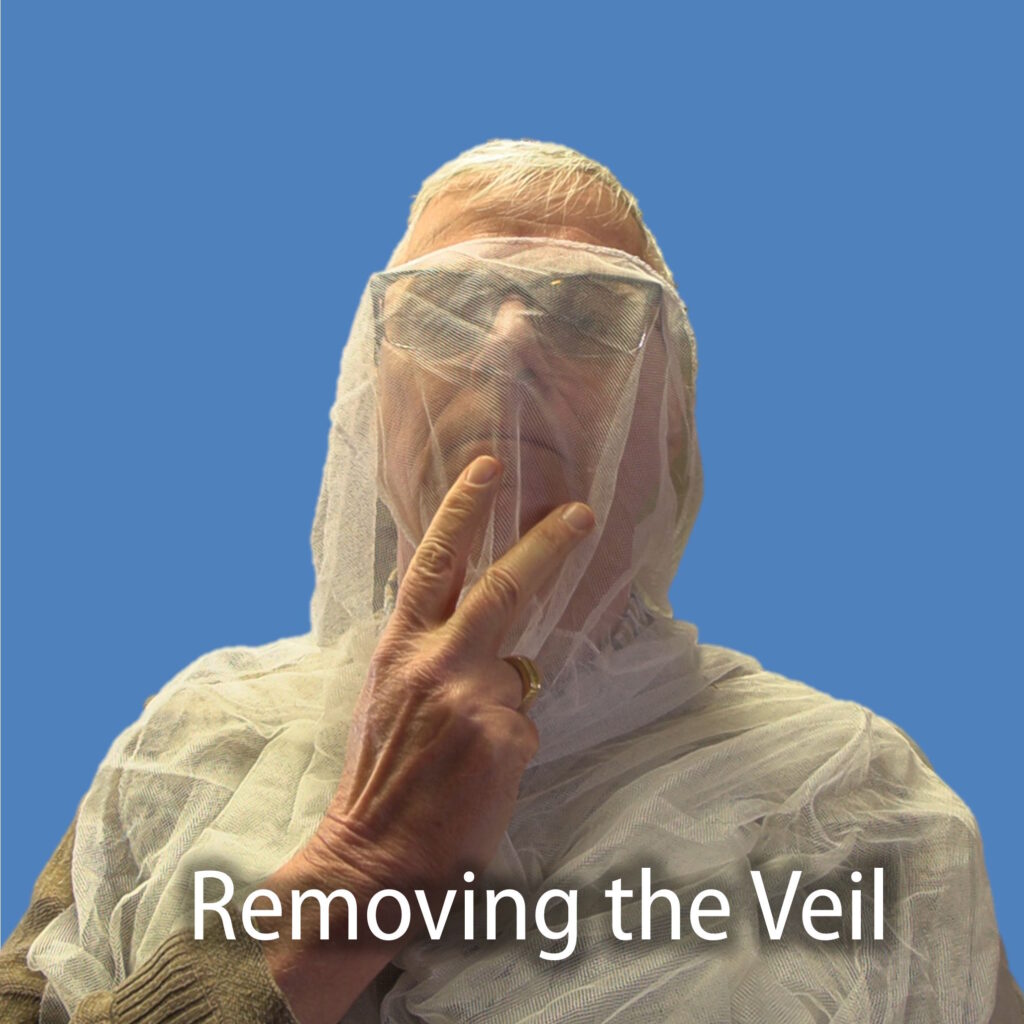
But the people saw none of that struggle because of the veil. Yes, they said it was to cover up the scary aftereffects of him being in the presence of God. But they never got to peek under it. If his face was actually shining or if it was just showing lingering uncertainty or doubt, they didn’t know because all they saw was the veil.
It made everything that Moses said when he wore it absolute truth, the unquestioned word of God. It removed all shades of grey and reduced it all to black and white. But sometimes, I think, Moses must have wished for someone to understand that, under the veil he was just a man and maybe struggled with many of the things that they did.
I find that image of Moses wearing that veil and speaking for God through it to be extremely important. It is fascinating because the wearing of the veil indicates the presence of something that no one can see because of it: the shining of Moses’ face – the lingering aftereffects of being in the presence of God. Ironically, they only know that it is there because they can’t see it.
I think that this brief passage is key to understanding the role that priests and clergy have played in society down through the ages and right up to today. Clergy are these people who have been seen as having a unique relationship with God. They go into their study or vestry or prayer closet and God speaks to them in ways that are not accessible to other people.
In ancient times it was not uncommon for clergy to then literally put a mask or veil over their face and become the literal voice of the god to the people. We have become a little bit more sophisticated than that, of course. But we still have this tendency to defer to our clergy when we see them wearing certain collars or vestments or speaking from special places. It marks them as speaking for God.
I have always felt a little bit conflicted about all such thinking. Let me say this. As a member of the clergy and as someone called to preach in the church of Jesus Christ, I do believe that God uses me to speak the word of God. I know that I have written sermons and said things that, unquestionably as far as I am concerned, come from God and are things that God wants said here and now.
And, no, that is not because I have heard God speaking to me as a voice booming from heaven, nor even some still small voice whispering to me from an invisible point above the communion table.
I have found that message through years of studying the Bible and reading many scholars. I have particularly found that message by reflecting on contemporary events and struggling with the question of how they might relate to scriptures written in a very different time and place. On top of that, I also take the time to meditate and reflect on all of that to allow space for the Holy Spirit to guide my thoughts.
And when I do all of that, I have often been amazed to discover a message that I am quite convinced is from God. But, at the same time, I would never say that I don’t have any doubts about that.
I would also never suggest that I have received a complete and final oracle from God – it is more of a particular word for a particular moment. But it certainly is exhilarating to receive and to be able to pass on such a message.
But then what do I do? I come into the church and pass on that message. And, though I do not wear a literal mask or veil, I do feel like there is a kind of a metaphorical veil when I do so. All of the doubt and the ambiguity and the incompleteness of the message is covered up. All of the shades of grey that were there in the study somehow get filtered down to black and white.
That’s why I think I can understand what Moses went through when he put on the veil. I think, to a certain extent every priest and member of the clergy can understand. And maybe, to a certain extent, that veil is necessary. Maybe there are times when we need to have the message presented in black and white, but I still wish that we could find ways to give people more glimpses beneath that veil.
I think that this passage is inviting us to probe a little deeper into the role of clergy in our churches at a time when it seems to be in flux. For many decades now, the life and work specifically of our Presbyterian Churches has been dominated by the clergy.
Most of us grew up in a time when it was normal for every congregation to be led by one minister, at least in urban settings. In rural settings, two or sometimes three-point charges were also quite common. But the assumption was that there would almost always be that clergy in that leadership position.
When a minister moved on or retired, the expectation was that they would be replaced in fairly short order. The interim period was a scary time; congregations did their best to move through it as quickly as possible. The church could then breathe a sigh of relief when a new minister was called and get back to “normal.”
I don’t know if you have noticed this, but things don’t quite work like that in many of our churches these days. Many of the other Presbyterian churches around us these days don’t have full-time clergy. Many of them can’t afford them or struggle to find them if they can.
As a result, the clergy that we do have are being stretched thinner and asked to do more to keep our churches going. This is something that has been contributing to clergy burnout and people leaving the profession, something that has been happening across the religious spectrum in recent years.
Now, I do believe that there is a vital role for the clergy in our churches. I do believe that the depth of study and experience we bring to the church is essential. I expect clergy to continue to contribute in that way for a long time to come. But I also think that we are going to see a shift in the role of the clergy in coming years.
In particular, I see us shifting from being a denomination that is clergy led and supported by the laity to one that is led by the laity who are supported by the clergy. That is a subtle shift, but its an important one. And one of the key parts of that is a changing attitude towards those jobs that have been traditionally reserved only for the clergy.
Traditionally, in our denomination, the things that only clergy could do were preaching, leading the sacraments of baptism and communion, and moderating sessions. But that is changing, and I believe the change will accelerate in years to come.
For some time now, we have come to realize the wisdom and blessing that comes from the preaching of the laity. We have learned that lay preachers are not lesser preachers, nor greater preachers, but they are different preachers and they bring their own perspective which is valuable and enlightening.
More recently, the church has opened up ways for the laity to step up and offer leadership in the sacraments. And again, that’s not because they do it better nor is it that they are second best. They bring their own unique approach and wisdom to the task and that is also a gift to the church.
That is why, when the session considered the possibility of designating one of our elders as a sacramental elder, I supported the motion. I think having Steve as such an elder is an incredible asset that we now have.
We can ask him now to preside at the communion table or at the baptismal font when it is needed. We can even designate him to go to other congregations and lead in the sacraments when they may have a hard time finding someone to do so.
I welcome this development. Some might say that it takes away from the uniqueness and the mystique of the role of the clergy. Some even think that it will make the clergy irrelevant. But I don’t see it that way. I see it as welcoming us all to peek beyond the veil. It is an invitation to see that whoever is preaching or whoever is leading in the sacraments, they are human.
They don’t really have all the final answers. They don’t have an absolute truth that they can present in black and white. And they are not manipulating some sort of magical power. But they do have what we all have, the ability to encounter God in our own way and on our own terms and to share that experience with others in powerful ways.
I respect the traditional role of the clergy and also the traditional ways in which their special role has been marked. We don’t use veils or masks, but we have found other ways to mark them as speakers of the truth.
But truth, as important as it is, is seldom black and white. Finding truth is a struggle and a quest. It involves frequent doubts and questions and uncertainties. But it is the most important struggle that we can ever have. And it is something that I invite us all to engage in, beneath the veil.