Our GivingTuesday #GivingTuesdayWR campaign continues to run for the month of December! Have you thought about how you can give generously? Here's a few ideas: give a financial donation to a charity of your choice, give of your time and volunteer at a food bank, soup kitchen, etc.; do a random act of kindness, hold the door open for someone, teach someone something good. Use your imaginations, use your gifts and talents. Thank you for making our community a better one!
Second Sunday of Advent
Please join us for the Second Sunday in Advent. Our special music will be given in praise by the Adult Choir, as well as Corey, Randy & David.
Continue reading »
Besides this, you know what time it is
Hespeler, Dec. 1, 2019 © Scott McAndless – Advent 1, Communion
Isaiah 2:1-5, Psalm 122, Romans 13:11-14, Matthew 24:36-44
You brought a sleeping bag and wore your long johns and your warmest coat, but after sitting out here for many hours, you are completely chilled to the bone. How many times have you asked yourself over the last few hours, are you crazy to do this? I mean, what kind of fools put themselves through this kind of trial of their own free will? If your boss ordered you to go out and sit on a cold sidewalk from midnight until six in the morning and then fight off a bunch of other people in order to get your hands on a certain piece of merchandise, you would refuse. You would file a grievance with the union. You might even just quit right there on the spot. But here you have chosen to do that very thing of your own free will.
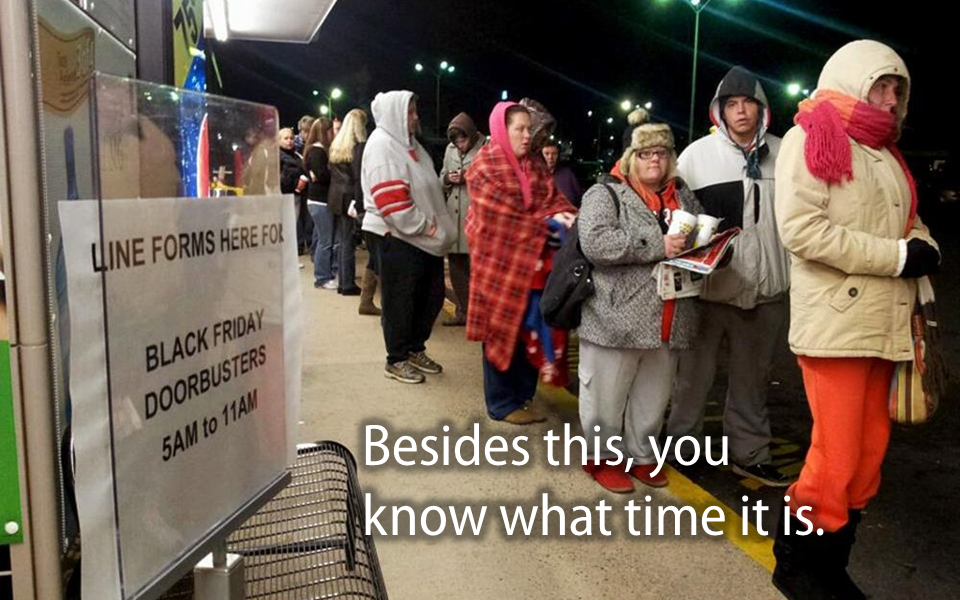
And why do you do it? Because your life actually depends on getting that particular piece of merchandise at a low, low price? No, not really. You do it because do you know that it’s just what people do. Besides this, you know what time it is. It is Black Friday and the doors will be opening in just a few minutes and those door crasher specials are waiting for you and you have vowed that this time you will get them. It is just what people do at this moment in time.
And that is just one example of people doing strange things at this time of year just because they know what time it is. You know very well that on December 19th, just a few minutes after midnight, there will be hundreds, if not thousands, of people lined up to see the biggest movie of the year, which I’m guessing will be Star Wars, the Rise of Skywalker, and they will do it simply because it matters to them to be the first to see that movie on the day that it opens. It just will not mean the same thing the next day when it’s not the right time. This time of the year is, more than any other, the time when we do things just because this is the time when we do them. “‘Tis the season,” isn’t that what we say. We gather with friends and family at this time of the year, not because it is always the most convenient time to travel (travelling can be horrible!), but because you are just supposed to do it and you will drive through the snowstorm to get there if you have to because you know what time it is. We give gifts to people, not because they are things that they need but just because this is the time when we are supposed to do it.
And, you know what, so much of that is great. I do so look forward to so many of those things that we do just because it is the right time at this time of year. And while I am not particularly interested in some of those events that take place at certain times (you will never find me crashing the door at a Black Friday sale, for example) if those things do bring joy to you during this season, by all means go ahead and make the most of them. There is great power and advantage to be gained by knowing what time it is.
But there is a question that we need to ask, maybe especially at this season of the year: what if you are wrong about what time it is? What if what the world is telling us about what time it is is wrong? That’s not my question, by the way; it is the Bible’s. In our gospel reading this morning, Jesus gives several examples of people who thought that they knew what time it was – who believed what the world was telling them about what time it was – but who were horribly and tragically wrong. Jesus speaks of the people in the days of Noah – people who were living just before a looming disaster but just did not recognize what time they were living in. If they knew what time it was, they would have been busy building ships like Noah and his family, but instead they were “eating and drinking, marrying and giving in marriage.”
He speaks of two men working in the field and two women grinding grain at the mill when it is clearly not the time to take care of those everyday tasks but instead a time to be prepared for a looming disaster that takes one of the two in both cases. And of course, Jesus gives the example of the homeowner who thought that it was time to relax and go to bed when there was actually a thief who was casing his house and getting ready to rob it; it was a time to be vigilant and prepare to resist intruders. The point of all of these illustrations seems clear. You had better not just take for granted what the world tells you about what time it is. To get that wrong could be very dangerous, even fatal. So, the stakes are very high.
In fact, some of these passages we read this morning really seem kind of annoying at this time of year. After all, it is Christmas time. There are so many disturbing things that are going on in the world all the time, can’t we, just for this one season, forget all about that and celebrate and have a good time?
I don’t think that any of this means that we are just supposed to ignore whatever the world says about what time it is. By all means go ahead and plan your special times with family and friends. Enjoy those special times and events of the season. But Jesus would say that, even so, you ought to keep your eyes open for any indication that God is operating under a different timetable.
Jesus’ reference to the days of Noah makes me think of all of the ways in which we often deal with potential or looming disasters in our modern world. A majority of people, for example, accept these days that we are facing some serious environmental crises, but many go on with their regular activities and make their usual choices as if there really was nothing to be concerned about.
Yes, I know that there are some who will deny that there is anything at all to worry about, but it seems to me that the more common response is just to not think about it and to go on “eating and drinking, marrying and giving in marriage” as if the worrying signs all around them didn’t exist.
I believe that that is what the Genesis story of the flood is about. I think the point of the story is that the world was on a course for destruction and it was plain for anyone to see. The problem in that story wasn’t environmental destruction; it was the spread of deadly violence. But the reaction seems to have been the same.
And I know why we react that way; I do it too often enough. Sometimes you just have to act as if the terrible possibilities didn’t exist in order to get on with your life and keep from going insane. But Jesus may be warning us that there are consequences for failing to recognize what time it really is. So, yes, carry on with your life, by all means, but remember that your life does not simply stand alone. You are part of a much larger system and your actions and your activism matter. And, somewhere deep down inside, you really do know what time it is.
But I don’t mean to just talk about dire or looming threats here. I do not think that being a follower of Jesus means that we have to be people who are constantly thinking of the worst thing possible that could happen. In fact, it is mostly the opposite. Knowing what time it is in God’s timetable, also means joyfully embracing the opportunities that God places before us. What that means is that, when we are busily going on with all of the things that the world tells us that we must do, God will interrupt us.
And you all know what that is like! You have just managed to get a couple of hours out of your busy schedule to get to the mall and finally finish all that Christmas shopping, or you’re heading to the grocery store and you absolutely have to concentrate and get everything you need for the big meal this time when something just happens to break in and disturb your flow. Say it is an opportunity to help someone – someone who needs a little kindness or a little bit of help and you, all of a sudden, are in a position where you can do something.
Oh, that’s frustrating, isn’t it? Here I’ve got a million things to do and then something unexpected comes out of nowhere. It’s enough to make you cry. But if you know what time it is – if you are sensitive to God’s time – you know that those things don’t just happen by accident. They are God’s timing. And, if you see them that way, you will be able to respond with joy and your joy this season will multiply. If you don’t, they are just another annoying interruption and the frustration will multiply. That is the difference that knowing what time it really is can make.
I’m going to lay another case of God’s timing on you – another challenge. The world is telling you these days what time it is – it is a time to buy and buy and buy. It starts on Black Friday and continues on Cyber Monday and all the way to December 24 as we count down the real 24 days of Christmas as the world defines them. It’s about buying and then receiving on Christmas Day, a frenzy that will lead to many a meltdown between now and then.
But we have discerned God saying to us that it is a different time. After Black Friday a couple of days ago and Cyber Monday tomorrow, the next day will be Tuesday – Giving Tuesday. We have joined in the Giving Tuesday campaign this year because we believe that, while the world is saying that it is time to exercise purchasing power, God is saying that it is time to exercise the practice of generosity. And if you can hear what God is saying about what time it is, you will find the greater joy of this season.
I do not say this because I am afraid that St. Andrew’s is not going to be able to pay its bills. That’s not what this is about. Sure, we are behind, but it is God who will provide for the needs of this church as we remain faithful to the work God calls us to do, so I’m not asking you to give because we need it. We will be sharing with you some of the amazing things we do here at St. Andrew’s for our community and you definitely want to say after the service and join us in a celebration of those ministries, but this is not about making sure that you give to support those things.
Give prayerful thought about where God wants you to give and what God wants you to support. If it is not to St. Andrew’s, that is not an issue at all, but just don’t miss the opportunity that God is placing before you. I am calling on every single person here, on Tuesday or whatever day you can make it work for you, to give in some extraordinarily generous way as God has enabled you. I don’t want you to do it out of compulsion. I don’t want you to do it out of our need (that is in God’s supply), I don’t want you to do it grudgingly. I want you to do it joyfully because, besides you know what time it is.
Another busy day!
The Big Idea Club from Silverheights Public School visited Hope Clothing today to bring us their collection of new and gently used clothing from their recent clothing drive. A BIG SHOUT OUT to these wonderful people for thinking of other people in our community who need a little extra help.


A Celebration and Getting Ready!
It's starting to look a lot like Christmas. Thank you to all our creative decorators, who have been busy this week getting St. Andrew's ready for the Advent/Christmas season.
Celebrating with Paula today! We had some fun celebrating Paula's first year with St. Andrew's. She keeps us all on track, keeps us smiling and is a good friend. Cheers Paula! We are very happy you are part of the team.


It’s a Busy time of Year!
It's been busy lately! Here are a few photos from the past couple of weeks. The Holy Sherlocks made their own wooden crosses (thanks to Bill Hunter for his help), a great group built the float for the upcoming Santa Claus parade and the Annual Senior's Tea held at St. Luke's Place. Many thanks to everyone who helped build the float and helped at the tea.


This is the king of the Jews?
Hespeler, 24 November 2019 © Scott McAndless – Christ the King
Jeremiah 23:1-6, Psalm 46, Colossians 1:11-20, Luke 23:33-43
“This is the king of the Jews?” The Gospel of Luke tells us that these were the words that were posted on the wood of the cross upon which Jesus was crucified. And, since crucifixion was all about public display and warning others not to threaten the stability of the Roman Empire, it is plain enough why that sign was posted there. It was the charge upon which Jesus had been convicted. Pontius Pilate had sentenced him with the crime of sedition, insurrection and of threatening the sovereignty of the Roman Empire.
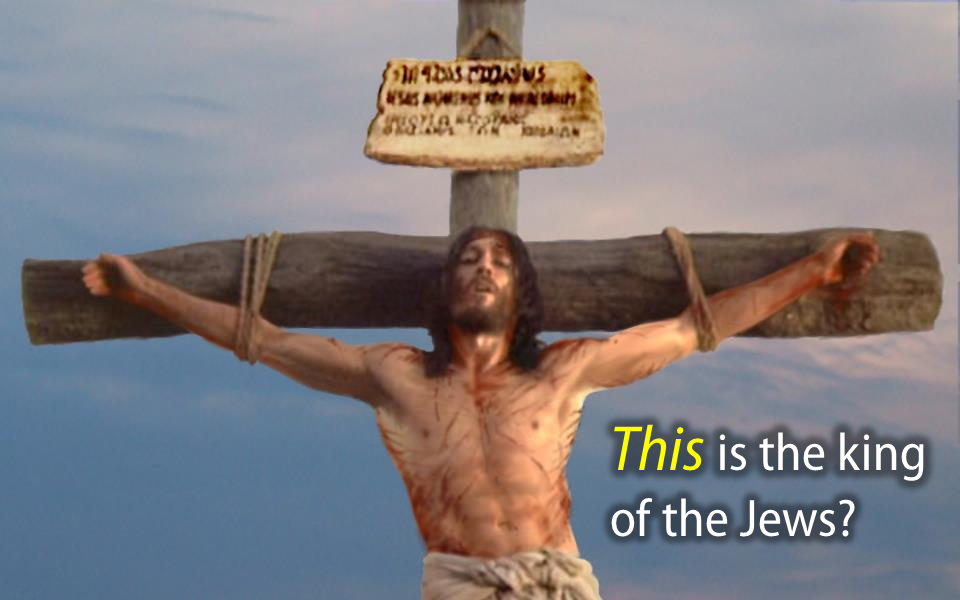
And yet I cannot help but wonder if, when Pilate ordered that those words be printed, he maybe didn’t say it like that, as a serious and solemn charge. I think that what he said was, “This is the king of the Jews?” as in, “Is this the best you can do? It this really what you call a king?” For Jesus had none of the trappings of a king. He did not wear a diadem or a royal robe. He had a motley crew of fishermen and tax collectors (all of whom seemed to desert him when the going got rough) rather than royal retainers and trained bodyguards. And, though he spoke with such authority, he had absolutely no earthly power to back it up. He wasn’t a king; he was a joke, a farce, a minor annoyance at best. So did Pilate declare, or at least so he tried to convince himself.
But we know different, don’t we? We declare Jesus to be our prophet, our priest and our king. Today is the Sunday of the year devoted to his kingly power and position. But, if Jesus is king, he is a king unlike any others that we have ever seen in this world. So what does it mean, on a day like this, to claim Jesus as our king?
I find that there is a certain reluctance these days to talk about Jesus as a king. In many churches, the last Sunday before the start of Advent is not called “Christ the King Sunday” anymore, but rather “Reign of Christ Sunday.” I understand why people do that, of course. The word king is archaic; as modern people who have had no experience of an effective ruling monarch (Queen Elizabeth, after all, is explicitly banned from exercising any political power), we aren’t quite sure how to relate to the notion of a king.
But I actually think that there are some good reasons to hold on to the original language. Jesus lived, after all, for his whole life within an actual kingdom. He lived in the Kingdom of Galilee and the Peraea. (Actually it was technically a tetrarchy and its ruler, Herod Antipas, was technically a tetrarch and not a king, but that was actually something that made no practical difference to the people who lived under Herod’s rule.) That meant that every single time that Jesus used the phrase, the kingdom of God or the kingdom of heaven, and suggested (as he did all the time) that there were people living in the reality of such a kingdom, he was essentially denying the very real political reality that surrounded him. He was denying that he lived under the jurisdiction of King Herod Antipas. And if Jesus was, in any sense, a king, he was clearly a king who stood in sharp contrast to King Herod and everything that he stood for.
So actually, if you want to understand what it means to call Jesus your king and to belong to his kingdom, you have to look at the kingdom of Herod and understand it. You have to see what kind of contrast Jesus was trying to set up. For example, the kingdom of Herod was set up on one principle above all others: exploitation. Galilee contained a unique resource, the Sea of Galilee, the largest freshwater lake anywhere in the ancient Mediterranean world. Did you know that King Herod Antipas attempted to dominate the fish trade by controlling that lake?
During Jesus’ lifetime, Herod built an entirely new capital on the shores of the Sea of Galilee for the purpose of taking as much profit as he possibly could from the fishers on that lake. Fisherman like Peter, James and John followed Jesus because, when he spoke about an alternate kingdom, the kingdom of God, he challenged the authority of the kingdom of Herod that had been bleeding them and their families dry.
When Jesus fed the multitude in the wilderness by giving to the people of Galilee the bread and the fish of Galilee, he was doing it in direct defiance of King Herod who claimed all of the bread and fish of Galilee for himself and his buddies so that they could get even richer.
Jesus’ claim to be a king was not made in a vacuum, it was not something that only applied to spiritual things or to heavenly realities and it was not just about getting people to heaven when they died. It may have been all of these things, but it was also much more – it was the intentional opposite of Herod Antipas and everything that he stood for. What’s more, Jesus’ own contemporaries – both his disciples and his enemies – knew that that was exactly what it meant to call Jesus a king. It was clear to them.
It is going to take a little bit more work for us to sort out today what it means to call Jesus our king. It is not immediately clear what the kingship of Jesus stands in contrast to. But consider this description from the letter to the Colossians: “[God] has rescued us from the power of darkness and transferred us into the kingdom of his beloved Son, in whom we have redemption, the forgiveness of sins.” Having Jesus as your king, belonging to his kingdom, means, according to this, being rescued and being transferred. In Jesus’ lifetime, that meant being rescued from Herod and the darkness of his plans, and transferred into the different reality of the kingdom that Jesus preached. Today we might understand that as being rescued from all the ways of this present world and the ways that they tend to darkness and being transferred to an alternate reality.
Think, for example, of the ways in which modern society drives people into relentless consumption. It’s a message that we are constantly surrounded with. If you have a problem, you need to buy something that will save you from that problem. If you are overweight and out of shape, for example, you need to buy yourself a gym membership or a piece of exercise equipment. And so people go out and do that, and then what happens? They don’t follow through. They never actually go to the gym and the exercise equipment gets stored in the attic until eventually it gets put in a yard sale. But that doesn’t matter, you see, because we have been convinced that the way you solve your problems is by buying something. The purchase is enough to save you.
And that’s true in many other ways. When people feel a spiritual lack in their life these days, what do they do? They go out and buy something. That’s one reason, for example, why the Bible remains one of the best-selling books in the world. They are constantly putting out new editions of the Bible because they know that people will buy them seeking to fill that spiritual hole. But, while the Bible is still the best-selling book in the world, it’s also one of the least read. People seem to assume that just purchasing one is enough to spark that spiritual revolution they know they need. But actually reading the book, or continuing to read it when the going gets tough, that’s where people drop out.
This is the philosophy of our society. And the relentless consumerism continues until what do we see? We see people buying and buying and buying until they can’t pay their bills and they go into debt. And does it solve anything? Usually not. But that doesn’t matter because the message we get back is that the next thing you buy is going to solve everything and so you just keep going. That’s one example of the darkness of our present age. Acknowledging Jesus as your king means that you get rescued from that relentless cycle and transferred to a different reality, the reality where you recognize that material goods are never going to fill that void that is within you. Are you willing to take Jesus as your king if that is what it means?
That is but one example of the darkness of our present age. Consider the extreme competitiveness of our time. People seem to be locked into a relentless battle to be seen as better than the people who surround them. In our capitalist society that is most often achieved through financial means; if you can manage to be paid more or to own more than your neighbours, you can see yourself as a winner. In some other arenas, money is not what is used to keep score. Sometimes it’s other signs of privilege or standing. But whatever it is, the competition and our modern world is relentless. People fall into depression and despair because they simply cannot keep up. This is a darkness of our present time. It drives things like inequality and poverty as some people inevitably get to claim much more of the resources of this world, even what they don’t actually need, to the detriment of others. And, in such a world, to take Jesus as your king means that you are rescued from needing that relentless competition to find your self-worth. It means being transferred into a kingdom where your ultimate worth is not based on how much you’re paid or what title you have but on the love that you receive from God and the love that you give.
But perhaps the greatest element of the darkness of our present age is found in the relentless desire to punish and seek revenge. How many wars are fought, how many people are vilified or ostracized because they belong to a people who, for whatever reason, somebody else has decided is the enemy. The ways that we hold on to past hurts and the wrongs that are committed against us are slowly tearing this world apart and yet we cannot let go of it because this enmity has become a part of who we are. This is the darkness of the kingdom of this present world.
But when you acknowledge Jesus as your king, you are rescued from that world and you are transferred to the kingdom of a king who had the greatest indignities committed against him, the greatest pain inflicted upon him and yet hung there and said, “Father, forgive them; for they do not know what they are doing.” His kingdom, the kingdom of the one “in whom we have redemption, the forgiveness of sins,” is a kingdom where we learn the power of forgiveness.
That does not mean, of course, that we continually have to let the people who have wronged us off from the consequences of their sins or their crimes, but it does mean that we are set free from that relentless need to take vengeance in order to feel good about ourselves. That need is a part of the darkness of this world and you have been rescued from that and transferred to the kingdom of the king of forgiveness.
That is the king that we serve. That is what it means to call Christ our King. And I fully realize that other people will look at that and incredulously say, “you call that a king?” The world won’t understand. The world is trapped in darkness. We belong to a different Kingdom because we have a different kind of king and his rule will last forever and ever, amen.
Advent, Christmas 2019 Newsletter
Read all about the upcoming special events and services.
Of Vineyards and Welfare Queens
Hespeler, 17 November, 2019 © Scott McAndless
Isaiah 65:17-25, Isaiah 12, 2 Thessalonians 3:6-13, Luke 21:5-19
In 1974, news and magazine stories began to appear about a woman named Linda Taylor in the United States. She was, apparently, quite a phenomenon. She didn’t work and collected welfare. In fact, it seemed, she collected a lot of welfare. If fact, she was eventually convicted of illegally obtaining 23 welfare checks using two aliases and was sentenced to prison. It was in these articles that a special name was coined for her and people like her, a welfare queen.
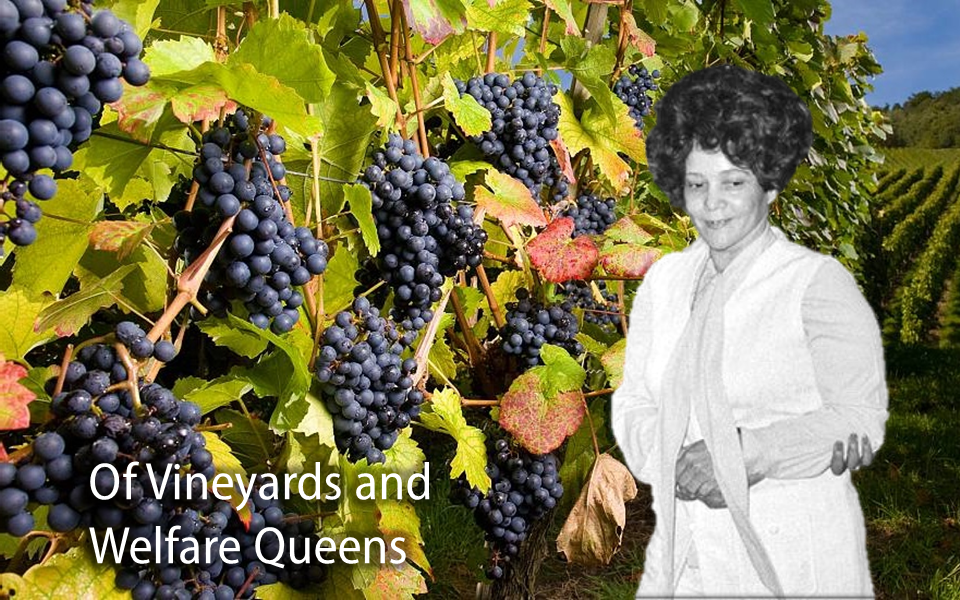
A few years later, in his campaign to become president of the United States, Ronald Reagan took that term, welfare queen, and kind of ran with it. At his campaign rallies and speeches, the welfare queen became a regular feature. Linda Taylor was not just one person, in fact, he never mentioned her by name. She was but one example of many. Welfare queens were apparently everywhere, they were bleeding America dry and they were at the heart of everything that was wrong with America. Reagan never actually offered any proof or statistics about any of this, he just confidently proclaimed it and you had to believe it; he was so sincere. People certainly did believe him.
And thus, after coming to office, Reagan had a mandate to carry out welfare reform – something that quickly caught on and spread to many other places including Canada. The idea behind it was that welfare was not only a drain on public funds, it also actually harmed the poor people that it was supposed to help. It encouraged them to be lazy, to give up control over their own lives and led them into the fraud and crime represented by the welfare queen. The solution, therefore, was to stop giving welfare to people, at least not without requirements – especially the requirement that they had to work. This was not presented as something mean-hearted or cruel, but actually a kind of tough love, a way of doing what was best for people even though they might not like it.
At that time, and often afterwards, the scripture that was used by Christian supporters of these initiatives was the one that we read this morning from the Second Letter of Thessalonians. “For even when we were with you, we gave you this command: Anyone unwilling to work should not eat.” I am not sure, of course, that when Paul wrote those words what he had in mind was everything that happened with welfare reform. I do rather suspect that he was speaking pretty specifically to particular problems that were happening in that church in Thessalonica and not necessarily putting forward general principles. And I am not entirely sure that welfare reform has been an unmitigated success over the last few decades, but I do agree that there is some wisdom in this general idea. Setting aside particular circumstances, of course, I do think that people have a natural need to contribute to their own sustenance and well-being, to do so is to fulfill what you are called to be as a human being.
And yet, at the same time, I believe that the Bible would invite us to look a little bit deeper when we are thinking of problems like poverty and people being unable to eat. I am particularly drawn to our reading this morning from the Prophet Isaiah. It is a famous passage in which the prophet lays out his vision of the world as it will be someday. It is a vision of peace and hope for all peoples. So peaceful is this world that the prophet describes that “The wolf and the lamb shall feed together, the lion shall eat straw like the ox.” In other words, the peacefulness of the human world will overflow into the natural world until even predator and prey can dwell alongside each other.
But there is another element in this vision of a world perfected that may be even more important. Isaiah goes on to say: “They shall build houses and inhabit them; they shall plant vineyards and eat their fruit. They shall not build and another inhabit; they shall not plant and another eat… and my chosen shall long enjoy the work of their hands. They shall not labour in vain.”
Think about that for a few moments. Think about the contrast between that and the “Anyone unwilling to work should not eat,” that we find in Second Thessalonians and in the world of welfare reform. When the prophet comes to imagine the perfect world, he doesn’t imagine a world where people don’t have to work. In fact, the people in this vision seem to be working very hard – building houses, planting vineyards and generally toiling all day long. The difference in this vision is that the people are working for themselves. It is their house, their vineyard and the work of their hands that they themselves are enjoying.
They are intimately connected to the work that they do and the outcome of their labour. There is no question that they will work. If they do not work, their vineyard or their field will not produce. Nobody has to tell them that those who do not work do not eat. If work has meaning and people are able to enjoy the fruits of their labour, you’re not going to see too many problems with people shirking work that just needs to be done.
So that is the ideal vision of the world as it is supposed to be that you find, not just in this passage in Isaiah but in many places in the Old Testament. In fact, I would even go so far as to say that that is how God designed us to live, with a close connection between the work that we do and the resulting production that provides for us life and sustenance. Under those conditions, I’m not saying that everything was perfect, but at least the connection between labour and being able to eat was not something that anybody could miss.
But then guess what happened, the world changed. It had already changed quite significantly by the time that Paul was writing his letters to the Thessalonians. The growth of slavery and the large-scale movement of people from the countryside into cities like Thessalonica, meant that entire generations of people had lived without ever seeing how their work produced anything of value to themselves.
Other people had seized control of things, like the land, that were able to produce what people needed and they only worked for those demanding masters, employers and patrons. Is it any wonder that there were some people in the church in Thessalonica who got carried away with the new freedom that they found in Christ and decided not to do any work because they didn’t have anyone forcing them to work? They had lost that connection and could no longer see how their failure to contribute impacted the whole community.
And if they struggled with the effects of that loss of connection, how much more has that become a problem for us in the modern world? We live in a society today where most people have become completely unaware of where the things that sustain them come from. Pork chops on styrofoam trays just appear on grocery shelves, fruit comes in rolls by the foot and who has a clue what Rice Crispies are made of? And the labour of very few is connected in any meaningful way to the production that sustains their lives. For the most part, we work to serve the profits of companies and corporations. We may live in fear that, if we don’t work or we can’t get a job, we won’t eat, but we no longer have a clear sense of how it is all connected.
Part of this, of course, just has to do with the complexities of modern life and modern economics. You do almost need a degree in economics these days to map out the chains of production and consumption, supply and demand. But it also does have something to do with how we have chosen to distribute the ownership of those things, like wealth and land and resources, that are the things that are able to provide to human beings what they need to survive. When these things are increasingly controlled by an elite few, you are bound to have problems as people fall into apathy, idleness and poverty.
This also has to do with what we truly value because everything in our economy seems to be screaming these days that we don’t really value work. Those who contribute their capital, their investment and their ownership generally expect to receive a much higher rate of return these days than those who merely contribute their labour. What is more, labourers are often seen as expendable – the first to get cut when there is any danger that profits will fall.
Now, before you all start to think that I am going to go off and start quoting from the Communist Manifesto here, let me say that I am not an idealist when it comes to economic systems. I know that we live in a capitalist society and I am okay with that. I don’t think capitalism is perfect – it certainly has some pitfalls – but I am not inclined to overturn it, though I’d like to see it work better for everyone. I’m not preaching economic systems here, I am just preaching what the Bible preaches, and that is economic justice.
Prophets like Isaiah really did dream of a world where every family lived under their own vine and their own fig tree, where they had the means to produce what they needed to live with their own hands and the work that they did all had meaning as a result. I know that we no longer live in a world where that is possible, but I still believe that we can be informed by that biblical vision and it can have an impact on how we deal with people today.
One thing I know is this: it doesn’t help when we simply treat people as categories and problems. In my work, I have often had time to deal with people who are unemployed or underemployed and don’t earn enough to live on. I know that it doesn’t help to categorize them as welfare queens or even as problems. I have known people who don’t work for various reasons, but few have been what I would call lazy. They may have issues that have not been resolved or injuries of mind or of body that are unhealed. They may have never been taught or given what they needed to be able to work and they may have missed out on certain opportunities, but they aren’t simply lazy, and I don’t really see what it helps anything to treat them as such.
People are not categories, they are people. They need to be treated as people. And if you take the time to get to know them and really listen to them (which may take a lot of time because they have often built up barriers around themselves) they may just let you in and you will see.
That is honestly one of the things that I really appreciate about the outreach ministries that we have here at St. Andrew’s. I know that we do give a whole lot of people free meals, extremely subsidised food to take home through the food bank and free clothing through Hope Clothing. But honestly, I do not think that these things are the most important services that we provide for people who live on the economic margins. We offer them a place and a context where they are treated as individuals. We sit beside them as they eat their meals, we enjoy their company as they select their food or clothing. We actually take the time to get to know them and their struggles and trials. I’m not saying that doing that will suddenly fix all of the problems in somebody’s life or enable them to make the jump to an excellent job tomorrow, but I am saying that it is in those kinds of personal connections that healing begins.
The problem is not that our welfare systems were too generous. Yes, there probably was some need of reform and improvements, but it is not true at all that welfare is a driver of poverty. The problem, you see, went much deeper than that. The problem was disconnection – disconnection from the land, disconnection from the means of production. We are not going to fix all of that simply by cutting people off even more from compassion and care, the solution and the hope is to be found in connection and that is something that we can all be part of.
You, simply by choosing to treat an unemployed or marginalized person as a person – by caring about them and their story – are part of the hope and the healing, part of the vision of God for what this world could truly be.
Sunday, November 17th
| Our scripture readings for Sunday are: Isaiah 65:17-25 Psalm 982 Thessalonians 3:6-13 Luke 21:5-19 The message is: Of Vineyards and Welfare Queens If you have any questions or comments about the scripture readings or message please contact Rev. Scott McAndless at [email protected] |
| Don't forget our Handcrafters' Market tomorrow, Saturday from 9:00 am - 2:00 pm. We have an incredible variety of vendors coming. This will be an excellent time to start your Christmas shopping. The hall and the gym will be full of vendors. |