For our Divine Detectives group, December 13, 2020
Our story continues
Continue reading »
Hespeler, 13 December 2020 © Scott McAndless – Advent 3
Isaiah 61:1-4, 8-11, Luke 1:46-55, 1 Thessalonians 5:16-24, John 1:6-8, 19-28
So, a vaccine – or rather a few vaccines at this point – have been created. Distribution in Ontario will begin in a matter of days and, if all of the research and testing turn out to be correct, we may soon get to the place where our entire lives are no longer dominated by a tiny little thing called a coronavirus. This is good news, and I realize that it’s probably a little bit premature to celebrate too much – certainly far too premature to celebrate with large maskless gatherings – but maybe it is time to at least start thinking about what comes next.
I am sure that some people are expecting that, on the day when it’s finally done, the day when enough people are vaccinated and herd immunity is attained, that the crisis will just be over. Everyone will just get up in the morning and go back to living their lives the way that they used to. That is what everyone who lives through a crisis dreams of and it is understandable. Sometimes when you’re living through a crisis, the only thing that keeps you going is the thought of getting back to life the way you used to know it. And yet, I think we all realize on some level that that is not all that realistic. Because of the direct and indirect effects of this crisis, there are many things that will simply not go back to the way they were.
We have no idea how many yet, but we can be sure that, when this is over, there will have been many businesses that have long been important parts of our local and national economies that will simply no longer exist. People’s savings will have been decimated and their debts will be that much more unmanageable. People will lose their homes or be thrown out of their apartments. People will continue to struggle to find good jobs for some time to come. Women, in particular, seem to have fallen out of the workforce and will face many struggles to get back in.
Oh, the end of the crisis will go just fine for some people: the fortunate few. That is almost always what happens in the aftermath of a crisis. In fact, for those who have the resources and are willing to ruthlessly take advantage of the misery of others, there is a very good chance that they will make enormous profits out of the whole situation. Chances are, when this is all over, there will be a small group that finds themselves greatly richer and there will be a very large group that have simply fallen through the cracks of society and the economy. And the simple fact of the matter is that, when that is the situation, it makes an economic recovery for everyone that much harder. But, that is where we will likely find ourselves in the coming months.
But, of course, we are not the first people in history to face such a situation. In fact, it is the kind of thing that happens just about every time a society faces a major crisis and then has to recover. Take, for example, the great crisis of the exile for the ancient people of Judah. When their country was destroyed and all the leading citizens were taken away into exile by the Babylonians, well you can just imagine the kind of devastation that caused.
But when that crisis finally came to an end, and the people were able to return from that exile and start all over again, their troubles were hardly over. The country had been ruined. The economy was in shambles. They were trying to rebuild and they had almost no resources to do so.
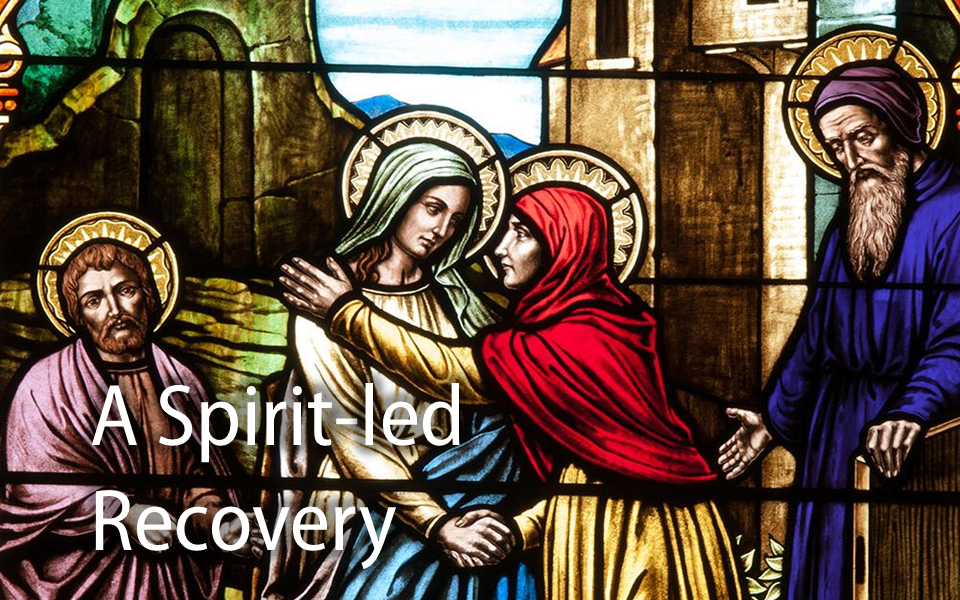
And, under those circumstances, it was the poorest folk who struggled most of all. They had no savings and they went deep into debt. Meanwhile, the few wealthy people who had returned were in a great position to benefit from the misery of these others. They loaned them money, and then, when they were unable to repay, they seized their lands, if they had any, and then they seized the people themselves and turned them into slaves.
And given that that was the kind of thing that was going on, the economy only got worse and the whole thing was a real mess. As a very few people got very rich and the great mass of the people fell into poverty and slavery, the recovery was looking like a complete disaster.
But then, a prophet came along. And he came along with a stunning message. “The spirit of the Lord God is upon me, Because the Lord has anointed me;” he cried out in the ruined city. “He has sent me to bring good news to the oppressed, To bind up the broken-hearted, To proclaim liberty to the captives, And release to the prisoners; to proclaim the year of the Lord’s favour.” And this was not just the ranting of a crazy person, it was actually a plan – a plan for a real recovery.
You see, there was an ancient law in Israel. Every fifty years, all debts had to be forgiven, all lands that had been foreclosed on had to be returned and all debt slaves released. It was called the year of Jubilee. It was a way – admittedly a radical and very disruptive way – but a way of making sure that people didn’t fall into permanent poverty and that the richest people were not able to exploit their misery, at least not forever.
Now, I do hear all of the objections that you are thinking about this idea of a year of Jubilee. I mean, can you imagine the havoc it would wreak in our economy if all debts were forgiven and all sales of land were undone? It is something that is quite unthinkable under our present economic system, though it may have made a bit more sense in the ancient agrarian economy of Israel.
But, even back then, it was likely problematic. So perhaps, many have suggested, the Jubilee was not practiced, at least not on a regular basis. Sure, it was a law, part of the law of Moses, but you can well imagine that it would have taken a strong will on the part of the authorities to make sure that such a law was actually implemented and you can also well imagine that there must have been times when that will was lacking.
And so, in the aftermath of the exile while the people were trying to rebuild their lives in the city of Jerusalem, it had probably been a very long time since there had been the will to hold a year of Jubilee. And there were almost certainly no authorities who would be inclined to implement the ancient law at that moment. And so, guess what happened. A prophet stood up and declared that he didn’t care that there was no king or priest or other authority who was going to implement a year of Jubilee.
Why didn’t he care? Because the Spirit of the Lord God was upon him. He might have been nobody, he might have had no power at all, but he had God’s Spirit and that was enough. And so he would speak up and demand that the Jubilee be proclaimed. And there is no doubt that a Jubilee is what he means when he speaks of, “good news to the oppressed. . . liberty to the captives, and release to the prisoners.” It is clearly what he means when he proclaims “the year of the Lord’s favour.”
And I have a lot of respect for that prophet for having the courage to do such a thing. I don’t think I’m the only one. You are probably aware that, according to the Gospel of Luke, when Jesus began his public ministry in his own hometown of Nazareth, he did it by taking this very same passage of scripture and applying it to himself, basically saying that he was the fulfillment of the prophecy.
That is to say that Jesus came at a moment in history when the people were facing the same kind of crisis of a country and an economy that were falling apart, this time mostly due to the greed of the Romans. And so, Jesus declared that he would be the embodiment of the same call of the ancient prophet. Though he also had no earthly power to do so, his presence in the world would bring about a new Jubilee.
But it is not something that is just there when Jesus announces it at the beginning of his ministry – it is something that runs through the entire Gospel of Luke, as we see in our reading from the Magnificat this morning. You see Mary doesn’t have to wait until Jesus returns to Nazareth to speak in synagogue to know that his mere presence in the world means that the impossible Jubilee is now possible. As soon as she can sense that she is pregnant she sings it: “He has scattered the proud in the thoughts of their hearts. He has brought down the powerful from their thrones, and lifted up the lowly; he has filled the hungry with good things, and sent the rich away empty.”
The mere presence of Jesus in the womb of his mother is enough – the fact that he is coming into the world means that the reality of the world and how it works is being turned upside down and the rich and the powerful are losing their place and the poor, the neglected and the forgotten have taken that exalted place. The unthinkable is happening.
I worry about the recovery after this pandemic, I really do – not because I doubt the ability of medical science and research to come up with a vaccine that will get us out of this mess. I have no worries about that. But I do have worries about human nature and especially that our greed and our selfishness will mean that whatever wealth is available will stop circulating and remain in the hands of a few and so the recovery will be much less than it could possibly be and that it will leave far too many people behind. I worry because I suspect that our leaders, who, after all, owe so much to the rich and powerful, will not be able to oppose them.
But maybe, if I listen to the Old Testament prophet, if I listen to the mother of Jesus as her hands clutch the life that is just beginning to grow inside her, and if I listen to her son as he stands before the people in Nazareth, I will realize that we don’t necessarily need to wait for our leaders to wake up and realize what is actually needed. All it takes is someone who has the Spirit of the Lord upon them. And, my friends, that is and can be any of us.
When you think about it, it is kind of amazing to hear some of the voices that are being raised right now, voices of people who are essentially powerless and who, under normal circumstances, would never be listened to, and yet, those voices are being heard right now even though they are saying things that were previously unthinkable.
I’m talking about people who are saying that maybe it is time to forgive student loan debt. I’m talking about people who are saying, let’s take some of that money that has been used to militarize the police and instead redirect it towards mental health and housing and building up social capital. I’m talking about people who are daring to suggest radical ideas like a universal basic income. These words are not coming from the powerful and the influential, and yet they are being heard. I wonder, is it maybe because somehow the spirit of the Lord is behind such ideas right now because that is what is needed?
I don’t know. I honestly don’t know how much merit is in some of those ideas and whether they will work or not. But I absolutely welcome such voices being heard because I know that we will never get anywhere if we quench the voice of the Spirit of the Lord.
What’s more, I believe that we, as people of faith, really ought to be those who are most open to such things because it is right there in the scriptures that we profess to believe. And it is especially there in the story of the incarnation, in the meaning of Jesus coming into the world in the first place, into the body of his mother and into that synagogue at Nazareth. If the spirit of the Lord God is speaking through somebody in the world today, we ought to be the first to rejoice in that.
Hespeler, 6 December 2020 © Scott McAndless – Communion
Isaiah 40:1-11, Psalm 85:1-2, 8-13, 2 Peter 3:8-15, Mark 1:1-8 (Click to read)
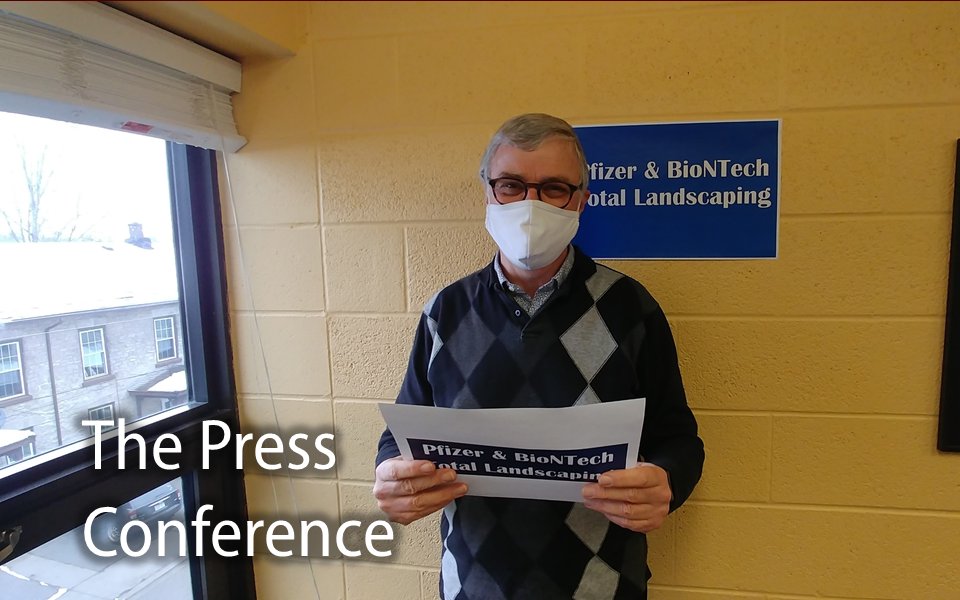
Good morning. It is Monday, November 9, 2020, and we take you now live to the headquarters of international drug companies, Pfizer and BioNTech for an announcement that that world has been waiting for:
Good morning, Scott, I am standing outside of the building where a stunning announcement has been made. The chief executive officers of Pfizer and BioNTech just came out to announce, and I quote, “Comfort, O comfort my people,” says the corporation. “Speak tenderly to the world, and cry to it that it has served its term, that its penalty is paid, that it has already received from the deadly coronavirus a double portion of suffering.
“For unto us, a vaccine has been born and an inoculation has been given. And behold, it’s efficacy shall be established at 90%.”
That is the announcement, Scott, though I would note that there is a little bit of fine print. There are a few steps yet to be accomplished. The vaccine will have to receive final approval and, of course it will have to be manufactured in significant quantities. But that’s not even the most complicated part. The companies say that, in its original form, the vaccine will have to be stored at -80 degrees Celsius, which will definitely complicate distribution. There is also the thorny necessity of convincing the vast majority of a population that, over the last little while, has discovered that it has some reasons to be wary of political authorities and medical experts, to actually take a vaccine that might make them feel sick for a short time.
And so, between now and the time when a sufficient portion of the population can be vaccinated and herd immunity be attained, there is a whole lot of work to be done. Basically, to get from here to there, we’re going to have to build a distribution highway. And you know how you build a highway: “Every valley shall be lifted up, And every mountain and hill be made low; The uneven ground shall become level, And the rough places a plain.” And I know that that sounds like a lot of work and that it’s going to take a lot of time, but, my friends, this really is still good news. Our salvation has arrived! Take comfort, O my people.
I have said it many times during this difficult year of 2020. Again and again as I open the scriptures during this year, I read familiar passages that I thought I understood and I see them in an entirely different light. And that is true yet again on this second Sunday in Advent. Every year around this time, the church traditionally reads from the fortieth chapter of the Book of Isaiah. We not only read it, but we also sing it or hear it sung as one of the most favorite arias of Handel’s Messiah. The passage is so powerful that you would think that it could not more deeply affect me this year than it has in the past, but it has.
This part of the Book of Isaiah was originally written to people facing a very difficult historical struggle. It is addressed to the people of Israel who have, for far too long, been living in exile in the land of Babylon. Forcibly taken from homes, they have been made to live in a strange land surrounded by strange gods and strange customs. It has been extremely hard for them. But, in this passage, the prophet comes to them with some exciting, good news.
Babylon has fallen (or maybe it’s just clear that it’s about to fall) and the Persian Empire is about to take over its territories. And that might not seem like a big deal, I mean, who cares if you exchange one overlord for another, but actually it is. The thing that makes that good news is that Cyrus, the king of the Persians, has a different policy about exiles. As far as he is concerned, if they want to go back home, they can. Yes, the good news of the moment is that the people of Israel can finally go back home.
And it is in that context that the prophet says, “Comfort, O comfort my people, says your God. Speak tenderly to Jerusalem, and cry to her that she has served her term, that her penalty is paid, that she has received from the Lord’s hand double for all her sins.” He is announcing that the exile is over by saying that God has decided that the people have suffered enough.
But, like I say, I really found those words sounded very different to me this year after we have seen our society struggling with an extended period of suffering caused by a pandemic. And when that announcement of a vaccine came, it certainly seemed like the very same kind of announcement of comfort to a people.
So, the words of the prophet certainly hit me on a different emotional level this year, but there was also something else that really struck me, something that I hadn’t seen before. When these words of comfort appear, it’s like a sudden announcement that everything is going to change for the better. The announcement of the vaccine sounded like that too. But, after that initial euphoria, there comes a let’s-get-down-to-earth moment when we realize that there is still a long way to go before we get there, that the road is going to be difficult and that it might even get worse before it gets better. I think we’ve all been feeling that as well.
Well, the same thing happens in this prophecy from the Book of Isaiah. Because, you see, no sooner did the prophet announce this incredible, wonderful news that the exile was over, than the people had to deal with a huge realization. The people were in Babylon, and Babylon was a long, long way from Jerusalem. I mean, not only was it about a thousand kilometers in an age where most people travelled on foot, but it was a thousand kilometers across the biggest, most uncrossable terrain in the entire world – a vast desert.
So, immediately after announcing this enormous comfort, the prophet goes on to announce a gigantic work project: “A voice cries out: “In the wilderness prepare the way of the Lord, make straight in the desert a highway for our God.” It was a highway for the people to return home and a very difficult highway to build: “Every valley shall be lifted up, And every mountain and hill be made low; The uneven ground shall become level, And the rough places a plain.” That’s right, we need to bring in the bulldozers and level the whole terrain, and that’s all before you can even start to lay down the asphalt!
Now, to be clear here, this passage is not describing the construction of an actual highway to take the people home. This is poetry – a poetic way of saying that it’s going to be a long and difficult process that takes a lot of work to get the people home. But it is still a stunning change of tone from the original promise – we go from supernatural comfort to a major public works project that has to be completed before the promise is fulfilled.
But that is how life often goes. We are told that we get to go home, but then we have to build the highway to get there; the vaccine gets announced but there is all this other work to be done before its promise is realized. This is the kind of thing that keeps on happening and so this passage is forever new – forever speaking to the hopes and the frustrations of delays that people have to live with.
Which is, of course, why, when the author of the Gospel of Mark was trying to capture the mood in Galilee just before Jesus appeared on the scene, he turned to this very same passage in the Book of Isaiah. He describes John the Baptizer as, “the voice of one crying out in the wilderness: ‘Prepare the way of the Lord, make his paths straight.’”
Now, on the surface, it might seem that what has happened here is that Mark has just misunderstood the original meaning of the Book of Isaiah. The original prophecy said, “A voice cries, ‘Prepare the way in the wilderness.’” And Mark has changed that to “A voice in the wilderness cries, “Prepare the way.” That is pretty close, but it is not exactly the same thing and Mark makes that change because Mark does see John himself as the voice that is crying in the wilderness because John preached out in the wilderness.
But I do not think that this is simply a mistaken interpretation on the part of the gospel writer. It is rather his way of saying that the ministry of John the Baptizer was a fulfillment of what had been anticipated in the prophecy in Isaiah, not literally in the sense that John was building a highway out there, but certainly in the sense that John’s call had so much in common with that of the ancient prophet.
In fact, I think we should greet the message of John the Baptizer today in almost exactly the same way that the ancient exiles in Babylon greeted the ancient prophet’s message – which is to say, much like how we received the news of the successful vaccine trials.
When John announces, “The one who is more powerful than I is coming after me; I am not worthy to stoop down and untie the thong of his sandals,” how should we react? We should greet that news – the news that God has come to us in the person of Jesus Christ to show us the power of God’s love and salvation – with joy because that means that the end of the story is written. God will bring us home. Because of Jesus we can know for sure that God’s purposes will not be thwarted and that our destiny and indeed the destiny of the whole world is safe in God’s hands.
And yet at the same time we cannot help but recognize that there is still some highway building to do before we get from here to there. And now especially, during this season of Advent, we are living in that tension between the promise of the coming of Christ, a promise that is sure and certain, and the simple reality that we are not quite there yet.
Because of Jesus because of his incarnation, because of his extraordinary teaching and example, because of his death and his resurrection, God has accomplished it all. The world is reconciled to God in Christ. The kingdom of God is established in the face of all the powers, principalities and rulers of this world. And we are forgiven, renewed and reconciled to God. That work is all done. As Jesus said on the cross at the very last, “It is finished,” which could also be translated as, “It has all been accomplished.”
And yet we are still in that waiting place. That is, by the way, what the season of Advent is all about; it is about life in the waiting place. Because, while everything is in place for all of that salvation to play out, we are still stuck here preparing for it all to be rolled out, for the highway to be built through the desert, for the vaccine to be approved and manufactured and safely distributed. That salvation is there, we can almost taste it, it is in the sights in the smells of this season of wonder, but there is still that sense of not quite yet.
And as Christians we are called to live into that promise. We are called to offer hope to people, to let them know that God has done the work and it is completed. And we are also called to live as if it were already so, and, in so doing we will make it so. That is our job. That is how we build the highway through the desert.