Food Bank
Mobile Food Market
Hope Clothing
Sunday, August 31, 2025
Worship will begin at 10:00 am.
Continue reading »
Sunday, August 17th
Please join us
Continue reading »
So Many Reasons Not to Stop
Watch Sermon Video Here:
Hespeler, 27 July 2025 © Scott McAndless
Psalm 82, Luke 10:25-37
A few months ago, the Vice President of the United States, who is a newly minted Roman Catholic convert, was doing an interview. He began to speak about a Roman Catholic teaching known as Ordo Amoris, or the Order of Love.
He explained that the Ordo Amoris meant that you needed to prioritize who you love and that you have to start with those closest to you. Family came first, then you needed to take care of your closest neighbours and community, then your country and only after that you could think about immigrants and foreigners.
Limited Love
The assumption behind that statement was that love is a limited thing – that the more you love somebody, the less love there is to go around. And so, you need to make sure that that love goes to the people closest to you first.
Now, I’m no expert on Roman Catholic moral teaching, so I’m not going to argue with him. I’ll just note that he got some pushback from people who are experts, including a certain American Bishop named Robert Provost who tweeted back at him that his explanation was wrong. And, given that Robert Prevost has since changed his name to Pope Leo XIV, he might just have known what he was talking about.
We Want to Define Our Neighbours
That is what we struggle with when it comes to loving our neighbours – we always want to define our neighbours in such a way that we only have to love those we already want to love.
When a man asked Jesus who his neighbour was, he knew that that was exactly what that man was trying to do. But Jesus was brilliant. He didn’t just tell the man that it meant loving people who he didn’t feel like loving. That would have made the man defensive.
So, Jesus told a story. He knew that stories can get in under people’s defenses and help them to see complete strangers in sympathetic ways. But his story was more powerful than we often realize.
What We Get Right
People know this parable well and get a number of things right about it. They recognize that Samaritans were people that Judeans (people like Jesus) despised. And so, it is generally understood that Jesus is saying that loving your neighbour has to include loving people who are not like you.
So far so good, but he was also saying more than that. For one thing, he doesn’t seem to be saying to his fellow Judeans that they should love Samaritans, at least not directly. Instead, he is giving an example of a Samaritan who loves a Judean. And given the twisted relationship that Samaritans and Judeans had, that was a much more powerful thing to say. But you really need to enter into the story to appreciate that. So, let’s do that.
Hiel of Samaria
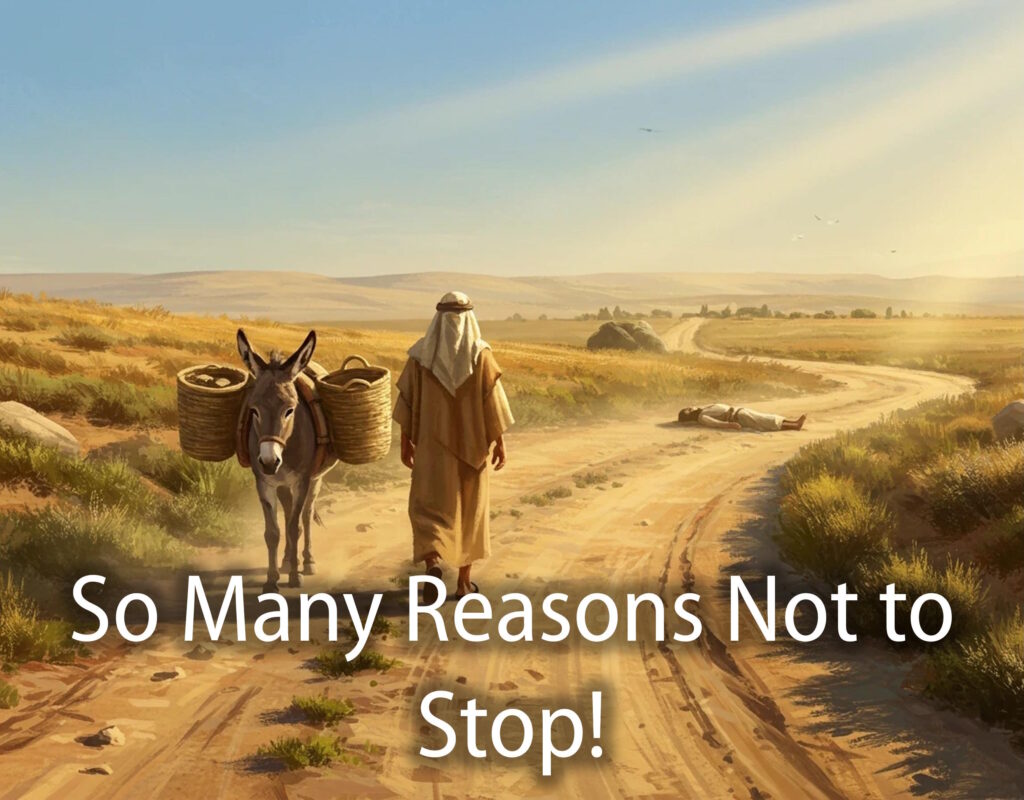
Hiel of Samaria was finally on his way home from Jericho. He never liked to go there, for it was deep within Judean territory. But Jericho was an important hub for trading throughout the entire region.
Hiel had done pretty well for himself in business lately. He had his own donkey for the transport of goods and more than a couple of denarii jangling in his purse. But the trade he was engaged in passed through Jericho and that made periodic trips unavoidable.
A Dangerous Road
The main road out of Jericho went directly across the plain and up into the hills towards Jerusalem. He had no intentions of going to the big city which he despised, but it made sense to follow the well-worn trail for several leagues before turning off north towards Samaria.
He was aware that because valuable trade goods often passed along this road, it was a frequent target of bandits and thieves. He’d been lucky so far on his journeys, but he always felt vulnerable when he traveled here – always aware of his surroundings and always viewing everyone else with suspicion. He sighed and urged his donkey to a faster pace.
Judean Hate
The journey always gave him a lot of time to think. “Why is it,” he asked himself, “that the Judeans hate us so much? It is not because we have ever done anything to them. We have never attacked them, confiscated their land or desecrated their temple, have we? No, come to think of it, those are all things that the Judeans have done to us over the last century.
“No, the only grievance that they have is the way that we worship. Oh, we worship the same God and follow the same scriptures (or at least they’re pretty much the same). No, it is just, they say, that we worship God in the wrong place and have some different traditions. That’s it.
“And it is not as if we could do anything to change their opinion of us. We aren’t welcome to worship in their temple in Jerusalem. And no reform of our worship will ever be good enough for them. So, it’s really nothing that we have done to make them hate us and nothing that we could do to make them stop. Is it any wonder that I feel so helpless every time I pass through Judea?”
A Priest
As Hiel continued down the road, there was a man approaching from the other direction. He was – as was abundantly clear from his fancy robes and high attitudes – one of the priests of the Jerusalem temple. As he went past, Hiel fully expected the man to insult him or maybe even spit at him, as such priests loved to do to Samaritans.
Much to his surprise, though, the priest did nothing of the sort. Rather than displaying the haughtiness for which the priesthood was famous, he appeared flustered and spooked, as if he’d seen some horror.
A Levite
Soon after him came a Levite. The Levites also worked in the temple carrying out more menial tasks. As this man approached, his attitude was much like the priest’s had been. He was so upset and hurried that he scarcely gave Hiel a glance, much less the customary sneer he usually would have received.
The Samaritan did not understand what was going on, but he was happy enough to see these men having a hard time. The Judeans had done enough to destroy the worship and priesthood of the Samaritans over the years.
Persecution of Samaria
Just over a century ago and entirely unprovoked, the Judeans had come and attacked Galilee just north of Samaria. In a series of bloody battles, they had seized control of the land dispossessing Samaritans and Syrians alike. That alone would have been affront enough.
“But even worse,” Hiel said to himself, “about twenty-five years before that, they came into the heart of our land and destroyed our most holy place. They razed the temple of the Lord at Mount Gerazim and killed our priests. Ever since, they have prevented us from rebuilding.”
Hiel had been to the mountain many times to attend festivals and to sacrifice. There, among the ruins, the Samaritans continued to worship in defiance of what the Judeans had done to them. “They tried to make it so that we couldn’t worship,” he muttered, “but we show them. We worship among the ruins as a continual reminder to ourselves of their cruelty and impiety! We will not give them the satisfaction of stopping us from worshipping God!”
Something on the Road
Hiel was so caught up in all of the reasons he had for hating Judeans, that it took him a while to recognize what seemed like an odd pile of rags by the side of the road just ahead of him.
Every step brought him closer, and the realization quickly began to dawn on him that this was not just garbage that someone had left. It was a person – or maybe it had recently been one. As he made out human features that were bruised and bloody, he began to understand what it was that had made the priest and the Levite so upset.
Clearly, this man had been assaulted by one of the brigands that this road was famous for. They had beaten him, taken everything he had and left him to die. As he saw this, he wondered why the others hadn’t been willing to stop and help him. Weren’t they all Judeans? They all worshiped in the same place, according to them, in the proper way. And yet, despite that, the priest and the Levite had seen no need to pause and help a fellow Judean.
Excuses
And sure, they might have given the excuse that, if they did touch him and he died (which he seemed close enough to be doing), it would have rendered them incapable of serving in the temple. No one who had come into contact with a dead body was allowed to serve without going through the purification rituals.
But surely, that was a silly excuse. The law was clear that the obligation to save someone’s life was more important than any purity law. And anyways, neither of them had been traveling up to the temple but rather away from it, so they did not have any temple duties.
No, they had clearly shown in their actions that having things in common – even worshiping the same God in the same way – did not mean that they had to love one another. Perhaps seeing him had made them feel a bit uncomfortable, but they had felt no obligation to take care of him.
What Would He Do?
But, as Hiel stood there, looking down upon the bleeding Judean, he was left with one question. What about him?
He had no doubt whatsoever that if their places were exchanged, if he were the one lying beaten by the side of the road instead, this man would not help him. He would see only a cursed Samaritan who didn’t worship properly. The Priest and the Levite would not give him a second thought either, unless that thought was that he deserved to be beaten. If they had not helped their own countryman, they certainly would not have helped him.
Not Acting Like a Judean
But did that let Hiel off the hook? Did he really want to become like them? No, the last thing he wanted to be was like a Judean. He did not want to become someone who judged and rejected someone else just because they were different or did things differently.
And so, in that moment, Hiel decided to do the most un-Judean thing that he could think of. He opened his packs. He took out a bottle of the wine he was bringing back for trade and a jar of the oil. He took his second-best tunic and began to rip it into strips to make bandages.
He took care of the wounded Judean by the side of the road and then he put him on his donkey to take him someplace where he could recuperate.
A Strange Twist
When Jesus was asked, “Who is my neighbour?” he answered with a story. The story had a strange twist to it. He was speaking to fellow Judeans. You might expect him to tell them a story where a Judean performed an extraordinary act of love towards a hated Samaritan.
But he didn’t tell that story. He told the opposite. He told of a despised Samaritan who chose to love someone whom he had every reason to hate.
Who We Owe Love to
That’s what makes what he did such an extraordinary act of love. And that says so much to us today. It certainly provides an answer to the question of who we owe the greatest love to. If we want to live out the kind of love of neighbour that Jesus was talking about, we cannot limit that love only to those most like us and closest to us.
Jesus tells the story as a way of illustrating that choosing to love those who are far away from us, doesn’t limit how much love we have. On the contrary, it only allows love to grow. For love is something that is limited only when we fail to share it.
Samaritans and Judeans
I also think that Jesus’ story has many things to teach us about those that we are tempted to look down upon and despise. The Samaritans really had never done anything to hurt the Judeans other than live their own lives and worship God in their own way.
But the Judeans had attacked them, taken away their land and destroyed their rituals and customs. I think that Jesus was saying something very powerful when he suggested that it was easier for a Samaritan to act in love towards a Judean than for it to happen the other way around.
Our Attitudes Towards Those We’ve Hurt
For, you see, when we have acted in hurtful ways towards others, it is always easier for us to think of them as somehow less than us. So long as we don’t come face to face with their humanity, we fail to come to terms with some of the things that we or our ancestors have done to them.
It is only our own failure to live up to everything that God has called us to be that prevents us from loving.
A Story to Meditate on
The story that Jesus told about that man beaten and left by the side of the road is a story that is meant to shake up all our assumptions about human relationships. It is meant to challenge you to think about those who are different from you in new ways. That is not easy to do. But I’m really thankful that Jesus gave us this story for us to remember and meditate upon. Please take this story with you and do exactly that.
Join us for worship on Facebook Live or Zoom on Sunday, July 27
Here is the Zoom link: https://us02web.zoom.us/j/82051017271?pwd=eERQV0lnMkRSVjFMN2JucHJjTHVSZz09
When the People Shake, God is With Us
Watch sermon video here:
Crieff, 20 July, 2025 © Scott McAndless – Baptism
Isaiah 7:1-7, 10-16, Psalm 78:1-7
I want to start out today by acknowledging the incredible gift that Erin and Bryce have given to us today. They have allowed us the wonderful privilege to be a part of their celebration of this most amazing and wonderful thing that has happened to them: the birth of their son.
We have all been given the privilege of participating in this very personal and family event. They have chosen to share it, not only with the church where Bryce is a member, Knox Crieff, but all four of our congregations today. We all get to be part of it. Isn’t that simply amazing?
And the best thing about all of that is that this is not just a personal celebration, or a family celebration, nor even a single congregational celebration. We have been privileged to be part of a cosmic and world-changing event that is meant to give us all hope.
The Opening Scene
Let me explain what I mean by taking us into the opening scene of our reading from the Prophet Isaiah this morning. Our reading opens with a whole bunch of names and places that I realize don’t mean a thing to any of you. One king makes an alliance with another king and together they decide to go up and attack another king. It all sounds serious but, who cares, since we don’t know any of these people or places.
So let us put it in terms that maybe we can relate to. In the days of Carney, son of Carney son of Carney, Prime Minister of Canada, Israel and America went up to bomb Iran but did not conquer it and Netanyahu was bombing the people of Gaza. And Ukraine and Russia were sending squadrons of deadly drones against each other.
An epidemic of measles was quickly spreading across the land, and tariffs were causing economic turmoil. The forests were on fire and the rivers were rising in deadly flood. “And the heart of his people shook as the trees of the forest shake before the wind.”
Why Their Hearts were Shaking
Does that sound a little bit more relevant? Does that make a little bit more sense and do you understand why the heart of the people was shaking? Everywhere you look these days it seems as if things are falling apart. Things that we once took for granted – things that made us feel safe and prosperous – just no longer seem reliable.
So, the people are shaking and the king, Ahaz, is trembling. No one quite seems to know what to do. I don’t know about you, but just about every time I look at news these days, there seems to be something that sets my heart to shaking like the trees of the forest shake before the wind.
And, on top of everything else, the church – which is supposed to give us a grounding and foundation in our lives so that we are not shaking – is going through times of difficult change which are disturbing.
A Message of Hope
And, amid all that shaking, God sends the Prophet Isaiah to the king with a message of hope. Oh, Isaiah admitted that things looked troubling but insisted that shaking was not in order. He said that the people threatening them were like “two smoldering stumps of firebrands” – that it was all smoke but little fire.
But things were going so badly that the king was unconvinced. So, Isaiah went on to offer him something that would convince him. “Ask a sign of the Lord your God;” he said, “let it be deep as Sheol or high as heaven.” Ask God to do something – anything – to prove it to you, the prophet invited him.
But I guess that the king was too discouraged because he refused to even ask for a sign. “I will not ask,” he insisted, “and I will not put the Lord to the test.” So, Isaiah did something extraordinary. He said, “Therefore the Lord himself will give you a sign.”
The Sign
And that brings us directly to why we are here today. What is the sign that God offers? “Look,” Isaiah says, pointing no doubt at the thing that the king is supposed to look at. “Look, the young woman is with child and shall bear a son and shall name him Immanuel.”
Apparently, Isaiah is pointing at a young woman who is there with the king’s entourage. Perhaps she is one of the king’s new young wives. He points at this woman with a growing belly, and he makes the bold but not particularly wild prediction that her pregnancy will lead to the birth of a child. And the child will be the sign given to the king by God.
And how, exactly, is the birth of this child going to be a sign from God that we should not lose heart despite all that’s happening in the world? For that, we look to the name of this child. “The young woman… shall name him Immanuel.” And “Immanuel” is a Hebrew word that means “God is with us.” So, this young child is a sign from God which means that God is with us.
Matthew’s Use of This Verse
This was a message given to that king at that moment when the hearts of the people were shaking. Isaiah was speaking about a child who would soon be born and would be a sign of hope.
And I realize that Christians, as soon as they read that verse, lose sight of that original setting. We have been told every Christmas of our lives that that verse is only about the birth of Jesus – that Jesus was born of a virgin and that he and he alone is the one whose birth means that God is with us.
That is, of course, because the Gospel of Matthew interprets this prophecy of Isaiah as being about Jesus. And, let me be clear here, Matthew is not wrong!
Jesus is the one whose birth brings us hope and he – in his own body – has shown us what it means that God is with us more clearly than anyone who has ever lived. He was also born of a virgin – which was not the word that Isaiah used when he spoke to the king, but it got translated that way in the Bible that Matthew was using when he wrote his Gospel.
Something that Continues to Happen
But just because Matthew’s application of this prophecy to Jesus is correct, that doesn’t mean that Isaiah wasn’t talking about a young woman who was present that day. He clearly was. What Matthew’s insight actually tells us is that there was something eternal about Isaiah’s prophecy that day. He was also talking about something that would continue to happen over and over again.
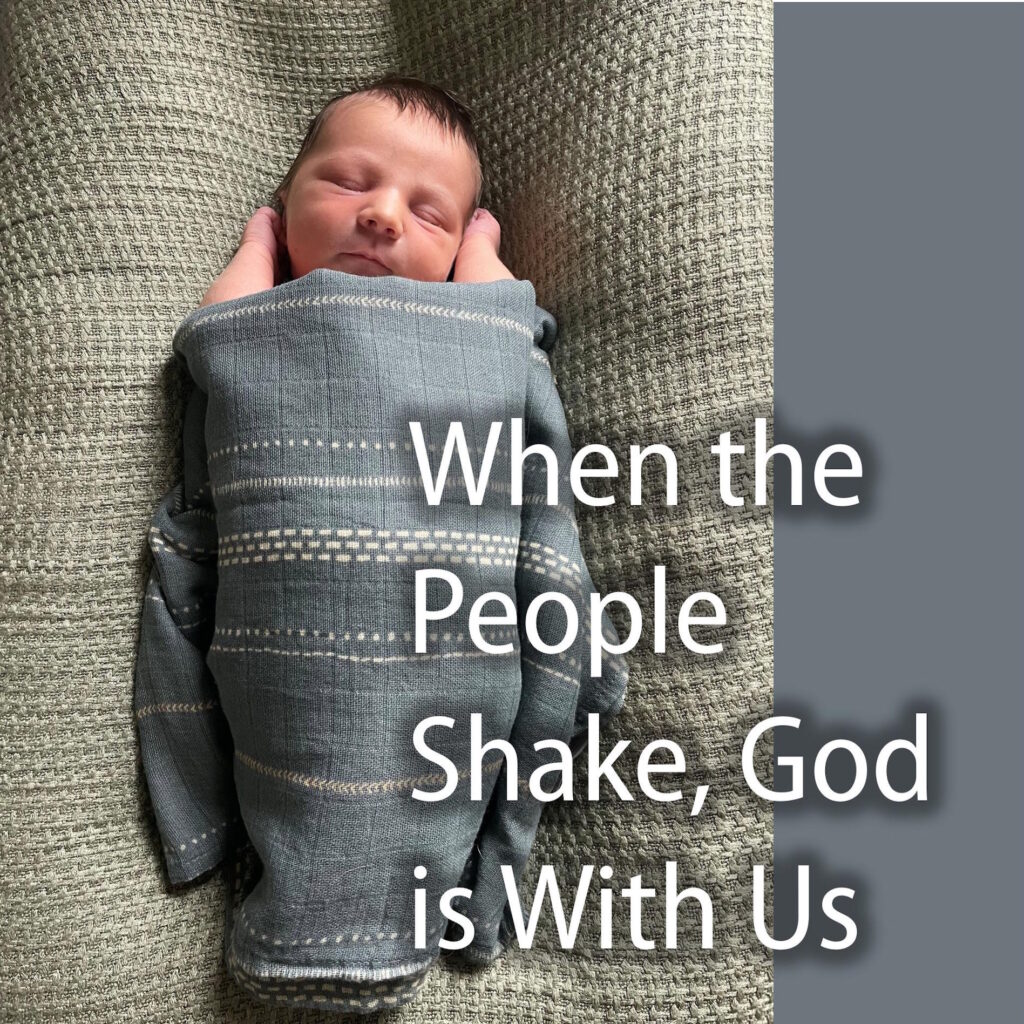
And that is what we are here celebrating today, because what Isaiah said, I’m here to tell you today that it has happened again. God has spoken to us today, even as we are shaking like the trees in the forest before the wind, because of all that is going on in the world. God has spoken to us in the same way – a young woman has conceived and borne a son, and she and her husband have brought him to us today as a sign.
Why Denny is a Sign
How exactly is Denny a sign for us? In so many ways. He is a sign because he is new life in a world where there is too much death these days. He is new life for the church, a sign that God will continue to bring children and young people into our churches as we act in faith and minister to them in trust.
He is also a message to us in the same way that a newborn child was in Isaiah’s time. One thing Isaiah was trying to do was give them some perspective on the disasters they were obsessing over.
Isaiah goes on to say this about the child who was to be born: “He shall eat curds and honey by the time he knows how to refuse the evil and choose the good. For before the child knows how to refuse the evil and choose the good, the land before whose two kings you are in dread will be deserted.” That is just a fancy way of saying that the child will grow up and by the time he gets to a certain age, the threat they’re all worried about will have disappeared.
Perspective on Troubling Events
What that means in terms that we might understand today is that Denny is going to grow up. Before long he will begin to walk and talk and try different foods and do all kinds of things. It will go by so fast. And when he does grow up all the things and people and political leaders we are so worried about right now will be gone.
This is a truth that I have observed repeatedly throughout my life. There are always things to be anxious about. This is true in our personal lives, in the church and on the world political stage. But the things that we get hung up over almost never turn out as we fear.
Yes, they may turn out differently and still be bad. And once the present threats have disappeared, no doubt something new will come along. I’m not promising that everything’s going to go great. But what I’m saying is, let’s not waste any energy fearing specific scenarios that we can't do anything about and that might never come to pass. Denny is a promise that the world will change in unexpected ways and sooner than we think. There is comfort in realizing that.
A Sign of God’s Salvation
But, more than anything else, I believe that Denny is a message to us today that God is with us. God is reaching out to save us, and we have baptized him because we believe that God has anointed him to do that for us.
I’m going to speak directly to Denny here, if you don’t mind. You’re welcome to listen in. I know he may not remember what I say, but I’m going to give him a copy of my words so that he can keep them.
Denny, we have baptized you here today because we believe that there is incredible potential in you to bring hope and life and new beginnings to our world so that the whole world may know that God is with us.
Unlimited Potential
I do not know how you will do that. We celebrate newborns because we know that their potential is unlimited. That is true of every child, but I hope you don’t mind if I say that my expectations are particularly high for you.
For one thing, look at this incredible family you have been born into. I know you don’t know this yet, but your mother is not just the person who gave you life, she is a brilliant scientist and public health doctor who is working to protect the people of Hamilton Region (and we who live nearby too) from the spread of devastating diseases. She is the kind of hero that we need these days, and I believe that her role is only going on get more crucial.
And as for your father, he is not just your hero. He is a dedicated educator who is doing his best to prepare our young people for some of the significant challenges that we know they will face in the years to come. Where would we be without people like him?
So, if you were to follow in the footsteps of either of your parents, you would definitely be a sign of God’s presence among us. But the amazing thing is that you don’t even have to do either of those things. You can take all the gifts and abilities and wisdom they share with you and set your own course.
An Act of Faith
We have baptised you today as an act of faith that, whatever course you eventually take, it is going to be amazing. We’ll all be looking forward to seeing what you do, and we have all promised – and especially the people of Knox Crieff have promised – that we will do whatever we can to encourage and support that amazing outcome.
And Denny, your great gift to us today is that you have allowed us to be part of the beginning of the amazing journey that lies before you. Thank you, and all thanks be to God!
Worship Today
Just a reminder that we worship today at Doon Presbyterian Church,35 Roos St. Kitchener, Ontario N2P 2B9
We hope you can make it out for a wonderful celebration, but just in case you can't, know that Doon will be livestreaming the service on their web site: https://doonpc.com/