Daily Devotion for April 20, 2021
Here's Scott's daily devotion.
Continue reading »
Hespeler, 18 April, 2021 © Scott McAndless
Acts 3:12-19, Psalm 4, 1 John 3:1-7, Luke 24:36-48 (click to read)
I was rather struck by the disciples’ reaction to the appearance of the risen Jesus in our reading from the Gospel of Luke this morning. It says that, “They were startled and terrified, and thought that they were seeing a ghost.” There is something about that that seems a bit extreme. I mean, I can understand to a certain extent why they might think that they are dealing with a ghost when they see this man who they thought was dead – especially when he appears suddenly among them, maybe even by walking through walls as he does in some of the other passages. That is startling and disconcerting, but I’m not sure if that sense of being terrified might not refer to something else.
I don’t know about you, but I’ve heard a lot of ghost stories over the years and seen lots of movies built around ghosts. And I know that stories and beliefs about ghosts are about as old as civilization itself, probably older. And in all of those stories about ghosts, there is a terror that goes deeper than just being startled by seeing someone who you thought was dead.

Now, to be clear here, I don’t really believe in ghosts, at least not in the sense that there are actual ectoplasmic beings hanging around in this world who are looking to haunt people or places. But I do think that the idea of ghosts in a psychological and social sense is a very real and powerful one. Ghost stories reflect our deep-seated fear of death, of our feelings of guilt or regret around those who have passed on and our anxieties about our own legacies. I mean, think of all the ghost stories you’ve ever heard, those are the kinds of themes that they always explore. And they are all topics that inspire abject terror in many of us.
So I would suggest that we have developed this whole idea of ghosts in order that we might tell stories about them to help us process these things that disturb us so deeply. So, it is actually very fitting that, when the disciples see the risen Jesus, they immediately jump to the conclusion that they are dealing with a ghost. For they are struggling with all of these terrifying thoughts.
First of all, they have just been dealt a very sharp reminder of their own mortality. This man Jesus, their friend, their teacher and the one who seemed more alive than anyone had ever been, has being struck down so quickly while in the prime of life. If that’s not a reminder that anyone of them could be cut down so quickly, I don’t know what is.
And there is also no question that they were struggling with a lot of guilt and regret around his death. There are so many references to them deserting him and running away when he was arrested. There is Simon Peter who denied that he even knew Jesus, not just once but three times. They must have felt keenly their own failure to speak up in his defense or to put their lives on the line for him as he was doing for them. They had probably been berating themselves for all of these things. And these are exactly the kinds of feelings that, when we are struggling with them, we will do almost anything to avoid thinking about them and expressing how we really feel. And, like I said, when we are suppressing feelings like that is exactly when we give in to the terrors that, from ancient times, have been associated with ghost stories.
And finally, they were feeling very anxious about their legacy. These were people who had given up everything in order to follow Jesus because they believed in what he said. But now, all of a sudden, the possibilities that he had made them believe in had all been taken away. They had to be asking themselves if they had just wasted the last three years of their lives. They certainly had no idea where they were going to go or what they were going to do from here. Those are also the kinds of difficult struggles that people have always worked through by scaring each other with ghost stories.
And so, in many ways, it is not very surprising that their response to seeing Jesus again was not just a startled reaction, but it was a reaction that stirred the deep terror that, from ancient times, people have associated with ghosts. But Jesus wasn’t a ghost, that is the whole point of this story we read this morning. Jesus goes on to demonstrate to them in various ways that he is not a ghost. He invites them to touch and feel the substance of him, the reality of his human body. He even asks them to give him some food and I assume it’s not because he is particularly hungry but because eating is a perfect demonstration that he is not a ghost, for ghosts need no sustenance. Jesus was not a ghost; Luke does not want us to leave this story without being assured of that simple fact.
Why is that? Is it because Luke does not want us to miss that central piece of Christian doctrine – the insistence that the resurrection of Jesus was a bodily resurrection? Well, yes, that is certainly part of it. He wants us to understand that bodies matter and that we need to extend our efforts to save not merely souls but bodies as well in all of our work as Christians. So, there is no question that Luke is underlining an important theological and doctrinal point.
But I think there’s another reason why Luke wants to make sure that we understand that Jesus wasn’t a ghost. I think that he might have foreseen how some people would come to think of and use the precious story of the life, death and resurrection of Jesus. You see, there is a long tradition of people using the story of the death of Jesus as a way of piling things like guilt and shame onto people.
At least, I know that I have heard sermons and read books in which people try to make me feel bad because of what Jesus had to suffer. Have you ever heard a message like this? “Do you see Jesus up there on the cross? Have you noticed how he suffers all of the pain that racks his body, the shame that seizes his soul? Well, you did that to him. You, with your selfish act, your lust and desire, your failure to do everything that I tell you is so important. Every single thing that you have done wrong is like another nail in the hands and the feet of Jesus upon that cross. You should feel awful!”
Have you ever gotten the impression that that was how you were supposed to feel about the death of Jesus? I know I have. It kind of reminds me of that amazing sermon that we read this morning from the Book of Acts in which Peter at first seems to be intent on making everyone in the crowd feel personally responsible for the crucifixion of Jesus. “The God of our ancestors has glorified his servant Jesus,” Peter says, “whom you handed over and rejected in the presence of Pilate, though he had decided to release him. But you rejected the Holy and Righteous One and asked to have a murderer given to you, and you killed the Author of life!”
I mean, I have always wondered about that sermon. How are you supposed to persuade people to make a change in their life by only telling them that they have done everything wrong? And I sometimes get the impression that that is the only gospel message some people have. All they can do is try and convince people how very bad and evil they are and then shame them by telling them that Jesus had to suffer for all of that. But that, I am sorry, is really not good news and the word gospel is supposed to mean good news.
But, of course, that is only one part of the sermon in the Book of Acts. Peter goes on to say, “And now, friends, I know that you acted in ignorance, as did also your rulers. In this way God fulfilled what he had foretold through all the prophets, that his Messiah would suffer.” He goes on to clarify that the story of Jesus’ death is not about blaming and shaming people into changing their lives; it is about what God has chosen to do for us and certainly not about what we have done to supposedly make God suffer.
But despite that, people have seemed to want to transform the story of Jesus into one that makes people think only of their own failures and their regrets. They have made it into a story that feeds people’s fear of death by making the gospel only about escaping from death and getting into heaven. They have made it into a story that is about manipulating some people’s deepest and most elemental fears that people have and that is what makes me say that I feel like people have turned the story of Jesus into a ghost story because, from ancient times, people have used ghost stories to process some of those deepest fears.

And make no mistake that this use of the story of Jesus’ death has done a lot of harm. I have known and spoken to many Christians who live with a deep fear of hell and death, a deep fear of disappointing their Lord or their church community. And that has led to church leaders of every sort using and abusing the people under their care because once you start motivating people with guilt, shame and fear, it gives you an extraordinary amount of power over them and it is a rare church leader who can resist the lure of misusing that kind of power. Those are the kinds of dangerous things that are unleashed when we turn the story of Jesus’ resurrection appearances into a ghost story.
But it is not a ghost story. As I said, Jesus goes out of his way in this passage to demonstrate just how embodied he is after his death, just as Luke goes out of his way to document it. And I know that a lot of people think that that is about proving that the resurrection of Jesus is real – that somehow the production of the body is what makes it real. But I actually don’t think that is the point of it. What makes the resurrection of Jesus real is the difference that it makes in the life of the person who experiences it. And if all the story of Jesus' resurrection does for people is inspire guilt and fear and shame, then, I am sorry, it doesn't matter what bodily proof you have been shown for the resurrection, it seems clear that all you believe in is a terrifying ghost story.
If, on the other hand, what you have experienced of the risen Jesus gives you freedom and grace, if it lifts from you the burdens that you carry on your shoulders – the burdens of regret and guilt and shame, and it sets you free from the need to please others in order to feel acceptable, then you have authentically experienced the resurrection of Jesus Christ. He came back from the dead with a body in order to set your body free from any chains and any bonds. He came back in the body so that you might experience the fullness of resurrected life here and now and have no anxiety about what might happen to you on the other side. He did not return to enslave you under the weight of a terrifying ghost story. When he came back, he was anything but a ghost.
Hespeler, 11 March 2021 © Scott McAndless – Second Sunday after Easter
Acts 1:15-20, 4:32-35, Psalm 133, 1 John 1:1-2:2, John 20:19-31 (click to read)
At the end of a long day’s labour, many of the people passed through the narrow streets of Jerusalem were making their way towards one particular house. Some of them were slaves who worked in the homes of wealthy citizens, a few of them had shops and stalls that they tended, but most really went out every morning with little idea what sort of work they might be doing that day.
They went to the marketplaces with the intention of hiring themselves out to work on some building site or work in someone’s field just outside the walls. They took whatever jobs they could get, and for a full day’s work, they could be paid as much as a denarius.
Of course, many days there was no work to be had. Sometimes some of them also found that people didn’t want to hire them because they came from Galilee and spoke with a strange accent. So there were a fair number who were coming home that evening with nothing in their purse.
Nevertheless, all of them, whether they had worked hard and sweated in the fields or workhouses or whether they had languished in the marketplaces, had faced everything with a light heart and often enough with a song on their lips because of where they were going now and what it meant to them.
As they entered the door, they all took out whatever they had earned or bartered for during the day and joyfully gave it over to the man who stood just inside the door. He offered to each one a blessing that was immediately returned.

As they moved into the open-air courtyard beyond, their noses twitched and their stomachs growled when they saw the piles of bread and the dried fish. There were some olives and dried figs as well as several skins of cheap wine. There was even a hearty stew that had been made with barley, beef and vegetables. They smiled and glanced at each other as some remarked in wonder, “The Lord has provided yet again, just as he promised.” “Praise the Lord,” others responded.
When everyone had finally arrived, one of the leaders stepped forward and he took one of the loaves. “When we were with him in Galilee,” the man began, “we traveled all over the countryside with almost nothing – no staff, no bag, no bread, nor money – not even an extra tunic. And I sometimes worried – we all did – that we would go so hungry that we wouldn’t make it. But Jesus promised us that, if we would only trust our Father in heaven, we would always have enough. And I’m not saying that we always had meals as good as the one you’re going to enjoy tonight, but it is true. There was always enough.
“And every time we stopped at the end of the day, no matter how much food there was, everyone was welcome at the table whether they had brought anything or not. And he always took a loaf of bread and he thanked God for the gift before he broke it and gave it out to everyone. And it was that simple meal that formed us into something special.” And with that, the man broke the bread, some people came forward to distribute it and the feast began.
When all had eaten their fill, they settled in contentedly to hear a message from one of the leaders. Usually one of those who had been with Jesus from the very beginning would come forward and tell a story of a miraculous healing or repeat one of the stories that Jesus had told while explaining how it applied to what was happening in the world. But they had been promised that, on this night, a special request would finally be answered. The sisters and brothers had heard the story of how Jesus had died many times. It was a horrible and yet beautiful story all at once.
But they always wanted to know how it had come to pass that Jesus had been arrested. They had heard that he had been betrayed and they even knew the name of the betrayer: Judas. But no one seemed to know what had happened to the man after he had acted so treacherously. The story seemed incomplete.
As much as the apostles had been with Jesus almost constantly during his ministry, they had not been able to witness everything about his life and especially about his death. They had neither been able to listen in on whatever trials had been conducted nor on the plots that had been hatched by his enemies. In the same way they had not been able to observe what happened to Judas. But that did not mean that they could not answer the question.
There were two things that allowed them to fill in the gaps in the story of Jesus. First of all, they knew that the scriptures had laid out just about everything that was supposed to happen to the Messiah. So, when they found anything in what would some day come to be called the Old Testament that seem to fit the details of Jesus’ life, they knew they could be certain that that was how it had happened.
This was how they were sure, for one thing, that it had been Judas who had betrayed Jesus. For was there not a story in the Book of Genesis of how Judas (or Judah in Hebrew), one of the sons of Jacob, had come up with a plot to sell his brother Joseph to some foreigners for a sum of money? Surely that was a prophecy about Jesus and it had been fulfilled when Jesus was betrayed.
The other source that the apostles could rely on was the Holy Spirit who would guide and inspire them. When they opened their hearts, they could be sure that the Spirit would lead them towards the truth of all things.
So, the apostles had studied the scriptures and they had opened their hearts to the Holy Spirit, and tonight they would tell the people what had been revealed to them concerning this Judas.
But first, the apostle announced, there was going to be a very special presentation. He went and took a seat as another man in the gathered group rose and came forward. It was Joseph. A member of the tribe of Levi and a native of Cyprus, he had been a part of the growing community that gathered in this house for a few months. In that time the gregarious and generous man had come to be well known and loved by all, so they all greeted him warmly and then quietly waited to hear what he might have to say.
“My dear sisters and brothers,” he began, “I know that you are amazed, as am I, by how the God who raised our Lord Jesus from the dead also provides for us our daily bread when we gather. These are the miracles by which God creates our community and it is marvelous in our sight. You know very well that the money you share from your daily labours is not sufficient to cover all that is provided, as well as the other things that are necessary to our common life.
The other day, as I was thanking God for this miraculous provision and marveling at how it was possible, the Lord spoke to me. He gave me the conviction that I was to be a part of that miracle. He set me to thinking about a piece of property, a field that I had inherited from my father. The Holy Spirit has revealed to me that that field no longer belongs to me, but it belongs to Jesus who has claimed all of me. It is part of God’s provision for this community. And so I have sold that field and I brought the money that I gained and have laid it here, at the feet of the Apostles. It is what has provided your feast this evening and it will for many evenings yet to come.
The whole group cheered this surprising and heartwarming announcement as Joseph returned to his seat and an apostle stepped forward. “We rejoice in our brother Joseph today. You all know what an incredible blessing he has been to our community and this is made all the more certain today. In fact, we have decided he deserves a new name. We think that he should be called the son of encouragement.
The whole group clearly agreed with this idea and they took up the new name as a chant in their native Aramaic tongue: “Bar Nabas, Bar Nabas!” and indeed, the name of Barnabas did stick to Joseph from that day forward.
Finally, the time had come. The apostle sat in front of the gathered company and hugged his knees as he began to tell the story. “Who can say why someone would choose to betray our Lord, to hand him over to those who sought his death? We only know that, in this city both Herod and Pontius Pilate, with the Gentiles and the peoples of Israel, gathered together against God’s holy servant Jesus to do whatever God’s hand and plan had predestined to take place.[1] And was Judas’ role also so predestined? Perhaps, but surely Satan must have entered into him to make such a thing possible.
“But this is what happened to him after he carried out his unspeakable betrayal. He was paid and paid handsomely. And he looked about to try and decide what he should do with his ill-gotten gains. He went out and he found a field. You know that field just outside the city to the south, the one where the soil is red? Well Judas went and he bought that field. And then he thought he was content and secure – that his field would provide him with all that he needed for the rest of his life.
“But know this: God is not mocked. The very day when he took possession of his field, he walked into it. And as he walked, he tripped on a root and he fell headlong. And such was the wickedness and greed inside of him, that his middle began to swell up until finally it burst and blew up and his entrails flew all over the field that he had bought – a field of blood. And that is how that piece of land shall be known from now on.
The company stirred as they heard this harrowing tale. It was very disturbing, but it also seemed so fitting for one who had carried out such a crime in order to enrich himself.
The apostle continued, “Tonight you have heard the story of two men, one who bought a field, and one who sold one. And in the difference between these two men, between Judas and Joseph, you will find the answer to the question that many of you have been asking me: what difference does it make if Jesus really rose from the dead?
Judas died without knowledge or belief in the resurrection of our Lord. And without that knowledge, he could have no hope or security beyond this present world system. For this reason, he knew he had to have property and that he had to have it at any cost, even at the cost of the life of his friend and Lord. He thought that that could make him safe, but God thought differently and we all see the folly of the choice that he made.
But Joseph lives with the knowledge and reality of the resurrection of Jesus. For this reason, he knows that nothing has more value than the community of the resurrected one, nor can anything else give him any security in this world or any world. And so, for Joseph, the field that he had was of little worth in comparison and he has chosen to act accordingly. This is the difference that the resurrection makes for us all.
The fact that there are two accounts of the death of Judas in the Bible, one in the Gospel of Matthew and one in the Book of Acts, has created a bit of a problem down to the centuries because the two accounts contradict each other. According to the Gospel of Matthew, Judas committed suicide. According to Acts, he kind of spontaneously exploded.
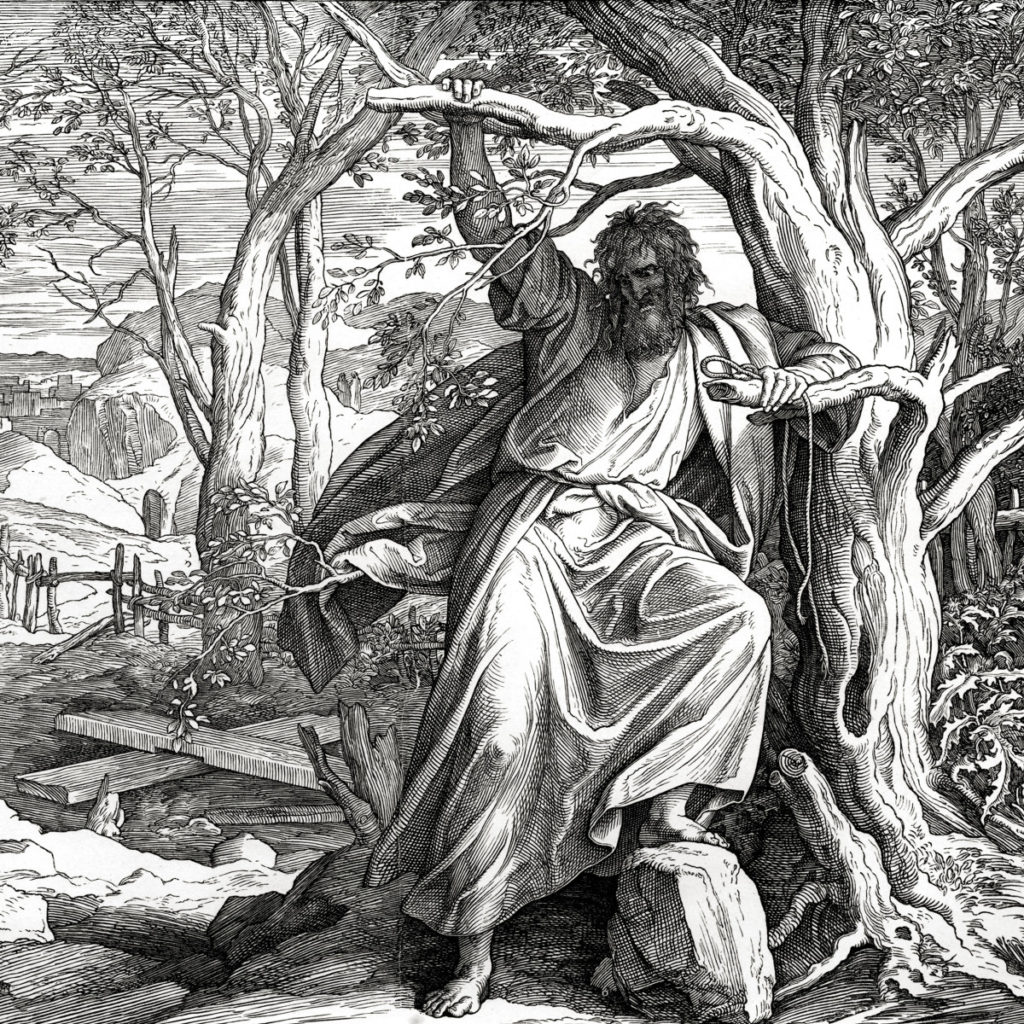
Both accounts associate his death with the purchase of a field called the field of blood, but according to Matthew, the priests in the temple bought the field and according to Acts, Judas bought it for himself.
Now, some people will say that the two stories are not really in contradiction with each other and that if you push and shove at these two passages you can force them to agree. And perhaps you can, but if you do, you end up twisting what the original authors actually wrote, and missing much of what they were trying to say. And I have too much respect for the Bible to twist it to suit my needs.
As a result of these attempts to reconcile two different accounts, what has often happened is that people have tried to downplay the fact that, according to Acts, Judas bought the field because that contradicts what it says in Matthew. And that has made us miss a key part of the story of the Book of Acts – because I don’t think that it is just by chance that, in the first chapter of Acts, somebody buys a field and then, three chapters later, somebody sells one. That simple contrast, is meant to illustrate so much to us of what it meant to the church of that age to know and believe that Jesus had really risen from the dead. And I wonder, how much difference does that knowledge make for us today?
[1] Act 4:27-28