Worship
We will worship, on line, on Zoom and Facebook Live and in person in the sanctuary, with precautions. Masks must be worn.
Continue reading »
Hespeler, 12 September 2021 © Scott McAndless
Proverbs 1:20-33, Psalm 19, James 3:1-12, Mark 8:27-38 (click to read)
You know, there was a time when I looked at the opening passage in the Book of Proverbs, the passage that we read this morning, and I thought that it was an exaggeration. “Wisdom cries out in the street; in the squares she raises her voice. At the busiest corner she cries out; at the entrance of the city gates she speaks: ‘How long, O simple ones, will you love being simple? How long will scoffers delight in their scoffing and fools hate knowledge?’”
I mean, I didn’t think that that was possible. I didn’t think that people would intentionally embrace a lack of knowledge. I knew, of course, that people could be wrong or mistaken sometimes. They might have misunderstood their lessons or been unable to get access to the right sources of information. But I assumed that people, if given the opportunity, would want to know the truth about the world.
I realize today how wrong I was. For we are living in a time today when the majority of the population actually has much of the accumulated knowledge of the world almost literally at its fingertips. They can look it all up from credible sources on their phones. And yet, it seems like a growing number of people are simply not interested in knowing what is true, at least, not if it’s going to contradict what they’ve already decided they want to believe.
We are living in an age when people actively choose to get their knowledge about important things like the spread of viruses and the safety of vaccines from random videos on YouTube rather than from people trained in public health and epidemiology. We are living in an age when people are deciding not to do things simply because some authority figure told them they should do it. Once again, it seems that the Bible has found a way to apply very directly to the serious issues that we are facing in our times.

It also reminds me of the time when Jesus turned to his disciples one day and asked them, “Who do people say that I am?” I don’t think that this question was just a matter of idle curiosity. Jesus understood that he was and would continue to be a polarizing figure. He knew that some people would just fail to understand who he was and what he came to do. But he also knew that there were some who would be only too happy to make Jesus what he wasn’t but rather what they desired him to be and what served their own purposes.
And so that is what he was discussing with his disciples, how there were people who were looking for Jesus to be like John the Baptist and lead the people in a new conquest of the land of Israel. Or they were looking for Jesus to be like Elijah and confront the people who were in charge head on. Or they wanted Jesus to be like one of the prophets. That’s really convenient, of course, because whatever message you wanted to be spoken, you could probably find a prophet who had said something along those lines.
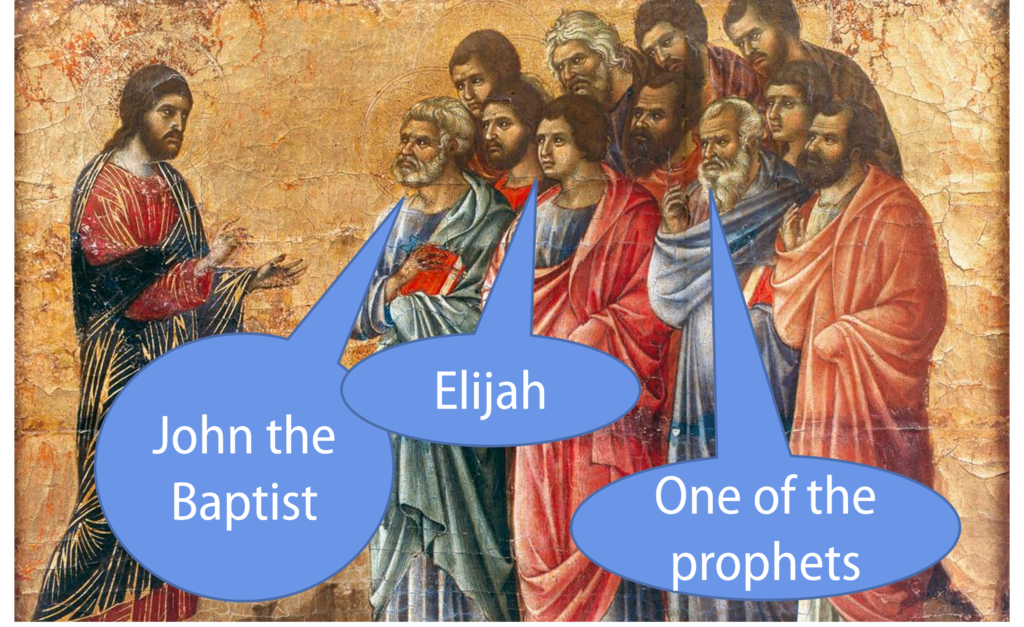
Jesus asked this question, in other words, because he knew very well that people were turning him into whatever they wanted him to be. And I would suggest to you that that is a process that is very much continuing to take place in our world today.
Take, for example, what I would consider to be the most famous prayer that has been publicly prayed in our world during this calendar year. I don’t know if you’ve heard about this prayer, but you need to. It was prayed by a group of people on the sixth day of January of this year and you can still go and watch the video of that prayer today. It all started when one of the people present cried out, “Jesus Christ, we invoke your name!” to which the others called out, “Amen!”
And then another man, Jacob Chansley, raised a bullhorn to his lips and shouted, “Let’s all say a prayer in this sacred space,” and immediately begin to lead such a prayer. He invoked the “divine, omniscient, omnipotent and omnipresent creator God.” He thanked this God for the police officers who, in his words, had allowed them into the building (even though the very same video shows a police officer telling all of the people that they needed to leave). Chansley above all thanked God for being able to “exercise our rights, to allow us to send a message to all the tyrants, the communists and the globalists that this is our nation, not theirs.”

Did you catch that prayer? It was, of course, prayed by a man whose face was painted red, white and blue, whose naked chest was covered with tattoos and whose head was adorned with buffalo horns. It was prayed on the floor of the United States Senate chamber by people who were there illegally, most of whom have since been arrested and are facing trial. And yet, they declared that they were there in the name of Jesus Christ. I think I know how those people would have answered the question that Jesus asks in the Gospel.
“Who do you people that I am?” “Well,” they would have replied, “we know who you are, Jesus. You are the one who has given to us the divine right to decide how this country is going to be run and to make sure that people who are not like us don’t get any say.” They would have said, “You are the Jesus who made this country one that must be dominated by white Christian men – a country that always will be dominated by white Christian men. And they would have said this without any sense of irony whatsoever, without realizing that Jesus himself was not white and certainly not a Christian nationalist.
And I realize, of course, that those people who stormed the US capital in the name of Jesus, who carried their crosses and Christian flags, are rather an extreme case. Not everyone warps their image of Jesus to make him fit their agenda as much as that. But I do think that there is a sense in which we all do it. We all like to make our idea of who Jesus is speak louder than Jesus himself.
For many people, they don’t have to think about it, they would just answer that question of, “Who do people say that I am,” with a picture of a nationalistic Jesus. They just assume that their Jesus would automatically give reverence to the flag and support to the troops no matter what. They assume that Jesus is on their side in any war or international dispute. Above all they would say that their nation is uniquely blessed by God and so cannot do any wrong.
But Jesus would press us with the deeper question, “But who do you say that I am?” He would perhaps remind us of the time that he said, “My kingdom is not of this world,” (John 18:36) and all of the times when he described a kingdom of God that was over and against this present world's systems. And I’m certain he wouldn’t let us forget his warning that, “Those who live by the sword, die by the sword.” (Matthew 26:52) Yes, it is true that we, as individuals, can love our country and give all respect to those who serve in its armed forces, but when we start to drag Jesus and our image of Jesus into that, I think Jesus would make us look deep into ourselves and ask, “Is that really who you say that I am?”
Of course, there are others who are only too happy to turn Jesus into a picture of their economic understanding of how the world works. They want a Jesus who says to them that if they are wealthy and prosperous and have good things happening to them, then it must simply be because they deserve it. They must have worked hard and been virtuous. Of course, it follows from that that if there are others who are poor or struggling, it must be because they also deserve it, because they have not pulled themselves up by their own bootstraps like the virtuous people have. Above all, they would say that Jesus is completely on board with their program of amassing as much wealth to themselves as they can.
But, I believe that, to these also, Jesus is asking, “But who do you say that I am?” He is reminding them that he is the Jesus who said, “Blessed are you who are poor, for yours is the kingdom of God.” (Luke 6:20) He is also the Jesus who went on to say, “But woe to you who are rich, for you have received your consolation.” (Luke 6:24) I have no doubt whatsoever that Jesus saw the value in hard work and the people who do it, but he also saw the flaws that were inherent in the system that meant there were many who could profit handsomely from the labour of others while some could never advance given the disadvantages they were saddled with
And, of course, don’t forget that this is also the same Jesus who told the rich man that the only way for him to be part of what God was doing was to sell everything he had and give it all to the poor. (Mark 10:17-31)
“Who do people say that I am?” For many people, the obvious answer to that question is that Jesus is the one who gives legitimacy to the present system of this world and the way things are done. Jesus is the one who makes sure that the system doesn’t change. Even with all of the turmoil we have seen in our society over the last sixteen months, I think many of us are still living with that expectation that at some point things will go back to how they used to be, which is to say, how they should be.
But Jesus turns to us and asks, “But who do you say that I am?” And he would remind us that he is the one who said, “The first shall be last and the last first.” (Matthew 20:16) And there is no way to understand that but that he was saying that he was here to overturn the established order of things. And he seemed to think that that kind of disruption was necessary for the kingdom of God to come into being.
The Book of Proverbs has this incredible image of this woman who is the personification of wisdom. She is offering to people what we all say that we desire – the wisdom that we need to work through life’s questions and problems. But, amazingly, she doesn’t have any takers.
But I think that I understand what the problem is now. It’s not that people don’t want wisdom, it’s that they don’t recognize her when she calls out because they are seeking for wisdom in all the wrong places – in the easy answers to life’s questions, in the answers that only conform to what they’ve already decided to believe. They especially seem to choose such an answer when it is so readily available on Facebook and Twitter. But if they knew what they were looking for, if they were able to recognize it, wisdom would actually be so easy to find. That is what the Book of Proverbs suggests.
It is kind of the same way with Jesus. People often complain that Jesus is absent from our world today. “Oh, if only we could hear his voice, maybe we would find our way through this present crisis!” But what if he’s actually out there standing on every street corner, maybe in the face of a beggar or someone struggling with mental illness or addiction. Maybe he’s right there in that person who’s fallen through the cracks of the system.
The problem is not that Jesus isn’t there in our world, it is that we are so busy looking for the wrong Jesus. We’re busy looking for the nationalistic Jesus or the capitalistic Jesus or the Jesus who will maintain the status quo no matter what.
“Who do you say that I am?” It is the question that Jesus continues to ask every single one of us. And maybe if we can just let go of our ideas of who Jesus is supposed to be and embrace some of the difficult pictures of who Jesus actually was and is, we can start getting somewhere.
What does faith look like in the handoff to a new generation?
Hespeler, 5 September 2021 © Scott McAndless
Proverbs 22:1-2, 8-9, 22-23, Psalm 125, James 2, Mark 7:24-37
There has been a lot of talk over the last few years about canceling. It is what happens when you have somebody who, for a long time, has been revered in the culture falls from their pedestal. Maybe they are an important historical figure or politician. Maybe they are a celebrated author or actor or businessperson. But then they do something. Maybe they tweet something intolerant or abusive or insensitive. Or maybe they treat somebody else in a way that just seems wrong.
And we all know what happens next. Word of this terrible offense spreads like wildfire through social media along with a rising tide of offense and condemnation. And once the tide has grown large enough, the repercussions begin and often we see the person who has committed the offense losing their platform or maybe their job or paying the price in some other significant way.
This phenomenon has been given the name of cancel culture in our modern times, which is a name that I will admit I have some trouble with. My problem with it is that people always seem to see cancel culture as something that other people do. But they never seem to see how their own activities of boycotting or demanding somebody’s resignation who they don’t agree with as effectively part of the same kind of culture. That tells me that, often the people who use this term are really only using it as a tool to put down people they disagree with and are not really trying to create a better culture.
But, for better or worse, the term does seem to have become a part our modern language. So maybe we ought to understand it and try to see what can be done with it. So let me suggest a bit of a case study.
Let me give you a real-life case of a very important and highly revered religious leader. I’m talking about the kind of guy that commands the love and devotion of millions. In fact, so much is he revered that many of those followers would think of him more as a God than as a man. And let’s say that I tell you that a very reliable report has come out that this man was in a twitter conversation with a woman of a different ethnic group. She had come to him and asked for his assistance with something really important to her and he turned her down.
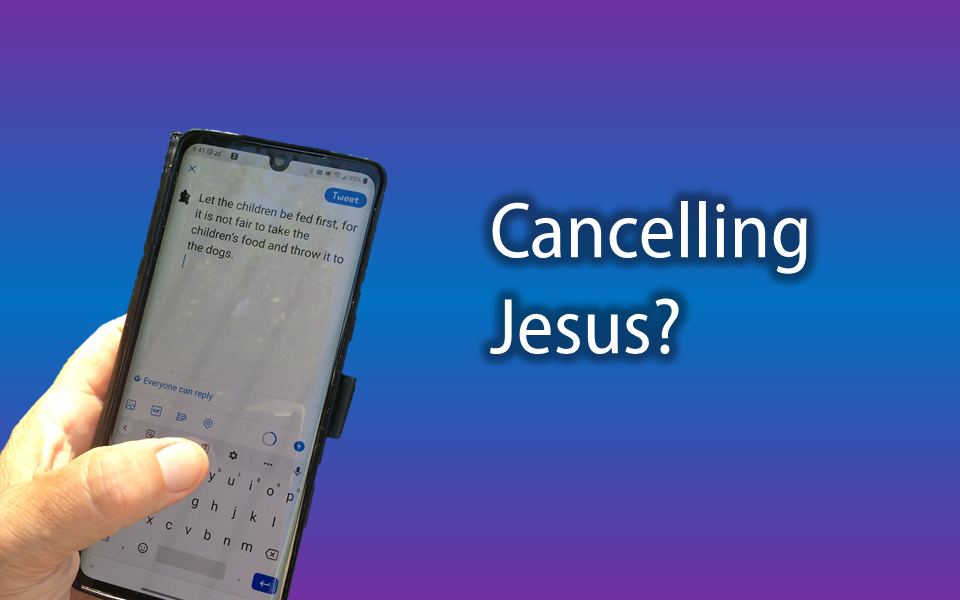
But wait, that’s not the terrible part of the story. I mean, somebody might have all kinds of good reasons not to come to the aid of somebody in need. It might be a bad look, but it’s not necessarily evil. No, it wasn’t the fact that he turned her down, it was how he did it. What if he turned her down by tweeting back, “Let the children be fed first, for it is not fair to take the children’s food and throw it to the dogs.”
Ouch, can you imagine what the cancellation brigade might do with a tweet like that? They would ask, and quite justly when you look at the context, “Didn’t he just imply that the people of his own ethnicity have priority simply because of that ethnicity? Even more important, didn’t he just call the people of her race dogs (which is a particularly insulting slur in that culture)? And finally, and the most damningly, isn’t there a word for a female dog, a word you wouldn’t even say in public? And didn’t he just personally call her that?” Oh, I can just imagine the culture warriors going to work, spreading the news and doing whatever they can to cancel the person who would have tweeted such a thing.
So, what do you think about that particular case study? It’s a big problematic, isn’t it? It is especially problematic because, of course, you have all already figured out which public figure I am talking about here. I am talking about something which, according to the Gospel of Mark, Jesus actually said. And there really is very little question that that is what he meant.
This story of Jesus and the Syrophoenician woman is one that is kind of inescapably problematic. It has been for a long time. One way you can know that is is because, for a long time, people have been trying to defend Jesus and his words in the story. One of the common defenses that you will hear is that maybe Jesus didn’t really mean it. You know, he just said it in order to test the woman, to see if she had enough faith to challenge him.
But I got to say, when it comes to defenses, that is a pretty thin one. After all, isn’t it the same defense that you have heard so many times when a powerful executive or public figure gets caught doing something horrible like sexual harassment? “Oh,” says the powerful man, “I was just testing her to see if she would do the right thing by turning me down.” That’s right, I think that most of us would be pretty skeptical about such an explanation if we heard it today, and I really think that it is no different in the case of Jesus.
So, what is going on in this story? Is Jesus reacting to this woman in a racist manner? I suspect the inescapable answer is probably yes. And I realized that that answer might mess with some of your understandings of who Jesus was and what he represented. We do confess, after all, that Jesus was the Son of God, the one through whom God was and is uniquely present in this world. And yet, at the same time, we also confess that Jesus was and is fully human. And, given that that is a logical inconsistency, we do sometimes have a bit of trouble putting those two confessions together.
After all, we consider, if Jesus was fully divine then he must have known everything. That means that he must have known that it was racially insensitive and offensive to suggest that that woman was a dog. He must have known how that would have felt to her. That is actually a misunderstanding of the divinity of Jesus as presented in the Gospels, where Jesus is not presented as being omniscient. But that is how we tend to think of it all the same.
And yet, at the same time, as someone who was fully human, Jesus grew up in the world, in Nazareth of Galilee, where he doubtlessly heard people putting down other people because of their ethnicity. And if, his whole life, Jesus had heard his parents and every person in his life that he respected casually refer to Syrophoenicians as dogs, would it not be the perfectly human thing to just casually pick up such attitudes and ways of speaking? Of course it is! I know that is what it is to be human because that is exactly what happens to each and every one of us as we grow up and uncritically adopt similar attitudes.
So, I really don’t feel as if it is all that surprising that Jesus should have picked up certain racial prejudices or attitudes. After all, the Bible does teach that Jesus was tested and tempted just like any of us, and yet was without sin. And so, having been exposed to such attitudes, he could well have carried them with him at least until such time as he was exposed to a living and breathing Syrophoenician. It is only at that point, I would suggest, that acting on such a prejudice would be a sin.
So the question is, if Jesus was fed racist attitudes by the society that raised him, why wouldn’t his initial reaction just have been to act on those attitudes? And if that’s what Jesus was doing, should he be canceled for that?
No. I would say this not just for Jesus but for anyone who has been in that kind of situation. And I suspect we’ve all been in that kind of situation. We have all been fed certain attitudes that may be hurtful to others by the culture around us. That’s not on us; that is on the culture. No one should be canceled for just one tweet or statement. Now, when such a statement is part of an ongoing pattern or somebody absolutely refuses to learn from the hurt that they cause, that may be a different matter. But we all make mistakes, and we all get things wrong; that is a big part of what it means to be human.
So what matters in Jesus’ case is not his initial statement so much as what comes after. And what comes after is that the woman challenges him on what he has said. “Sir,” she says, “even the dogs under the table eat the children’s crumbs.” She knows that what he has just said to her is hurtful. But she also knows that she’s not there merely for herself. There’s something much bigger at stake than the racism that people like her sometimes experience at the hands of Judeans. So, she actually embraces the derogatory term and turns it back to Jesus in a way that allows him to hear what his words sounded like to her.
In many ways, she is the hero of this story. You just have to admire her chutzpah. We could all probably learn something from her when we find ourselves in a position when people do or say something that they might not realize is hurtful to us.
But you know what the human reaction to that kind of situation often is. When we are challenged by somebody in the way that this woman challenges Jesus, our automatic reaction is often to get our backs up. Who wants to admit that they are wrong? We see this kind of thing all the time in our society.
For example, you can give some people all the evidence in the world about why they should get the vaccine or why they should wear a mask, and they will resist learning anything new about it. In many cases the more reasonable a case you make, the more irrational the response you get. People don’t like being wrong and they will actually go so far as deluding themselves to avoid admitting it.
But here is where Jesus truly stands out – where his response goes beyond what is simply human to give us a demonstration of what it might mean for him to be divine. Jesus does not get defensive. He doesn’t try and cling to the idea of Judean ethnic superiority that he has been fed all of his life. He learns and he grows in his understanding of this woman who, up until this moment, was merely an ethnic stereotype to him.
I do believe in the mystery of the incarnation – the teaching that Jesus was and is, at one and the same time fully human and fully divine. But I also believe that one of the key reasons why the incarnation was needed was in order to show us where, in this world, the human can intersect with the divine – where it can happen for any of us.
We all make mistakes. We have all of us picked up from the culture around us and from our families and others who have formed us ways of looking at the world that are wrong or hurtful. There is nothing extraordinary about that. It is what it is to be human. That is why indeed I do not believe that we ought to “cancel” people for their simple mistakes or their failure to see the flaws in the worldviews that were passed onto them.
The real question is how do you react when you suddenly realize that you might be wrong or, even more importantly, when someone confronts you with the reality that the attitudes you have inherited uncritically are actually hurting people. What do you do then? Oh, that can be so hard. It can feel as if someone is attacking you and you want so much to fight back and defend yourself. I guess my question for you today is to ask yourself how willing are you to follow the example of Christ – the example of his divinity – and not do that? How willing are you to re-examine the worldview you were given as painful or as confusing as that might feel? There are times when I feel as if the very future of humanity itself may hang on the answers to those questions.
But Jesus has already shown us the way and, in doing that, has shown us where the heart of God lies. Isn’t it about time that we started to learn from that?