Christmas Eve service
Here's our Zoom link for worship.
Continue reading »
Hespeler, 19 December 2021 © Scott McAndless
Micah 5:2-5, Psalm 80:1-7, Hebrews 10:5-10, Luke 1:39-55 (click to read)
Zechariah had always been a good husband. He had been devoted and loving. And he had stuck by her in the good times and in the bad. Even when she endured the disgrace… (And, yes, that is how she thought of it, disgrace. That is what some of the other women said of her as well.) – she had endured the disgrace of being childless, he and he alone did not blame her or treat her as any less than a valued wife.
But Zechariah had one flaw. He had never been one for talking, and certainly not for sharing his feelings. Nor had he been the kind of person that she could share her feelings with. You know, men. They just don't know how to communicate. They can often be quite useless in that way.
And that had been before the incident in the temple, the incident that still had not yet been adequately explained to Elizabeth. All she knew was that, after he had completed his temple service, he came home and she greeted him with all her usual affection, but he didn’t say a single word. Nothing! She hadn’t a clue what was going on. She had thought that he was uncommunicative before, but this was kind of crazy.
It was only after several days that he seemed to have had an idea. He found a wax tablet and a sharp stylus, scribbled a few lines and gave it to her. Even with the written word, Zechariah was still very taciturn. Elizabeth couldn’t read it, of course. Few women could read. So, she took it to one of his brother priests and he read it for her. It said, “You shall have a son. We will name him John. Drink no wine or strong drink.” That was it.
It wasn’t much in the way of explanation. But it seemed as if that was all that Elizabeth was going to get. She accepted that it was true, as unbelievable as it was, because she knew that her husband would not joke about a matter like that. But it still didn’t seem real. She might believe it with her head, but how could she believe it in her heart? She said it aloud, trying to convince herself as much as anyone else “This is what the Lord has done for me when he looked favourably on me and took away the disgrace I have endured among my people.” But she was still not sure she believed it.
When her body began to change, she recognized that something was going on, but how could she truly believe that she was expecting after having been disappointed so many times before? That is the real problem that people have when they struggle with infertility. They’ve gone through that monthly cycle of hoping against hope only to have that hope crushed so many times that it becomes so much easier just not to hope anymore. And maybe these changes in her body were actually a bad sign. She was getting very old after all. Could these not just be the signs she was finally getting too old for it even to be a possibility?
There was one thing that she had always heard from other mothers, though. They had always told her that there had been one thing that had made it all real for them. It was something called the quickening. They had promised her that when she finally felt her child moving within her, it would be a wondrous event and she would finally know for sure that a baby lived within her. So, with great trepidation and fear, Elizabeth waited to feel something. Every day she didn’t feel it was a day of agony. And then, when she actually did begin to feel something, something like little flutters or bubbles, they were so small and fleeting that they just weren’t enough to convince her that anything was real.
And so, even if she was well into her fifth month on the day when her cousin Mary from Nazareth in Galilee came by to visit, Elizabeth was not really in a very good place. She was getting no support from her husband. I mean, I know it wasn’t his fault that he wasn’t communicative this time. But still, she couldn’t help but feel abandoned. And she was filled with doubt and fears. She was having a hard time hoping.
And here’s the other thing you need to understand about her visit from Mary: this was not an age of lightning communication. Mary had not been able to call or text to say that she was coming. The Roman Empire did not have a civilian postal service. The only way for someone like Mary to visit a relative who lived in another town was to drop in unannounced.
So, Elizabeth had absolutely no idea who was about to walk through her door. Nor is there any indication that she had been given any information about what had been going on with Mary who had just received her own message from an angel that she was going to have her own very remarkable child. Apparently, Mary just set out to see her cousin right away when she heard, from the angel (and, no, it had not been posted on Facebook) that Elizabeth was also expecting.
Elizabeth had no clue what was going on when, in the middle of the day, she heard the door to the house open followed by the voice of her well-loved cousin Mary calling out to her. And in that moment, as she heard that familiar voice, many things happened. First, and most important of all, the child moved within her. And this was no flutter. This was no indistinct movement that her doubting mind could just dismiss. No, her son leapt within her and immediately banished from her mind all doubt, all fear and all anxiety about whether she was really expecting. The flood of joy and relief was overwhelming.
At the same moment, she was also filled with an assurance that there was something about Mary. It wasn’t just that her beloved cousin was there, it was that something was happening in her. She had only heard one word of greeting. But in that word, Elizabeth had recognized the same joy that she was feeling about the life that was growing within her.
How she knew that her son within her was telling her that there would be something truly extraordinary about Mary’s child, is a little bit harder to explain. But, given all of the knowledge, relief and joy that were flooding through her in that moment of time, maybe it’s not all that surprising that she was also completely certain that her child had made a revelation to her. And that was when she cried out, “And why has this happened to me, that the mother of my Lord comes to me?”
And, for me, that is what Christmas is all about. It is not about shopping or gifts. It is not about eating huge amounts of food. It is about what happens to Elizabeth there. It is about people finding a reason to hope. It is about people being surprised by relief and by joy, especially when those things meet them in the very thing that they are struggling with.
But here is the thing that particularly strikes me about this story of Mary and Elizabeth this year. I suppose you might say that it is God who gifts Elizabeth with all of these wonderful things, but it is surely no coincidence that this happens at the very moment when she is visited by her relative who has come from a distance to visit her.
That seems important, maybe especially this year as many people look forward to gathering over the holidays with their extended families – gathering with people who they may not have seen for a very long time, not even last Christmas, because of this blasted pandemic. Wouldn’t you love to see all of our family gatherings filled with such feelings of hope, joy and comfort? I certainly would.
And yet I am also keenly aware that it might not be quite so simple as that. I know that there are many for whom family gatherings are anything but edifying. They dread going back to those people because they know all of the old arguments will be dredged up. They know that Mom or Aunt Sally or Uncle Fred just has this way of getting under their skin and making them feel bad about the life choices that they have made, the ones that they’re actually normally pretty good with. They know that Cousin George is going to say something racist or that is some wild political conspiracy theory that is going to make everybody cringe, but that nobody’s going to call him on it.
I mean, I know that every family is different, and these are just examples of the kinds of things that go on, but I would wager that there are a lot of families out there that have these dynamics that do make people feel more dread than joy at the prospect of family gatherings.
And that’s just in an ordinary year. I am afraid, with all of the stress that we’ve been going through, that the potential for that kind of stuff is really going to be ramped up this year. There are some people who might be on a hair trigger when it comes to interactions with families. A lot of people might feel as if they are walking on eggshells. And that’s even before you get into those very fraught discussions about inviting or disinviting people who are unvaccinated or who you cannot rely on to wear masks. Yes, as I look forward to family gatherings this season, there could just be an emotional minefield out there. And we’re all heading towards it.
But here is a challenge for you this Advent. I know that you do not have any control over the stress of this season or the stress that you might be carrying because of all that’s been going on. You certainly don’t have any control over the stress that other people are feeling. You also have no control over what other people do as a result of the burdens they carry. But I’ll tell you what you do have control over. You have control over what you do and how you respond. And you can commit yourself right now to going into any encounters with those important people in your life, your family, during this holiday season with a spirit of grace and kindness.
I’m not accusing anyone of anything but, is it possible that sometimes, when your family gathers, you are the one who reminds people of old arguments and disagreements? Can you sometimes be the person who just has to put down somebody else’s accomplishments in order to feel good about your own? Or maybe you’re just that person who has a way of getting under somebody else’s skin, of being judgmental or even mean. Do you sometimes share opinions that you know no one else wants to hear?
None of us are perfect and I would suggest that each one of us, maybe even in just a small way, contributes to the dysfunction that sometimes happens when families gather. Well, first of all, you could just decide not to do that this year – not to be part of the dysfunction.
But even more than that, what if you went into all of those encounters this year with a determination to be what Mary was to Elizabeth, the bearer of a blessing. You could do your best to respond to someone who seems determined to take you down a peg by honouring them and lifting them up because, guess what, they’ve had a pretty lousy year too. What if you were to respond to what feels like judgment with a little bit of unconditional love?
The more I look at this story of Mary and Elizabeth, what I see is Mary, her heart full of joy and love and promise, walking in on her cousin and being completely unaware of all of the agony and doubt and questions that Elizabeth has been struggling with. And with a word, she transforms the entire situation into an encounter with pure joy. I honestly believe that that can be you this Christmas, if, with God’s power and the help of the Holy Spirit, you take on the challenge that Mary offers to us.
Hespeler, 12 December 2021 © Scott McAndless – Advent 3
Zephaniah 3:14-20, Isaiah 12:2-6, Philippians 4:4-7, Luke 3:7-18 (Click to read)
Can I make a confession to you? Every time I read out the story of the preaching of John the Baptist from the Gospel of Luke, I do a double take. Something doesn’t seem quite right. The thing that trips me up is the little summary of the preaching of John that Luke tags on the end of it: “So, with many other exhortations, he proclaimed the good news to the people.”
This is, pretty clearly, the gospel writer’s take on what John was doing. It isn’t found anywhere else in the gospel record and doesn’t appear to be an oral tradition. This is basically Luke looking at the whole message of the Baptist and saying, yes, this sounds like a whole lot of good news. But I have to ask, what about what John has just said sounds like good news to you?
He has just spent his time calling the people who, in good faith, have come out to listen to him a “brood of vipers!” He’s been talking about the “wrath to come” and warning that it’s going to be hard to escape. He says, “the axe is lying at the root of the trees; every tree therefore that does not bear good fruit is cut down and thrown into the fire.” Ouch!
He’s been talking about how the people will be sorted from one another like the wheat is separated from the chaff by a winnowing fork and he is saying that a good number of people are about to be burned up in the fire! You know, not really your average good news report. So I do kind of wince every time I read that. It makes me wonder if Luke is trying to be ironic.
But, as I think about it, maybe my problem with Luke’s summary of the message of John is the same problem that I have with the season of Advent. In many ways, Advent seems to be a very ironic season in the life of the church. These are the uplifting themes that we run through every Advent: hope, love, peace and joy. Because, in our society, it is considered to be part of the Christmas season we also tend to focus on heartwarming stories and hopeful ideals. What’s more, because we simply cannot wait, we usually go ahead and start singing Christmas carols with all the nostalgia and good feelings that come with them. Advent feels like a good news season.
But have you read the passages of scripture we usually read in the church during this season? It is all full of disaster, destruction and all of the elements of John the Baptist’s speech. It is a season of apocalyptic fire and floods, pestilence and persecution. That is because Advent is not supposed to be about preparing for Christmas. As far as the church is concerned, we do not spend this season anticipating the coming of the Son of God born in a manger but rather the coming of the Son of Man in the clouds with glory at the end of all things.
But there are two kinds of good news. There is the kind of good news that is basically just puff pieces. These are stories that are meant to distract and divert. They focus on the positive aspect of some person or event without even acknowledging that they might have a negative side. There is a lot of that kind of news around Christmas time as the media pitches in to get everyone in the right mood so that they will go out and do a lot of shopping. And that’s all well and good, we do sometimes need a break from being serious. But I would argue that good news is supposed to be something more than just looking at the bright side of everything. Because, if that’s all it is, it is really just a practice of denialism.
I would suggest that truly good news has to be able to grapple with the dark side of life, not just the bright side. And that’s what I do see John the Baptist struggling with in this passage. It is also what I see the church struggling with during this season of the year and that is a good thing.
When the people come out to John, he doesn’t sugar-coat the situation to them. He demands that they come to terms with what is really going on in the world. If he were preaching today, for example, he would demand that we face problems like the homelessness crisis, the opioid epidemic and the climate crisis. In fact, I have no doubt that John would be, let’s just say, very forceful in his presentation of these problems and threats. But, as inflammatory as John’s language might be, and I do mean literally inflammatory, there is one thing that makes it good news.
The people who’ve come out to see him ask him, “What then should we do?” And the good news is that he has an answer. You see, when you have a crisis or a problem that you can’t do anything about, that’s nothing but bad news. But, if you can do something, that changes your perspective about everything. Now, that doesn’t mean that you have to have the ability to totally resolve or fix what is wrong. That is a mistake that people often make and it leads to despair and often to nothing being done at all.
For example, people look at a huge problem like global climate change and they say, “Anything that I do personally is going to be such a small drop in the bucket, I might as well not even try.” That’s the kind of attitude that leads to a lot of disillusionment. But I think it is important to remember that, even if you do not have the means or the influence to actually fix what is wrong, if you do take the right action, you can be part of the solution and that makes all the difference in your attitude. It allows you to hold onto hope.
So, John does give to the people examples of the right kind of actions that they can take. And, interestingly enough, he’s able to recognize that different people are in different positions and that might require different kinds of actions in order to be effective. So, let’s take a look at the specific actions that John does encourage people to take.
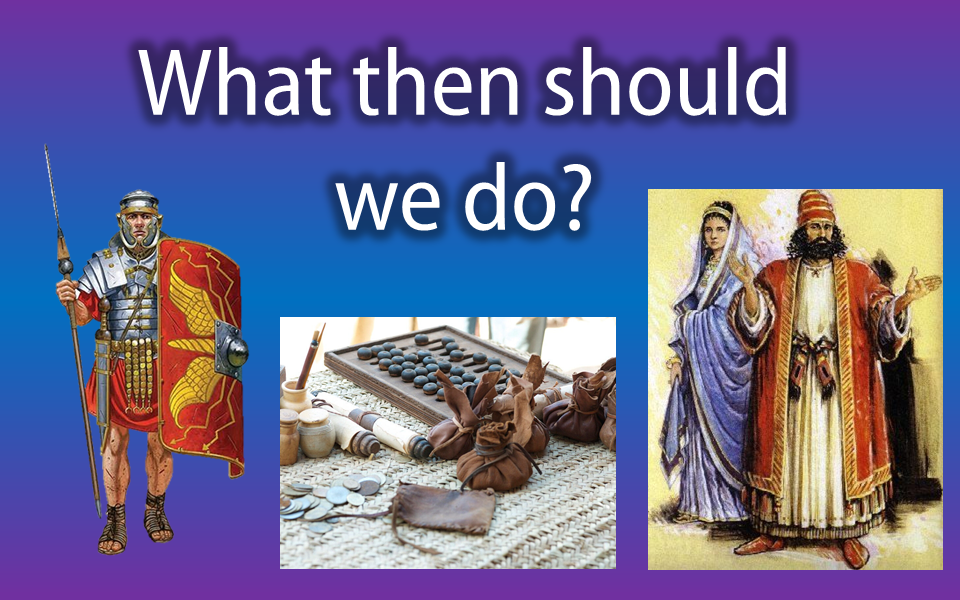
He speaks to the soldiers. Now, it is not entirely clear who these soldiers are. They might be Roman legionary troops, though it would seem rather strange for members of a foreign occupying force to come out to see a figure like John. It is maybe more likely that they are members of a local militia force. But whoever they are, it is pretty clear what they represent.
They are the official defenders of the system according to which the entire world works. They are the ones who ensure that the wealthy keep their wealth while the poor stay in their place. They are the ones who wield the violence that exploits the people for the benefit of the powerful. And, of course, they really don’t have much choice in that matter. Wherever their sympathies may lie, they have to follow orders.
So, what does the Baptist say to them? “Do not extort money from anyone by threats or false accusation, and be satisfied with your wages.” Think about what this means. These are people who are totally caught up in a system of exploitation. They are the defenders of the system itself. And yet, John is challenging them to take a stand and not personally take part in that systemic exploitation – at least not to use it for their own purposes. He is encouraging them, in whatever small ways they can, to undermine the system from within.
He gives the same advice to the tax-collectors who came to him. Now nothing, in the ancient Roman Empire was more riddled with corruption and exploitation than the tax system. This was because it was designed to work that way. Tax collectors were not government employees but rather independent contractors who bid to get the gig. They weren’t actually paid and the only way they could earn their living was by squeezing extra money out of the people. So, from top to bottom, the entire system was riddled with individuals who were all squeezing the people under them for whatever they could get. The people at the bottom – the actual taxpayers – were often squeezed far beyond what they could bear.
So, when John says to them that they should, “Collect no more than the amount prescribed for you,” he is actually asking a great deal. He is basically asking them to forgo the only source of income or profit that they have. The message seems to be that, when you are caught in a corrupt and exploitative system, anything you do to personally step out of that system can be a powerful and transformative statement.
So John speaks to the soldiers and the tax collectors. He has one more answer that seems to be directed to the people in general. To them he says, “Whoever has two coats must share with anyone who has none; and whoever has food must do likewise.” This is perhaps the hardest one to hear, especially as it is directed at everyone so that nobody can say it doesn’t apply to them. This answer attacks the basic, underlying system that undergirds the very structure of society and that makes it possible for some people to have a superabundance of things while others don’t have enough to get by.
And the point of this is not to villainize or guilt the people of this world who have done well for themselves. If you have been successful in this life as a result of your talent and hard work, good for you. John is not attacking you. What he is targeting is the system that allows such wild inequity between those who have and those who have not. And the reason why that happens has much more to do with how everything has been structured in our society than it does with the acts of individuals.
John understands that an individual cannot change the system. But he does say that, if you have the means to and you want to be part of the solution instead of the problem, well then, you need to start to look at the possessions you have in a very different way. You need to start to see how they can be of service to those who are in the greatest need instead of just asking what they can do to make your life more comfortable.
This, then, is where I see the genius of John the Baptist’s good news message. He recognizes the corrupt and problematic systems that are at work in this world and that create misery and evil. He sees the corrupt political systems, financial systems and economic systems. And he recognizes that all of us, depending on the position we play in life, are part of these corrupt systems. We can’t help that. And we certainly can’t change them on our own. But he begins to put out there a dream of groups of people who decide to do things differently, who opt out of these systems in the ways that they can, and he suggests that they are the ones who will actually change the world.
The good news is that we are not powerless in the face of the evil and dysfunction of this world. We have a part to play in God’s work for its redemption. The good news is that as individuals we have little power to change anything. But if we all do it together, we can radically remake the systems of this world.
Which brings us, finally, to our challenge for this third Sunday of Advent. I think all of us, maybe especially in the chaos of recent months, have been in the place of those people who came out to John the Baptist in the wilderness. We don’t need him to tell us that the world is in a bit of a mess. We have all seen it. No, we come looking for some good news. And the good news he gives us is there something that we can do. We can choose together not to live according to the corrupt and evil systems of this world. And that is something that will have impact when we do it all together.
And that’s actually what the purpose of the church is. It is this thing that allows us to do it all together. My challenge for you this week is to take some action to be a part of what this congregation is doing to challenge the dysfunctional systems of this world. We are doing our best to address the inequality in our city by providing food through the food bank on a week by week basis. Can you do something to support or encourage that?
We are doing what we can to reach out to families who are finding that they don’t have enough tunics or cloaks or other pieces of clothing. And we are enabling a way to get that clothing from those who have enough to spare to those who don’t have enough. That is what Hope Clothing is. What can you do this week to support that endeavour?
Above all, we are trying to model in this church a way of living out what John was asking those people who came to him to do. Do we do that perfectly? No. But the closer we stay to what John was asking for and what Jesus was calling for from his disciples, the more we are part of the solution instead of the problem.
So, do you know what you can do this week to help that along? You can share what we are doing in this church with someone else. Tell them, share a link or video on social media, reach out to someone and share with them the difference that the good news has made in your life. Be a part of the solution, not the problem.
Hespeler, 5 December 2021 © Scott McAndless – Advent 2
Malachi 3:1-4, Luke 1:68-79, Philippians 1:3-11, Luke 3:1-6 (click to read)
In my line of work, as you can imagine, I will often come into contact with people who are going through rough times – who, to use the phrase that we read together this morning from the Gospel of Luke, “sit in darkness and in the shadow of death.” Sometimes they tell me their stories or show me what they are going through in other ways. That is actually a great privilege, though it can be a hard one to bear. And often what they share with me is quite private and I honour their trust in me by keeping those things private.
So I won’t give you any examples of this with any identifying details, but I am going to tell you that I have observed something. There has been more of that over the last several months. More people have been sitting in darkness that is deeper and more impenetrable. And the shadow of death, it has grown larger, gloomier and more oppressive. I mean, that just something that we seem to be dealing with these days.
Every story is different, and the challenges are unique to every individual’s life, but let me tell you some of the things that I have seen in non-identifying ways. The social isolation of recent months has been hard for some to bear. They are just lonely, and everyone has found their own ways to deal with that. Some have quietly slipped into depression, and I know that some have essentially been self medicating. That might mean, for example, that they’ve been drinking more or using other prescription or non-prescription products. Others have managed to cope by developing other habits – indulgent eating, gambling or just about any other activity that might be distracting them from the pain that they feel.
And I want to be clear here, I do not believe that anybody should feel ashamed of doing what they need to do to get by during a difficult time. I’m not here to condemn anyone for the strategies that they may have used to do so. But this crisis has gone on longer than most others that we have faced which has meant that people have been coping for longer. And many have reached the point where their coping mechanisms are becoming destructive either to themselves or to the people that they love. And the problem is, once you enter into that kind of cycle, it can be very hard to escape.
Another thing that has been happening is that there has been an enormous amount of loss. People have died and more of them have died than we had become used to. Others have lost things that had deep meaning to them, the kinds of things that told them who they were and gave them a sense of meaning. People have lost jobs and businesses. They have seen people they love move away or they have lost them in other ways.
And, yes, grief and loss are, and always have been, an essential part of life. But something about this season has been particularly hard for some people to bear. The grief and loss have been piling up so quickly that some have not been able to process it. We have also often not been able to grieve our losses in the ways that we would have liked. And I suspect that all of this has meant that many people are carrying around something like a huge backpack filled with grief that they’re not quite sure what to do with. And it is like a great burden that some have been carrying so long that they’ve almost forgotten that it is weighing down their every step and every movement.
These are but some of the ways in which people have been sitting in the darkness. I’ve certainly known others who struggle with illness, either in themselves or in someone they love. And of course, there have also been enormous economic struggles as many families have had a hard time feeding their children and keeping them in clothes. What’s more, I suspect that many of us scarcely even grasp the enormity of the housing problems that have emerged as people have been simply priced out of shelter.
Alongside all that, often making it worse, we are dealing with a pandemic of misinformation. I know this is something that you have all encountered. Do you remember when conspiracy theories were just this amusing thing that some people got into. They would turn it into this little hobby where they liked to talk about the Kennedy assassination or whether or not Paul McCartney was really dead. It was harmless and amusing.
But we now find ourselves living in an age where conspiracy theories are dangerous and destructive. And I know that some of us can get very angry with people who become obsessed with anti-vax or anti-mask or with ridiculous political theories that are based on nothing. I understand this, of course, because a lot of this is having some very dangerous effects.
But I’ve got to say that I’m learning to feel a bit of compassion for the people who get caught up in this kind of thinking. I think they are living in a particular kind of darkness where they cannot trust institutions or political leaders or health officials. And often, when you talk to them, there are actually some good reasons for that mistrust. So, I would actually count the people who are caught up in such things among the victims of the darkness. And, honestly, that kind of makes it all even more frightening.
And on this day, the Second Sunday of Advent which is the Sunday of peace, I declare to you that we are being given a challenge that is absolutely tailored to this present moment. This morning we read the song of Zechariah the priest. Ever since the angel first came to him to announce that, against all expectations, he and his wife were going to have a son, he has been struck dumb. This is because he had asked for a sign that it would all come true, given that it was so impossible for him and his wife, Elizabeth, to have a child at such an advanced age. The sign given, or perhaps it was a punishment, was that he was rendered unable to speak.
But now, now that the child has been born and been given a name, Zechariah’s tongue has finally been loosed and he bursts forth in this amazing song. And in this alone there is a message for our time. All this time, Zechariah has silently held onto a word of promise. It is a promise for him and for Elizabeth, the fulfillment of a dream that they have long held close. For their own personal darkness has been their inability to have a child.
But clearly, during all that time of silence, Zechariah has had a chance to think. And he has come to realize that what is good news for him and his wife, must be good news for more than just them. For what good is it if he and Elizabeth are freed from their darkness but others continue to sit in it? And so, Zechariah begins to speak a promise for all.
And that is exactly where all of us need to be during this Advent season. There is a temptation in the Christian church today to think of the good news only in terms of what is good news to ourselves. People want to embrace the idea that God has saved them, has given them the hope of life beyond death and restored their own personal relationship with God. Christianity has largely become an individualistic religion within our individualistic society. How many Christians only think of it in terms of what is in it for them? But Zechariah has learned the folly of such thinking and the joy that he has found in the promises of God must burst forth from him and be shared with other people as well.
And so, during this difficult Advent season when many are sitting in the darkness, our tongues must be loosed as well. If the good news that we have heard about Jesus is for ourselves alone, then I am afraid that it is not truly good news. And I don’t mean to say by that that we need to go out and impose a gospel message onto others. This is not about pressuring anybody to listen to gospel stories or messages. And I certainly don’t think it means that we need to go out and condemn people for their sin or threaten them with hellfire. That is not what Zechariah does.
But, at the same time, silence is no longer an option in this troubled world. If you have found a reason to hope or even just a reason to hold on in difficult times, you have a responsibility to let others know, especially those who are sitting in darkness. And I believe that that is what Zechariah does.
He celebrates God’s commitment to be with the whole people of Israel and to save them during the darkest and most difficult times – a God who “has shown the mercy promised to our ancestors, and has remembered his holy covenant, the oath that he swore to our ancestor Abraham, to grant us that we, being rescued from the hands of our enemies, might serve him without fear, in holiness and righteousness before him all our days.” That is the God that we must remember and who can give comfort to these sitting in darkness. For it is a God who never forgets the ones who are lost or alone.

And then he finally arrives at his reflection on this child of his that has just been born. Any time a new child is born, it is a sign of hope. Because every new child has unlimited potential. Who knows what this child might go on to do? She might grow up to find a way to defeat a particularly pernicious kind of cancer. He might grow up to be the one to broker a lasting peace between the Israelis and the Palestinians. She might discover the technology that gives us near limitless green energy.
And so, Zechariah looks at his newly born, newly named child and declares his potential. “And you, child, will be called the prophet of the Most High; For you will go before the Lord to prepare his ways… By the tender mercy of our God, the dawn from on high will break upon us, to give light to those who sit in darkness and in the shadow of death, to guide our feet into the way of peace.”
And of course, that is a prophecy particularly concerning John. He is the one who is to prepare the way for all that Jesus is going to accomplish. But it is also a statement about what has been put into motion by the coming of John and by the coming of Jesus. “The dawn from on high will break upon us,” is not merely a statement about what John is going to do. It is a statement about what God is doing at this moment in time for a world where many sit in darkness and in the shadow of death.
And so, we also are the ones who are called to give light. That is why my challenge for you this Advent is simply to walk in the footsteps of John the Baptist and of Jesus. Just as they reached out to many who were sitting in darkness, that is your task this season. And, no, I’m not saying that it’s all on you individually. You are not going to drag all of the people out of the darkness and into the light. But my challenge to you is to find a way to do it for somebody this week.
Do you know someone who is struggling with their finances? How could you practice generosity to them this week? I think that would cause the dawn to break for them. Do you know someone who is struggling with illness or disease? You don’t have to go to them with some magic word that is going to suddenly make them well. That’s not your job. But, maybe, you can just go to them. You can sit with them for a while in their struggles. You would be amazed at the difference it can make just to have a person with you when you are sitting in the darkness. And that person can be you this week.
Do you know someone who is caught up in destructive life patterns? Don’t think that you could go to them and tell them to straighten up and that’s going to fix them. It usually doesn’t work like that. But maybe you could go and listen to them and try and understand what it is that is causing them to behave in self-destructive ways. A little bit of understanding can go a long way in terms of bringing people light when they are sitting in the darkness.
And I’ll bet you know someone who’s been caught up in some ridiculous conspiracy theory. I know you’ve figured out by now that it really doesn’t help anything to argue with them about it. It never does. In fact, it will probably only make them more committed to their conspiracy. But do you know what they might need? They might need somebody who can help them see what it is they are really afraid of. They might need someone who is still actually willing to sit with them and just talk about other things.
I’m not saying that bringing light to those who sit in the darkness is easy. It’s one of the hardest things you ever could do. But, by God’s grace, you can do it. Sure, you don’t have it in you to fix everything that’s wrong in another person. Only God has that kind of power. But I think that John and Jesus discovered that when you are willing to go to people who are sitting in the darkness and love them as they are, you might just have the incredible privilege of being present when God does begin to allow the dawn to break for them.