Lots going on this month
For our community
Continue reading »
Hespeler, 30 October 2022 © Scott McAndless – Anniversary
Habakkuk 1:1-11; 2:1-4, Psalm 119:137-144, 2 Thessalonians 1:1-4, 11-12, Luke 19:1-10
The prophet Habakkuk is one of those guys who just seems to have the ability to be completely open and honest with God. He opens the book that bears his name in the Bible with a question that I think many of us could ask if we dared to be so honest. “O Lord, how long shall I cry for help, and you will not listen? Or cry to you ‘Violence!’ and you will not save? Why do you make me see wrongdoing and look at trouble? Destruction and violence are before me; strife and contention arise. So the law becomes slack, and justice never prevails.”
Habakkuk was obviously living through some pretty hard times – times when it seemed as if the very structure and conventions of society were breaking down. And I could probably spend some time going through all of the ways in which things were breaking down in his day, but I honestly don’t feel like I need to. I kind of feel like we are living through it.
I constantly hear today about how some of the basic conventions of our society – the things that once held us together and allowed us to function – are no longer working for us. We see it in a growing mistrust of the basic assumptions of democratic government. I realize that this is something that probably started in the United States in the aftermath of their last Presidential elections, but it has absolutely spread to Canada and many other parts of the world.
Growing numbers of people everywhere have lost confidence in the security and fairness of democratic elections even though these things continue to function well. Suddenly it seems that losing candidates only need to say that the election of their opponent was unfair, without needing to offer any evidence at all, and huge groups of people will believe them. And I have to wonder how we can possibly manage to govern ourselves if people are attacking the very foundations of that system.
And it’s not just there that we see the breakdown. The whole experience with the pandemic has led to a huge loss of confidence in both public health measures and medical expertise. And I’m not even saying that this didn’t happen without some reason. In many cases, the implementation of even the best advice left a great deal to be desired. As a result, many people have felt let down and I fear that it is leading us to a place where so many people are going to mistrust all expertise in healthcare. If a sufficient number of people no longer follow sensible public health recommendations, it probably doesn’t matter what the rest of us do. We will all get caught up in the public health crises that follow.
But it is not just in the big public issues that we see this kind of breakdown. In all kinds of ordinary interactions and discourses it certainly feels as if the very rules of civility that we took for granted no longer apply. All of a sudden, we hear people saying racist things or hateful things about women, people who don’t fit traditional gender roles and others. These are things that, just a little while ago, would have been unthinkable for people to actually say them.
And, sure, maybe people were thinking those kinds of things all along and just didn’t dare to say them. But I’ve got to ask the question what does it mean for our society when the inhibitions that once stood in the way of people actually saying them are no longer there?
And maybe this is just me, but I am rather concerned about the impact of all of this on the Christian Church. I’m not just talking about all of the ways in which the church seems to be declining as a recognized institution in society, though I guess that is part of it. What disturbs me more, however, is how some of the worst tendencies we see at work in society are being so thoroughly associated with certain brands of Christianity.
What I mean is this. Not all that long ago, if you asked people in general what a Christian was, you would have gotten answers like that a Christian was someone who went to church fairly regularly, who at least tried to act morally and ethically. They may have even said that Christians were people who tried to take care of the less fortunate.
You want to know what kinds of answers you get to that question today? People are much more likely to reply that Christians are people who are anti-immigration, who have animosity towards LGBTQ people, who are perhaps even white nationalists. In fact, in some recent American studies, there was a stronger association between voting Republican and being a Christian than there was between going to church and being a Christian.
The association between these things has gotten so strong that it seems to have started to work in reverse. Some people look at themselves and say, “Look, here I am. I am against immigration, I don’t much like LGBTQ people and think that white people really ought to be in charge, hey, I must be a Christian even though I never go to church or read the Bible. That is what the understanding of Christianity has become in many circles.
Now, please understand me that I’m not saying that that is what Christianity is or that all Christians think like that. That is anything but true. No, it is just that a certain very intolerant expression of Christianity has become very successful at representing itself to the world as the only legitimate kind of Christianity. And I find that very disheartening.
So, these, for me, are the signs that the structures and conventions of society are breaking down under pressure. You might point at different indications, and that is fine. But the feeling that these things are breaking down is very pervasive these days. I feel very much in tune with Habakkuk and what he is saying. But the wonderful thing about Habakkuk is that he doesn’t just dare to talk about what he sees going wrong with the world, he actually demands to know what God is going to do about it. And God answers.
God’s answer comes in the form of a vision that Habakkuk receives. Habakkuk is assured that God is at work in some of the disturbing things that are happening in the world. God says, “I am raising up the Babylonians, that ruthless and impetuous people, who sweep across the whole earth to seize dwellings not their own. They are a feared and dreaded people; They are a law to themselves and promote their own honour.”
Now, let me reassure you that that does not mean that God endorses or enjoys the terrible things that are associated with war and invasion in this world. God does not endorse the incursions of the Babylonians any more than God today endorses the incursions of Russia into Ukraine.
No, what the prophet is saying is that God is at work even in the terrible things that sometimes take place in this world. God doesn’t endorse the violence and terror of war, but God is able to bring goodness and hope even out of the worst of all situations. So the message of this part of the prophecy is that we should not lose hope even when things look bleak.
But Habakkuk wants to know more than just what God might be doing. “I will stand at my watchpost and station myself on the rampart;” Habakkuk says, “I will keep watch to see what he will say to me and what he will answer concerning my complaint.” Like I said, I like this guy. He wants to know what God wants him to do in the midst of all this and amazingly he gets an answer.
This is what God tells the prophet: “Then the Lord answered me and said: Write the vision; make it plain on tablets, so that a runner may read it. For there is still a vision for the appointed time; it speaks of the end and does not lie. If it seems to tarry, wait for it; it will surely come; it will not delay.”
Now, there are two parts to this answer. The second part is essentially a command to not lose hope and wait upon the Lord. “If it seems to tarry, wait for it; it will surely come; it will not delay.”
And honestly, holding onto our hope and expectation of God during times when it feels as if everything is falling apart is a very difficult thing to do. It is so much easier to give into cynicism, to throw up our hands and conclude that the evil forces at work in our world are going to win and so we might as well just go along with them. It seems easier to give in to the hatred, the selfishness and the xenophobia that is overtaking our world. But God tells Habakkuk and all of us to hold on.
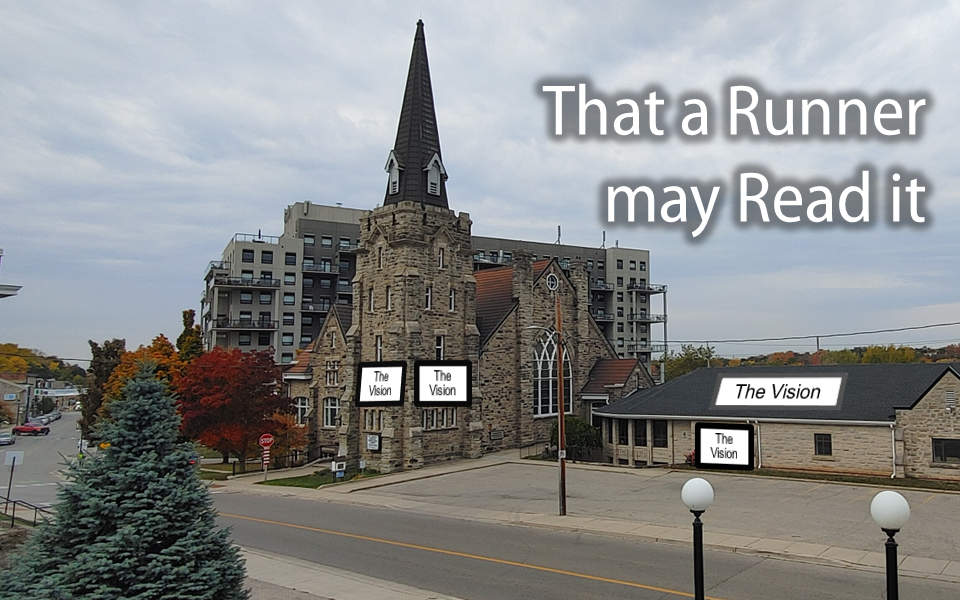
But the first part of God’s answer to Habakkuk also matters because it tells us what we can do while we wait on God. “Write the vision; make it plain on tablets, so that a runner may read it.” And I will admit that that instruction made my mind race. I had images of us setting up huge billboards on the side of our church building that would proclaim our vision in letters so large that not only runners but even street racers and motorcycle clubs driving at top speed would have not a choice but to read it.
There is something about how he puts that that speaks to me. He talks about creating a vision that is so clear and compelling that even somebody who is running past you – someone who was moving about as fast as anyone ever moved in that world at that time – will totally understand exactly what you care about and what you stand for.
And I am not sure how good the church is at doing that today. Are we so clear about our vision that somebody running by at their fastest could capture it? What would such a brief and clear statement be today? I suspect that many of us, if we were asked to summarize in a few words what it meant for us to be followers of Christ, might come up with a few platitudes and maybe some good intentions, but would we really be able to communicate what we stand for?
There was a German preacher, for example, who, in the midst of the worst anti-Semitism of the Second World War, proclaimed that the whole Christian Gospel could be summed up in just one phrase: Jesus was a Jew.
Now, of course, under normal circumstances, that would hardly be a good summary of the gospel. But in those circumstances, when the German Church was not only supporting the rounding up and murdering of millions of Jews but also actively purging the church itself of all traces of Jewish origins and influence, it was a bold statement that immediately communicated what living for Christ meant at that moment in time. It was four words that could totally communicate what a believer stood for even if you only saw them when you were running by at top speed.
That is not the specific message, but it is the kind of message that the church needs to be offering today. In a world where many are defining their faith in terms of who they hate, we need to boldly say that we do not hate. In a world where many assume that Christians are simply people who are intolerant, we need to not be afraid to loudly proclaim our tolerance. We are no longer living in a world where we can just put out a few vaguely positive sentiments and expect that people will admire us for it. It is time for us to write our vision of a better world, of inclusion and hope and love even for the outsiders on a tablet so large and so clear that a runner may read it.
What that specific message might be, I want to leave that to your imagination for a bit. In fact, I would encourage you to write down just a few words on the papers I have distributed today or send me a text or an email. Make it as simple as “Jesus was a Jew” or “God’s love includes Immigrants” or whatever it might be. What is the vision for a better world that we could proclaim so clearly that a runner could read it?
Hespeler, 23 October 2022 © Scott McAndless
Joel 2:23-32, Psalm 65, 2 Timothy 4:6-8, 16-18, Luke 18:9-14 (click to read)
Jesus once told a parable about two men who went to the temple to pray, a Pharisee and a tax collector. And anyone who has ever heard that parable has adopted an automatic dislike for the Pharisee. The thing about the prayer of the Pharisee that really gets to us is that at least half of it is not really a prayer. It is simply a man who is talking himself up. “I fast twice a week; I give a tenth of all my income.”
We all know that anyone who, half the time, can only talk about themselves and what wonderful things they do is absolutely insufferable. That’s the kind of person you avoid at a cocktail party. So I’m pretty sure that, when he included this in the man’s prayer, Jesus was indicating that we are not supposed to like this guy. And, of course, he also lets us know that God is really not all that much interested in listening to him either because the end of the parable implies that God was not impressed with his prayer.
But all of that part where he’s talking about himself, is not really what you would call a prayer, not any more than a situation where someone is just talking about themselves is what you would call a conversation. No, the actual prayerful content comes before that. It is a prayer of thanksgiving, which is normally seen as a really good thing, right? But here is that actual prayer of thanksgiving: “God, I thank you that I am not like other people.” And then he goes on to list all of the objectionable kinds of people that he is not like.
And that is the prayer I would like to focus on today. In telling this parable, Jesus gives us all the signs and indications that we are not supposed to like this guy or what he prays. Most of us wouldn’t really think of that as an appropriate prayer. But I’ll tell you something – it is a prayer that I hear all the time.
Oh, people don’t pray it in so many words, but if you listen to what they are saying, you can often find that prayer in the background of it. In fact, when I think of it, I would say that that Pharisee’s prayer is the fundamental prayer of our time and perhaps of any time. When you know what you are listening for, you hear it everywhere. And, as Jesus strongly suggested in this parable, it is not a very helpful prayer.
For example, one of the major crises we are seeing in our society right at this moment is a housing crisis. More people do not have adequate shelter in our society today than we have seen in a very long time. And it is especially disturbing because it has become so visible. Major cities all across this country, including our own, of course, have large homeless encampments, many right out where everyone can see them.
As a result, the subject of this crisis tends to come up a lot. People are talking about it over coffee or beer. And you know what I hear people saying? I hear people saying, “Oh, that’s just people who don’t want to work.” I hear people saying, “People live in encampments like that because they choose to.”
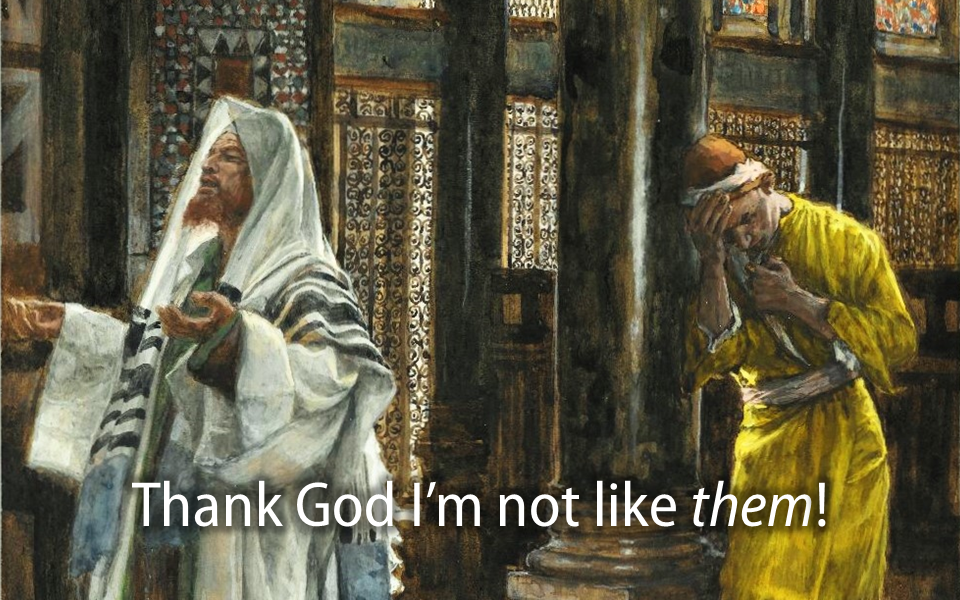
And do you know what people who talk like that are really saying? It is a prayer. They are saying, “God, I thank you that I am not like those other people.” Because, when people look at those who do not have adequate shelter, that is all they see because that is all they are looking for. They only see how such people are unlike them. And so long as that is all they see, that makes them feel very safe because it makes them feel like they will not find themselves in the same situation. So, a person looks at themselves and says, “Well, I’ve always been willing to work, and I don’t want to end up homeless, so obviously such an outcome will never befall me.” Or, in other words, “God, I thank you that I am not like them.”
Of course, the housing crisis is only one of the areas where we react like that. There is an overdose crisis that has been plaguing our cities for about ten years now. This has led to thousands of deaths and near deaths from fentanyl and carfentanyl, pain medications of extraordinary potency. So that is also a topic that often comes up for discussion and I can also tell you what kind of comments you will hear when it comes up. Folks talk about how some people just don’t have any control these days, how people of a certain ethnic group or age group are only interested in indulging themselves and that’s why they get hooked on these drugs.
And people will especially talk about how they never got hooked on tobacco or alcohol or any illicit substance. Or, if they ever were, they’ll talk about how they got off them through their own sheer willpower. And do you know what they are saying when they say such things? That’s right, they are praying, “God, I thank you that I am not like those other people.” They are only interested in how such people are unlike them and cannot see any similarities because they do not look for them.
Here’s what I find particularly objectionable about that prayer. (I suspect that Jesus may have had the same problem with it.) When we pray like that, we are being thankful for something that is simply not true. The people who struggle, whether it be with drug addiction or lack of shelter, whether it be of unemployment or broken relationships or any number of other issues that are plaguing our society today, they are always much more like us than we want to see and so we don’t see it. We don’t see it because we don’t look for it.
Now, looking at the crisis in shelter, I would not say that it is never true that people end up in such a situation because they have a problem with employment. Nor would I suggest that there aren’t some people in shelters or encampments because they have, in some sense, chosen to be there. But I will push us all to consider that the problem is definitely much more complex than that.
Just ask, for example, somebody who is complaining that unhoused people just don’t want to work whether they would hire somebody who had no fixed address and no reliable transportation to get to work. I suspect the answer to that question would be no. So it’s got to be more complex than just a simple desire not to work.
And if some people choose to be unhoused, which some may do, do we ask what other option they might have had? What if the only other option is to be in a relationship where they are abused? What if they know that they are susceptible to addiction and the only living situation available to them means that they will be constantly exposed to drugs? Can you not see where it might be a better choice to be unhoused when those kinds of things are your only other options?
But most of all, any of us who observe the housing crisis from afar likely got into the housing market at a very different time than what people are dealing with today. The prices we were able to pay and the equity that we were able to build up have made us feel much more secure, but do we really think that if we did not have those advantages or if we were just starting out today with housing prices as they are that we would end up all that differently?
And when it comes to addiction, you would absolutely be amazed to see the statistics about who got caught up in the latest overdose crisis. They are not marginalized people in the majority. The statistics indicate that that crisis cut across every demographic of society equally – wealth, race, age and gender. They are just like you, and they are just like me. And, in many cases, the addiction crisis is also how many people who are just like you ended up without shelter because the two crises are connected.
No, when we look at it all openly and honestly, we do have to come to terms with the simple truth that we may not be as unlike the people who struggle with these things as we thought. But of course, we cling to the idea that they aren’t like us because the alternative, frankly, is terrifying. But that makes the prayer, “God, I thank you that I am not like other people,” not just a bad prayer but a delusional one.
But that leaves us with the question: what should we then pray? The realities of this life being what they are, the hard truth is that any one of us could find ourselves dealing with the same kinds of disasters that happen to others. Any one of us could lose our shelter or our wealth or our health as a result of some random conglomerate of disasters or unforeseen events. We can’t exempt ourselves by saying that such things only happen to people who aren’t like us. That is why the Pharisee’s prayer is so unwise. But we need a prayer, for otherwise where can we find hope and comfort?
So let us turn instead to the prayer of the tax collector. Jesus tells us that he went up to pray that day too. And we should not forget that the people in the audience listening to Jesus were very much predisposed to hate the tax collector. He was exactly the kind of person that everyone else was happy not to be like. He was a collaborator who worked with the foreign occupying government. Think, for example, of a Ukrainian working with the Russians in the territory they occupy today. That’s how people saw him.
And yet Jesus tells us that he prayed and not only that he prayed but that God was disposed to listen to him. Perhaps it helped that his prayer was simple: “God, be merciful to me, a sinner!”
But let me tell you something about that prayer. It was brief and humble, but that was not what made it so acceptable to God. I believe that God appreciated its honesty. But its honesty was not found in the notion that this man was somehow worse than everyone else because of who he was. It was honest because it is true of all of us.
I know that we like to insulate ourselves from all of the bad things that could potentially happen to us in this world by thinking that we are somehow better than everyone else to whom such things befall. That is why we pray like the Pharisee. But since we are all much more alike than we dare to think, we cannot take comfort in our own righteousness. Where do we find comfort then? Only in God’s mercy and in God’s grace. Finding comfort in how we are unlike those who suffer is a fool’s errand. Finding comfort in God’s grace is the source of true and lasting peace.
Jesus famously ended his parable of the Pharisee and the tax collector by saying this about the tax collector, “I tell you, this man went down to his home justified rather than the other.” And I know how people often read that. We seem to have learned to read all of God’s promises exclusively in terms of what happens to us after we die. And so I know that many hear Jesus saying that the tax collector got to go to heaven and the Pharisee didn’t.
But I actually think that Jesus was saying something much more important than that. You see, what happens to us after we die, that doesn’t depend on us just following certain formulas or even on us praying certain prayers. That depends entirely on God’s grace. And when the Bible says that we are saved by grace through faith, what it is actually saying is that we need to trust in God’s grace. That is always a wise thing to do. In the gracious hands of God is the safest place you will ever be.
So, Jesus wasn’t making a pronouncement about who would get into heaven and who wouldn’t. He was talking about the kind of prayer that you can pray that will actually assist you to make your way through the various trials of this life. The prayer of the Pharisee might make you feel safe by fooling you into thinking that bad things only happen to people who aren’t like you. But the prayer of the tax collector helps you to face up to the very real and dark side of life in this world, and it lets you know that you need not face it alone – you have a God of grace who loves you as you are and who will be with you.