God With Us
This week's playlist
Continue reading »
Hespeler, 11 December 2022 © Scott McAndless – Advent 3
Isaiah 35:1-10, Luke 1:46b-55, James 5:7-10, Matthew 11:2-11
John had been so sure. He had looked around at what was happening in Judea and knew that it was all wrong. This was, after all, the land that God had given to his people in order to support them as they brought a message of peace and hope to the whole world. It was there to feed their families and their children and allow them to live out their relationship with their God.
But now, though they still lived in that land, it was as if they no longer truly possessed it. The land was in the control of foreign interlopers. And it was those foreigners, together with their collaborators among the people, who enjoyed the riches of a Promised Land that flowed with milk and honey. John knew that that was not what God intended.
There was a biblical model for how the people could repossess the land – the Joshua model. After God had led the people out of the land of Egypt and after they had wandered for a full generation in the wilderness, they finally came to the border. They stood there on the eastern bank of the Jordan River and they looked upon that land in all of its beauty and splendour. Just one barrier remained: the river. Once they had passed it, the real work of possessing the land could begin.
And of course John knew – everyone knew – the incredible story of that crossing, how the Lord had led the people down the banks and into the river. And so holy was the passage of God with the people that the water parted before them, and they came out renewed and cleansed and ready to take possession of the land that God had given them.
And that, John decided, was what needed to happen again. Now, John knew that he was no Joshua. He was not the one to lead the conquest of the land. But he felt that he could do the first part.
And so, he called the people to come out to the Jordan River, and out they came! They came in such numbers that it seemed as if all of Judea and the whole city of Jerusalem had heeded his call. He brought them to the far bank, and he began to re-enact the great crossing. He took them one-by-one down into the Jordan and then up on the opposite bank. They came up from the water renewed and cleansed, ready to possess the land again.
And, yes, it was true that the water did not part before them as it had in ancient times. Instead, they were baptized into the waters of the Jordan. Perhaps the waters would part when the new Joshua came. But in the meantime, John felt as if he had done his part. He had prepared the way.
And now you can perhaps understand why John was so excited, one day, when an extraordinary man arrived at the Jordan. The first thing that John noticed about him was that his name was Yeshua. Someday someone would translate that name into Greek and it would become Jesus, but no one had ever called him that yet. In the local language, Aramaic, his name was Yeshua. The reason why that caught John’s attention was because that was the Aramaic form of the Hebrew name Joshua.
And, as John looked at this Yeshua who stood before him, he could not help but think that he might be the Joshua he had been waiting for – the Joshua who would lead a new conquest of the Promised Land. There was a charisma to him, he had a way of speaking with authority and power. Here was someone who really could command a new conquest.
John had been promising the people who came out to him that, if they went through with his baptism, someone else would come to lead them. This is how he described that leader: “I baptize you with water for repentance, but the one who is coming after me is more powerful than I, and I am not worthy to carry his sandals. He will baptize you with the Holy Spirit and fire. His winnowing fork is in his hand, and he will clear his threshing floor and will gather his wheat into the granary, but the chaff he will burn with unquenchable fire.”
As he looked at this man, Yeshua, John wondered if he might not be that man.
But things did not go very well for John after that. The Romans began to notice what he was doing, and it seemed like insurgency to them – which it kind of was. I guess they didn’t want to bother with him themselves, so they got King Herod of Galilee to take care of him. Herod also ruled over Perea on the east bank of the Jordan where John was operating. Herod didn’t need much convincing by the Romans though. He had heard that John had been saying bad things about his marriage. He gleefully arrested John and threw him in prison.
And it is one thing to believe that God is about to intervene and give your people back their land when you are standing boldly and free on the banks of the Jordan River. But it is quite another to hold onto that hope when you are locked in Herod’s dungeon, when you start to forget what the sun looks like and when you are fed so poorly that you begin to long for the taste of the grasshoppers you used to eat in the wilderness. John began to fall into despair.
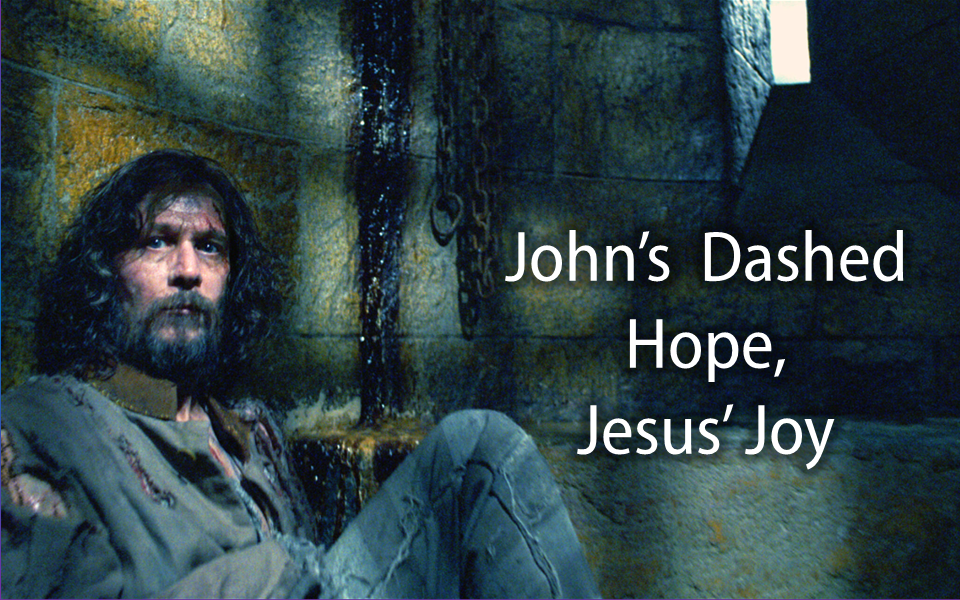
But what particularly bothered him was what he was hearing about this Yeshua. The reports coming back about him didn’t make it seem like was busy clearing threshing floors and burning chaff with unquenchable fire.
Instead of taking on the Romans, he seemed to be spending all of his time helping out the sick, blind and lame. Rather than attacking the wealthy collaborators for profiteering off the occupation, he seemed to put too much effort into reaching out to the poor with encouragement and good news. What kind of Joshua was this? It was naive to think that the Promised Land could be retaken only by such acts of gentleness and kindness?
So John’s hope which he had placed in this man who seemed to have such potential, appeared to be dashed. It was that, more than the darkness and the dankness of his prison that had broken his spirit. If he could believe that that new conquest was coming, that the forces he had prepared in the waters of the Jordan would be led to victory, he would have been willing to put up with anything and even to die without regret. But this uncertainty was killing his spirit.
And that is why, when a couple of his old disciples came to visit him, he sent them to ask. He told them to find this Yeshua and say, “Are you the one who is to come, or are we to wait for another?”
In many ways, I think that the picture we have of John the Baptist in our reading this morning from the Gospel of Matthew is a pretty good picture of where we often feel in the church today. You know, there was a time not all that long ago when the Christian church felt as if it could just take over the whole of our culture and lead us all into a new Promised Land. Like John at the height of his popularity out at the Jordan River, the Christian Church could count legions of people spread throughout our society among its numbers. We had all been baptized and we were sent out to conquer the whole land in the name of Christ.
That was the mission and that is how we often spoke of it. Those were the heady days of Christianity and I know that many people still remember them. Indeed, many still think of the mission of the church in exactly those terms. But the last few decades of the Christian experience have shown us that we may be needing to rethink that mission. And, like John sitting in jail and stewing in his disappointment, we have been feeling a little bit depressed as we watch it.
Over the last few decades, the church has not exactly gone from triumph to triumph. Various abuse scandals in various denominations – and there are none who have been entirely spared this, including our own denomination – have certainly tarnished the reputation of the church in the eyes of many. How can the church be part of a glorious conquest of society if it has been shown to be so very flawed?
And, of course, alongside of that we have seen that the continual growth in numbers of Christians has leveled off and fallen into decline. This, also, is something that has struck across denominational lines. I know you may have heard that it was just the mainline and liberal churches that were in decline, and that may have been true for a while. But most recently that decline has spread to the more conservative and fundamentalist churches as well. In the most recent years the decline has been right across the board.
I know there are always a few exceptions here or there, but the overall trend is pretty clear. Recent census reports showed us that, for example, Wales and England are no longer majority Christian countries. You can bet that many other countries are about to follow that trend. And it is not particularly because of immigration or the growth of other religions, though that has been part of it. In fact, the fastest growing religious group around the globe has consistently been that group who claim no religious identity whatsoever.
What do we do with that as believers living in our society today? I suspect many of us, just like John, have fallen into all kinds of doubts and questions. Is this the movement that we were promised? Where is the promise of the triumph and continual growth of the church that’s going to transform our society? And so, like John, we would like to send to Jesus and ask, “Is this what you promised would come, or should we be looking for something else?”
And this is where Jesus’ answer to John is, I think, exactly what the church needs to hear today. When John asks Jesus where is the proof that he is the fulfillment of all of God’s promises, Jesus doesn’t point to the kind of success that John experienced on the banks of the river. He doesn’t point to the size of his crowds, even though, of course, Jesus had drawn a number of disciples. The answer that Jesus sends back is this: “Go and tell John what you hear and see: the blind receive their sight, the lame walk, those with a skin disease are cleansed, the deaf hear, the dead are raised, and the poor have good news brought to them. And blessed is anyone who takes no offense at me.”
What is the sign that we are part of what God is doing in the world? What is the sign that God is creating the conditions that bring about the kingdom? Only this, that the people who are living on the margins of society, the people whose plight is often forgotten by those in power, are experiencing healing and hope even when things look bleak. And if we, with our outreach and efforts to care for the people around us, are part of that work, then we are part of the kingdom. This is the work that God calls us to do. These are the signs of his kingdom. That is what Jesus is saying.
And yes, I do believe that if we do that kind of work with integrity, we will draw other people to join us, and our numbers will have an impact on society. But things like the overwhelming growth in numbers and attendance, these are not the proof of the coming kingdom. If we keep to the work that God has given us to do, we can count on God taking care of the rest.
Jesus does include the subtlest jibe at John the Baptist when he ends his answer by saying, “And blessed is anyone who takes no offense at me.” People will take offense if we concentrate on reaching out to the poor and marginalized. They will say that that is not what victory for God’s kingdom is about. But they are wrong, and I would rather claim God’s blessing on our work by continuing to reach out with whatever resources our God places in our hands.
My friends, we ought not to despair for the future of the church. That is in God’s hands and that is always the best place for anything to be. And so long as we continue in that work, I believe we will find the joy that Jesus found in the work that he was doing, joy that can penetrate even the darkest prison.
Hespeler, 4 December 2022 © Scott McAndless – 2nd Advent, Communion
Isaiah 11:1-10, Psalm 72:1-7, 18-19, Romans 15:4-13, Matthew 3:1-12
Today is the Second Sunday in Advent and on this day we traditionally light the candle of peace. And that is why it seems so fitting that we should read a passage from the Book of Isaiah which puts forth an amazing vision of world peace: “The wolf shall live with the lamb; the leopard shall lie down with the kid; the calf and the lion will feed together, and a little child shall lead them… The nursing child shall play over the hole of the asp, and the weaned child shall put its hand on the adder’s den. They will not hurt or destroy on all my holy mountain.”
Think about what that is saying. When we talk about peace, we usually focus on ending human conflict. We think of negotiating some sort of cease-fire or even a peace treaty between, say, Russia and Ukraine. We’ll talk about settling things like labour strife by negotiating an end to strikes or job actions.
Or, on a much more personal level, when we talk about peace, we think about eliminating all sorts of conflicts from our life. When no one is arguing or doing things that are upsetting everybody else, when everyone appears to be getting along, we call that peace.
But isn’t it interesting to see how the vision of peace we get in the Bible goes so much further? Any peace that is able to be found in the human sphere apparently overflows humanity to infect the whole of creation. And so, we see natural enemies like wolves and lambs and leopards and kids lying down in safety. Even the longstanding enmity between legless reptiles and humanity is apparently set aside and it is suddenly safe for children to play around poisonous snakes without fear.
I think this is saying something very powerful. It is saying that peace is about more than simply human concerns, that it is about healing and wholeness for the whole of creation.
You may have heard that the Hebrew word for peace is shalom. But what you might not know is that shalom doesn’t just mean that there are no hostilities. It comes from a Hebrew root that refers to peace, but also harmony, wholeness, completeness, prosperity, welfare and tranquility. Shalom means all of that. It is about the whole universe coming together to find purpose, meaning and completeness.
And that, my friends, is very much the kind of peace that we are desperately in need of in our world today. It is true that many different kinds of conflict are raging in our world today – a war in Ukraine, riots and dissent in Iran and China, labour battles here in Canada. There is also a great deal of tension over issues concerning the environment, the wealth gap and more in society.
On a personal level, I know that many people are dealing with enormous stresses in their lives that make everything feel anything but peaceful. So, isn’t it about time to create the peace that heals the whole world?
And, fortunately, our reading from Isaiah tells us about how such an ideal state of peace can be established. It all starts with a shoot. “A shoot shall come out from the stump of Jesse, and a branch shall grow out of his roots.”
Now, Jesse is the name of the father of King David. So, if a shoot is growing from the stump of Jesse, what that means is that somehow the house of King David has been going through some hard times. It has been, in some sense, cut off. It’s hard to know exactly what this is meant to refer to, but I assume what it means is that the prophet has been somewhat disappointed with the kings of the House of David when he gives this prophecy. He feels as if the main tree of David’s line has been cut down in some sense.
But, he says, this new shoot – a new and different kind of king – is about to burst out of the wreck of the Davidic royal line. And when this ruler comes, he will bring about the incredible reign of peace that is described in this passage.
And who is this shoot of Jesse? Most Christian readers will say that it is an obvious reference to Jesus, the Christ. That’s probably not who the prophet initially thought that he was talking about. He was probably very hopeful that such a child would be born to the House of David in his own day.
But there is something about this figure that he imagines that transcends expectations about what an ordinary political figure can accomplish. It’s not at all surprising that this passage became associated with the idea of a coming Messiah.
For it is this shoot who will accomplish the incredible peace that is described. And the very important question is how will he accomplish that. Because I’m going to tell you how we often assume that peace is made. As I said before, we often work from a definition of peace that sees it simply as a lack of conflict.
In international affairs, this is often achieved by placating, in some sense, the most powerful actors. For example, after Russia first invaded Ukraine in 2014, you might say that a certain peace was achieved when Russia annexed the Crimean Peninsula. The powerful, belligerent Russia was placated and so there were no more open hostilities between Russia and Ukraine for many years. We often call that peace in this world.
And you probably see the problems with that practice of peacemaking. One of the biggest ones being that it obviously didn’t last. And this year Russia came back looking for more territory, seeking initially to annex the whole of Ukraine and plunging Europe and the whole world a lot closer to the dangerous precipice of open war. So, was that armistice in 2014 really peace? I don’t think so, but it is often the only peace we feel we can hope for.
This is not just true of international matters either, by the way. I think this is something that we often do in our personal lives. Because we operate on this idea that peace is a lack of conflict, many of us have dedicated ourselves to avoiding conflict in our lives at all costs. But avoiding conflict is not the same thing as embracing peace.
I sometimes catch myself doing this and I’ll bet you do too. When you know that a certain topic is going to lead to an argument, you just avoid that topic. When you see someone and you know they will have a complaint or be upset with you, you just avoid talking to them. When things get heated, you change the subject of conversation or maybe even just leave the room.
These are all methods of avoiding conflict, and there are certainly times when they can be useful strategies, but never make the mistake of thinking when you are doing such things that you are creating genuine peace. For that, let us look instead to the example of this shoot of Jesse and what he does in order to bring about the extraordinary peace that is described in our passage.
“His delight shall be in the fear of the Lord. He shall not judge by what his eyes see or decide by what his ears hear.” This is, of course, the classic image of blind justice. It is why the most common image for justice even today is a woman holding scales and wearing a blindfold. It is a powerful image that means that justice must be administered in a way that is fair.
Justice wears a blindfold so that she is not influenced by the race or wealth or power or standing of the people who come before her. If she were to look at these things, she would decide in favour of the powerful and important. But instead, she must decide what is right.
Of course, when we are oriented towards a peace that is merely a lack of conflict, this is exactly what we are not going to do. The easiest way to avoid conflict is to allow the powerful or the noisy people to get away with whatever they want. The shoot of Jesse intentionally does not look at any of these things and so administers a justice that is untainted. So equal justice is essential to the creation of true and lasting peace.
But that is not the whole story. The shoot of Jesse actually goes further than to administer equal justice. Isaiah goes on to say this: “But with righteousness he shall judge for the poor and decide with equity for the oppressed of the earth; he shall strike the earth with the rod of his mouth, and with the breath of his lips he shall kill the wicked.”
This does suggest more than equal blind justice. For we are told that he judges for the poor and decides for the oppressed. He also seemingly takes into account the wickedness of those he judges and not just the case that they have.
In some ways, this would appear to be a contradiction against the blind justice that has just been described. The shoot of Jesse is playing favourites! But I would suggest to you that what is being described here is a deeper commitment to equal justice.
It is a recognition that, if people are poor or oppressed, it is often because they have many invisible forces working against them. It recognizes that there are structures in society that keep people in poverty no matter how hard they might work as individuals. It recognizes that subtle racism or sexism or other prejudices can be at work to keep people in situations where they are oppressed or prevented from flourishing. It suggests a justice that seeks to redress such deep underlying issues.
And obviously it can be very difficult to strike a balance between dispensing equal justice to all and seeking to address structural injustices that are bigger than the individual cases that may come up. I don’t think any nation has ever managed to get that balance quite right.
But Isaiah suggests that the shoot of Jesse does. He refers to the blindness of justice first so that suggests that we must strive to serve equal justice first. And yet, in that priority, we must still find ways to create justice for the poor and oppressed.
The care we need to take to create a system that balances all of that out is something that we will need to constantly work on, but the overall principle that is at stake should not be missed. This passage is about the creation of the kind of justice that leads to peace in this world.
And, yes, perhaps the ultimate peace that it describes will elude humanity – at least until Christ shall come. But that should not prevent us from getting as close to that peace as we humanly can. And the message of this passage is clear. If we aspire to achieve such peace, we cannot settle for merely avoiding conflict.
Conflict is sometimes unavoidable if you are going to do what is right. It is certainly going to be inevitable sometimes when you are standing up for a person in the minority or someone who is marginalized. You will have to enter into conflict of some sort if you are going to resist someone who is determined to exploit or oppress others.
Now all of that might not feel very peaceful. Sometimes making sure that what is right and just is done can feel very much like the opposite of peace. But remember always what the goal is. The goal is not just to avoid conflict but to create shalom which includes harmony, wholeness, completeness, prosperity, welfare and tranquility for the entire universe.
None of that can happen without justice and fairness for all. And that is something that is worth struggling for.