Family Playlist
For families this week
Continue reading »
Watch the Youtube version here: https://youtu.be/2U4g5WlUjgE
Hespeler, September 18, 2022 © Scott McAndless
Jeremiah 8:18-9:1, Psalm 79:1-9, 1 Timothy 2:1-7, Luke 16:1-13
The parable of Jesus that we read this morning from the Gospel of Luke is one that has troubled many readers down through the centuries. How many people have read this parable, put it down and said, “Why on earth is Jesus praising the manager in this story who starts out being merely incompetent at his job and then goes on to apparently swindle his master on behalf of his master’s clients by forgiving their debts to him?”
Not only is it strange to think that Jesus would have praised a man for doing such a thing, he even says that the master himself, the man who was swindled, praised him too. “And his master commended the dishonest manager because he had acted shrewdly.” Who praises a robber for robbing them shrewdly?
And it seems as if the author of this gospel has about as much trouble with the parable as we do. He tries, as he often does, to sum up the parable with a kind of moralistic lesson. He just throws out a bunch of morals for this strange story that may sound pious but don’t make much sense. He finally ends up by saying this: “If then you have not been faithful with the dishonest wealth, who will entrust to you the true riches?” I mean, what does that even mean?
So, what I think has happened is this. Luke received this parable. It was handed down to him by Christian tradition and he felt certain that Jesus had told it. So, he felt he had to include it in his gospel. But he didn’t really get it, possibly because he didn’t adequately understand the cultural context in which Jesus told the parable.
But, if that is what happened, we are even further removed from that context than the author. So, what hope could we possibly have of making sense of this very disturbing parable? Well, perhaps some recent events have brought us a little bit closer to that ancient cultural context. So, maybe, if we just play around with Jesus’ story a little bit, we might find that it makes more sense than we originally thought. Would it make more sense if Jesus told the parable with these modern characters that we can relate to?
Once upon a time there was a very powerful and rich country that decided to hire somebody to be the manager of all their affairs. He was the chief executive, the president if you like. Now, they didn’t choose this man because they loved absolutely everything about his policies and his past work history. There were some issues. But he just seemed like the better option when compared to the man who had held the office before him, so they decided to give him a chance.
But this president’s time in office was pretty rocky almost from the start. And a year or maybe a year and a half into his tenure, many in the country were beginning to feel as if their affairs were being mismanaged. I won’t go into all of the things that were going wrong, but let’s just say that inflation was out of control, businesses were unable to get workers, a terrible virus continued to cause death and sickness, forest fires raged and hurricanes threatened.
And so, the polls put the president on notice that he was bound to lose power. The people would overwhelmingly vote for his opponents in the upcoming midterm elections and things were definitely not looking good for his own re-election down the road.
And so, the president said to himself, “What will I do now that my country is taking the position away from me? I am getting a little bit old, Jack. I am no longer strong enough to dig ditches, and my voice and elocution is not good enough to make money narrating documentaries on Netflix.
“So, I have decided to do something that will make people love me and maybe even welcome me back into their homes and hearts again.”
And so, this is what he began to do. He called in one by one the people in the country who had gone to school and who had large debts that they owed as a result.
One woman[1] came in and she said, “I went to school to get a professional degree. To do that, I needed to borrow about $30,000. But I now owe almost $120,000 due to compounding high interest and income-based repayment programs that only drove my principal higher and higher even when I never missed a payment. I’ve paid a fair amount over the years that has done nothing to decrease my balance.
“I have been a hard-working professional all my adult life. The government has collected far more in taxes (which I’ve paid cheerfully) than the cost of my education, yet still, I owe four times what I borrowed.
“I was 17 years old when I entered the student loan program as a college freshman,” she continued. “I had no experience with lending. I thought I was doing the right thing by attending college and trying to lift myself out of generational poverty. Instead, I wound up further in debt, with death or permanent disability being the only way I’ll ever get out of it.”
Another student came in and told the president a story in terms of very simple and succinct numbers. “My original debt, when I first graduated, was $25,170.50. In the 21 years since I have graduated, I have repaid $45,650.19. Today, thanks to the wonders of compound interest, I still owe $34,713.11 on that same loan.”

The stories went on and on. The numbers varied, of course. Some were large, some were relatively small, but in so many cases the debts that these people still carried had had a huge negative impact on their lives. And so, the president went to the first person and said, “Here, take your account and where it says that you owe 120,000, write down 60,000 instead.” And to the second he said, “Where it says that you owe 35,000, write down 25.”
And so, he went from one debtor to the next providing relief that was maybe not huge and maybe not sufficient in every case, but at least it made some difference in each person’s life.
And what was the reaction when the president did these things? Well, there is no doubt that the reactions were mixed. There were certainly some who said that it was not enough. That it was too little to really help some who needed it most. Others complained that to offer such forgiveness was completely unfair and unjust to those who, in previous times, had managed to pay off their own debts with hard work.
But there were certainly some for whom this began to change their perspective on what had seemed to them to be a failed presidency. Some even began to praise the president, or, at the very least, they had to admit that he was a much more shrewd politician then they had perhaps given him credit for.
I assume that many of you have followed the discussion about the forgiveness of student debt in the United States. It has been all over the news and connects to some similar issues in Canada. But I wanted to tell this story of recent developments around the issue in the United States for a very particular reason this morning.
It is not because I want to make a political point or endorse a political position. I do have my own political beliefs about the forgiveness of student debt, but I’m not here to push them. I just wanted to bring it up because it seems to be an issue that everybody has opinions on.
And there are wildly different opinions. Some will declare the forgiveness of such debts to be terrible and unjust while others will say the same thing about the debts themselves. This is actually not very surprising because we are talking about a load of debt that, collectively, is so large that it affects the entire economy. Student debt is totally connected to the inflation crisis, the housing crisis and the employment crisis. These are things that affect us all.
And so, if you hear me tell a story about a president forgiving debts to students in our present context, everyone immediately knows exactly what I’m talking about. Not only that, they also immediately have strong opinions about it.
And I wanted you to understand that, when Jesus told the story about a manager who was forgiving debts that were owed to his master, the reaction would have been almost exactly the same. They all would have known immediately exactly what he was talking about. And they all would have had their strong but various opinions about it as well because Jesus told this story in a very similar situation.
Galilee at that time had a debt crisis. It wasn’t a student debt crisis; it was spread throughout society. People everywhere were being crushed by their debts. They were losing their family homesteads, being pushed into homelessness, begging, marginal labour and even slavery.
This was also complicated because, according to the ancient laws of Israel, debt was actually illegal. The laws of Moses were quite clear, lending at interest was simply not permitted. And yet, in Palestine in Roman times, it was found everywhere. How could that be? Well, when money is involved, it seems that people are infinitely creative. So here is what they did.
When someone was in a desperate state and needed to borrow, say, eighty bushels of wheat, they would go to rich people and beg for their help. And the wealthy would help, but, as is often typical, they also wanted to know what was in it for them. They wanted interest, but they couldn’t legally demand it.
So here was what would happen. When the manager wrote down the debt, he wouldn’t write, “I owe you eighty bushels plus 25% interest.” No, that would be illegal! No, instead the manager would write down, “I owe you 100 bushels,” even though the poor person only received eighty. There would be no mention of interest, no paper trail so nobody broke the law, right? Only the manager, the master and the debtor knew what had really happened.
Except, of course, that everyone knew exactly what was going on. They just couldn’t prove it because there was no paperwork. But Jesus told this parable to illustrate the vulnerabilities of rich people in this system. Basically, their managers had all the dirt they needed to bring them down. So, when a manager falls out with his master, all he has to do is go around to all of the people who owe his master and rewrite the records of what they owe.
Everyone who heard this parable would have understood that this was what was going on. The manager wasn’t robbing the master of anything but the illegal interest that he had charged. And the best part, of course, was that the master couldn’t do a thing about it. To punish his crooked manager, he would have to admit that he was charging interest which was illegal. So, he really had no choice. He actually had to praise him.
And I can just imagine the press conference. “Uh, I would just like to thank my blessed manager for, um, uncovering the egregious and totally unintentional errors in my financial records and restating the correct amounts that these people owe me. I will be eternally grateful to him.”
So, really, everyone who was listening to Jesus tell this parable would have understood exactly what it was about. They would have understood that it was about forgiving interest on debts. They would have understood exactly how the shrewd manager managed to get away with it.
So, why did Jesus tell them this story? Was he trying to press them to take a certain position on the forgiveness of debts and what it could do? Possibly. But he may have also just been trying to tap into all of the conflicting thoughts and ideas and opinions that were swirling around at that time. Jesus told his parables, above all, to be provocative, to make people think about the things that they had been trying to avoid thinking about.
That’s why I think that, maybe, what Jesus is looking for us to do right now is not necessarily to embrace any particular party’s policy on the issue of debt, but he is asking us to think and think carefully about what we do with the debts we make people carry. He wants us to think creatively about what we can do about the burdens and the harm that they can cause. He is pushing us to at least think about what we can do to address a huge problem that affects us all.
[1] These are based on real stories found at studentdebtcrisis.org
We invite everyone to check out our weekly playlists. You will find bible stories and readings, activities and music here.

Hespeler, 11 September 2022 © Scott McAndless
Exodus 32:7-14, Psalm 51:1-10, 1 Timothy 1:12-17, Luke 15:1-10
There are a couple of things that are deeply disturbing about our reading this morning from the Book of Exodus. The first is kind of obvious. We have the image of a God who has just saved a people from lives of slavery and hardship and made them God’s own people. And yet we see this same God choosing to devote the whole lot of them to genocidal destruction. “I have seen this people, how stiff-necked they are.” God says to Moses, “Now let me alone so that my wrath may burn hot against them and I may consume them, and of you I will make a great nation.”
And I realize, of course, that the people of Israel have definitely messed up at this point of the story. God has set before them, in the form of a commandment, the requirement that they must have no other gods before Yahweh. And yet they have created an idol and declared that they trust more in this idol to save them than in the God who has brought them out of Egypt.
So, it is definitely not as if they have done nothing to deserve God’s anger with them. But you have got to at least wonder whether the punishment – complete annihilation – fits the crime. Is total destruction justified?
Could you imagine any authority figure whose temper was so severe that, if someone showed them a little bit of defiance or failed to follow an instruction, their outbursts of rage killed people? I think that if we saw anyone responding to disobedience in that way, we would find it to be not just unacceptable but criminal. And yet this is the reaction that we see in God.
But remember what these stories are there to do in the Bible. These are stories that were written by people who were struggling to come to terms with their experiences of God. They were people who had lived through all kinds of troubling circumstances and yet came out of them with the conviction that, somehow, their God had been with them as they passed through those difficult times.
And, pretty clearly, this story was told by people who were disappointed with themselves. They knew that they had failed, that they had not lived up to what God expected of them and they believed they were coming face to face with the consequences.
Most of these stories of the wandering of the people of Israel in the wilderness actually came to be written down while the people of Israel were coming to terms with their defeat and exile by the Babylonian Empire. They were asking themselves why God had allowed such a terrible thing to happen to them and had concluded that it was because they had failed to live up to God’s expectations.
Since they had decided that they must have deserved all of the bad things that had happened to them, it made sense to tell a story about a God who was angry with them because that was the only way they could make sense of the things that they were living through.
That is actually something that we all do. Today is the anniversary of the events of September 11, 2001. How much energy has been spent in the last twenty-one years trying to make sense of that disaster and why it happened?
We all have a deep need to make sense of the tragedies that we have experienced. Accepting that we may be somehow to blame for it is one of the ways that we do that. Strangely, this can actually be a comforting thought. I mean, it doesn’t feel good, of course, to blame yourself, but at least it feels better than the alternative which is to think that tragedy just happens for no reason at all. That seems frighteningly chaotic.
This story was told by the people of Israel when they were at a particularly vulnerable moment. Bad things had happened to them, and they needed to understand why. Recognizing their own failure, they needed the image of a God who could not only be angry with them, but who could also be so angry as to consider wiping them out entirely.
They found this to be a comforting image of God because what was the alternative? The alternative was a God who had let such terrible things happen to them out of neglect or disinterest. And so, yes, they did find something oddly comforting in this story because it at least showed that God cared.
But please understand that this does not mean that that was therefore a complete and entirely correct image of God. It was just people trying to make sense of what they were experiencing of God at that moment. That is always a work in progress.
They are also not the only ones to do this kind of thing as they seek to come to terms with God. I am sure that many of you have known people who have lived through some terrible tragedies in their lives. Perhaps they have come out of abuse or addiction. Maybe they have made some deeply troubling choices that led them into dark paths or maybe they have been deeply damaged by others.
I have noticed that, in the initial phase as they try to heal from that kind of hurt and create some sense of order and morality in their life, it is not uncommon for people to embrace an image of a God who is rigid, inflexible and who has a sense of justice that is hard to satisfy. There is, in such an image of God, something that is deeply helpful to people who are trying to heal in that kind of circumstance.
At the same time, that does not mean that they should remain with that one image of God ever after. In fact, if they are going to mature spiritually, their understanding of God will necessarily change as they do so.
Which brings us to the second troubling thing about this story in Exodus. When God tells Moses that God intends to destroy the people, Moses talks God out of it.
Moses does this by saying. “Don’t you have a reputation to maintain? Here you have saved this people from the Egyptians and made them your own. If you destroy them now, the Egyptians are going to have a field day! They will make fun of your failure to follow through. And what’s more, what of all the promises you made to these people's ancestors? Won’t that reflect badly on you if you break your solemn promises?” And so, God is persuaded, one might almost say shamed, into changing God’s mind.
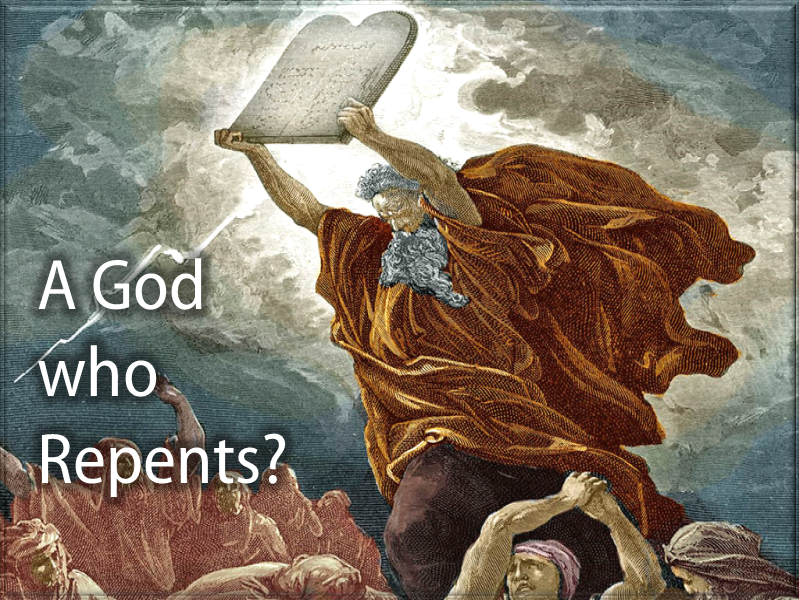
And that has caused a certain amount of consternation for many Bible readers. “Isn’t God…. God?” They may ask. “So how can the mind of the eternal, unchanging and immutable God be changed?” They might even appeal to scripture itself. After all, does it not say in Numbers 23:19, “God is not a human being, that he should lie, or a mortal, that he should change his mind. Has he promised, and will he not do it? Has he spoken, and will he not fulfill it?”
This story in Genesis is even more troubling in some older translations that translate the concluding verse, quite correctly, as “And the Lord repented of the evil which he thought to do unto his people.” Somehow the word repent, though it essentially means the same thing, feels even more uncomfortable when applied to God!
People have long struggled with this part of the story for that very reason. It seems to be saying something about God that is deeply troubling. Some people have tried to explain it away by saying that God never really intended to destroy the people, that he was only testing Moses.
But I don’t think that such an explanation takes this scripture seriously. I think that this story is saying something important about the nature of God and to explain that meaning away is to rob it of that power.
Remember how I said that this story functioned for the people who told it? It is a story that people told because they were struggling to come to terms with a terrible tragedy that they had lived through, and they were wondering where their God had been in it. They made sense of that by embracing a view of a God filled with righteous anger who would justly destroy his people for their failures and shortcomings.
Such a view can be comforting when you have lived through a trauma. But that’s not the best place to end your spiritual journey, it really is just the beginning of a process of understanding God.
So, what we also see happening in this passage is a people who have been surprised by God’s mercy and grace. They have experienced tragedy which has brought them into a recognition of their failure to themselves and to their God.
But, just as they have recognized that they may be worthy of destruction, they have also recognized that God has not destroyed them, that there may yet be a path to redemption and hope for them. And the best way for them to make sense of that is to see that God had every right to wipe them away because of their failures, but that God thought better of it.
This story is not actually about the changeability of God. There is actually something that is deeply unchanging about God in this story because the reason why God ultimately changes God’s mind is because of God’s longstanding commitments to this people.
To act out the wrath of a moment would be to forget the long-standing covenant that God has made with them, promising to be their God and claiming them as God’s people. No, this is not about God changing but rather about God defaulting to God’s truer self and deeper commitments.
It is not really God who changes in this story, it is the people who see their understanding of God change and grow. Once they were living in the Promised Land and they maybe took God’s faithfulness to them for granted. But then they lost the Promised Land which confronted them with the reality of their own failures to live up to the commitments they had made.
Thus was born in them the fear of a vengeful and angry God who wanted to wipe them away. It was, perhaps, a helpful thing for them to believe in that moment of trauma.
But their journey of discovery of who God did not end there. For there, in the land of exile, they met a God who had not forgotten the covenant and whose commitment to them as a people would remain firm despite their failures. In the moment of their greatest fear, they met a God of grace. And it may have been disconcerting and distressing to have to shift their understanding of God in that moment, but it also greatly deepened their experience and understanding of their God.
We might be able to learn a great deal from the people who told this story. We too seem to be living in an era when we are coming to terms with our own failure as a people. We are waking up to the uncomfortable truth, for example, that we have not cared for the earth that God has given to us because we have not learned how to live upon it in a sustainable way.
And the sad truth is that we are now living with the consequences of those failures. Extreme weather events, massive forest fires, floods and famines and at least some of the diseases that have been plaguing us are consequences of some of the ways in which we have failed to live well upon this earth. And some are beginning to wonder, to fear, that we might well be wiped from the face of the earth as a consequence of our failure.
The ancient Israelites gathered up those kinds of fears and personified them in the form of an angry God facing off with Moses on Mount Sinai. We, as modern people, may not turn it into that kind of story, but the fear of consequence that we are living with is nevertheless quite real.
It is a good thing that we are coming to terms with our own failures as a collective human race. And if we are reacting to that with fear in guilt driven action, that might be the start of something better. But I’m not sure that’s the end of the spiritual journey we are supposed to be on right now. I hope you don’t just stay with the image of an angry God who is ready to wipe us out. Our spiritual journey of discovery has only begun.
I hope you hold on and continue to argue with God – like Moses argued with God on the mountain – because there is another, deeper truth about who God is. God is more than just an angry God intent on punishment. Jesus came to introduce us to a God of compassion and sympathy – a God who understands what it is to be human. Press on, despite the challenges, to know that God. In the very nature of that God is great comfort and actually the best hope that we have for a faithful future.
Hespeler, 4 September 2022 © Scott McAndless
Jeremiah 18:1-11, Psalm 139:1-6, 13-18, Philemon 1:1-21, Luke 14:25-33
The letter of Paul to Philemon is unique in the New Testament. It is the shortest of the letters of Paul, but other things set it apart too. While the others are addressed to entire churches and all are focused on the matters of church life, this one is really only focused on one individual, on Philemon, and it is seeking to resolve a personal matter between the two of them – a matter of property.
Philemon, who was a leader of the church that met in his home, was also a relatively prosperous man. The measure of prosperity, in that ancient world, was defined by one thing: the ownership of slaves. A poor person in ancient Rome was someone who couldn’t even afford a single slave so Philemon, apparently, must have owned several. One of them was named Onesimus.
Does it surprise you that an early Christian leader was also a slave owner? It probably shouldn’t. The idea that good Christians could own slaves is taken for granted in much of the New Testament. When the topic comes up, New Testament writers never condemn the practice, though they do advocate for good and fair treatment of slaves.
But at least Philemon must have been a good master – one who treated his slaves well, right? You might hope so, but Onesimus doesn’t seem to have thought so because he ran away.
Onesimus, by fleeing, became a thief and an outlaw. He also became stolen property. So, I can’t imagine that he did it lightly. He must have had a good reason to run. Being a slave of Philemon couldn’t have been a great experience. Though he was a church leader, that apparently did not mean that Philemon lived out Christian ideals in every relationship in his life. Sadly, he is hardly the last church leader to have had that particular problem.
The occasion of the letter is that Paul has become acquainted with this fugitive slave. In fact, Onesimus has become a convert to faith in Jesus under Paul’s influence. But, now that he knows he is stolen property, Paul has a legal obligation to send Onesimus back to his owner. What we have in our Bibles is a copy of the letter that he writes and places in Onesimus’ hand to give to Philemon on his return.
In this letter, Paul pulls out every trick he can possibly think of to persuade Philemon to grant Onesimus his freedom when he returns. And the mere fact that Paul puts so much pressure on him suggests that Philemon needed a lot of persuasion.
That is where the attention is usually placed when people read this letter, on Paul’s persuasion. But I have always wondered about Onesimus. Even if the title of this letter is, according to tradition, the letter to Philemon, it is the letter about Onesimus. The mere fact that this letter made it into our Bibles tells us something about God’s priorities. So, who was Onesimus?
When he was born to a female slave in Philemon’s household, his mother, who was a Judean by birth, wanted to call him Simon. It was a common name in her family. But Philemon wouldn’t hear of it. He preferred it if his slaves didn’t have too strong a sense of personal identity and he didn’t like for them to feel a strong attachment to their ethnic heritage either. He wanted them to see themselves as belonging primarily to the household and he wanted them to understand that their value was found in one thing only: their utility to him. So long as they were helpful and beneficial to him, fine, but the moment they weren’t, they became disposable.
So, Philemon looked at the little baby that his mother wanted to call Simon and he said no. No, this one would be called Onesimus. It was not a name, not really. It was an adjective. It meant “useful.” Anytime anyone used it for the rest of his life, Onesimus would be reminded that there was only one thing that gave him any value or meaning. He was there to be useful.

Onesimus never allowed to forget it. As soon as he was old enough to contribute, in any way, to the household or the comfort of his owners, that became the entire purpose of his being. As paterfamilias, Philemon had the power of life and death over every member of his household. He certainly had the right to employ corporal punishment for any reason. I’m not saying that Onesimus was constantly beaten. It was just that he was never allowed to forget that beatings were possible.
But more than the fear of punishment, he grew to resent the narrow definition of his value of which he was reminded every time he heard his name. He couldn’t help but wonder if there was more worth in him than whatever usefulness his master found.
One day, something changed in Philemon. He encountered a traveling preacher named Paul and became a believer in someone called Christ Jesus – a man who Paul said had been raised from the dead and who reigned in heaven at the right hand of power.
Coming to believe in Christ and becoming part of the church didn’t really make much difference to Philemon’s treatment of Onesimus though. When someone has been conditioned all their life to think of a slave as little more than a useful object, it is not a pattern of thinking that is easily changed.
Onesimus was glad, he supposed, that his master had found something that gave a sense of meaning and purpose to his life, but where was there anything like that for Onesimus? He was so convinced that there was something more for him, something beyond mere usefulness to his master, that he simply couldn’t bear it anymore. He saw his opportunity and he took it. Onesimus ran for freedom.
Once he was free of the household, there was something exhilarating about being responsible for the course of his own life. He could scarcely believe that he didn’t need to be useful to anybody and yet he still existed. But, at the same time, the life of a fugitive slave was filled with many pitfalls. It was not easy to find work. Who would hire a man who had to constantly keep on the move, who was always looking over his shoulder?
Onesimus quickly found that he had to resort to petty theft just to survive. That is how he came to be caught while thieving and, while the authorities were trying to figure out where he properly belonged (for Onesimus was not about to tell them where he had come from) he was placed in detention.
Imagine his surprise when he found himself incarcerated alongside the very man of whom his master had not ceased to speak ever since he had first met him. There, right beside him, sat Paul of Tarsus. And, to tell the truth, Onesimus was not particularly impressed with the man at first. What he had heard from his master had led him to believe that Paul was just like everybody else, that he had won Philemon over by flattering him for his wealth and his ownership of so many other human beings. But, as he came to know Paul, he started to realize how wrong that initial impression was.
Over the following days and then weeks, Onesimus learned a great deal about the Jesus that Paul preached. One thing stood out to him. Paul taught him that, when Jesus was raised from the dead, he transformed the previous structure of this world. In particular, Paul said that if anyone was in Christ Jesus, that person became a completely new creation. Everything old had passed away; all had been made completely new.
Even more stunning, as far as Onesimus was concerned, was the church that Paul said had been created because of Christ. It was, he said, like a body in which every member could play a vital role. He also said that when all were one in Christ, there was no longer Jew or Greek, there was no longer slave or free, there was no longer male and female. The more Onesimus heard about this church, the more he felt as if it could be, for him, a place where he could find himself, where he could truly belong. Onesimus began to look to this Christ Jesus to save him.
The more Onesimus remained with Paul, the more he saw him not only as a teacher and preacher, but also as a father – the father he had never had and the father that Philemon had certainly never been to him. And, as that bond was formed, something very strange began to happen. He started to feel a deep desire to be useful to Paul – to serve him in ways that would allow him to pursue the important work he was doing.
I am not sure you understand how significant such a thing was to one such as Onesimus. For him, his usefulness had always been his only currency – the only thing he could offer to justify his existence. It was an obligation, an imperative. And so, he had always experienced it as something that drained him of energy and of identity. But now, with Paul who treated him like a son and did not require that he be useful in order to be loved, Onesimus felt filled with the desire to be useful to Paul in whatever ways he could. Even in the menial tasks he performed, tasks that had once only irritated him, he found a sense of meaning and of purpose because he offered them freely.
Onesimus came to feel that there should be nothing that he could hide from Paul, and so he did reveal to him what his status was. Paul actually laughed when he discovered that he knew Onesimus’ master. He was also pleased because he knew that Philemon would really have no choice but to give to Onesimus his freedom, at least if Paul asked with the right degree of pressure.
There was really no choice. Now that all was revealed, Paul would have to send Onesimus back to his master. But Onesimus was in the room when Paul dictated the letter. The words that Paul said would remain with him always. As he carried the letter with him on the way to his old household, he repeated the words again and again to himself.
“I am appealing to you for my child, Onesimus, whose father I have become during my imprisonment.Formerly he was useless to you, but now he is indeed usefulboth to you and to me. I am sending him, that is, my own heart, back to you. I wanted to keep him with me, so that he might be of service to me in your place during my imprisonment for the gospel; but I preferred to do nothing without your consent, in order that your good deed might be voluntary and not something forced. Perhaps this is the reason he was separated from you for a while, so that you might have him back for ever, no longer as a slave but as more than a slave, a beloved brother—especially to me but how much more to you, both in the flesh and in the Lord.”
As he clutched the letter close to his heart, Onesimus felt certain that everything would be well.
There are some uncomfortable things about the attitude of early Christians towards slavery. We would like to think that they would be against slavery because of what they had learned from Jesus. But the practice of slavery was so deeply entrenched into every aspect of society that most Christians simply couldn’t imagine going on without it. What we mostly find in the New Testament, therefore, are passages that just take for granted that slavery will continue to exist but put forward measures that will at least make it a little bit less cruel and that will create a certain amount of mutual respect between masters and slaves, at least within the church.
The Apostle Paul, in his letter to the Galatians, says something that is very provocative about life inside the church. “There is no longer Jew or Greek; there is no longer slave or free; there is no longer male and female, for all of you are one in Christ Jesus.” (Galatians 3:28) There is also another similar statement in Colossians 3:11.
And this does seem to reflect an attitude that was common in the early church. There is evidence that people who were slaves did hold important leadership positions in the church, as did women. But, at the same time, it seems clear that this attitude towards slaves, and probably women too, only applied inside the dynamics of the church. As soon as you left the meeting, you became a slave again and your life once again belonged to your master, who may have called you a brother or sister and even acknowledged your leadership moments before.
So, the early church did begin the work of changing attitudes towards slavery in its practice. But it did not confront the institution, at least not outside of the church. And that’s what makes the letter to Philemon so significant. Here we do see Paul looking at Onesimus and seeing more than just a slave. Paul is keenly aware that Onesimus’ name means useful. It was a common name for slaves. Paul makes reference to this meaning several times in his letter. But he does it in a way that looks beyond Onesimus’ utility to his master.
Paul sees Onesimus as a true person in every sense of the word and that, my friends is the beginning of revolutionary change. In fact, I would suggest that Paul’s decision to see Onesimus as being more than useful, to see him as a multifaceted person, contains the roots of the eventual destruction of the institution of slavery. The world changes when the people we saw as categories we learn to see as people.
And I know that we see ourselves today as well beyond the scourge of slavery. In many ways we are and that is a very good thing. But I will tell you that I am often disturbed by the way we talk about people in our modern economy. We have a great tendency to judge people according to their productivity. That is to say, we judge them based on whether they are useful – whether they are Onesimus – to the economy or not. And whenever we fall into that kind of thinking, whenever we see usefulness as the only thing that matters, we may be heading down a dangerous road.
I would also add this. I think many of us tend to see our own value only in terms of our usefulness to others. Onesimus discovered his value beyond simple usefulness, I believe that God wants you to discover your true value in the same way.